Capella FNP Preceptor in West Virginia
The Capella MSN-FNP requires 750 practicum hours across the lifespan, and you secure the preceptor yourself. In West Virginia that search is harder than the number suggests: it is a reduced practice authority state where every county is a primary care shortage area, so the family medicine, pediatric, and women's health providers who could precept are already stretched thin. We match you with a verified, West Virginia-licensed preceptor in 7 days, with no payment until you are matched.
Last updated: June 28, 2026 · Reviewed by the Capella Preceptor placement team
How many FNP hours do I need in West Virginia?
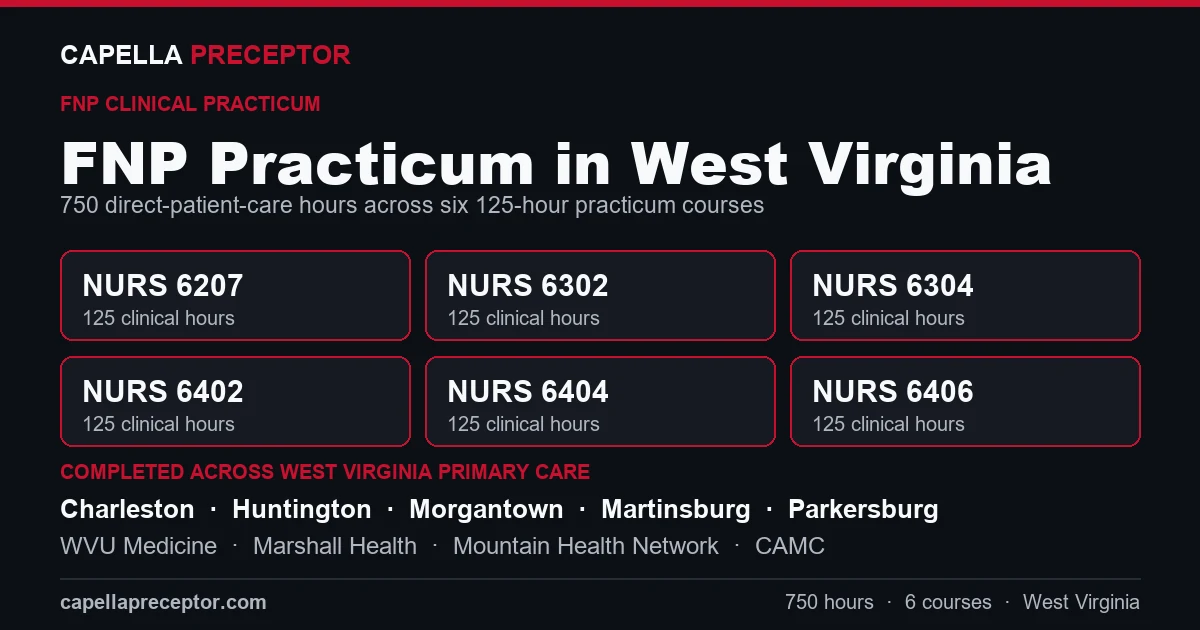
A minimum of 750 practicum hours, and West Virginia does not change that. The Capella MSN Family Nurse Practitioner specialization spreads those hours across six clinical practicum courses, each carrying 125 hours, and you complete them in your own local community while the coursework stays online (Capella, MSN-FNP courses). The hour count is a Capella requirement, identical in Charleston, Wheeling, or a single-clinic town in the eastern panhandle. What West Virginia changes is the supply side: who is available to precept across the lifespan, and how a primary care clinic in a reduced-practice state is staffed. The full breakdown of the six courses and their populations lives on the FNP specialty page; this page is about doing those 750 hours specifically in West Virginia.
Does West Virginia's reduced practice authority change my FNP practicum?
West Virginia is a reduced practice state for nurse practitioners (AANP, State Practice Environment). A licensed NP here can evaluate, diagnose, and treat, but prescribing is tied to a written collaborative agreement with a physician. State law lets the West Virginia RN Board authorize an NP to prescribe without that agreement only after at least three years of a duly documented collaborative relationship with granted prescriptive authority (W. Va. Code 30-7-15b). A 2026 bill to remove the collaborative-agreement requirement, House Bill 5681, did not pass, so the rule still stands for the foreseeable term.
Here is the practical read for an FNP student. You are not prescribing under your own authority during practicum; you log hours under your preceptor's license and direct supervision, so the reduced category does not block a single hour of your 750. What it does shape is where you train. Because prescribing is collaborative, many West Virginia primary care practices already pair an NP with a collaborating physician, and those supervised, physician-adjacent clinics are exactly the kind of full-scope family setting an FNP rotation fits. The same statute layers on West Virginia-specific prescribing limits an FNP should recognize on the job, such as a three-day supply cap on Schedule II narcotics and a 72-hour limit on Schedule III drugs and benzodiazepines (W. Va. Code 30-7-15a). You will see your preceptor working inside those limits, which is part of what the practicum teaches.
What preceptor and setting does the Capella FNP need here?
An FNP preceptor in West Virginia has to clear two bars at once: the clinical match Capella expects and the licensure West Virginia requires. The preceptor practices in an outpatient primary care setting matched to your course population, and holds an active, unencumbered West Virginia RN/APRN license. Because the FNP is a lifespan credential, a single adult-only panel will leave you short, so plan the population spread before you start.
The closest single-site fit, often covering adults, children, and women's health in one West Virginia panel.
Strong for the two adult-gerontology practicum courses and the chronic-disease load common across the state.
Well-child and acute pediatric visits for the pediatric primary care course, often the hardest hours to find rurally.
Prenatal, postpartum, and gynecologic visits for the reproductive health practicum.
Before you log an hour, we confirm the preceptor's license is active and unencumbered through the West Virginia RN Board (formally the Board of Examiners for Registered Professional Nurses), which credentials every APRN in the state. You can run the same check yourself; the board's License Lookup is public and free (WV RN/APRN license verification), and Nursys covers interstate verification for a clinician licensed elsewhere.
Why is finding an FNP preceptor in West Virginia so hard?
This is the part students underestimate. West Virginia is one of the most primary-care-short states in the country. Every county in the state sits inside a designated Health Professional Shortage Area, and roughly 100% of residents live in a shortage area, spread across more than 120 primary care HPSAs (CDC, West Virginia HPSA data; Rural Health Information Hub, West Virginia). The providers who could precept an FNP are the same providers already carrying overloaded panels, so a cold email to a stretched rural clinic often goes unanswered. The shortage is sharpest in southern West Virginia and the rural counties, and thinnest, but still real, in the metros.
Capella does not solve this for you. The university is direct that learners are responsible for finding an appropriate preceptor, and that practicum happens in your own community (Capella, MSN-NP program). So a West Virginia FNP student is handed the 750-hour lifespan requirement and pointed at the most provider-short market in the nation. That is the exact gap we close: we carry a standing network of West Virginia primary care preceptors, we approach them on your behalf instead of leaving you to cold-outreach, and we line up the pediatric and women's health coverage that single rural panels usually cannot supply.
Where in West Virginia FNP students train
Clinical density tracks the state's health systems and population centers. Outpatient primary care affiliated with the larger networks (WVU Medicine and its Peak Health partnership, Marshall Health, and Mountain Health Network in the south, plus CAMC in the Kanawha Valley) anchors the metros, while independent family practices and federally qualified health centers fill in the rural counties.
Kanawha Valley family medicine and internal medicine, the state's largest outpatient base.
Marshall Health and Mountain Health Network outpatient clinics across the lifespan.
WVU Medicine primary care and a dense north-central health-sciences corridor.
Eastern panhandle family practice serving a fast-growing population.
Mid-Ohio Valley and northern panhandle outpatient primary care.
FQHCs and small family practices, where the virtual route below often keeps you moving.
We also place in Beckley, Clarksburg, Fairmont, and the surrounding regions. If you live where in-person FNP options are genuinely scarce (common in a state where the whole population is in a shortage area), the virtual path keeps your hours running rather than waiting on a clinic that is not there. For the broader state picture beyond the FNP, see the West Virginia placement page.
FNP clearance steps, done in West Virginia
Once a preceptor and site are confirmed, the clearance workflow is the same statewide, and the FNP version has more moving parts than a short capstone because six courses each have to stay covered. Capella runs practicum application, site and preceptor approval, hour tracking, and evaluations through its practicum management system, which we track in our workflow as CORE ELMS. Before your first hour, a signed affiliation agreement between Capella and the West Virginia site has to be executed, and third-party compliance (such as a CastleBranch background check and health records) has to clear.
- Submit the West Virginia site and preceptor in CORE ELMS for Capella review and approval.
- Confirm lifespan coverage so the adult, pediatric, and women's health courses each have an approved site, not just an adult panel.
- Execute the affiliation agreement between Capella and your West Virginia clinic before day one.
- Clear the compliance file through Capella's third-party vendor (commonly CastleBranch for the background check and health records); verify the current vendor with your program.
- Log and submit hours per course in CORE ELMS, where your preceptor approves what you record before each course closes.
The most common West Virginia stall is not paperwork, it is discovering mid-program that the one local family clinic that took you cannot supply pediatric or women's health hours, then scrambling for a second preceptor in a shortage market while a course clock runs. Mapping the lifespan coverage up front, before the first course, is the single biggest thing that keeps an FNP student on schedule here.
In-person or virtual FNP practicum for West Virginia students
Both paths satisfy the same Capella FNP requirements; the right one depends on where you live and what primary care is actually around you.
Best near Charleston, Huntington, Morgantown, or another metro with clinic capacity. You build hands-on lifespan hours at a local site and we handle the match and the CORE ELMS paperwork.
Built for rural counties and tight timelines, the common case in a 100%-shortage state. You earn supervised hours remotely with a license-verified preceptor, and they post to CORE ELMS just as an in-clinic rotation would.
West Virginia FNP FAQ
How many FNP practicum hours do I need in West Virginia, and does the state change the count?
A minimum of 750 hours across six 125-hour courses. West Virginia does not change the number; it is set by Capella and is the same in every state. What changes here is how clinics are staffed and how hard a primary care preceptor is to find.
Does West Virginia's reduced practice authority affect my FNP practicum?
Not your hours. West Virginia keeps a written physician collaborative agreement for NP prescribing, but as a student you log hours under your preceptor's license and supervision, so the category does not block your practicum. It mostly means many primary care clinics already pair an NP with a collaborating physician, which are supervised settings that fit an FNP rotation.
What kind of preceptor and setting does the Capella FNP need in West Virginia?
A primary care preceptor in outpatient family medicine, internal medicine, pediatrics, or women's health, holding an active, unencumbered West Virginia RN/APRN license. Because the FNP spans the lifespan, you often need a panel or a second site covering pediatrics and reproductive health, not adults alone.
Why is finding an FNP preceptor in West Virginia hard?
West Virginia is one of the most shortage-heavy primary care states; every county is a designated shortage area, so the providers who could precept are already stretched and pediatric and women's health coverage is thin outside the metros. That is the gap a placement service closes.
Can I do my West Virginia FNP practicum virtually?
Where in-person primary care options are genuinely scarce, a verified virtual preceptorship keeps you on schedule, with hours logged in CORE ELMS the same way as an on-site rotation. In a state where the entire population lives in a shortage area, the virtual route often saves a rural student a lost term.
Sources
- Capella University, MSN-FNP courses (750 hours, six 125-hour practicum courses)
- Capella University, MSN-NP program (learner responsibility, local practicum)
- AANP, State Practice Environment (West Virginia, reduced practice)
- West Virginia Code 30-7-15b (APRN prescriptive authority, three-year collaborative requirement)
- West Virginia Code 30-7-15a (APRN controlled-substance prescribing limits)
- CDC, West Virginia primary care provider shortages (HPSA data)
- West Virginia RN/APRN license verification (License Lookup)
How Capella Preceptor helps West Virginia FNP students
You now know the shape of it: 750 lifespan hours across six courses, a reduced-practice state with collaborative prescribing, and a primary care market where every county is short. The hours are Capella's; the search is yours, and West Virginia makes that search genuinely hard. We take it off your plate. We match you with a verified, license-checked West Virginia primary care preceptor whose coverage fits your FNP courses, prepare every CORE ELMS form and affiliation agreement, and keep your hours logged and submitted on time.
- Verified West Virginia FNP preceptor matched in 7 days, in person or virtual
- Lifespan coverage mapped so pediatrics and women's health are not left short
- No payment until you are matched, with your exact quote in a free consult
Get a Capella FNP preceptor in West Virginia
Free 15-minute consult. No payment until matched. We map all 750 hours across your six FNP courses.
Get my free consult →