Capella FNP preceptor in Wyoming
The Capella MSN-FNP requires 750 practicum hours across six courses, and you secure the preceptor yourself. Wyoming makes one part of that easier: it is a full practice authority state, so the Wyoming State Board of Nursing does not require a collaborative or supervisory agreement, which means a Wyoming-licensed nurse practitioner can precept you on their own license, no physician attached. Here is how the FNP requirement and Wyoming's rules line up, then how we secure the placement, in person or virtual, matched in 7 days with no payment until matched.
Last updated: June 28, 2026 · Reviewed by the Capella Preceptor placement team
What does the Capella FNP require, and what does Wyoming add?
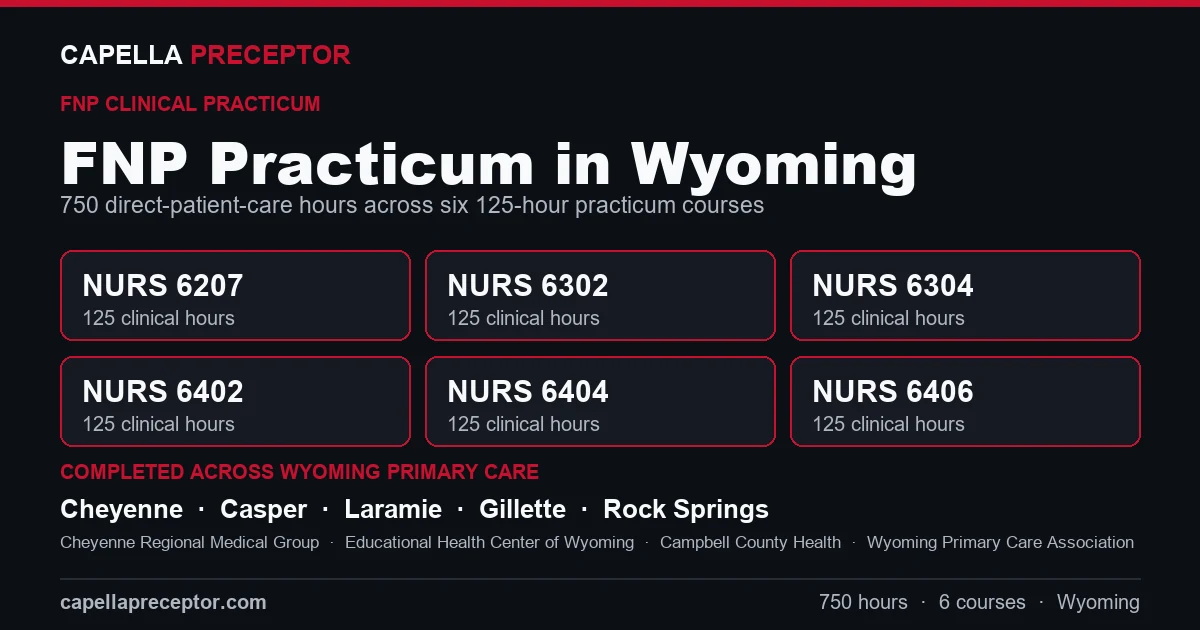
Two separate rule sets meet on this page. Capella sets your academic requirement: a minimum of 750 practicum hours across six clinical courses, each carrying 125 hours, in primary care across the lifespan, with the learner responsible for finding the preceptor (Capella, MSN-FNP courses). That number is national. It is the same in Cheyenne as it is in any other state, and the full course breakdown lives on our Capella FNP page.
Wyoming adds the second rule set: who is allowed to precept you and under what authority. That is governed by the Wyoming State Board of Nursing (WSBN), not Capella. The practical headline is that Wyoming is one of the least restrictive states in the country for nurse practitioners, which widens the pool of people who can sign on as your FNP preceptor. The rest of this page is the Wyoming half, because the Capella half does not change by state.
Do you need a physician to precept an FNP practicum in Wyoming?
No. Wyoming grants nurse practitioners full practice authority, the least restrictive of the three categories the American Association of Nurse Practitioners tracks (AANP, Wyoming). The WSBN puts it plainly: APRNs may provide care in all settings, and supervision or collaboration agreements with another provider are not required by Wyoming law (WSBN, Practice). The state has followed the national APRN Consensus Model since adopting it in 2007, giving its nurse practitioners a full independent scope.
For an FNP practicum that is a real structural advantage. In a restricted state, an NP-owned clinic often cannot host you without a physician in the supervision chain, and in a reduced state at least one element of practice rides on a career-long collaborative agreement. In Wyoming neither applies. A nurse-practitioner-owned family practice can serve as your site, and that NP can be your preceptor, without a supervising physician bolted onto the arrangement. Full authority does not lower Capella's bar, but it removes a layer of friction that stalls students elsewhere.
One thing full authority does not change: your preceptor still has to be the right clinical fit for the course. Capella expects an FNP preceptor whose patient panel matches the population a given practicum course covers, whether that is a physician, a nurse practitioner, or in some courses another qualified clinician. Wyoming widens who is eligible; it does not waive the population match.
What does the Wyoming board require of your preceptor?
The WSBN rule that matters for practicum sits in its standards for nursing education programs. A preceptor must hold a current, unencumbered RN or APRN license, or privilege to practice, in the jurisdiction where the clinical practicum is conducted, and must demonstrate competency in the area of the assigned clinical teaching (WSBN, Education). In plain terms, an FNP precepting you in Wyoming needs an active Wyoming license, or a multistate compact privilege, in the right role, with no disciplinary encumbrance.
Wyoming licenses APRNs in four roles, including the nurse practitioner role, and a preceptor for your family practicum should hold the nurse practitioner credential (or be a qualifying physician for the relevant population). Because Wyoming is a compact state, a preceptor practicing on a multistate privilege can qualify as long as that privilege is valid for practice in Wyoming. You can and should verify this yourself before the placement is submitted.
Verify a Wyoming FNP preceptor before submitting: search the WSBN licensing portal or Nursys by name or license number, confirm the license or compact privilege is active and in the nurse practitioner role, and confirm there are no disciplinary flags. When we propose a preceptor, their license is already verified, but it is reasonable to check the board's own record before the placement enters Capella's practicum system.
Why is finding an FNP preceptor in Wyoming hard, and where do students actually place?
This is where most Wyoming FNP students get stuck, and the obstacle is supply, not paperwork. Wyoming is the least populous state in the country, with a wide geography and a thin spread of clinics. Much of the state is designated as a primary care health professional shortage area, and in many rural counties a nurse practitioner is the only primary care provider for a wide radius (Wyoming Department of Health, Office of Rural Health). A student in a small county may have one or two clinics within an hour, and those clinics are often already hosting learners from the University of Wyoming or other programs.
The flip side of full practice authority is that those NP-led rural clinics can host you cleanly. Real settings where Capella FNP students place across the state include:
The state's deepest concentration of primary care, including Cheyenne Regional Medical Group family and internal medicine and the Educational Health Center of Wyoming.
A central-Wyoming medical hub; integrated community health centers here combine family medicine, pediatrics, women's health, and behavioral health under one roof.
A university town with primary care and behavioral health sites that fit the FNP lifespan mix.
Campbell County Health runs a family medicine clinic serving all ages across northeast Wyoming, useful for coverage outside the southern corridor.
Federally qualified community health centers and regional clinics that fill gaps for students in the north and west.
Where in-person FNP sites are scarce, we move you to a virtual placement so distance does not stall your hours.
Wyoming's network of community health centers, organized through the Wyoming Primary Care Association, is a particularly strong fit for the FNP because a single federally qualified center often covers adults, children, and women's health in one panel (Wyoming Primary Care Association). That matters more for FNP than for a single-population track, because your 750 hours have to span the lifespan.
How do you cover the FNP lifespan populations in a rural state?
The Capella FNP is a family, primary care role, so your hours must span adult-gerontology, pediatrics, and reproductive or women's health rather than one age group. In a dense metro a student can sometimes hit the whole range in one busy family practice. In Wyoming, where a small-town clinic may skew heavily adult, the most common stall point is discovering mid-program that the original site cannot supply pediatric or women's health hours while a practicum course clock is already running.
- Map the populations to the courses first. Two practicum courses are adult-gerontology, one is pediatric, one is reproductive health, plus the core and transition courses. Plan coverage before day one.
- Lean on the integrated community health centers. Wyoming FQHCs that combine pediatrics and women's health with family medicine can cover most of the lifespan in one affiliation agreement.
- Use a second site or virtual hours for the gaps. If your in-person preceptor cannot supply pediatrics or women's health, a second short rotation or the virtual practicum option fills it without losing a term.
What does Capella require before your Wyoming hours count?
Identifying a Wyoming preceptor is only the first step. Before you can log a single hour, the placement has to clear Capella's workflow. Capella manages practicum application, site and preceptor approval, and hour logging through its practicum system, which we track as CORE ELMS. A signed affiliation agreement between Capella and the Wyoming site, plus a third-party compliance check such as a CastleBranch background and health-records screen, must be in place before practicum begins.
- Propose your Wyoming site and preceptor in CORE ELMS for Capella's review and approval.
- Execute the affiliation agreement between Capella and the clinic before day one.
- Clear compliance through the program's third-party vendor (such as CastleBranch); confirm the current vendor with Capella.
- Log and submit hours in CORE ELMS, where your Wyoming preceptor approves what you record.
None of this changes because Wyoming is a full practice authority state. What full authority changes is who is eligible to be the preceptor in the first step, not the approval and logging that follow.
In-person or virtual FNP practicum for Wyoming students
Geography drives this decision in Wyoming more than in almost any other state. If you live near Cheyenne, Casper, or Laramie, an in-person FNP placement at a local family medicine or community health center is usually the cleaner path, and you build relationships you may carry into practice in a state where nurse practitioners are in genuine demand. If you are in a frontier county where the one nearby clinic is full, the virtual option keeps you moving instead of waiting months for a seat.
Hands-on FNP hours at a verified local clinic, well suited to the larger towns and to the state's full practice authority NP-led family practices.
Live, supervised telehealth-based hours for students far from a clinic, with everything logged in CORE ELMS.
Either way the compliance and approval path is identical. Always confirm with your faculty that a given format and site meet the requirements for your specific FNP course before you commit hours to it.
Wyoming FNP FAQ
Do I need a physician to precept my Capella FNP practicum in Wyoming?
No. Wyoming is a full practice authority state, and the WSBN states that supervision or collaboration agreements with another provider are not required by Wyoming law. A Wyoming-licensed family nurse practitioner can serve as your FNP preceptor on their own license. Capella still requires the preceptor to be qualified for the FNP course population and the placement to clear its practicum system.
How many FNP practicum hours does Capella require in Wyoming?
A minimum of 750 hours, the same nationwide, spread across six clinical courses that each carry 125 hours. The hour count is set by Capella and does not change by state; Wyoming sets the preceptor licensing rules, not your Capella hours.
Can an FNP preceptor in Wyoming cover pediatrics and women's health?
The FNP spans the lifespan, so your 750 hours must include adult-gerontology, pediatric, and reproductive or women's health. In larger Wyoming towns a single family medicine or community health center panel often covers most of that range; in smaller communities students rotate across two sites or use the virtual option to reach the pediatric and women's health hours.
How do I verify a Wyoming FNP preceptor's license before submitting them to Capella?
The WSBN education rule requires a preceptor to hold a current, unencumbered RN or APRN license, or privilege to practice, in the jurisdiction where the practicum is conducted. Confirm the license or compact privilege is active, in the nurse practitioner role, and free of disciplinary flags through the WSBN licensing portal or Nursys before the placement enters Capella's practicum system.
Sources
- Capella University, MSN Family Nurse Practitioner courses (750 hours, six courses)
- Wyoming State Board of Nursing, APRN practice (no collaboration agreement required)
- Wyoming State Board of Nursing, education program preceptor standards
- AANP, Wyoming state practice environment (full practice authority)
- Wyoming Primary Care Association, community health centers
- Wyoming Department of Health, Office of Rural Health and primary care
How Capella Preceptor helps in Wyoming
You now know the landscape: the Capella FNP needs 750 hours across the lifespan, Wyoming is a full practice authority state whose board does not require a collaborative agreement, and Capella still leaves the preceptor and site to you. That last point is the one that costs students months, and it costs more in a state this rural. We secure a verified, Wyoming-licensed, FNP-appropriate preceptor whose panel fits the populations your courses require, prepare every CORE ELMS form and affiliation agreement, and keep your hours logged and submitted on schedule.
- Verified Wyoming FNP preceptor matched in 7 days, in person or virtual
- Lifespan coverage planned across adult, pediatric, and women's health
- Every CORE ELMS form and affiliation agreement handled, no payment until matched
Related: Capella FNP requirements and course breakdown · Capella practicum and preceptors in Wyoming
Get a Capella FNP preceptor in Wyoming
Free 15-minute consult. No payment until matched. We map your entire 750-hour FNP plan.
Get my free consult →