Home / MSN-PMHNP / PMHNP Preceptor in Alaska
PMHNP · AlaskaCapella PMHNP Preceptor and Psychiatric Practicum Placement in Alaska
A Capella MSN-PMHNP practicum in Alaska requires 750 supervised psychiatric clinical hours, completed as 150 hours in each of five practicum courses, under an on-site psychiatric-mental health preceptor you are responsible for securing. Alaska is a full practice authority state, so an Alaska NP with controlled-substance authority can precept independently and prescribe psychiatric medications without a physician agreement. The hard part is that psychiatric prescribers are genuinely scarce here. This page covers what the PMHNP requires, Alaska's controlled-substance and telepsychiatry rules, the real psychiatric settings, and how a placement actually comes together.
Last updated: June 28, 2026 · Reviewed by the Capella Preceptor placement team
What does the Capella PMHNP practicum require in Alaska?
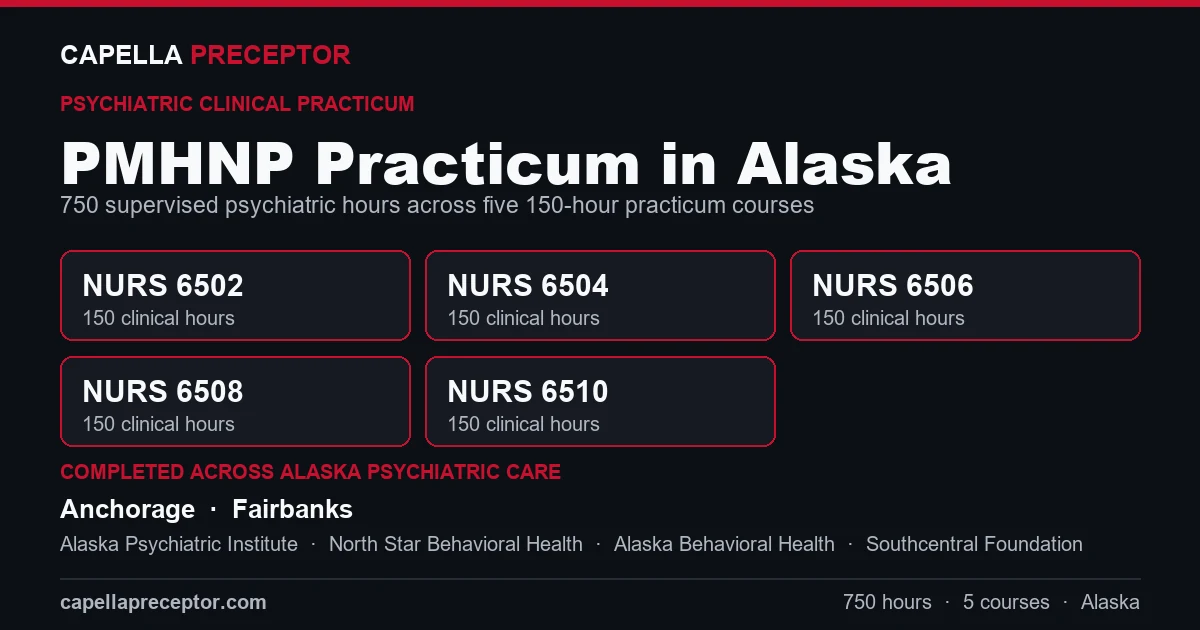
The hour count is identical wherever you live. The Capella MSN Psychiatric-Mental Health Nurse Practitioner specialization needs a minimum of 750 supervised practicum hours, completed as 150 clinical hours in each of five practicum courses, NURS6502, NURS6504, NURS6506, NURS6508, and NURS6510 (Practicum I through V), all in psychiatric and behavioral-health settings under a qualified on-site preceptor (Capella, MSN-PMHNP courses). That five-course, 150-hour structure is specific to the PMHNP. It is not the Capella FNP pattern of six 125-hour courses, and the population is psychiatric across the lifespan rather than primary care, so an Alaska FNP placement and an Alaska PMHNP placement are different searches in different kinds of clinics. We keep the full course-by-course breakdown on the PMHNP page rather than repeating every code here.
What changes in Alaska is everything around those hours: who can supply psychiatric supervision, what a preceptor is allowed to prescribe in front of you, how much can run by telepsychiatry, and how thin the prescriber pool actually is. The rest of this page is the Alaska-specific psychiatric part.
What does full practice authority mean for a psychiatric preceptor in Alaska?
Alaska sits in the full practice category on the American Association of Nurse Practitioners State Practice Environment map, and was one of the earliest states to adopt that model (AANP, State Practice Environment). Under Alaska regulation an APRN "practices independently in the role for which the individual has received specialized education," with no career-long physician collaboration or supervision requirement (Alaska Board of Nursing, statutes and regulations, 12 AAC 44). For a psychiatric placement that matters more than it does in primary care, because a PMHNP preceptor in independent practice can take a student on their own authority, with no collaborating psychiatrist who has to sign off first.
The practical effect shows up at the contracting stage. In a reduced or restricted state a prospective psychiatric preceptor often has to weigh whether taking a student touches a written collaborative arrangement. In Alaska a board-certified PMHNP who runs an independent behavioral-health practice has nothing to disturb, which is one of the few things working in your favor in a state where psychiatric prescribers are otherwise hard to reach.
Can an Alaska preceptor prescribe psychiatric controlled substances in front of you?
This is the question that makes a psychiatric placement different from a primary care one. Much of PMHNP training is medication management, and a large share of psychiatric prescribing involves controlled substances: Schedule II stimulants for ADHD, benzodiazepines for acute anxiety, and buprenorphine for opioid use disorder in the many Alaska patients with co-occurring substance use. To model that, your preceptor needs Alaska controlled-substance authority, which is a separate credential from a basic prescriptive license.
Under 12 AAC 44.445, an Alaska APRN may obtain Schedule II to V prescriptive and dispensing authority after completing 15 hours of pharmacology and drug-therapy education, at least two hours of education in pain management, opioid use, and addiction, obtaining a federal DEA registration, and registering with the state's Prescription Drug Monitoring Program (MIEC, Alaska advanced-practice laws and regulations). Alaska practitioners must check the monitoring database before prescribing a Schedule II or III controlled substance. None of this requires a collaborative physician plan, which is consistent with the state's full practice model. Two things follow for your placement:
- Match the preceptor's authority to the learning. A PMHNP preceptor with full Schedule II to V authority lets you observe stimulant, benzodiazepine, and buprenorphine management directly, which is exactly the prescribing your certification exam tests.
- This is about what the preceptor can model, not what you need to start. You are a student logging supervised hours, so the authority that matters is the supervising provider's. Confirm any current rule directly with the board before you rely on it.
We check a prospective preceptor's psychiatric scope, not just that they hold a license, so the placement actually exposes you to the medication management your PMHNP courses expect.
Can PMHNP hours run by telepsychiatry in Alaska?
More than most specialties, psychiatry travels well over video, and Alaska's geography makes telepsychiatry a genuine clinical setting rather than a workaround. Alaska law lets a provider licensed in the state "provide health care services within the health care provider's authorized scope of practice to a patient in this state through telehealth without first conducting an in-person visit," and an Alaska APRN may prescribe controlled substances by telehealth when they comply with AS 08.68.710 and federal law (Center for Connected Health Policy, Alaska telehealth laws). At the federal level, a 2025 final rule lets a patient start and continue buprenorphine for opioid use disorder for up to a six-month supply through audio-visual or audio-only telehealth before an in-person visit is required (SAMHSA, buprenorphine telemedicine prescribing).
That does not mean a Capella PMHNP practicum can be completed entirely from a laptop. How much telepsychiatry counts toward your 750 hours depends on each individual practicum course, your preceptor's practice, and the supervised-training expectations, and Capella names telepsychiatry within the Practicum III experience rather than as the whole program. Confirm the current telehealth allowance for each course against your Capella course instructions before you build a plan around remote hours. We will flag which of your five practicums realistically lean on telepsychiatry and which expect in-person psychiatric contact.
Where do PMHNP students actually complete psychiatric hours in Alaska?
Psychiatric capacity in Alaska is concentrated, and it sits in behavioral-health organizations rather than the family clinics an FNP would use. The systems below are real Alaska providers of psychiatric and substance-use care; we approach the sites where a credentialed psychiatric preceptor and the right patient mix actually exist, instead of chasing a placement that cannot supply psychiatric hours.
The 80-bed state psychiatric hospital on Piper Street in Anchorage, with adult, adolescent, and forensic units, for inpatient and acute-crisis psychiatric experience (State of Alaska, API).
An Anchorage-area psychiatric network serving children, adolescents, and adults across inpatient, residential, and outpatient behavioral health, including co-occurring substance use.
Alaska Behavioral Health and similar outpatient centers carry mild to severe mental illness, a strong fit for the adult and older-adult psychiatry in your earlier practicums.
The Alaska Native Tribal Health Consortium, Southcentral Foundation, and SEARHC in the Southeast run psychiatric and wellness services, several with telepsychiatry reach into rural communities.
Addiction and medication-assisted treatment settings, where buprenorphine and co-occurring psychiatric care are central, cover the substance-use exposure PMHNP training expects.
For students off the road system in village or smaller Southeast communities, an Alaska-licensed telepsychiatry preceptor is often the most realistic route to supervised hours.
Tell us your Alaska community and we will tell you honestly whether a local psychiatric match is realistic there, or whether telepsychiatry is the faster path to your hours.
How hard is it to find a psychiatric preceptor in Alaska?
Harder than in almost any other state, and it is worth being blunt about. Alaska is a designated mental health professional shortage area with far too few psychiatric prescribers for its population, a gap measured in the hundreds of providers, and that workforce is clustered in a few communities while much of the state is off the road system (Alaska Mental Health Trust Authority, mental health workforce shortage report). A scarce psychiatric prescriber is also a busy one, which makes an unaffiliated preceptor with open capacity rare. Three realities shape an Alaska psychiatric search:
- The pool is small and concentrated. Most psychiatric prescribers are in Anchorage, Fairbanks, and a few Southeast hubs, so a student in a smaller community often has no local psychiatric preceptor at all.
- The lifespan split adds a second search. PMHNP training covers child and adolescent psychiatry as well as adults, and in Alaska child-and-adolescent psychiatry is even scarcer, so one preceptor rarely covers both ends. Plan for that early.
- Telepsychiatry widens the field. Because Alaska allows telehealth without a prior in-person visit, an Alaska-licensed telepsychiatry preceptor can reach a remote student, which is often the difference between a placement and a lost term.
Capella is direct that the student secures the preceptor and the site, and in this market that is a real obstacle, not a formality. We carry the search, including the telepsychiatry options most students never find on their own.
What clearances come before the first PMHNP hour in Alaska?
Finding the psychiatric preceptor is step one. Before you log an Alaska hour, the placement has to clear Capella's practicum workflow, which runs the same way it does in every state. Alaska also maintains an Advanced Nurse Practitioner Preceptorship Registration that out-of-state students commonly need on file before starting clinical hours, so confirm whether it applies to your enrollment directly with the board.
Inpatient psychiatric sites like a hospital unit can carry their own credentialing on top of Capella's, which adds lead time. We sequence the site onboarding alongside the CORE ELMS approval so neither one is the thing holding up your first day.
Alaska PMHNP FAQ
How many psychiatric practicum hours does the Capella PMHNP require in Alaska?
A minimum of 750 supervised psychiatric hours, the same in Alaska as everywhere else, completed as 150 clinical hours in each of the five practicum courses NURS6502, NURS6504, NURS6506, NURS6508, and NURS6510. That five-course, 150-hour structure is specific to the PMHNP and differs from the Capella FNP, which spreads 750 hours across six 125-hour courses.
Can an Alaska NP prescribe psychiatric controlled substances while precepting a PMHNP student?
Yes, if the NP holds Alaska controlled-substance authority. Under 12 AAC 44.445 an Alaska APRN may obtain Schedule II to V authority after 15 hours of pharmacology education, at least two hours of pain, opioid, and addiction education, a DEA registration, and Prescription Drug Monitoring Program registration. No collaborative physician agreement is required because Alaska is a full practice authority state. A preceptor with this authority lets you observe stimulant, benzodiazepine, and buprenorphine prescribing firsthand.
Can Capella PMHNP psychiatric hours be done by telepsychiatry in Alaska?
Partly. Alaska law lets a licensed provider deliver telehealth without a prior in-person visit, and an Alaska APRN may prescribe controlled substances by telehealth when they comply with AS 08.68.710 and federal rules, so telepsychiatry is a real Alaska setting. How much telehealth counts toward your 750 hours still depends on each Capella practicum course, so confirm the current allowance against your course instructions rather than assuming all hours can be remote.
Where do PMHNP students complete psychiatric hours in Alaska?
Real Alaska psychiatric settings include the Alaska Psychiatric Institute, the 80-bed state hospital in Anchorage with adult, adolescent, and forensic units; North Star Behavioral Health; Alaska Behavioral Health and other community mental health centers; tribal behavioral health through the Alaska Native Tribal Health Consortium, Southcentral Foundation, and SEARHC; substance-use and medication-assisted treatment programs; and telepsychiatry groups for remote communities.
Is it hard to find a psychiatric preceptor in Alaska?
Yes. Alaska is a designated mental health professional shortage area with too few psychiatric prescribers for its population, concentrated in a handful of communities, so an unaffiliated PMHNP preceptor is genuinely scarce. We do the search, verify the preceptor's Alaska license and psychiatric scope, and route a placement that meets Capella's published requirements into CORE ELMS for the university's review.
Sources
- Capella University, MSN-PMHNP courses (750 hours across five 150-hour practicum courses)
- AANP, State Practice Environment (Alaska listed as full practice)
- Alaska Board of Nursing, nursing statutes and regulations (AS 08.68, 12 AAC 44, including 44.445)
- MIEC, Alaska advanced-practice laws (APRN controlled-substance authority, PDMP, no collaborative agreement)
- Center for Connected Health Policy, Alaska telehealth laws (telehealth without prior in-person visit; APRN controlled-substance telehealth)
- SAMHSA, buprenorphine telemedicine prescribing (2025 final rule)
- State of Alaska, Alaska Psychiatric Institute (80-bed state psychiatric hospital, Anchorage)
- Alaska Mental Health Trust Authority, mental health workforce shortage report
How Capella Preceptor helps with an Alaska PMHNP placement
Full practice authority makes Alaska a workable state to precept a PMHNP in, but Capella leaves the search to you and the psychiatric prescriber pool is one of the thinnest in the country. We secure a verified, Alaska-licensed psychiatric preceptor whose scope and controlled-substance authority fit your five PMHNP courses, in person where psychiatric capacity exists or by Alaska-licensed telepsychiatry where it does not, prepare the affiliation agreement and CORE ELMS forms, and keep all 750 hours logged and submitted on schedule. A placement is matched to meet Capella's published requirements and submitted for the university's review; we never claim a placement is endorsed by Capella.
- Verified Alaska psychiatric preceptor matched in 7 days, no payment until matched
- Adult and child/adolescent psychiatry covered across all five practicums
- In person across Anchorage and Fairbanks, or Alaska-licensed telepsychiatry where you are remote
Get a Capella PMHNP preceptor in Alaska
Free 15-minute consult. No payment until matched. We map your full psychiatric practicum, the controlled-substance and telepsychiatry questions, and all 750 hours. See pricing.
Get my free consult →