Capella PMHNP preceptor and psychiatric practicum in Arizona
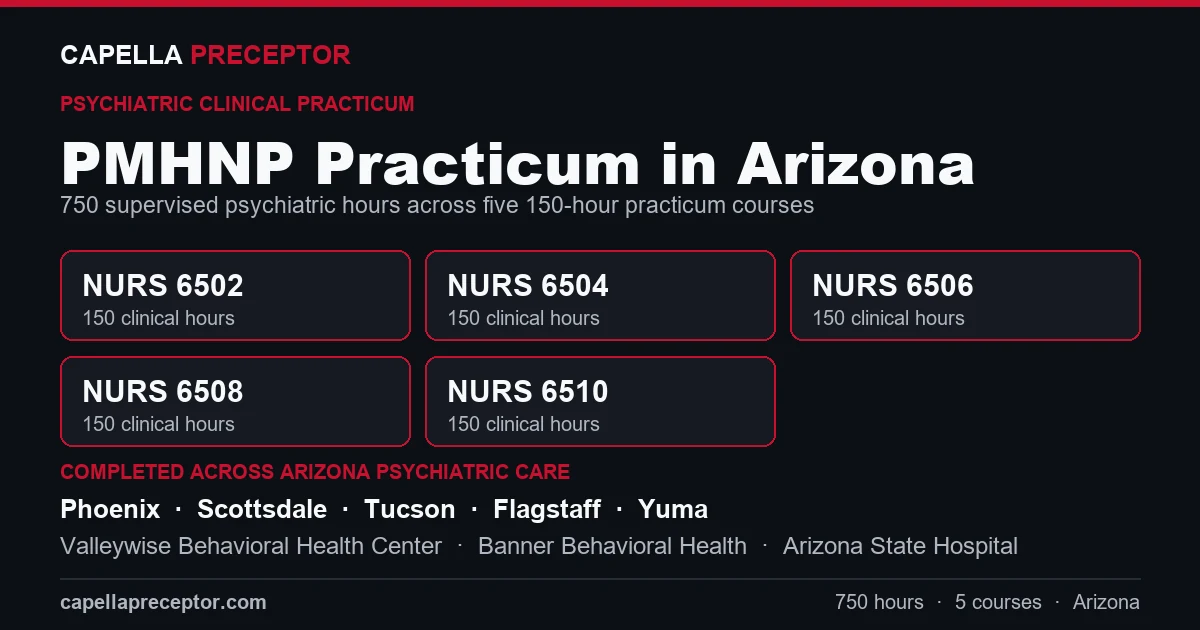
A Capella PMHNP practicum in Arizona requires 750 supervised psychiatric clinical hours across five practicum courses of 150 hours each, completed under an on-site psychiatric-mental health preceptor at an approved Arizona site. Arizona is a full practice authority state, so a licensed PMHNP here diagnoses and prescribes psychiatric medications independently, but the controlled-substance rules that matter most in psychiatry, stimulants, benzodiazepines, and buprenorphine, carry their own Arizona conditions. Here is how the program requirements and the state board rules combine, and how we secure the psychiatric preceptor for you.
Last updated 2026-06-28 · Reviewed by the Capella Preceptor placement team
How many psychiatric hours does the Capella PMHNP require in Arizona?
The Capella MSN Psychiatric-Mental Health Nurse Practitioner specialization requires a minimum of 750 practicum hours, completed as 150 clinical hours in each of five practicum courses, NURS6502, NURS6504, NURS6506, NURS6508, and NURS6510, Practicum I through V (Capella, MSN-PMHNP courses). The number does not change in Arizona. What is genuinely Arizona-specific is the board context those hours are supervised under and the prescribing environment you train in, which is what the rest of this page covers. Note that this is a psychiatric sequence: it is structured differently from the Capella FNP practicum, which is primary care, spread across six courses of 125 hours, and trains you in physical-health prescribing rather than psychopharmacology. If you came here for the primary-care track, the all-programs Arizona page covers it.
PMHNP is a lifespan specialty, so the five practicums deliberately spread your hours across adult, older-adult, child, and adolescent psychiatry, with advanced work in psychopharmacology, psychotherapy, crisis intervention, and telepsychiatry. Because Arizona psychiatric sites rarely cover the full lifespan in one place, plan early for more than one site or preceptor over the sequence. The broader hour breakdown lives on the all-states PMHNP page; this page stays focused on Arizona.
What does Arizona full practice authority mean for a psychiatric NP?
The American Association of Nurse Practitioners places Arizona in its highest tier, Full Practice (AANP, State Practice Environment). For a psychiatric NP that is meaningful. A licensed registered nurse practitioner in Arizona can evaluate, diagnose mental-health conditions, order and interpret diagnostics, and start and manage treatment, including prescribing psychotropic and controlled medications, without a mandated physician supervisory or collaborative agreement, once the Arizona State Board of Nursing recognizes the credential and prescriptive authority. On the supply side this helps you as a student: because Arizona PMHNPs are not tied to a supervising physician, many run independent psychiatric or telepsych practices and are both willing and legally able to take a learner without first routing it through a physician group, which widens the pool of clinicians who can precept you. It does not remove the practicum requirement. Full practice describes what a licensed PMHNP may do after graduation; as a student you still complete all 750 supervised hours, and Capella still requires you to bring the preceptor.
How does Arizona handle controlled psychiatric prescribing?
Psychiatry runs on controlled substances in a way primary care does not: Schedule II stimulants for ADHD, benzodiazepines for acute anxiety and withdrawal, and buprenorphine for opioid use disorder. Arizona has specific rules on each, and training in a state where your preceptor prescribes these daily is part of the value of the rotation.
- DEA and CSPMP registration first. An Arizona prescriber with an active DEA registration must also hold an account in the Arizona Controlled Substances Prescription Monitoring Program, run by the State Board of Pharmacy, before prescribing controlled substances (A.R.S. § 36-2606). Your preceptor will have both.
- Mandatory PMP check for benzodiazepines and Schedule II opioids. Arizona requires the prescriber to review the patient's preceding twelve months in the prescription-monitoring database before prescribing a benzodiazepine or a Schedule II, III, or IV opioid analgesic (A.R.S. § 36-2606). For a psychiatric rotation, where benzodiazepines are common, you will watch your preceptor run this check as routine practice.
- The Schedule II opioid carve-out for addiction care. Arizona rule R4-19-511 states that a registered nurse practitioner shall not dispense a Schedule II controlled substance that is an opioid, except an opioid used for medication-assisted treatment of substance use disorders (Ariz. Admin. Code R4-19-511). That carve-out is why Arizona PMHNPs play a real role in opioid-use-disorder treatment, and why an addiction or MOUD clinic is a strong PMHNP rotation site here.
None of this changes your hour count, but it shapes what you learn. A practicum supervised by an Arizona PMHNP who prescribes stimulants, benzodiazepines, and buprenorphine under these rules is closer to real psychiatric practice than one limited to talk therapy alone.
Can PMHNP hours in Arizona be done by telepsychiatry?
Partly, and the line matters. Arizona telehealth law lets a mental or physical health status examination be conducted during a telehealth encounter, and telehealth services must meet the same standard of care as an in-person visit (A.R.S. § 36-3602). Capella names telepsychiatry directly in the Practicum III experience, so supervised telepsych hours can count toward your sequence, subject to your specific course instructions. That makes PMHNP one of the more telehealth-friendly tracks for a student in a rural Arizona county.
The constraint is controlled substances. Under Arizona law a Schedule II drug may be prescribed only after an in-person or audio-visual examination, and the federal Ryan Haight Act generally requires a prior in-person evaluation before a controlled substance is prescribed by telemedicine, with temporary federal flexibilities for remote starts running through the end of 2025 and a hybrid in-person rule expected after (A.R.S. § 36-3602). Because so much of psychiatric care is medication management of exactly these drugs, a fully remote practicum is not realistic for the whole sequence. Expect a blend: telepsych for assessment and follow-up where your course and preceptor allow it, and in-person time where controlled-substance prescribing and inpatient exposure require it. We confirm the current telehealth allowance for each practicum against your course rules rather than assuming any share is remote.
Where do PMHNP students complete psychiatric hours in Arizona?
Your hours must be earned in behavioral and mental-health practice, not general primary care, and supervised by an appropriately credentialed psychiatric provider, typically a board-certified PMHNP or a psychiatrist. Arizona has real settings across the spectrum:
The deepest concentration of sites: outpatient psychiatry and community mental-health clinics, inpatient units such as Valleywise Behavioral Health Center in Phoenix and Banner Behavioral Health in Scottsdale, and the Arizona State Hospital for acute and forensic psychiatry.
Community mental-health clinics and behavioral-health programs across Pima County, strong for adult and community psychiatry hours and for the lifespan mix your practicum sequence needs.
Medication-assisted-treatment and substance-use programs, where Arizona's opioid carve-out makes PMHNPs central to buprenorphine care. Excellent exposure to co-occurring psychiatric and substance-use disorders.
Telepsych groups and federally qualified health centers serving Flagstaff, Yuma, tribal communities, and rural counties, where the local psychiatric pool is thin and the virtual option keeps you on schedule.
Whichever setting fits, the credential and the site both have to clear Capella's review before you can log an hour, so the supervisor's license and scope and the site's patient mix are checked first.
Why is finding a PMHNP preceptor in Arizona so hard?
Be honest with yourself about this part, because it is the real bottleneck. Arizona carries a designated mental-health professional shortage that is acute statewide and worst outside the Phoenix and Tucson metros and across rural and tribal regions. The psychiatric preceptor pool is far smaller than the primary-care pool an FNP student draws from, the demand for PMHNPs is high enough that working clinicians are stretched, and university PMHNP programs in the state openly warn students that they may have to travel to a different area if a suitable local preceptor cannot be found. A psychiatrist or PMHNP who can take a student, has time to supervise, will sign an affiliation agreement, and matches your course's population focus is genuinely scarce here.
That is the gap this service closes. Capella does not assign a psychiatric preceptor or a site; it offers support resources, but securing the preceptor and the behavioral-health site is the student's responsibility for all 750 hours. We carry that search, match a verified, Arizona-licensed PMHNP or psychiatrist whose practice fits your practicum, and handle the paperwork, so you are not cold-calling clinics while a practicum quarter clock runs.
What has to clear before your Arizona psychiatric practicum starts?
Securing the psychiatric preceptor is step one. Before you log an hour, the placement moves through Capella's practicum workflow, tracked in CORE ELMS, and we handle each step with you:
- Propose the Arizona psychiatric site and preceptor in CORE ELMS so the credential and setting can be submitted for Capella's review and approval.
- Verify the preceptor's Arizona license. APRN, RN, and LPN licenses are published to Nursys and updated each business day, so an active, unencumbered psychiatric credential can be confirmed before you commit. We run that check on every match.
- Execute the affiliation agreement between Capella and the behavioral-health site, signed before day one.
- Clear compliance through CastleBranch, the background-check, drug-screen, and health-records vendor Capella requires for nursing practicum; psychiatric and inpatient sites can add their own onboarding, so front-load it.
- Log and submit hours in CORE ELMS, where your Arizona preceptor approves the hours you record, until each of the five courses reaches its 150-hour total.
Arizona PMHNP FAQ
How many psychiatric practicum hours does the Capella PMHNP need in Arizona?
A minimum of 750 supervised psychiatric hours, completed as 150 clinical hours in each of five practicum courses (NURS6502, NURS6504, NURS6506, NURS6508, NURS6510 / Practicum I through V), under an on-site psychiatric-mental health preceptor at an approved Arizona site. The hours are the same in Arizona as anywhere; what changes is the state board context you practice under.
Can a PMHNP prescribe controlled psychiatric medications independently in Arizona?
Yes, once licensed and credentialed. Arizona is a full practice authority state, so a registered nurse practitioner with prescriptive authority, a DEA registration, and an Arizona CSPMP account can prescribe Schedule II to V medications, including stimulants and benzodiazepines, without a collaborating physician. One Arizona rule is psych-specific: an RNP cannot dispense a Schedule II opioid except one used for medication-assisted treatment of substance use disorder.
Can Capella PMHNP hours in Arizona be done by telepsychiatry?
Some can. Arizona law lets a mental health status examination be conducted by telehealth, and telepsychiatry is named in Capella's Practicum III, so supervised telepsych hours can count subject to your course rules. Starting a Schedule II medication such as an ADHD stimulant by telehealth is more restricted: Arizona and the federal Ryan Haight Act generally require a prior in-person or audio-visual evaluation, so a fully remote practicum is not realistic for the full sequence.
Where do Capella PMHNP students complete psychiatric hours in Arizona?
Common Arizona settings include outpatient psychiatry and community mental health clinics, inpatient psychiatric facilities such as Valleywise Behavioral Health Center in Phoenix, Banner Behavioral Health in Scottsdale, and the Arizona State Hospital, plus substance-use and addiction treatment programs, federally qualified health centers, and telepsychiatry groups, each under an appropriately credentialed psychiatric supervisor.
Is it hard to find a PMHNP preceptor in Arizona?
Yes. Arizona has a designated mental-health professional shortage, worst outside Phoenix and Tucson and in rural and tribal areas, and university PMHNP programs warn students they may have to travel if no local psychiatric preceptor is available. The psychiatric preceptor pool is smaller and more contested than the primary-care pool, which is why securing the site early matters.
Sources
- Capella University, MSN-PMHNP courses and 750 practicum hours
- American Association of Nurse Practitioners, State Practice Environment (Arizona full practice)
- Ariz. Admin. Code R4-19-511, prescribing and dispensing authority (Schedule II opioid carve-out)
- A.R.S. § 36-2606, Controlled Substances Prescription Monitoring Program registration and review
- A.R.S. § 36-3602, delivery of health care through telehealth (telepsychiatry and Schedule II limits)
How Capella Preceptor helps PMHNP students in Arizona
The hard part of the Arizona PMHNP is not the coursework, it is lining up 750 supervised psychiatric hours across the lifespan, with a credentialed preceptor and a behavioral-health site that will sign an affiliation agreement, in a state with a real psychiatric-preceptor shortage. That is what we do. We secure a verified, Arizona-licensed PMHNP or psychiatrist whose patient mix fits your practicum, in Phoenix, Tucson, an addiction program, or via telepsych, prepare every CORE ELMS form and affiliation agreement, and keep your hours logged and submitted on time. We match preceptors who meet Capella's published requirements and submit the placement for Capella's own review; we never claim a Capella endorsement or guarantee an approval the university controls.
- Verified Arizona psychiatric preceptor matched in 7 days, no payment until matched
- Adult, older-adult, child, and adolescent psychiatry covered across all five practicums
- In-person across the metros or telepsych for rural and tribal counties, with every CORE ELMS form handled
Get a Capella PMHNP preceptor in Arizona
Free 15-minute consult. No payment until matched. We map your full psychiatric practicum plan and pricing on the call. See pricing or contact a coordinator.
Get my free consult →