Capella PMHNP preceptor in Arkansas
A Capella PMHNP practicum in Arkansas requires 750 supervised psychiatric clinical hours across five practicum courses of 150 hours each, completed under an on-site psychiatric-mental-health preceptor. Arkansas is a reduced-practice state where prescribing ties to a collaborating physician, controlled-substance rules shape what you can learn to prescribe, and about 97 percent of counties are behavioral-health shortage areas, which is exactly why the preceptor is the hard part. Here is how the PMHNP requirements and the Arkansas psychiatric rules meet, and how we secure the placement.
Last updated 2026-06-28 · Reviewed by the Capella Preceptor placement team
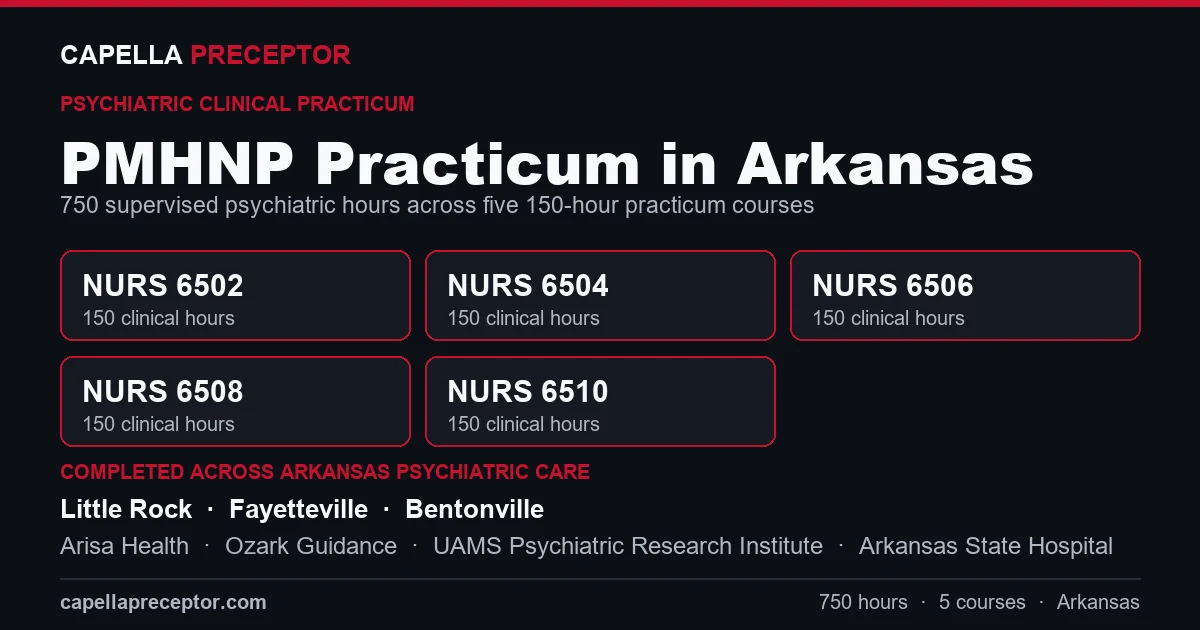
How many psychiatric hours does a Capella PMHNP need in Arkansas?
The Capella MSN Psychiatric-Mental Health Nurse Practitioner specialization requires a minimum of 750 practicum hours, and they all have to be psychiatric and behavioral-health hours, not primary care. The 750 are split as 150 clinical hours in each of five practicum courses, NURS6502 (Practicum I), NURS6504 (Practicum II), NURS6506 (Practicum III), NURS6508 (Practicum IV), and NURS6510 (Practicum V) (Capella, MSN-PMHNP courses). The coursework is online; the practicum is completed in person at an approved site in your own Arkansas community under an on-site preceptor (Capella, MSN-NP program). That five-courses-of-150 structure is specific to PMHNP and is the reason this placement is harder to staff in Arkansas than a family-practice placement: every one of those hours has to sit inside psychiatric care.
Because PMHNP is a lifespan specialty, the sequence deliberately spreads your hours across adult, older-adult, child, and adolescent psychiatry. In a state where child and adolescent psychiatry is concentrated in a few systems, that lifespan split is the part most likely to force a second site or a second preceptor. Plan for it from the start rather than at Practicum II.
What does reduced practice mean for a psychiatric NP in Arkansas?
The American Association of Nurse Practitioners classifies Arkansas as a reduced-practice state (AANP, State Practice Environment). For a psychiatric NP that is not an abstraction. An APRN who wants to prescribe must hold a certificate of prescriptive authority and keep a current collaborative practice agreement with a physician on file with the Arkansas State Board of Nursing, and may not prescribe until the board issues an approval letter (Arkansas State Board of Nursing, APRN rules, Chapter 4). Psychiatry runs on prescriptions more than almost any specialty, so the collaborating-physician relationship shapes the day-to-day of the practice you will train in.
As a practicum student you are not the one signing a collaborative agreement during your hours. What reduced practice changes for you is the kind of preceptor and setting available: a psychiatric practice in Arkansas is usually built around a physician-APRN collaboration, and your on-site preceptor is the credentialed clinician, a PMHNP-BC or a psychiatrist, who supervises your psychiatric care directly. Arkansas also opened a path past the requirement: under Act 412 of 2021, a certified nurse practitioner who logs 6,240 hours under a collaborative agreement can petition for full independent practice (ASBN, Full Independent Practice Credentialing Committee). Your practicum hours are the first step on that arc.
How do Arkansas controlled-substance rules shape psychiatric training?
This is where a psychiatric placement in Arkansas differs most from a primary-care one, because psychiatric prescribing leans heavily on controlled substances. Under the Arkansas State Board of Nursing rules, an APRN with prescriptive authority may prescribe drugs in Schedules II through V, but the collaborative practice agreement must spell out the controlled-substance categories the APRN is authorized to prescribe, a DEA number has to appear on every controlled prescription, and Schedule II opioids for acute pain are capped at a five-day supply with anything more requiring physician referral (ASBN APRN rules, Chapter 4, prescriptive authority; Ark. Code 17-87-310).
For psychiatry the scheduled drugs that matter are not opioids for pain, they are the medications you will see managed every clinic day:
- Stimulants are Schedule II. ADHD medications such as methylphenidate and amphetamine products are Schedule II, so the agreement has to authorize that category for the prescriber and you will learn how Arkansas handles the tighter Schedule II controls.
- Benzodiazepines are Schedule IV. Anxiolytics and sedatives used in anxiety and crisis care fall in Schedule IV, within an Arkansas APRN's prescriptive range when the agreement covers it.
- Buprenorphine for opioid use disorder is Schedule III. Medication for opioid use disorder is central to co-occurring substance-use care, and buprenorphine sits in Schedule III, so addiction and MOUD settings are valuable psychiatric training sites in Arkansas.
The takeaway for a Capella PMHNP student is that the prescribing you watch and document in Arkansas is governed by these board rules and your preceptor's own authority, not by anything you carry as a learner. Choosing a site that prescribes across these categories, an outpatient psychiatry practice plus an addiction or MOUD program, gives you a fuller psychopharmacology experience than a single narrow clinic would.
Can PMHNP practicum hours be done by telepsychiatry in Arkansas?
Partly, and the limits are Arkansas-specific. Telepsychiatry is a real and growing part of Arkansas behavioral health, and Capella names telepsychiatry directly inside the Practicum III experience, so supervised remote hours can count when your course and preceptor support them (Capella, MSN-PMHNP courses). What you cannot assume is that the entire practicum can be remote. The Arkansas State Board of Nursing requires an APRN/patient relationship to be established before services are delivered by telemedicine, and an APRN using telemedicine may not prescribe a controlled substance unless the patient was seen in person or a consultation or referral relationship exists (ASBN APRN rules, Chapter 4, telemedicine).
Because psychiatric care is so prescription-heavy, that controlled-substance restriction is the rule that most often pulls a telepsychiatry practicum back toward in-person sessions, particularly for new patients and for the stimulant and buprenorphine prescribing you most want to observe. A workable Arkansas plan usually blends an in-person psychiatric site with a telepsychiatry component rather than treating the whole 750 hours as remote. Confirm the exact telehealth share for each practicum against your course instructions and your preceptor's practice before you build your schedule around it.
Where do PMHNP students actually complete psychiatric hours in Arkansas?
Arkansas has real psychiatric infrastructure, it is just unevenly distributed and stretched thin. These are the categories of approved setting where Capella PMHNP students log hours, with the credentialed supervising provider on site:
Arisa Health, the state's largest behavioral-health system, serves dozens of counties through affiliates including Ozark Guidance in Northwest Arkansas and Counseling Associates, alongside regional centers across the state.
The UAMS Psychiatric Research Institute and Arkansas State Hospital in Little Rock anchor inpatient and specialty psychiatry, including adult, women's, and child diagnostic units.
Programs such as Centers for Youth and Families and the child diagnostic services concentrated in central Arkansas cover the younger-population hours the PMHNP lifespan sequence requires.
Substance-use and medication-assisted treatment centers give you the co-occurring-disorder and buprenorphine experience that rounds out psychiatric psychopharmacology training.
Telepsychiatry practices extend reach into rural counties, within the Arkansas board limits on establishing the relationship and on controlled-substance prescribing.
Private and group outpatient psychiatry across the Little Rock and Northwest Arkansas metros offers the medication-management and assessment volume the early practicums need.
Naming a system is not the same as having an open preceptor seat there. Every site and preceptor still has to be proposed and approved through Capella's process before you log an hour, and a busy center can be at capacity for students. That gap between where psychiatric care exists and where a student can actually be placed is the real Arkansas problem, which the next section is honest about.
How hard is it to find a PMHNP preceptor in Arkansas?
Harder than almost anywhere, and it is worth being concrete rather than reassuring. About 97 percent of Arkansas counties are designated behavioral-health professional shortage areas, a group that includes psychiatrists and the psychiatric nurse practitioners students need as preceptors (AY Magazine, on Arkansas mental-health shortages; Rural Health Information Hub, mental-health HPSA map). When the providers who could precept are already carrying full patient panels in a shortage state, the few who also take students fill their slots fast. Northwest Arkansas around Fayetteville and Bentonville and central Arkansas around Little Rock have the deepest benches; the delta and the rural south have the least, which is where students stall or get pushed toward a partial telepsychiatry plan.
This shortage is the single biggest reason a Capella PMHNP student in Arkansas loses a term. Capella requires you to secure your own preceptor and clinical site and does not assign one (Capella, MSN-PMHNP overview), so in a state where 97 percent of counties are short on exactly the providers you need, the search lands entirely on you. That is the gap we close. We source a preceptor who meets Capella's published psychiatric supervision requirements, confirm their Arkansas APRN or physician licensure, and submit the placement for Capella's review, in person where the density supports it and with a telepsychiatry component where it does not.
Getting an Arkansas psychiatric placement approved
Securing the preceptor is half the job. Before you log an hour at an Arkansas site, Capella's clearance workflow has to run, and it runs through CORE ELMS, Capella's practicum-management system, with a separate background-check step:
- Propose the Arkansas site and psychiatric preceptor in CORE ELMS for Capella's review, with the preceptor's credential and the setting both clearing first.
- Execute the affiliation agreement between Capella and the Arkansas behavioral-health site before day one.
- Clear the background check through CastleBranch, which handles the background screen, drug testing, and health records on its own portal (Capella, MSN-PMHNP overview).
- Log and submit hours in CORE ELMS, where your preceptor approves what you record, until each of the five courses reaches its 150-hour total.
For the full PMHNP hour breakdown and course-by-course detail, see the Capella PMHNP requirements page. For the wider Arkansas picture across every program, including the reduced-practice rules and the metro map, see the Capella preceptor in Arkansas page.
Arkansas PMHNP FAQ
How many psychiatric practicum hours does a Capella PMHNP need in Arkansas?
A minimum of 750 supervised psychiatric hours, completed as 150 clinical hours in each of five practicum courses (NURS6502, NURS6504, NURS6506, NURS6508, NURS6510), at an Arkansas behavioral-health site under an on-site psychiatric-mental-health preceptor.
Can PMHNP practicum hours be done by telepsychiatry in Arkansas?
Telepsychiatry is part of real Arkansas practice and Capella names it within Practicum III, but the Arkansas State Board of Nursing requires an APRN/patient relationship to be established before telemedicine, and an APRN may not prescribe a controlled substance by telemedicine unless the patient was seen in person or a consultation or referral relationship exists. Confirm the telehealth share with your course instructions and preceptor.
What can a PMHNP prescribe under Arkansas controlled-substance rules?
With a certificate of prescriptive authority and an approved collaborative practice agreement, an Arkansas APRN may prescribe Schedules II through V, but the agreement must specify the controlled-substance categories, a DEA number appears on each controlled prescription, and Schedule II opioids for acute pain are limited to a five-day supply. Stimulants are Schedule II, benzodiazepines Schedule IV, and buprenorphine Schedule III, so these matter heavily in psychiatric training.
Where do PMHNP students complete psychiatric hours in Arkansas?
Real Arkansas settings include community mental health centers such as Arisa Health and Ozark Guidance, the UAMS Psychiatric Research Institute and Arkansas State Hospital in Little Rock, child and adolescent programs, addiction and medication-assisted treatment centers, and telepsychiatry groups, each under an appropriately credentialed supervising provider.
Is it hard to find a PMHNP preceptor in Arkansas?
Yes. About 97 percent of Arkansas counties are designated behavioral-health professional shortage areas, so qualified psychiatric preceptors are scarce, especially in rural counties. We secure a preceptor who meets Capella's published requirements and submit the placement for Capella's review.
Sources
- Capella University, MSN-PMHNP courses and practicum hours
- Capella University, MSN-PMHNP overview
- Arkansas State Board of Nursing, APRN rules, Chapter 4 (prescriptive authority and telemedicine)
- Arkansas Code 17-87-310, APRN prescriptive authority
- AANP, State Practice Environment (Arkansas reduced practice)
- AY Magazine, addressing Arkansas mental-health shortages
- Arkansas State Board of Nursing, Full Independent Practice Credentialing Committee
How Capella Preceptor helps
You now have the Arkansas PMHNP picture: 750 psychiatric hours across five 150-hour courses, a reduced-practice state where prescribing ties to a collaborating physician, controlled-substance rules that shape what you observe, telepsychiatry limits that pull some hours back in person, and a behavioral-health shortage in 97 percent of counties that makes the preceptor the hard part. Capella leaves that search to you. We do it instead, then hand the placement back ready for Capella's review.
- A psychiatric preceptor who meets Capella's published requirements, matched in 7 days, no payment until matched
- Adult, older-adult, and child/adolescent rotations covered across all five practicums
- In person across Arkansas metros or a telepsychiatry blend for rural counties, with every CORE ELMS form prepared
Get a Capella PMHNP preceptor in Arkansas
Free 15-minute consult. No payment until matched. We map your full psychiatric practicum plan, in person or with a telepsychiatry blend.
Get my free consult →