Capella PMHNP preceptor and psychiatric practicum in California
A Capella PMHNP practicum in California requires 750 supervised psychiatric clinical hours across five practicum courses of 150 hours each, completed under an on-site psychiatric-mental-health preceptor. California is a restricted practice state, so that preceptor furnishes psychiatric medications under standardized procedures and a furnishing number, and the state runs one of the deepest psychiatric provider shortages in the country. Here is how the hours, the board rules, telepsychiatry, controlled-substance prescribing, and the real psych settings come together, and how to secure a preceptor for them.
Last updated: June 28, 2026 · Reviewed by the Capella Preceptor placement team
How many psychiatric hours does the Capella PMHNP practicum need in California?
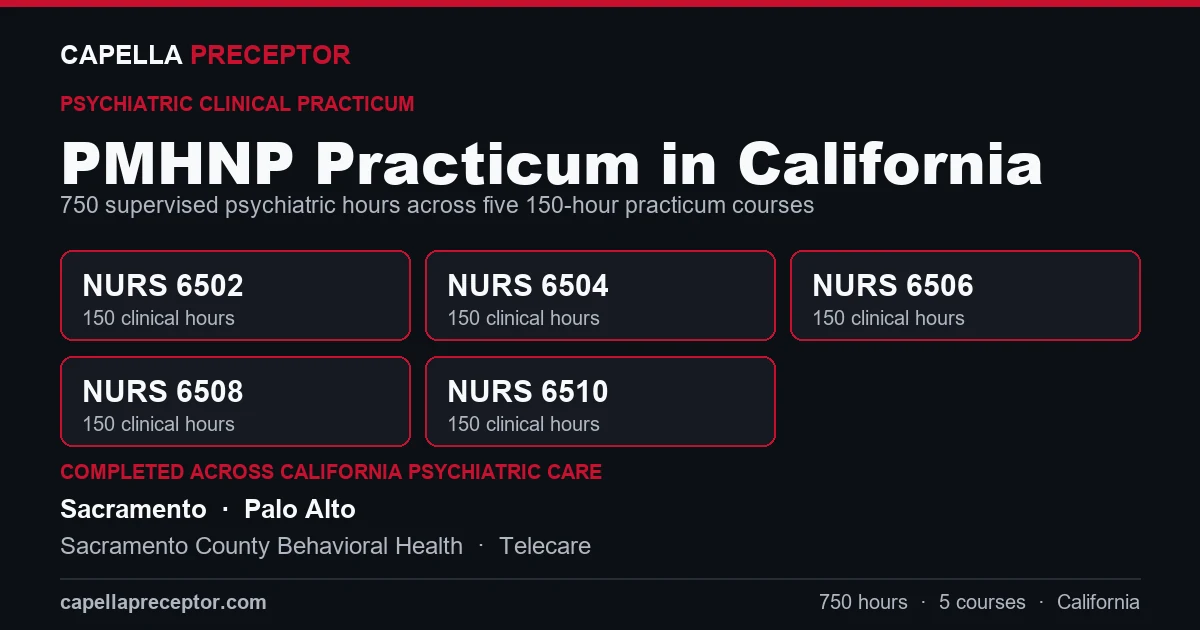
The Capella MSN Psychiatric Mental Health Nurse Practitioner specialization requires a minimum of 750 practicum hours, completed as 150 clinical hours in each of five practicum courses, NURS6502 (Practicum I), NURS6504 (Practicum II), NURS6506 (Practicum III), NURS6508 (Practicum IV), and NURS6510 (Practicum V) (Capella, MSN-PMHNP courses). The hour count is fixed by the program and does not change because you train in California. What changes by state is the kind of preceptor you train under, the prescribing context, and how hard the psychiatric placement is to find. That last point is where California stands apart.
This is also where a California PMHNP practicum is unlike a California FNP one. The FNP sequence is six practicum courses of 125 hours in primary care; PMHNP is five courses of 150 hours in psychiatric and behavioral-health settings, supervised by a board-certified PMHNP or a psychiatrist, never a general primary-care preceptor. Two students in the same state are doing structurally different placements. See the broader Capella PMHNP page for the full course breakdown and the all-programs California page for how restricted practice affects every NP specialty here.
What does California's restricted practice authority mean for a psychiatric preceptorship?
The American Association of Nurse Practitioners classifies California as a restricted practice state, its most limited tier (AANP, State Practice Environment). In California that takes the form of standardized procedures: written protocols a nurse practitioner and a supervising physician develop together that define what the NP may diagnose, treat, and furnish (California BRN, Nurse Practitioner). For a psychiatric placement this matters more than it does for primary care, because so much of a PMHNP's work is medication management.
Practically, it means your California PMHNP preceptor is almost always working inside a documented psychiatric scope, and physician psychiatrists are a common preceptor option alongside board-certified PMHNPs. That is generally a help to a student: the supervising structure is already built, the expectations for what you assess and prescribe under supervision are explicit, and you see how a psychiatric NP operates within California's standardized-procedure model from day one. Assembly Bill 890 created newer "103 NP" and "104 NP" categories that let qualified nurse practitioners eventually practice without standardized procedures after thousands of post-licensure hours in California (California BRN, Assembly Bill 890). That shapes your career, not your practicum: as a Capella student you train under a licensed psychiatric preceptor regardless of which category they hold.
How does California controlled-substance prescribing shape a PMHNP placement?
Psychiatric practice runs on controlled medications, so the prescribing rules are part of your training, not a footnote. In California a nurse practitioner furnishes drugs using a furnishing number issued by the Board of Registered Nursing, under standardized procedures (California BRN, Nurse Practitioner). For the controlled drugs that dominate psychiatry the bar is higher, and the difference is concrete:
- Schedule II stimulants and benzodiazepines. To furnish Schedule II controlled substances, such as the stimulants used for ADHD, a California NP must hold a DEA registration and furnish them under a patient-specific protocol approved by the treating or supervising physician (California Business and Professions Code § 2836.1). You will see this protocol-driven workflow in any California psychiatric clinic that manages stimulants or controlled sedatives.
- Buprenorphine and medication for opioid use disorder. The federal X-waiver was eliminated in 2023, so a clinician with a DEA registration that includes Schedule III authority may now prescribe buprenorphine for opioid use disorder with no patient cap (SAMHSA, MAT Act). New or renewed DEA registrations also require an 8-hour substance-use training attestation under the MATE Act (SAMHSA, MATE Act). This matters for PMHNP students because co-occurring substance use is everywhere in California psychiatry, and a preceptor who runs medication-assisted treatment gives you that exposure directly.
Why care as a student? Because the PMHNP certification exam and your future scope both assume real psychopharmacology exposure. A California preceptor who actively furnishes stimulants, mood stabilizers, antipsychotics, and buprenorphine under these rules is training you in the prescribing reality you will graduate into. We screen for that when we match you.
Can PMHNP practicum hours in California be done by telepsychiatry?
Some, often a meaningful share, but not automatically all. California is one of the more telehealth-permissive states for behavioral health: state guidance affirms telehealth for nearly all specialty mental-health and substance-use services, and even allows audio-only contact for sensitive services such as mental health under defined conditions (California DHCS, Behavioral Health Information Notice 23-018). Capella itself lists telepsychiatry within the Practicum III experience (Capella, MSN-PMHNP courses), and psychiatric care, intake interviews, medication management, and psychotherapy, translates to video better than most specialties.
That does not make the whole 750 hours remote. How many telehealth hours count toward each practicum depends on your specific course requirements and on your preceptor's actual practice, and your faculty sets the line. The practical California upside is real: in the Central Valley, the Sierra, or the far north, where in-person psychiatric preceptors are thin, a California-licensed telepsychiatry preceptor can keep you on schedule when a local placement would stall. Confirm the current telehealth allowance for each practicum with your course instructions before assuming a course can be completed entirely online.
Where do PMHNP students actually complete psychiatric hours in California?
PMHNP hours must be earned in behavioral and mental-health practice under an appropriately credentialed psychiatric provider, never in general primary care. California has a wide range of real settings that qualify, each with its own patient mix:
County systems such as Sacramento County Behavioral Health and the community mental-health clinics that anchor California's safety net carry high volumes of serious mental illness and co-occurring substance use, ideal for breadth across the lifespan.
Behavioral-health hospitals and licensed psychiatric health facilities, including operators like Telecare across the state, expose you to acute stabilization, crisis work, and inpatient psychopharmacology.
Pediatric and youth psychiatry practices cover the younger end of the lifespan requirement that runs through the PMHNP sequence, a population one adult-only clinic cannot supply on its own.
Substance-use and medication-assisted treatment settings, where buprenorphine and co-occurring care are the daily work, give you the SUD exposure California psychiatry demands.
California-licensed telepsychiatry practices that deliver medication management and therapy by video, useful both as a primary placement and as a way to reach rural counties.
Behavioral-health teams embedded in larger California health systems, where psychiatric NPs manage medications alongside a broader care team under standardized procedures.
Whichever setting you land, your specific site and preceptor are proposed and approved in CORE ELMS before you log a single hour, the credential and the setting both have to clear that review, and a signed affiliation agreement between Capella and the California site has to be in place first. California health systems frequently route those agreements through their own legal review, so start early.
Why is finding a PMHNP preceptor in California so hard?
Because the math is brutal, and being honest about it serves you better than a reassurance. California graduates only about 75 to 80 PMHNPs a year while its psychiatrist workforce is projected to fall by roughly one-third by 2028, and nearly two-thirds of Californians with a mental-health condition already go untreated (California Health Care Foundation, Training PMHNPs). The same scarcity that drives that workforce gap is exactly what makes a psychiatric preceptor hard to land. Every NP and PA program in the state is competing for the same small pool of psychiatrists and board-certified PMHNPs willing to take a student, and many of them are already at capacity.
Capella leaves that search to you. The university states that "learners are responsible for finding an appropriate preceptor to oversee the practicum experience," and a support team helps connect you with site opportunities rather than assigning a psychiatric preceptor (Capella, MSN-PMHNP overview). In a market this tight that is where students lose terms. We carry the search instead, matching a California-licensed psychiatric preceptor who meets Capella's published requirements and preparing the placement for Capella's own review and approval. We never describe a preceptor as endorsed by the university, because that approval is Capella's to grant; our job is to bring you a compliant, screened match and the paperwork to clear it.
California PMHNP FAQ
How many hours does the Capella PMHNP practicum require in California?
A minimum of 750 psychiatric practicum hours, completed as 150 clinical hours in each of the five practicum courses (NURS6502, NURS6504, NURS6506, NURS6508, NURS6510), all under an on-site psychiatric-mental-health preceptor at an approved California site. The hour count is set by Capella and does not change by state.
Can PMHNP practicum hours in California be done by telepsychiatry?
California permits telehealth for behavioral-health services, including audio-only in limited circumstances, and Capella lists telepsychiatry within Practicum III. How many of your 750 hours can be earned by video depends on your specific course requirements and your preceptor's practice, so confirm the current allowance with your faculty rather than assuming the whole sequence can be remote.
Does a California preceptor's prescribing authority matter for a PMHNP student?
Yes. California is a restricted practice state, so your nurse practitioner preceptor furnishes psychiatric medications under standardized procedures and a furnishing number, and furnishes Schedule II drugs such as stimulants only under a patient-specific protocol approved by the supervising physician and with DEA registration. Training under a preceptor who actively manages psychopharmacology gives you the prescribing exposure your certification exam expects.
What psychiatric settings count for PMHNP hours in California?
County behavioral-health clinics, community mental-health centers, inpatient psychiatric and behavioral-health hospitals, child and adolescent psychiatry practices, substance-use and medication-assisted treatment programs, and telepsychiatry groups, each staffed by an appropriately credentialed psychiatric provider and cleared in CORE ELMS before you start logging hours.
Is it hard to find a PMHNP preceptor in California?
It is genuinely hard. California graduates only about 75 to 80 PMHNPs a year against a psychiatrist workforce projected to fall by a third by 2028, so psychiatric preceptors are scarce and heavily competed for by every nursing program in the state. We carry that search for you and match a California-licensed psychiatric preceptor who meets Capella's published requirements.
Sources
- Capella University, MSN-PMHNP courses and practicum hours (750 hours, five courses of 150)
- California Board of Registered Nursing, Nurse Practitioner (standardized procedures and furnishing number)
- California Business and Professions Code § 2836.1 (patient-specific protocol for Schedule II furnishing)
- SAMHSA, MAT Act (X-waiver elimination for buprenorphine)
- California DHCS, Behavioral Health Information Notice 23-018 (telehealth for behavioral health)
- California Health Care Foundation, Training Psychiatric Mental Health Nurse Practitioners (shortage figures)
- California Board of Registered Nursing, Assembly Bill 890 (103/104 NP categories)
How Capella Preceptor helps PMHNP students in California
You now have the whole picture: 750 psychiatric hours across five practicum courses, a restricted practice state where your preceptor furnishes controlled medications under standardized procedures, generous but bounded telepsychiatry, and a psychiatric preceptor pool stretched thin across the entire state. The coursework is not the hard part. Lining up a credentialed California psychiatric preceptor and a site that will sign an affiliation agreement is. That is what we do.
- A California-licensed psychiatric preceptor who meets Capella's published requirements, matched in 7 days, in person or telepsychiatry
- Adult and child/adolescent psychiatric rotations covered across all five practicums
- Every CORE ELMS form and affiliation agreement prepared and submitted for Capella's review, with no payment until you are matched
Get a Capella PMHNP preceptor in California
Free 15-minute consult. No payment until matched. We map your entire California psychiatric practicum plan and the prescribing exposure you need.
Get my free consult →