Capella PMHNP preceptor in Colorado
A Capella PMHNP practicum in Colorado requires 750 supervised psychiatric clinical hours across five practicum courses of 150 hours each, completed under an on-site psychiatric-mental-health preceptor you secure yourself. Colorado is a full practice authority state, so an independent PMHNP can precept and sign off without a physician in the chain. The catch is supply: behavioral-health providers are scarce here, and psychiatric slots go fast. Here is how the program, the Colorado board rules, controlled-substance prescribing, telepsychiatry, and the real psychiatric settings fit together, and how we secure your placement.
Last updated: June 28, 2026 · Reviewed by the Capella Preceptor placement team
What does a Capella PMHNP practicum require in Colorado?
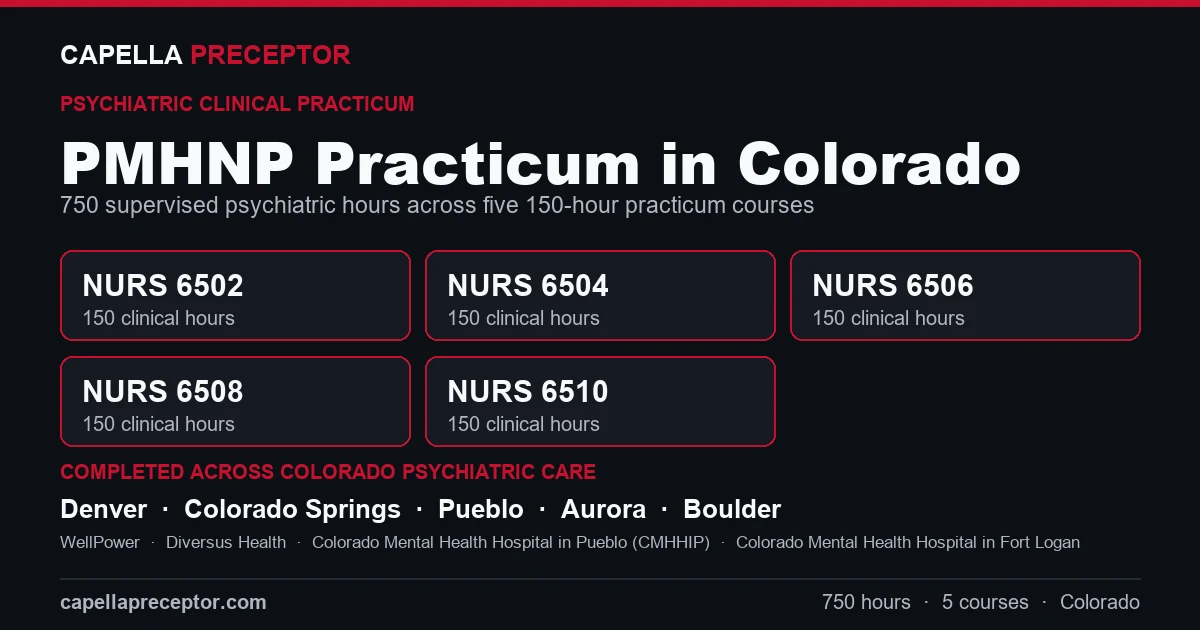
The Capella MSN Psychiatric Mental Health Nurse Practitioner specialization requires a minimum of 750 practicum hours, completed as 150 clinical hours in each of five sequential practicum courses: NURS6502 (Practicum I), NURS6504 (Practicum II), NURS6506 (Practicum III), NURS6508 (Practicum IV), and NURS6510 (Practicum V) (Capella, MSN-PMHNP courses). That five-by-150 structure is specific to PMHNP and is the first reason a psychiatric placement in Colorado plays out differently from a primary-care one. Every one of those hours has to be earned in a psychiatric or behavioral-health setting, under a preceptor whose scope is mental health, not the family-medicine or internal-medicine clinics that anchor an FNP placement in Colorado.
PMHNP is a lifespan specialty, so the sequence deliberately spreads your hours across adult and older-adult psychiatry, then child and adolescent psychiatry, then advanced practice that pulls in psychopharmacology, psychotherapy, crisis work, and telepsychiatry. In Colorado that lifespan spread is the practical bottleneck, because the providers who see children and adolescents are far rarer than the ones who see adults. The broader requirements, the course-by-course breakdown, and the approved psychiatric settings are laid out on the all-states Capella PMHNP preceptor page; this page is about what changes when the site is in Colorado.
What does Colorado full practice authority mean for a psychiatric preceptor?
The American Association of Nurse Practitioners places Colorado in the full practice authority category (AANP, State Practice Environment). For a PMHNP that is more than a label. A psychiatric-mental-health nurse practitioner with full prescriptive authority in Colorado can own and run an independent psychiatric practice, carry their own panel, and agree to precept you without first clearing it with a collaborating physician. In a reduced or restricted state a psych NP often cannot sign your evaluations alone, which adds a layer and a delay. In Colorado the sign-off chain is usually one clinician, which is one of the few things that works in your favor here.
One nuance matters specifically for psychiatry, a medication-heavy specialty. Colorado runs a two-step prescriptive model: a newer APRN first holds provisional prescriptive authority (RXN-P), then earns full prescriptive authority (RXN) after completing a 750-hour prescribing mentorship and an articulated plan for safe prescribing (3 CCR 716-1.15). A PMHNP still in their own RXN-P mentorship can supervise your hours, but it helps to know where a potential preceptor sits on that ladder. We confirm the prescriptive credential, not just the license, before we propose anyone.
Can a Colorado PMHNP preceptor prescribe controlled psychiatric medications?
Yes, and this is central to a psychiatric practicum in a way it is not to primary care, because so much of psychiatric treatment is scheduled medication. Under Colorado's prescriptive-authority rules, an RXN-P or RXN who holds a valid DEA registration may prescribe Schedule II through V controlled substances within their role and population focus (3 CCR 716-1.15). In practice that scope covers the medications a PMHNP rotation actually turns on:
The buprenorphine picture shifted recently. The Consolidated Appropriations Act of 2023 removed the old federal X-waiver, so any clinician with a state license and a DEA registration that allows Schedule III prescribing may now prescribe buprenorphine for opioid use disorder, where state law permits; DEA registrants must complete a one-time MATE Act training on treating substance use disorders (SAMHSA, MATE Act training requirements). A Colorado preceptor who treats co-occurring substance use gives you medication-assisted-treatment exposure that many psychiatric rotations cannot, which is valuable for the certification exam and for practice. When you weigh a site, ask whether it offers any MOUD or addiction work.
Can Colorado PMHNP hours be completed by telepsychiatry?
Some of them, and Colorado is more telehealth-friendly than most states for this. Colorado does not require an in-person examination to establish the provider relationship; a clinician can establish it through live audio and video (Telehealth.HHS.gov, prescribing controlled substances via telehealth). Capella names telepsychiatry directly within its Practicum III experience, so a portion of your psychiatric hours can legitimately be earned by video where your preceptor and faculty agree (Capella, MSN-PMHNP courses). That matters here, because a student in Durango, Montrose, or out on the eastern plains may have almost no local psychiatric site, and a telepsych group can keep them on schedule.
The limit is controlled-substance prescribing, which is exactly where psychiatry lives. The federal Ryan Haight Act generally requires at least one in-person evaluation before a controlled substance is prescribed by telemedicine, and the DEA flexibilities that relaxed that have been extended through the end of 2025 while permanent rules are finalized (DEA, telemedicine prescribing rules). A telepsychiatry rotation can teach assessment, diagnosis, therapy, and medication management broadly, but how much of your stimulant and benzodiazepine prescribing experience can be fully remote is a live question. Confirm the current telehealth allowance for each practicum course against your Capella course instructions and your preceptor's practice before assuming hours can be done entirely online.
Where do Colorado PMHNP students actually complete psychiatric hours?
Psychiatric practicum hours have to come from behavioral-health practice, not a general clinic. The settings that fit Capella's psychiatric-site approval in Colorado, when staffed by an appropriately credentialed supervising provider, fall into a few real categories:
Colorado's safety-net behavioral-health providers, including WellPower in Denver (which merged with Jefferson Center in 2023 to form the state's largest center) and Diversus Health, formerly AspenPointe, around Colorado Springs.
The Colorado Mental Health Hospital in Pueblo (CMHHIP), a forensic and acute facility, and the Colorado Mental Health Hospital in Fort Logan for the Denver metro, both inpatient settings.
Programs offering medication-assisted treatment and dual-diagnosis care, where buprenorphine and co-occurring psychiatric management are part of the day.
Private psychiatric practices and Colorado-licensed telepsychiatry groups that carry adult and, less commonly, child and adolescent panels.
Naming these is not the same as a placement at any of them; they are illustrative of the kinds of Colorado settings where psychiatric hours are earned, and large systems run their own student-affiliation rules. What we do is identify a Colorado-licensed psychiatric preceptor whose setting and credential meet Capella's published requirements, then submit that placement for Capella's review. We match preceptors who meet Capella's published requirements and submit the placement for Capella's own review; Capella reviews and approves the placement, and we never call a preceptor endorsed by the university before that review is complete.
Why is it so hard to find a PMHNP preceptor in Colorado?
Because the supply genuinely is not there, and it is honest to say so. Colorado has a documented behavioral-health workforce shortage, and most rural counties are designated mental-health professional shortage areas, where the federal designation is driven largely by the psychiatrist-to-population ratio (Colorado Department of Public Health and Environment, health professional shortage areas). The state has responded with PMHNP fellowships and residencies precisely because there are not enough psychiatric prescribers to go around. That is good for your career prospects and bad for your search: the few PMHNPs and psychiatrists who could precept are already carrying full caseloads, and the ones who see children and adolescents, which your sequence requires, are the scarcest of all.
The practical consequences for a Colorado PMHNP student are concrete:
- Plan for more than one preceptor. One practice rarely covers both adult and child or adolescent psychiatry, so the lifespan requirement often needs two arrangements over the sequence.
- Front Range slots go first. Denver, Aurora, Boulder, and Fort Collins fill earliest; Western Slope and eastern-plains students often lean on a Colorado-licensed telepsychiatry option for part of the load.
- Start months ahead. An affiliation agreement can take weeks to execute, and a psychiatric site that has to vet a new student rarely turns it around quickly.
What has to be in place before you log a Colorado psychiatric hour?
Identifying a willing psychiatric preceptor is step one, not the finish line. Before a single hour counts, the placement runs through Capella's practicum workflow in CORE ELMS, and the sequence is the same statewide:
- Propose the Colorado psychiatric site and preceptor in CORE ELMS for Capella to review and approve.
- Verify the credential and prescriptive level against the DORA registry, confirming an active Colorado APRN license with a psychiatric population focus and RXN-P or RXN prescriptive authority.
- Execute a signed affiliation agreement between Capella and the psychiatric site before practicum begins.
- Clear compliance for the background check and health records through Capella's vendor (CastleBranch), which behavioral-health and forensic sites in Colorado tend to scrutinize closely.
- Log hours in CORE ELMS for preceptor approval, until each of the five courses reaches its 150-hour total.
You verify a Colorado license, including APRN status and prescriptive level, through the DORA Division of Professions and Occupations online lookup (Colorado DORA license lookup). We check every preceptor against that record before we match, so the clinician signing your psychiatric evaluations holds an active, unrestricted Colorado license in the role your specialty needs.
Colorado PMHNP preceptor FAQ
How many hours does a Capella PMHNP practicum in Colorado require?
A minimum of 750 psychiatric practicum hours, completed as 150 clinical hours in each of five practicum courses (NURS6502, NURS6504, NURS6506, NURS6508, NURS6510), under an on-site psychiatric-mental-health preceptor at a Colorado site you secure yourself and submit through CORE ELMS for Capella's review.
Does Colorado full practice authority let a PMHNP precept independently?
Yes. Colorado is a full practice authority state, so a PMHNP with full prescriptive authority (RXN) can run an independent psychiatric practice and sign off as your preceptor without routing the decision through a physician. A newer PMHNP may still hold provisional prescriptive authority (RXN-P) while completing the 750-hour mentorship Colorado requires for full RXN status.
Can a Colorado PMHNP preceptor prescribe controlled psychiatric medications?
Yes. Under Colorado rule 3 CCR 716-1.15, an RXN-P or RXN with a valid DEA registration may prescribe Schedule II through V controlled substances within their role and population focus, which covers Schedule II stimulants for ADHD, benzodiazepines, and buprenorphine for opioid use disorder. Buprenorphine no longer requires the old X-waiver, though prescribers must complete the federal MATE Act training.
Can Colorado PMHNP practicum hours be completed by telepsychiatry?
Some can. Colorado allows a provider to establish a patient relationship by live audio and video, and Capella names telepsychiatry within its Practicum III experience, so a share of hours can be earned remotely. Controlled-substance prescribing by telehealth is still shaped by the federal Ryan Haight in-person rule and its DEA flexibilities, so confirm with your Colorado preceptor and Capella faculty how many hours can be virtual for each course.
Why is finding a PMHNP preceptor in Colorado so hard?
Colorado has a documented behavioral-health workforce shortage, with most rural counties designated mental-health professional shortage areas. The few psychiatrists and PMHNPs who could precept are already carrying heavy caseloads, and child and adolescent psychiatry slots are the scarcest of all. Slots fill fast, so most students line up the site months before the practicum quarter.
Sources
- Capella University, MSN-PMHNP courses and practicum hours
- AANP, State Practice Environment (Colorado full practice authority)
- 3 CCR 716-1.15, Colorado APRN prescriptive authority (RXN-P, RXN, Schedule II to V)
- SAMHSA, MATE Act training requirements (buprenorphine, X-waiver removal)
- DEA, telemedicine prescribing of controlled substances (Ryan Haight flexibilities)
- Colorado Department of Public Health and Environment, health professional shortage areas
- Colorado DORA online license lookup
How Capella Preceptor helps Colorado PMHNP students
You now have the full picture: 750 psychiatric hours across five practicum courses, a full practice state where an independent PMHNP can precept, an RXN prescriptive model that shapes who can supervise your controlled-substance experience, telepsychiatry that fills some but not all of the gap, and a real behavioral-health shortage that makes the search the hard part. That search is what we handle. We secure a verified, Colorado-licensed psychiatric preceptor near you or by telepsychiatry, confirm the credential and prescriptive level against the DORA registry, prepare every CORE ELMS form and affiliation agreement, and keep your hours logged on schedule.
- Verified Colorado psychiatric preceptor matched in 7 days, in person or by telepsychiatry
- Adult and child or adolescent psychiatric rotations covered across all five practicums
- Credential and prescriptive level checked, every CORE ELMS form handled, no payment until matched
Get a Capella PMHNP preceptor in Colorado
Free 15-minute consult. No payment until matched. We map your entire psychiatric practicum plan, all 750 hours.
Get my free consult →Compare options first? See pricing or the broader PMHNP and Colorado pages.