Capella PMHNP preceptor in Connecticut
A Capella PMHNP practicum in Connecticut requires 750 supervised psychiatric clinical hours across five practicum courses of 150 hours each, completed under an on-site psychiatric-mental-health preceptor. Connecticut is a full practice authority state, so an experienced PMHNP can precept you on their own license and prescribe the full range of psychiatric controlled substances. This page explains what that environment means for your psychiatric hours, the controlled-substance and telepsychiatry rules that shape them, where students actually earn hours in Connecticut, and how to secure a psych preceptor in a state where they are scarce.
Last updated 2026-06-28 · Reviewed by the Capella Preceptor placement team
How many psychiatric hours does a Capella PMHNP need in Connecticut?
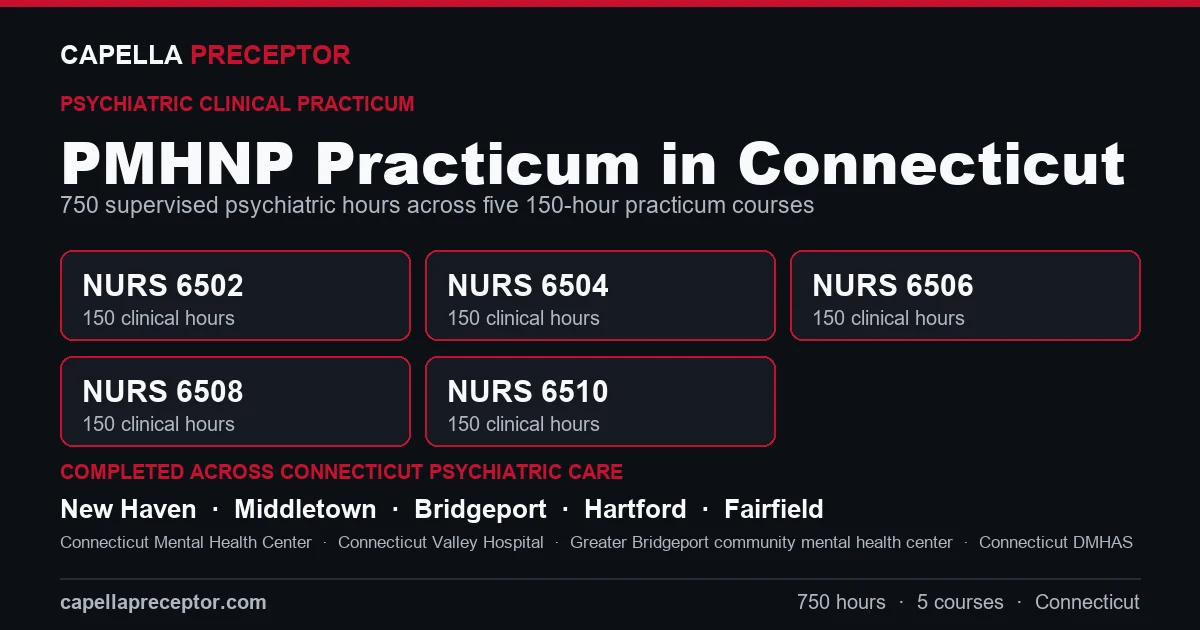
The hour total does not change when you cross a state line. Capella's MSN-PMHNP specialization requires a minimum of 750 practicum hours, earned as 150 clinical hours in each of five practicum courses, NURS6502, NURS6504, NURS6506, NURS6508, and NURS6510 (Practicum I through V), all in psychiatric and behavioral-health settings under a qualified preceptor (Capella, MSN-PMHNP courses). That five-by-150 structure is specific to PMHNP; it is not the same as the primary-care FNP pattern, so do not plan your Connecticut hours off an FNP schedule. The coursework is online and the supervised hours are completed in person in your own community (Capella, MSN-NP program).
What Connecticut changes is not the count but the clinical reality behind it: which clinician can sign your hours, what your preceptor is allowed to prescribe in front of you, and how much of your psychiatric care can happen over video. Those three things, supervision, controlled-substance authority, and telepsychiatry, are where a Connecticut PMHNP practicum genuinely differs from the same practicum in a restricted state, and from a Connecticut FNP placement, which sits in primary care rather than psychiatry. The broader hour breakdown, including the population focus of each practicum, lives on the all-states PMHNP page; the wider Connecticut picture across every Capella program is on the Connecticut placement page.
What does full practice authority mean for a PMHNP preceptor in Connecticut?
The American Association of Nurse Practitioners classifies Connecticut as a full practice authority state (AANP, State Practice Environment). For a psychiatric practicum that detail matters more than it does for most specialties. In a full practice state an experienced PMHNP can evaluate, diagnose, order diagnostics, and prescribe psychiatric medication, including controlled substances, on the sole authority of the Connecticut Board of Examiners for Nursing, without a standing contract that ties them to a supervising psychiatrist. A board-certified PMHNP is therefore a complete, self-sufficient preceptor for your hours; you are not forced into psychiatrist-led practices the way a restricted state would force you.
One condition shapes which Connecticut NPs can precept on their own authority. The state reaches full practice through a transition model: an APRN who has not yet completed at least three years and 2,000 hours of practice in collaboration with a physician must keep that collaborative relationship during the transition, and only after meeting both thresholds may they practice independently (Connecticut DPH, APRN Practice; Connecticut General Assembly, OLR report 2016-R-0190). In practice this means a seasoned psychiatric NP can precept you outright, while a newer PMHNP may still be working alongside a collaborating physician, which is perfectly acceptable for your hours but worth knowing when you weigh who is supervising you and what they can prescribe in your presence.
What can a Connecticut PMHNP preceptor prescribe in front of you?
Psychiatric training is largely training in controlled-substance prescribing, so a state's drug-control rules shape what you actually see during your hours. A Connecticut APRN may prescribe controlled substances in Schedules II through V under the state nursing statutes (Connecticut General Statutes, Chapter 378, Nursing). That range covers the three controlled-substance classes a PMHNP rotation lives in: Schedule II stimulants for ADHD, the benzodiazepines used in anxiety and acute presentations, and buprenorphine for opioid use disorder. A primary-care FNP preceptor in the same state rarely touches the psychiatric end of that list, which is one concrete reason a PMHNP placement is not interchangeable with an FNP one.
Two Connecticut-specific guardrails are worth understanding before you watch your preceptor prescribe:
Sources for the table: the state nursing statutes (CGS Chapter 378), the Connecticut Department of Consumer Protection Controlled Substance Practitioner registration (DCP, Controlled Substance Practitioner Registration), the state prescribing-law summary that sets the 72-hour CPMRS rule (DCP, Laws Impacting Prescribing and Practice), and SAMHSA on the eight-hour MATE Act requirement (SAMHSA, MATE Act training). None of this restricts where you can do hours; it just explains the prescribing world your preceptor operates in, which is the substance of a psychiatric practicum.
Can Connecticut PMHNP hours be done by telepsychiatry?
Psychiatry is the most telehealth-native of the NP specialties, and Connecticut has made the legal framework for it permanent. Under Public Act 24-110, the state turned its pandemic-era telehealth expansion into standing law, keeping both audio-and-video and audio-only telehealth, naming APRNs and behavioral-health providers as covered telehealth providers, and barring insurers from paying less for a telehealth visit than for the same visit in person (Connecticut General Assembly, OLR report 2024-R-0122; Connecticut General Statutes Sec. 19a-906, Telehealth services). Telepsychiatry is therefore a normal, funded part of how psychiatric care is delivered across Connecticut, which means real telepsych practices exist and can serve as legitimate clinical sites.
That state allowance is the floor, not the ceiling on your hours. Capella names telepsychiatry directly within the Practicum III experience, but how much of your 750 hours can be earned remotely still depends on your specific course requirements, your preceptor's practice, and the school's clinical-hour rules (Capella, MSN-PMHNP courses). Confirm the current telehealth allowance for each practicum against your course instructions before you assume the whole sequence can be virtual. In Connecticut the most common pattern is a blend: an in-person anchor site for the bulk of your hours, with a telepsych practice filling a population or a stretch the local site cannot cover.
Where do Capella PMHNP students complete hours in Connecticut?
Connecticut has a deep public behavioral-health system, which is unusual and useful for a psychiatric student. The state Department of Mental Health and Addiction Services (DMHAS) runs a network of community mental health centers and four state-operated inpatient facilities, and funds hundreds of community-based programs (Connecticut DMHAS, About). Real Connecticut settings where PMHNP students earn psychiatric hours, when staffed by an appropriately credentialed supervising provider, include:
- Community mental health centers, including the DMHAS Local Mental Health Authority network and the state-operated Connecticut Mental Health Center in New Haven, a long-running DMHAS and Yale Department of Psychiatry partnership and an active nursing training site.
- State psychiatric inpatient settings, such as Connecticut Valley Hospital in Middletown and the Capitol Region and Greater Bridgeport community mental health centers, for acute and inpatient psychiatric exposure.
- Addiction and substance-use programs, including DMHAS substance-abuse treatment units and outpatient MOUD and buprenorphine clinics, which matter for the co-occurring disorders central to psychiatric practice.
- Private outpatient psychiatry and child-and-adolescent practices across Greater Hartford, the New Haven shoreline, and Fairfield County, which cover the lifespan rotations the practicum sequence requires.
- Telepsychiatry groups operating under Public Act 24-110, useful for filling a population gap or for students in the thinner northeast and northwest corners of the state.
The supervising provider must hold an active, unencumbered Connecticut license with the scope to oversee psychiatric care, typically a board-certified PMHNP or a psychiatrist. You can confirm any APRN or physician credential through the state's online License Verification at Connecticut eLicense; we run that check on every preceptor we propose. Whatever the setting, the site and preceptor are proposed in CORE ELMS and submitted for Capella's review before you can log an hour.
Why is finding a PMHNP preceptor in Connecticut so hard?
Here is the honest part. Connecticut is small and densely populated, which sounds like it should make placement easy, but psychiatric preceptors are scarce everywhere and the squeeze is sharper in psych than in primary care. The national shortage of behavioral-health prescribers means the same handful of PMHNPs and psychiatrists field requests from students at every regional program at once, and a public-system clinician carrying a full caseload often cannot take a student even when they want to. A polite email in January can quietly become a missed practicum start in May.
The structure of the PMHNP sequence makes it harder still. Capella spreads the lifespan requirement across adult, older-adult, child, and adolescent psychiatry, so one practice rarely covers everything, and many students need more than one preceptor or site across the five practicums. Child-and-adolescent psychiatry is the thinnest segment of all in Connecticut, so the Practicum II population is usually the bottleneck. This is exactly the kind of search that drives students to a placement service: not because the paperwork is complex, but because the right credentialed clinician is genuinely hard to reach on your own.
When we place a Connecticut PMHNP student, we are matching a preceptor who meets Capella's published requirements, then preparing the proposal so it can be submitted for Capella's review and approval in CORE ELMS. We do not assign a preceptor on Capella's behalf, and no service can promise the university will approve a given placement; what we can do is reach the credentialed psychiatric clinicians you cannot reach alone and handle the affiliation agreement, the compliance package, and the hour logging so a paperwork gap never costs you a term.
The Connecticut PMHNP placement sequence
Full practice authority decides what a licensed NP may do; it does not shortcut Capella's clearance workflow. No matter how favorable Connecticut's environment is, you cannot log a psychiatric hour until the placement is approved. The sequence looks like this:
1. Confirm the psychiatric preceptor's Connecticut license in eLicense -> active, unencumbered, in role
2. Propose the site and preceptor in Capella's practicum system -> CORE ELMS
3. Sign the affiliation agreement between Capella and the Connecticut psychiatric site
4. Clear third-party compliance, background check and health records, e.g. CastleBranch
5. Log and submit each course's 150 hours in CORE ELMS for preceptor approval
Two pieces consistently stall Connecticut students. The affiliation agreement is a contract between Capella and the site, and a busy community mental health center or hospital can sit on it for weeks; we push it through. Third-party compliance, typically a CastleBranch package, has to be complete before day one (Capella, MSN-PMHNP overview). Because the lifespan rotations are split, plan early for one source of adult and older-adult hours and a separate source for child and adolescent hours.
Connecticut PMHNP FAQ
How many psychiatric hours does a Capella PMHNP need in Connecticut?
A minimum of 750 supervised psychiatric clinical hours, completed as 150 hours in each of five practicum courses (NURS6502, NURS6504, NURS6506, NURS6508, NURS6510), under an on-site psychiatric-mental-health preceptor at an approved Connecticut behavioral-health site. The number is the same in every state; what changes in Connecticut is the practice and prescribing environment your preceptor works in.
Can a Connecticut NP precept a PMHNP student on their own authority?
Connecticut is a full practice authority state, so an experienced PMHNP who has completed the transition period (at least three years and 2,000 hours of physician-collaborative practice) can evaluate, diagnose, and prescribe psychiatric medication, including controlled substances, on their own license. That makes a board-certified PMHNP a fully sufficient preceptor for your psychiatric hours; you are not limited to psychiatrist-led practices the way you would be in a restricted state.
Can Capella PMHNP practicum hours be done by telepsychiatry in Connecticut?
Connecticut made audio-and-video telehealth, including behavioral-health and audio-only visits, permanent under Public Act 24-110, and APRNs are named telehealth providers, so telepsychiatry is an established part of Connecticut psychiatric practice. How many of your hours can be earned remotely still depends on your specific Capella course requirements and your preceptor's practice, so confirm the current allowance against your course instructions rather than assuming all 750 hours can be virtual.
What controlled-substance rules affect a PMHNP preceptor in Connecticut?
A Connecticut APRN may prescribe Schedule II to V controlled substances, which covers the stimulants, benzodiazepines, and buprenorphine that psychiatric practice relies on. During the three-year transition period the written collaborative agreement must specify the Schedule II and III levels the APRN may prescribe, prescribers must check the CPMRS before prescribing any Schedule II to V drug intended to last more than 72 hours, and a separate Connecticut Controlled Substance Practitioner registration is required on top of a federal DEA registration.
Where do Capella PMHNP students complete psychiatric hours in Connecticut?
At approved behavioral-health sites: the DMHAS network of community mental health centers and state-operated facilities such as the Connecticut Mental Health Center in New Haven and Connecticut Valley Hospital, plus private outpatient psychiatry, child and adolescent practices, substance-use and MOUD programs, and telepsychiatry groups. Each site and preceptor is proposed in CORE ELMS and submitted for Capella's review before hours can begin.
Sources
- Capella University, MSN-PMHNP courses and practicum hours
- AANP, State Practice Environment (Connecticut listed as full practice)
- Connecticut DPH, APRN Practice and the transition period
- Connecticut General Statutes, Chapter 378 (Nursing, APRN Schedule II to V authority)
- Connecticut DCP, Controlled Substance Practitioner Registration
- Connecticut DCP, Laws Impacting Prescribing and Practice (72-hour CPMRS rule)
- SAMHSA, MATE Act eight-hour training requirement (buprenorphine and MOUD)
- Connecticut General Assembly, OLR report 2024-R-0122 (Public Act 24-110 telehealth)
- Connecticut DMHAS, About (community mental health centers and state facilities)
- Connecticut eLicense, online License Verification
How Capella Preceptor helps Connecticut PMHNP students
You now know the landscape: Connecticut is full practice authority, a board-certified PMHNP can precept you and prescribe the full psychiatric controlled-substance range, telepsychiatry is permanent law, and the real challenge is reaching a scarce psychiatric preceptor, especially for the child-and-adolescent rotation. That last gap is where students lose months. We match a preceptor who meets Capella's published requirements, prepare the CORE ELMS proposal for the university's review, push the affiliation agreement through, and keep each course's 150 hours logged and submitted on time, in person or by telepsychiatry.
- Verified Connecticut psychiatric preceptor matched in 7 days, no payment until matched
- Adult and child/adolescent psychiatric rotations covered across all five practicums
- Every CORE ELMS form and affiliation agreement prepared and submitted for Capella's review
Get a Capella PMHNP preceptor in Connecticut
Free 15-minute consult. No payment until matched. We map your entire psychiatric practicum plan, all five courses.
Get my free consult →