Capella PMHNP preceptor in Idaho
A Capella PMHNP practicum in Idaho requires 750 supervised psychiatric clinical hours across five practicum courses of 150 hours each, completed under an on-site psychiatric-mental-health preceptor. Idaho is a full practice authority state, which shapes who can supervise you and how psychiatric controlled substances are prescribed. Here is how the hours, Idaho board rules, telepsychiatry allowances, controlled-substance prescribing, and the real psychiatric sites fit together, and how to secure a preceptor for them.
Last updated: June 28, 2026 · Reviewed by the Capella Preceptor placement team
How many psychiatric hours does a Capella PMHNP in Idaho need?
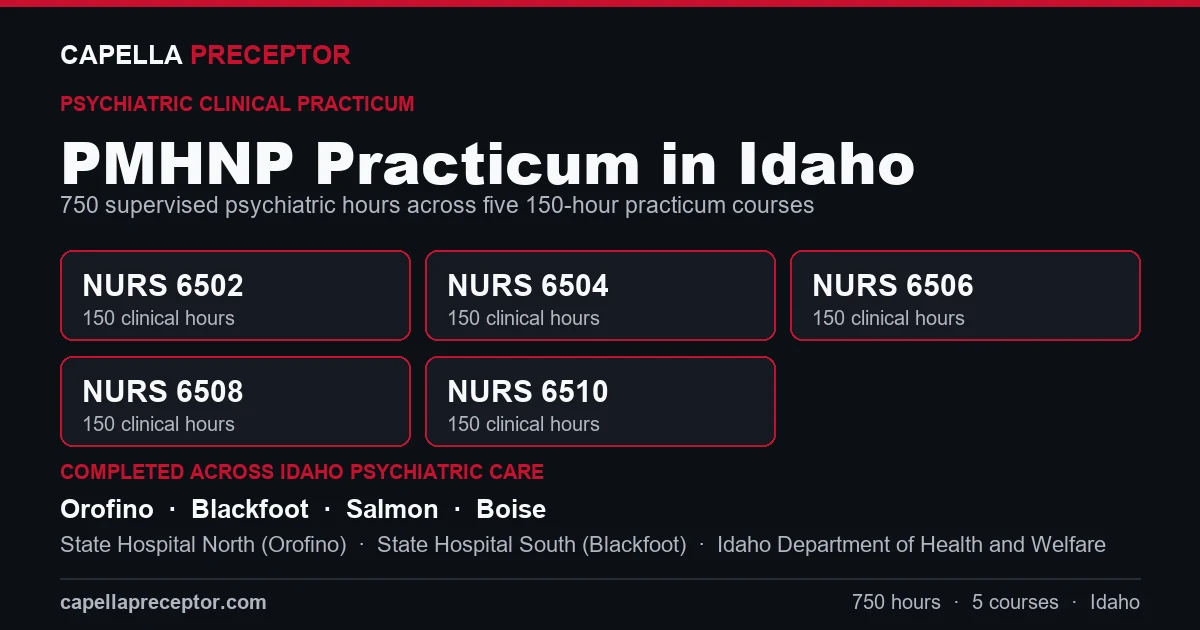
The Capella MSN Psychiatric Mental Health Nurse Practitioner specialization requires a minimum of 750 practicum hours, completed as 150 clinical hours in each of five practicum courses, NURS6502 (Practicum I), NURS6504 (Practicum II), NURS6506 (Practicum III), NURS6508 (Practicum IV), and NURS6510 (Practicum V) (Capella, MSN-PMHNP courses). Every one of those 750 hours is direct psychiatric care, not primary care, so an Idaho placement only counts if it is a behavioral-health setting supervised by a credentialed psychiatric provider. This is the structural difference between a PMHNP placement and an Idaho FNP placement: a family practice clinic that would satisfy an FNP rotation does nothing for your psychiatric hours.
The coursework is delivered online, while the psychiatric practicum is completed in person at an approved site in your own Idaho community (Capella, MSN-NP program). PMHNP is a lifespan specialty, so the sequence deliberately spreads your hours across adult, older-adult, child, and adolescent psychiatry, which in a state as rural as Idaho usually means more than one preceptor or site over the five courses. We cover the broader program detail on the PMHNP preceptor page and the full state placement landscape on the Idaho page; this page is specifically where the two meet.
What does Idaho full practice authority mean for a psych preceptor?
The American Association of Nurse Practitioners classifies Idaho as a full practice authority state (AANP, State Practice Environment). For a licensed Idaho PMHNP that means evaluating, diagnosing, ordering tests, and prescribing under the sole authority of the Idaho Board of Nursing, with no mandated collaborative or supervisory contract with a psychiatrist (Scope of Practice Policy, Idaho). In psychiatry specifically, this is a meaningful advantage: a board-certified Idaho PMHNP runs a panel, manages medications, and carries the full clinical decision without a physician co-signature.
For you as a student, that has a practical upside and one important caveat. The upside is that a fully independent PMHNP is a complete preceptor: they own every diagnostic and prescribing decision you watch them make, which is exactly the modeling you need. The caveat is that full practice authority describes a licensed, certified clinician, not a student. While you are in the Capella program you still complete every one of your 750 supervised hours under a qualified, approved preceptor, and any prescription you participate in is written under your preceptor's authority, never your own. Idaho's independence widens the pool of who can supervise you, because a solo PMHNP-owned psychiatric practice is a valid site here, but it does not shorten your hours.
Who can precept PMHNP hours under Idaho board rules?
Nursing in Idaho is regulated by the Idaho Board of Nursing, housed within the Idaho Division of Occupational and Professional Licenses (DOPL) in Boise (Idaho Board of Nursing, DOPL). The board licenses registered nurses and the four advanced practice registered nurse roles, and an APRN in the psychiatric-mental-health population is the credential you want supervising your psychiatric rotations. A board-certified PMHNP or a psychiatrist both satisfy Capella's psychiatric supervision requirement; a primary-care NP or a family physician does not, even though Idaho would let them practice independently, because they are not credentialed in the psychiatric population your hours must cover.
You can confirm any clinician's credential yourself before you trust them with a term. The board runs a public license search through DOPL where you look up an RN, LPN, or APRN by name or license number and see status, expiration, and disciplinary history (Idaho Board of Nursing, license search). We verify every preceptor's active Idaho license and psychiatric scope before we put them in front of you, but the tool is there for your own peace of mind too.
Prescribing psychiatric controlled substances in Idaho
Controlled-substance prescribing is where a psychiatric rotation differs most sharply from a primary-care one, and Idaho has specific requirements you should understand before you walk into a med-management clinic. Idaho APRNs may prescribe Schedule II through V controlled substances, which in psychiatry covers the Schedule II stimulants used for ADHD, the benzodiazepines used for anxiety and acute agitation, and buprenorphine for opioid use disorder (MIEC, Idaho advanced practice provider laws).
To hold that authority, an Idaho APRN must complete at least 30 hours of post-basic education in pharmacotherapeutics, obtain an Idaho Controlled Substance Registration (CSR) from the state, and then secure the matching federal DEA registration (Idaho Board of Nursing rules, IDAPA 24.34.01). Every controlled-substance prescription must carry the prescriber's DEA number, and continuing education for a prescribing APRN must include pharmacology hours. None of that registration is on your shoulders as a student, but it is exactly why your psychiatric preceptor matters: a PMHNP without an active CSR and DEA registration cannot model the controlled-substance decisions, the stimulant titration, the benzodiazepine taper, the buprenorphine induction, that make up a large share of real psychiatric practice. When we screen an Idaho preceptor for you, the prescribing credential is part of what we check.
Can Idaho PMHNP hours be done by telepsychiatry?
Some can, and psychiatry is one of the more telehealth-suited specialties because intake interviews, medication management, and psychotherapy are routinely delivered by video in real Idaho practice. Capella names telepsychiatry directly within its Practicum III clinical experience (Capella, MSN-PMHNP courses), so some telehealth exposure is built into the program. Idaho's wide-open geography makes this genuinely useful: a student in Salmon, in the Panhandle, or in a frontier county can complete supervised psychiatric hours with a telepsychiatry group without relocating.
Two limits keep this from being an all-remote shortcut. First, the share of telehealth that counts toward your hours depends on your specific course requirements and your preceptor's practice, so confirm the current allowance against your course instructions rather than assuming the whole sequence can be remote. Second, on the prescribing side, controlled-substance telemedicine sits inside an evolving federal framework: the DEA and HHS extended pandemic-era telemedicine flexibilities and issued a final rule expanding remote buprenorphine access for opioid use disorder, but with conditions and timelines that continue to change (SAMHSA, telemedicine rule for buprenorphine access). For a student that means a telepsychiatry rotation is a legitimate way to earn psychiatric hours, but the controlled-substance pieces you observe are governed by rules your preceptor follows, not ones you set.
Where PMHNP students complete psychiatric hours in Idaho
Idaho has real psychiatric infrastructure, but it is concentrated and stretched, which is why a setting plan matters. These are the kinds of behavioral-health sites where PMHNP students earn supervised hours:
Med-management and therapy clinics across the Treasure Valley and the regional behavioral-health centers, the deepest pool of adult psychiatric hours.
State Hospital North in Orofino (a 55-bed adult psychiatric crisis hospital) and State Hospital South in Blackfoot (adult psychiatric and skilled-nursing beds), both run by the Idaho Department of Health and Welfare.
Addiction and medication-assisted treatment settings where co-occurring psychiatric and substance-use care, including buprenorphine, is delivered, valuable for the dual-diagnosis side of PMHNP training.
Idaho's regional behavioral-health crisis centers and telepsychiatry groups that reach rural and frontier counties where no in-person psychiatric site is within driving distance.
Idaho's state psychiatric hospitals sit inside the Department of Health and Welfare's behavioral-health division (Idaho DHW, State Hospital North; Idaho DHW, State Hospital South). Because the lifespan requirement splits between adult/older-adult and child/adolescent psychiatry, child and adolescent hours are the scarcer half in Idaho and usually require a separate site, so plan that rotation early rather than assuming one clinic covers the whole sequence.
The real difficulty of finding a psych preceptor in Idaho
It is worth being honest: a psychiatric preceptor is the hardest single placement to secure in Idaho, harder than a primary-care preceptor and harder than the same PMHNP search in a dense coastal metro. Idaho is consistently among the states with the most severe per-capita behavioral-health workforce shortages, driven by its large rural geography and few metropolitan centers, and large stretches of the state are designated Mental Health Professional Shortage Areas by HRSA (Rural Health Information Hub, mental-health HPSA map). Fewer psychiatric prescribers means fewer potential preceptors, and the ones who exist are already carrying heavy panels.
Capella is direct that the student secures the preceptor and the site, and that the university does not assign one (Capella, MSN-PMHNP overview). For an Idaho PMHNP student that combination, a thin psychiatric workforce plus a self-secured-preceptor policy, is exactly where terms get lost. That gap is what we close. To be clear about what that means, no university hands out a vetted preceptor list and we make no claim of affiliation or endorsement; we match a psychiatric preceptor who meets Capella's published requirements and submit the placement for Capella's own review.
Getting an Idaho psychiatric placement approved
Identifying a willing Idaho psychiatric preceptor is only the first step. Before you log a single hour, Capella runs a clearance workflow, and every piece has to be in order for your Idaho site:
- Propose the site and preceptor in CORE ELMS, Capella's practicum-management system, so the psychiatric placement can be reviewed and approved before the practicum opens.
- Execute an affiliation agreement between Capella and the Idaho psychiatric site before practicum starts. A small private psychiatry practice that has never hosted a student often needs help with this, and we handle it.
- Clear compliance through CastleBranch, the background-check and health-records vendor Capella requires for its nursing practicums.
- Log and submit hours in CORE ELMS, where your psychiatric preceptor approves what you record toward each course's 150-hour target.
Idaho-specific friction shows up most at the affiliation-agreement stage: many of the state's psychiatric prescribers work in small or solo practices that have never executed a university agreement, and a first-time agreement can take weeks. Starting that conversation before your practicum quarter opens is the single biggest thing that keeps an Idaho PMHNP student on schedule.
Idaho PMHNP FAQ
How many psychiatric hours does a Capella PMHNP practicum in Idaho require?
A minimum of 750 supervised psychiatric clinical hours, completed as 150 hours in each of the five practicum courses NURS6502, NURS6504, NURS6506, NURS6508, and NURS6510, all in behavioral-health settings under an on-site psychiatric-mental-health preceptor in Idaho.
Does Idaho's full practice authority let a PMHNP prescribe psychiatric controlled substances independently?
Idaho is a full practice authority state, so a fully licensed PMHNP can diagnose and prescribe without a physician collaboration agreement. To prescribe controlled substances such as stimulants and benzodiazepines, the APRN must hold an Idaho Controlled Substance Registration and a federal DEA registration and complete the required pharmacotherapeutics education. As a student you prescribe only under your preceptor's authority, never your own.
Can Idaho PMHNP practicum hours be completed by telepsychiatry?
Some can. Capella lists telepsychiatry within its Practicum III experience and psychiatry is one of the more telehealth-suited specialties, but the share of telehealth hours that count depends on your specific course requirements, your preceptor's practice, and Idaho rules for supervised training, so confirm the current allowance against your course instructions.
Where do PMHNP students complete psychiatric hours in Idaho?
In behavioral-health settings such as outpatient psychiatry and community mental-health clinics, Idaho's state psychiatric hospitals (State Hospital North in Orofino and State Hospital South in Blackfoot), substance-use and medication-assisted treatment programs, crisis centers, and telepsychiatry groups, supervised by a credentialed psychiatric provider.
Does Capella find my PMHNP preceptor in Idaho?
No. Capella offers support resources but states that learners are responsible for securing their own preceptor and site for all 750 hours. We match a preceptor who meets Capella's published requirements and submit the placement for Capella's review.
Sources
- Capella University, MSN-PMHNP courses and practicum hours
- Capella University, MSN-PMHNP overview (student secures preceptor)
- Idaho Board of Nursing, Division of Occupational and Professional Licenses
- Idaho Board of Nursing, license search
- Idaho Board of Nursing rules, IDAPA 24.34.01 (APRN prescriptive authority)
- MIEC, Idaho advanced practice provider laws and regulations
- SAMHSA, DEA and HHS final telemedicine rule for buprenorphine access
- Rural Health Information Hub, Mental Health HPSA map by county
- Idaho DHW, State Hospital North
- AANP, State Practice Environment (Idaho: full practice)
How Capella Preceptor helps PMHNP students in Idaho
You now know the landscape: 750 psychiatric hours across five 150-hour courses, an independent-practice state that widens who can supervise you, controlled-substance rules that make your preceptor's prescribing credential matter, and one of the country's thinner psychiatric workforces to find that preceptor in. That last part is where Idaho PMHNP students lose terms. We match a verified psychiatric preceptor who meets Capella's published requirements, prepare every CORE ELMS form and affiliation agreement, submit the placement for Capella's review, and keep your hours logged and approved.
- Verified psychiatric preceptor matched in 7 days, in person or by telepsychiatry
- Adult and child/adolescent psychiatry rotations covered across all five practicums
- Every CORE ELMS form, affiliation agreement, and CastleBranch step handled, no payment until matched
Get a Capella PMHNP preceptor in Idaho
Free 15-minute consult. No payment until matched. We map your entire Idaho psychiatric practicum plan, then see our pricing.
Get my free consult →