Capella PMHNP preceptor and psychiatric practicum in Illinois
A Capella PMHNP practicum in Illinois requires 750 supervised psychiatric clinical hours across five practicum courses of 150 hours each, completed under an on-site psychiatric-mental-health preceptor. Because Illinois holds APRNs at reduced practice, your preceptor works under a written collaborative agreement with a physician, or holds full practice authority and still keeps a physician consultation relationship to write the Schedule II stimulants and benzodiazepines that fill a psychiatric medication list. Layer on a behavioral-health shortage that is among the worst in the nation, and the placement, not the coursework, becomes the obstacle. This page walks through the hours, the IDFPR rules, prescribing, telepsychiatry, the Illinois settings that count, and how a psychiatric preceptor actually gets secured here.
Last updated: June 28, 2026 · Reviewed by the Capella Preceptor placement team
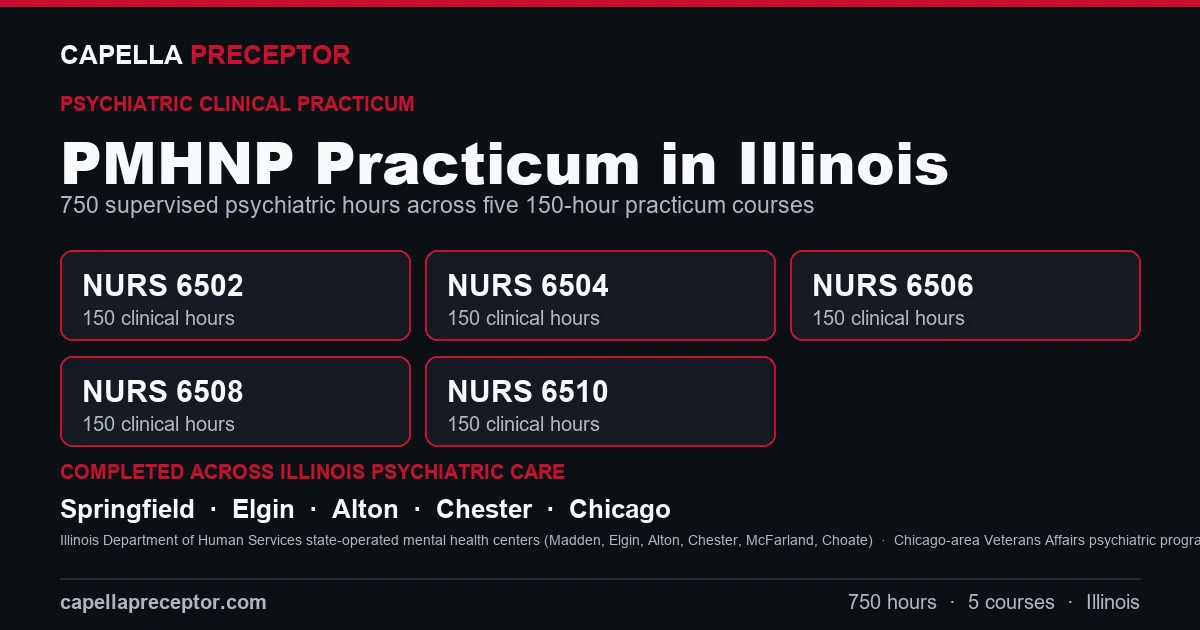
How many psychiatric hours does the Capella PMHNP practicum need in Illinois?
The Capella MSN Psychiatric Mental Health Nurse Practitioner specialization requires a minimum of 750 practicum hours, completed as 150 clinical hours in each of five practicum courses, NURS6502 (Practicum I), NURS6504 (Practicum II), NURS6506 (Practicum III), NURS6508 (Practicum IV), and NURS6510 (Practicum V) (Capella, MSN-PMHNP courses). You take the didactic work online and earn the psychiatric hours in person near where you live in Illinois. That 750-hour figure is the same in Springfield as it is in San Francisco; Illinois is not where the number changes. Illinois is where three other things change: who is allowed to precept you, what they can prescribe in front of you, and how long the hunt for a willing psychiatric provider takes. Those three are the substance of this page.
It also helps to see how far a PMHNP placement sits from the FNP one many Illinois students assume it resembles. FNP is six 125-hour courses spent in primary care; PMHNP is five 150-hour courses spent in psychiatry and behavioral health, signed off by a board-certified PMHNP or a psychiatrist rather than a family-practice clinician. Same state, same school, two entirely different clinical worlds. The broader Capella PMHNP page carries the full course-by-course detail, and the Illinois placement page covers the board rules across every NP specialty. This page narrows both down to the search you actually ran: getting a PMHNP preceptor in Illinois.
What does Illinois reduced practice authority mean for a psychiatric preceptorship?
The American Association of Nurse Practitioners classifies Illinois as a reduced practice state (AANP, State Practice Environment). In Illinois that limit takes the form of a written collaborative agreement: by default an advanced practice registered nurse practices under an agreement with a collaborating physician that defines the categories of care provided, rather than fully on their own (IDFPR, Nursing). Illinois does have a route to independence. Since rules that took effect in 2019, an APRN can apply to IDFPR for full practice authority after at least 4,000 hours of clinical experience and at least 250 hours of continuing education or training beyond initial national certification (68 Ill. Admin. Code 1300.465).
In primary care that collaborative-agreement rule is mostly paperwork. In psychiatry it touches the core of the job, because prescribing is most of what a PMHNP does, and the agreement shapes what your preceptor can put on a prescription pad. So your Illinois psychiatric preceptor is typically a seasoned PMHNP who either practices under a collaborative agreement or has earned full practice authority, or a psychiatrist whose scope already covers everything you need to observe. The benefit to you is that the supervision is already structured: from your first day you watch a psychiatric NP make medication decisions inside the exact legal frame Illinois imposes. We verify which arrangement a preceptor holds before the site reaches your file, so the reduced-practice rule never resurfaces as a mid-term approval problem.
How does Illinois controlled-substance prescribing shape a PMHNP placement?
A psychiatric panel is, in large part, a list of controlled prescriptions, which is why the Illinois rules below are not background detail but the daily texture of your rotation. Illinois happens to apply its tightest controls to the very drug classes a PMHNP reaches for most, and exactly what your preceptor can do turns on whether they hold full practice authority or still practice under a collaborative agreement:
- Schedule II stimulants (ADHD medication). An Illinois APRN with full practice authority may prescribe Schedule II controlled substances, including the stimulants used for ADHD, but only within a written physician consultation relationship recorded in the Illinois Prescription Monitoring Program, not a formal collaborative agreement (68 Ill. Admin. Code 1300.465). An APRN still under a collaborative agreement prescribes Schedule II drugs only as delegated by the collaborating physician, limited to a 30-day supply with any continuation requiring prior physician approval. You will see this protocol-driven workflow in any Illinois psychiatric clinic that manages stimulants.
- Benzodiazepines. Illinois carves out benzodiazepines specifically. Since January 1, 2024, an APRN with full practice authority may prescribe up to a 120-day supply of benzodiazepines without a consultation relationship; continued prescribing beyond that requires a physician consultation (Illinois APRN controlled-substance prescribing summary). For a PMHNP managing anxiety and sleep disorders, this is a rule you will work inside directly.
- Buprenorphine and medication for opioid use disorder. The federal X-waiver was eliminated in 2023, so a clinician with a DEA registration that includes Schedule III authority may now prescribe buprenorphine for opioid use disorder with no patient cap, where state law permits (SAMHSA, MAT Act waiver elimination). In Illinois behavioral health, opioid and other substance use sits alongside the primary psychiatric diagnosis far more often than not, so a preceptor who treats it gives you medication-assisted treatment reps you cannot get any other way.
Why does this belong on a placement page? Because the ANCC PMHNP board exam, and the practice you step into after it, both presume you have managed real psychopharmacology, not just read about it. A preceptor who is actively titrating stimulants, mood stabilizers, antipsychotics, controlled sedatives, and buprenorphine under the Illinois rules above is the difference between a credential and a clinician. It is one of the things we weigh when we match you.
Can PMHNP practicum hours in Illinois be done by telepsychiatry?
Part of the sequence, frequently a sizeable part, but rarely the entire 750 hours. Illinois leans permissive on behavioral-health telehealth. The Illinois Telehealth Act (225 ILCS 150) tells clinicians to hold video care to the same standard as a face-to-face visit and names advanced practice registered nurses among the providers permitted to use it (Illinois Telehealth Act, 225 ILCS 150). Capella names telepsychiatry directly in its Practicum III description (Capella, MSN-PMHNP courses), which fits the reality that intake interviews, med checks, and talk therapy carry over to a screen more cleanly than most clinical work.
None of that turns the practicum fully remote. An Illinois wrinkle worth filing away: the state's Medicaid telepsychiatry provision (89 Ill. Adm. Code 140.403) reserves the narrow telepsychiatry distant-site slot for a physician who finished an accredited psychiatry residency, so when an APRN delivers your supervised hours by video it falls under the wider telehealth rules, not that specific category. Either way your faculty has the final word: the share of each course that may be telehealth is set by your course requirements and what your preceptor genuinely does. Where this helps in Illinois is geography. Across the southern, western, and central counties that the state itself flags as the most under-served, an Illinois-licensed telepsychiatry preceptor can keep your clock running when no in-person psychiatric site is within reach. Always check the per-course allowance in your instructions before you count on finishing a practicum from home.
Where do PMHNP students actually complete psychiatric hours in Illinois?
Your hours have to land in genuine behavioral and mental-health practice, signed off by a credentialed psychiatric provider; a primary-care clinic does not qualify no matter how busy it is. Illinois is unusually deep in qualifying sites, and each one tends to own a different slice of the lifespan and acuity range the five practicums ask you to cover:
Illinois's certified community behavioral-health clinics and community mental health centers, concentrated across Cook, DuPage, and Lake counties, carry high volumes of serious mental illness and co-occurring substance use, ideal for breadth across the lifespan.
The seven Illinois Department of Human Services mental health centers, including Madden in Cook County, Elgin, Alton, Chester, McFarland near Springfield, and Choate, expose you to acute and forensic inpatient psychiatry and inpatient psychopharmacology.
Youth and family psychiatry clinics handle the pediatric end of the lifespan, the piece the PMHNP sequence insists on and the piece an adult-only practice simply cannot give you.
Opioid treatment programs and substance-use clinics, where buprenorphine inductions and co-occurring care fill the schedule, are the most direct route to the MAT and dual-diagnosis hours your training expects.
Video-based psychiatric practices holding an Illinois license can serve as a primary placement and, just as usefully, reach the downstate counties where an in-person psychiatric preceptor is hard to find at all.
Consult-liaison and outpatient psychiatry teams inside Illinois hospital systems, plus the Chicago-area Veterans Affairs psychiatric programs, put you on a multidisciplinary team managing complex medication regimens.
Wherever you land, nothing counts until the placement clears CORE ELMS: you propose the specific site and preceptor, both the provider's credential and the setting are reviewed, and a signed affiliation agreement between Capella and the Illinois site is executed before your first logged hour. The big Illinois health systems and the state mental health centers push those agreements through their own counsel, which takes time, so the calendar rewards starting months ahead.
Why is finding a PMHNP preceptor in Illinois so hard?
The honest answer is in the numbers, and the numbers are bleak. At the end of 2025 the federal government had designated 228 mental-health Health Professional Shortage Areas in Illinois, those areas were meeting only about 23 percent of their estimated need, and clearing every designation would take roughly 301 more practitioners than the state currently has (KFF, Mental Health Care HPSAs by state). Southern, western, and central Illinois carry the deepest gaps, while Cook, DuPage, and Lake counties absorb the heaviest demand. That shortage is not abstract when you are a student: every nursing and PA program in Illinois is fishing the same shallow pool of psychiatrists and PMHNPs willing to precept, and a large share of them are already full.
And Capella does not fish it for you. Its policy is explicit that "learners are responsible for finding an appropriate preceptor to oversee the practicum experience," with a support team that surfaces site leads rather than handing you a psychiatric preceptor (Capella, MSN-PMHNP overview). In a market this thin, that responsibility is precisely where terms get lost. So we do the fishing: we locate an Illinois-licensed psychiatric preceptor who meets Capella's published requirements, then assemble the placement and submit it for Capella's own review. We are careful never to call a preceptor or site endorsed by the university, since granting that approval is Capella's role alone; ours is to deliver a screened, compliant match and the paperwork to clear it. No service can promise that a given placement will be approved, and we do not.
Verifying an Illinois psychiatric preceptor's license
Nursing licensure in Illinois runs through the Illinois Department of Financial and Professional Regulation (IDFPR) and its Board of Nursing (IDFPR, Nursing). For a PMHNP placement the verification is not just whether a person is licensed. It is whether the license and certification carry psychiatric-mental-health scope, and whether the prescribing arrangement fits the controlled-substance work your courses require.
Before we propose a site, every preceptor's name runs through the IDFPR License Look-Up and, where it applies, Nursys, to confirm an active Illinois license whose scope covers the psychiatric populations you still need. The check is public, so you can repeat it yourself.
Clearing the practicum before your first Illinois psychiatric hour
Securing the preceptor is step one. Capella then runs every placement through its practicum system, CORE ELMS, where you propose the Illinois site and preceptor, get them approved, and log hours for preceptor sign-off. None of your 750 hours count until the clearance is complete.
- Submit the Illinois psychiatric site and preceptor in CORE ELMS for Capella's review and approval.
- Execute an affiliation agreement between Capella and the Illinois clinical site before the practicum starts.
- Clear compliance through a background-check and health-records vendor such as CastleBranch; confirm the current vendor with your program.
- Cover both ends of the lifespan. Confirm one source for adult and older-adult psychiatric hours and a separate option for child and adolescent hours, since one Illinois practice rarely covers both well.
- Log hours per course and have your preceptor approve them, with each of the five courses reaching its 150-hour total.
Illinois PMHNP FAQ
How many hours does the Capella PMHNP practicum require in Illinois?
A minimum of 750 psychiatric practicum hours, completed as 150 clinical hours in each of the five practicum courses (NURS6502, NURS6504, NURS6506, NURS6508, NURS6510 / Practicum I to V), all under an on-site psychiatric-mental-health preceptor at an approved Illinois site. The hour count is set by Capella and does not change by state.
Does an Illinois preceptor's prescribing authority matter for a PMHNP student?
Yes, more than in primary care. Illinois is a reduced-practice state, so by default an APRN prescribes under a written collaborative agreement with a physician. Even an APRN granted full practice authority must keep a physician consultation relationship, recorded in the Illinois Prescription Monitoring Program, to prescribe Schedule II controlled substances such as stimulants and, beyond a 120-day supply, benzodiazepines. Since psychiatry runs on exactly those medications, training under a preceptor who actively manages psychopharmacology gives you the prescribing exposure your certification exam expects.
Can PMHNP practicum hours in Illinois be done by telepsychiatry?
Often a sizeable part of the sequence, but seldom the full 750 hours. The Illinois Telehealth Act holds video care to the same standard as a face-to-face visit and lists APRNs among the providers who may deliver behavioral health this way, and Capella names telepsychiatry inside Practicum III. The exact telehealth share allowed per course is set by your course requirements and what your preceptor actually does, so check it with your faculty before counting on a remote-only practicum.
What psychiatric settings count for PMHNP hours in Illinois?
Behavioral-health settings under a credentialed psychiatric provider: community mental health centers, county and safety-net clinics, inpatient units and the seven state-operated mental health centers, youth and family psychiatry practices, opioid-treatment and substance-use programs, and Illinois-licensed telepsychiatry groups. Each site and preceptor must clear CORE ELMS review before any hour is logged.
Is it hard to find a PMHNP preceptor in Illinois?
It is genuinely hard. As of late 2025 Illinois carried 228 mental-health Health Professional Shortage Area designations with only about 23 percent of need met and roughly 301 more practitioners needed to clear them, so every nursing program in the state competes for the same small pool of psychiatrists and board-certified PMHNPs willing to precept. We carry that search for you and match an Illinois-licensed psychiatric preceptor who meets Capella's published requirements, then submit the placement for Capella's review.
Sources
- Capella University, MSN-PMHNP courses and practicum hours (750 hours, five courses of 150)
- Capella University, MSN-PMHNP overview (students secure their own preceptor)
- AANP, State Practice Environment (Illinois: reduced practice)
- Illinois Department of Financial and Professional Regulation, Nursing
- 68 Ill. Admin. Code 1300.465, Full Practice Authority (4,000 hours, physician consultation for Schedule II)
- Illinois Telehealth Act, 225 ILCS 150 (same standard of care, APRN telehealth)
- SAMHSA, MAT Act waiver elimination (buprenorphine for opioid use disorder)
- KFF, Mental Health Care Health Professional Shortage Areas by state (Illinois figures)
How Capella Preceptor helps PMHNP students in Illinois
Put it together and the shape of the problem is clear: 750 psychiatric hours over five courses, a reduced-practice state where your preceptor holds a physician consultation relationship to write the stimulants and benzodiazepines a psychiatric panel needs, telepsychiatry that helps but does not cover everything, and a willing-preceptor pool drained by one of the country's deepest behavioral-health shortages. Passing the courses was never going to be your bottleneck. Finding a credentialed Illinois psychiatric preceptor whose site will sign an affiliation agreement is, and that single problem is the one we exist to solve.
- An Illinois-licensed psychiatric preceptor who meets Capella's published requirements, matched in 7 days, on site or by telepsychiatry
- Both the adult and the child/adolescent psychiatric rotations lined up across all five practicums
- Every CORE ELMS form and affiliation agreement built and filed for Capella's review, and nothing to pay until you are matched
Get a Capella PMHNP preceptor in Illinois
Free 15-minute consult. No payment until matched. We map your entire Illinois psychiatric practicum plan and the prescribing exposure you need.
Get my free consult →