Home / MSN-PMHNP / PMHNP Preceptor in Indiana
PMHNP · IndianaCapella PMHNP preceptor and psychiatric clinical placement in Indiana
A Capella PMHNP practicum in Indiana requires 750 supervised psychiatric-mental health clinical hours across five practicum courses of 150 hours each, completed under an on-site psychiatric preceptor at an Indiana behavioral-health site. Indiana is a reduced-practice state, which shapes how you will prescribe psychiatric and controlled medications after graduation, and it is one of the harder states to find a psychiatric preceptor in because most of it is a mental-health shortage area. Here is exactly what the hours, board rules, telepsychiatry allowance, and real Indiana settings look like, and how to secure a preceptor who meets Capella's published requirements.
Last updated: June 28, 2026 · Reviewed by the Capella Preceptor placement team
How many psychiatric hours does a Capella PMHNP need in Indiana?
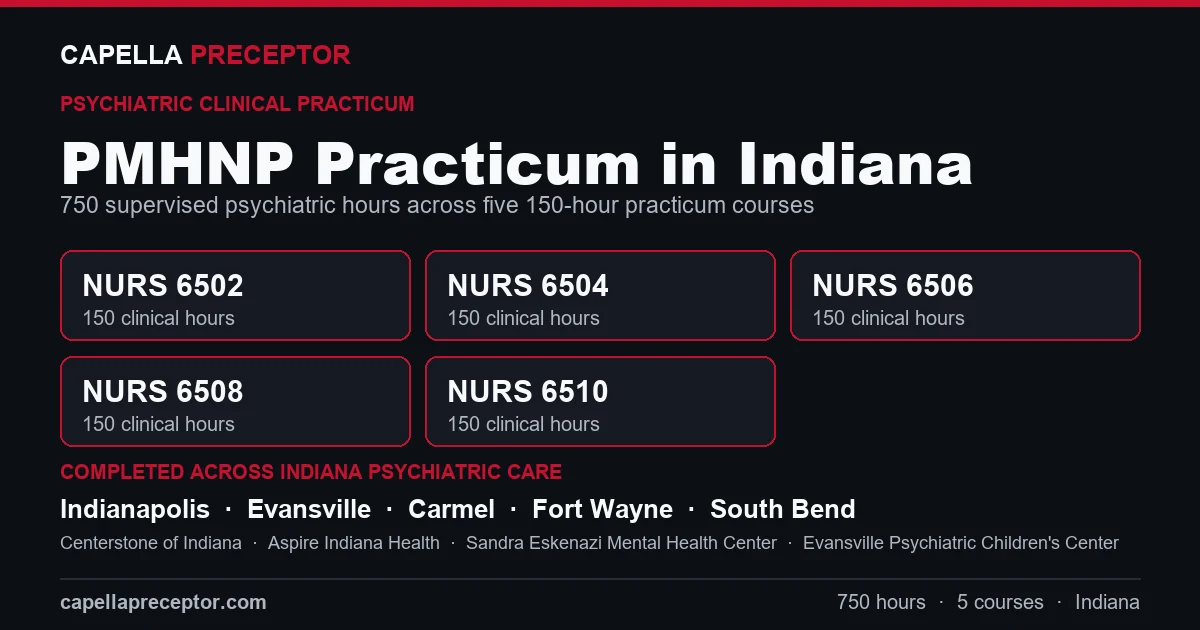
The number does not change at the state line: the Capella MSN Psychiatric Mental Health Nurse Practitioner specialization requires a minimum of 750 practicum hours, completed across five practicum courses, with 150 clinical hours in each (Capella, MSN-PMHNP courses). What changes in Indiana is where those hours can be earned and how scarce a psychiatric preceptor is to supervise them. Unlike a family-practice rotation, every one of these 750 hours has to sit inside behavioral and mental-health care, which is exactly the field Indiana is short of.
The five courses are NURS6502 (Practicum I), NURS6504 (Practicum II), NURS6506 (Practicum III), NURS6508 (Practicum IV), and NURS6510 (Practicum V). PMHNP is a lifespan specialty, so the sequence deliberately moves you across adult, older-adult, child, and adolescent psychiatry. That lifespan split is the single biggest reason Indiana students need to plan early: one Indiana practice rarely covers both ends of the age range, and child and adolescent psychiatry is the thinnest part of the state's already thin psychiatric workforce.
For the hour totals across every Capella track, see the full hours breakdown. For the program detail behind the five courses, see the Capella PMHNP page. This page is about doing those 750 hours specifically in Indiana.
Why is a PMHNP preceptor so hard to find in Indiana?
Be honest with yourself about this up front, because it is the part that derails Indiana PMHNP students. Most of Indiana is a federally designated Mental Health Professional Shortage Area, and the Bowen Center for Health Workforce Research and Policy maps large stretches of the state as falling below the population-per-psychiatrist ratios that trigger shortage status (Bowen Center, Mental Health HPSA StopLight; KFF, Mental Health HPSAs). The same shortage that leaves Hoosier patients waiting weeks for a psychiatric appointment is the shortage that leaves you without a preceptor.
Three things make it tougher for an online PMHNP student specifically. First, the few established psychiatric prescribers are usually already precepting students from in-state nursing programs, so a cold email from an out-of-network online student rarely jumps the line. Second, the child and adolescent psychiatry hours that Practicum II demands are the scarcest of all; even in Indianapolis the wait for a pediatric psychiatric provider is long. Third, the rural counties downstate may have no psychiatric prescriber within an hour's drive, which pushes students toward telepsychiatry to stay on schedule. The IU-led mental-health workforce playbook names psychiatric-mental health APRNs as one of the roles Indiana most needs to grow, which is the demand side of the same gap you feel as a student (IU News, Indiana behavioral-health workforce playbook).
Which Indiana settings count for PMHNP hours?
Your 750 hours must be earned in behavioral and mental-health practice, not general primary care, and Indiana has a defined map of where that care happens. Indiana's Division of Mental Health and Addiction (DMHA) certifies 24 community mental health centers across the state and runs the state psychiatric hospital network, and these are the settings PMHNP students most often rotate through when a credentialed psychiatric provider is on staff to supervise (Indiana DMHA, community mental health centers).
- Community mental health centers, Indiana's backbone for outpatient psychiatry. Real statewide and regional systems include Centerstone of Indiana, Aspire Indiana Health out of Carmel, Meridian Health Services, and LifeSpring Health Systems.
- State psychiatric hospitals, for inpatient adult hours: Logansport, Madison, Richmond, and Evansville State Hospital, plus the NeuroDiagnostic Institute in Indianapolis (Indiana DMHA, state psychiatric hospital network).
- Child and adolescent psychiatry, for the Practicum II population. The Evansville Psychiatric Children's Center is the state's dedicated children's psychiatric hospital, and several CMHCs run youth behavioral-health teams.
- Addiction and opioid-treatment programs, where co-occurring substance use is treated. Indianapolis sites such as Sandra Eskenazi Mental Health Center run medication-assisted treatment with buprenorphine and methadone alongside psychiatric care.
- Telepsychiatry groups, which Indiana fully licenses APRNs to practice in and which keep rural students moving when no local prescriber is reachable.
In every one of these, the supervising provider must hold an active Indiana license with the scope to oversee psychiatric care, typically a board-certified PMHNP or a psychiatrist. Your site and preceptor are proposed for Capella's review before a single hour counts, so both the credential and the setting have to clear that review first.
What does Indiana's reduced-practice status mean for a psychiatric NP?
The American Association of Nurse Practitioners classifies Indiana as a reduced practice state (AANP, State Practice Environment). For a psychiatric NP that has a sharper edge than it does for primary care, because so much of psychiatric treatment is medication, and a large share of psychiatric medication is controlled. Under the Indiana State Board of Nursing's rules, an NP with prescriptive authority keeps a written collaborative practice agreement with a licensed practitioner, and that practitioner reviews a sample of charts where medications were prescribed, specifically 5 percent of those charts within seven days of the visit (Indiana Administrative Code, Title 848, Article 5).
Indiana does grant NPs the authority to prescribe Schedule II to V controlled substances inside that collaborative arrangement, which for a PMHNP is the heart of practice: Schedule II stimulants like methylphenidate and amphetamine salts for ADHD, the Schedule IV benzodiazepines used in anxiety and acute agitation, and Schedule III buprenorphine for co-occurring opioid use disorder. Two Indiana-specific points matter for psychiatric prescribing. Before prescribing a stimulant to a child for ADHD, an Indiana APRN must follow the current American Academy of Pediatrics or American Academy of Child and Adolescent Psychiatry guidelines, a rule written directly into Indiana code (Indiana Code 25-1-9-6.8). And to prescribe controlled substances at all, the NP needs an Indiana controlled-substance registration plus a federal DEA registration.
What this means during school: the collaborative agreement and prescribing registrations apply once you are a licensed, practicing PMHNP, not during the practicum. As a student you prescribe only under your supervising preceptor's authority and Indiana's student rules. So the reduced-practice rule shapes your Indiana career more than your rotation. It is still worth understanding now, because choosing a preceptor who actively manages controlled psychiatric medications, ADHD stimulants, benzodiazepines, and buprenorphine, gives you exposure to the exact prescribing reality you will step into after graduation.
Can PMHNP hours be done by telepsychiatry in Indiana?
Partly, and Indiana is friendlier to this than many states. Indiana licenses APRNs, including psychiatric NPs, to deliver mental-health care by telehealth, and Capella names telepsychiatry inside its Practicum III experience (Capella, MSN-PMHNP courses). Because intake interviews, medication management, and much of psychotherapy are routinely delivered by video in real Indiana practice, a portion of your hours can legitimately be earned remotely under a qualified preceptor. For students in rural counties with no nearby psychiatric prescriber, that telepsychiatry route is often what keeps the practicum on schedule.
It is not a blank check, and two Indiana rules are worth knowing. For behavioral-health services billed through Indiana Medicaid, the telehealth modality has to be reviewed for appropriateness, and the program expects at least one in-person session with a member of the treatment team roughly every 90 days, so a fully remote model is not the assumption even in real practice. And the amount of telehealth that counts toward your specific practicum hours depends on your course requirements and your preceptor's practice. Confirm the current telehealth allowance for each course against your Capella course instructions before assuming a whole practicum can be remote.
How do I get an Indiana PMHNP placement approved?
Once you have a psychiatric preceptor and a site, there is a clearance process before any hour counts, and it runs through Capella's practicum-management system, which we track in our workflow as CORE ELMS. The steps are the same whether you rotate in Indianapolis or a small town downstate:
- Propose your Indiana site and psychiatric preceptor in CORE ELMS, where Capella reviews and approves the placement before you begin.
- Verify the preceptor's Indiana license against the state system at mylicense.in.gov, so you are not logging hours under a credential that will not hold up at review.
- Execute a signed affiliation agreement between Capella and your Indiana psychiatric site before practicum starts. State hospitals and large CMHCs can take weeks to sign one, so start early.
- Clear compliance through a background check and health-records vendor such as CastleBranch. Psychiatric and state-hospital sites often add their own onboarding on top.
- Log hours as you go and have your preceptor approve them in CORE ELMS, course by course, until each of the five reaches its 150-hour total.
Note the honest framing throughout: we match a preceptor who meets Capella's published requirements and submit the placement for Capella's own review. No service can label a preceptor endorsed in advance, and no service can guarantee that Capella will clear any given placement. The decision to approve a placement is always Capella's.
Where in Indiana do you place PMHNP students?
Capella leaves the preceptor search to you. The university states learners are responsible for finding an appropriate preceptor, and the practicum is completed in your own community (Capella, MSN-NP program). We carry verified psychiatric preceptor relationships across Indiana so you are not starting from a blank page:
- Indianapolis and the metro, including Carmel and Fishers, where most of Indiana's outpatient psychiatry, community mental health, and addiction-treatment volume sits.
- Fort Wayne, Evansville, and South Bend, the regional hubs with behavioral-health systems and, near Evansville, the state's adult and children's psychiatric hospitals.
- Bloomington, Lafayette, Logansport, Madison, and the rural counties, where local psychiatric options thin out and a verified telepsychiatry preceptor often keeps you on schedule.
For the broader picture of Indiana board rules and license verification across every NP track, see our Capella preceptor in Indiana page. This page narrows that to the psychiatric reality PMHNP students actually face here.
PMHNP in Indiana FAQ
How many psychiatric hours does a Capella PMHNP need in Indiana?
A minimum of 750 supervised psychiatric-mental health practicum hours, completed as 150 clinical hours in each of the five practicum courses (NURS6502, NURS6504, NURS6506, NURS6508, NURS6510), all earned in Indiana behavioral-health settings under an on-site psychiatric preceptor. The hour count is the same in every state; what changes in Indiana is the supply of psychiatric preceptors and the board rules around prescribing.
Can PMHNP practicum hours be done by telepsychiatry in Indiana?
Indiana licenses APRNs to deliver psychiatric care by telehealth, and Capella names telepsychiatry inside its Practicum III experience, so some hours can be earned remotely with a qualified preceptor. The share that counts toward your hours depends on your course requirements, your preceptor's practice, and Indiana's supervision and telehealth rules, so confirm the current allowance against your course instructions rather than assuming all 750 hours can be remote.
Does Indiana's collaborative agreement rule affect my PMHNP practicum?
Not your hours directly. Indiana is a reduced-practice state, so a licensed NP with prescriptive authority keeps a written collaborative agreement under which 5 percent of charts where a medication was prescribed are reviewed within seven days. That governs prescribing once you are a credentialed PMHNP. During the practicum you work under a supervising psychiatric preceptor, and what matters for hours is a preceptor who meets Capella's published requirements and a placement submitted for Capella's review in CORE ELMS.
Where do PMHNP students complete psychiatric hours in Indiana?
Indiana behavioral-health settings: the state's certified community mental health centers such as Centerstone of Indiana, Aspire Indiana Health, and Sandra Eskenazi Mental Health Center; the state psychiatric hospital network including Logansport, Madison, Richmond, Evansville State Hospital, the Evansville Psychiatric Children's Center, and the NeuroDiagnostic Institute in Indianapolis; opioid and substance-use treatment programs; and telepsychiatry groups, each supervised by an appropriately credentialed psychiatric provider.
Is it hard to find a PMHNP preceptor in Indiana?
Yes. Most of Indiana is a federally designated Mental Health Professional Shortage Area, the same shortage that makes psychiatric preceptors scarce. Established psychiatric providers are often already committed to students from in-state programs, and child and adolescent psychiatry is the tightest segment of all. That is why we carry verified psychiatric preceptor relationships across Indiana rather than leaving you to cold-email clinics.
Sources
- Capella University, MSN-PMHNP courses (750 hours, five 150-hour practicums, telepsychiatry)
- Capella University, MSN-NP program (student secures the preceptor, local practicum)
- AANP, State Practice Environment (Indiana reduced practice)
- Indiana Administrative Code, Title 848, Article 5 (prescriptive authority, 5 percent chart review)
- Indiana Code 25-1-9-6.8 (stimulant prescribing guidelines for children)
- Indiana DMHA, state psychiatric hospital network
- Indiana DMHA, community mental health centers
- Bowen Center for Health Workforce Research and Policy, Mental Health HPSA map
How Capella Preceptor helps PMHNP students in Indiana
You have the picture now: 750 psychiatric hours across five courses, a reduced-practice state that shapes how you will prescribe controlled psychiatric medications, a telepsychiatry route that helps but is not unlimited, and a real psychiatric preceptor shortage that hits the child and adolescent hours hardest. That shortage is exactly where Indiana PMHNP students lose terms. We close it, securing a verified, Indiana-licensed psychiatric preceptor who meets Capella's published requirements and whose setting fits your course, then preparing the CORE ELMS proposal and affiliation agreement for Capella's review and keeping your hours logged on schedule.
- Verified Indiana psychiatric preceptor matched in 7 days, no payment until matched
- Adult and the scarce child/adolescent psychiatric rotations both covered
- In-person across the metros or telepsychiatry for rural counties, statewide
Get a Capella PMHNP preceptor in Indiana
Free 15-minute consult. No payment until matched. We map your full psychiatric practicum plan, adult through child and adolescent.
Get my free consult →