Home / MSN-PMHNP / PMHNP Preceptor in Kansas
Specialty + StateCapella PMHNP preceptor in Kansas
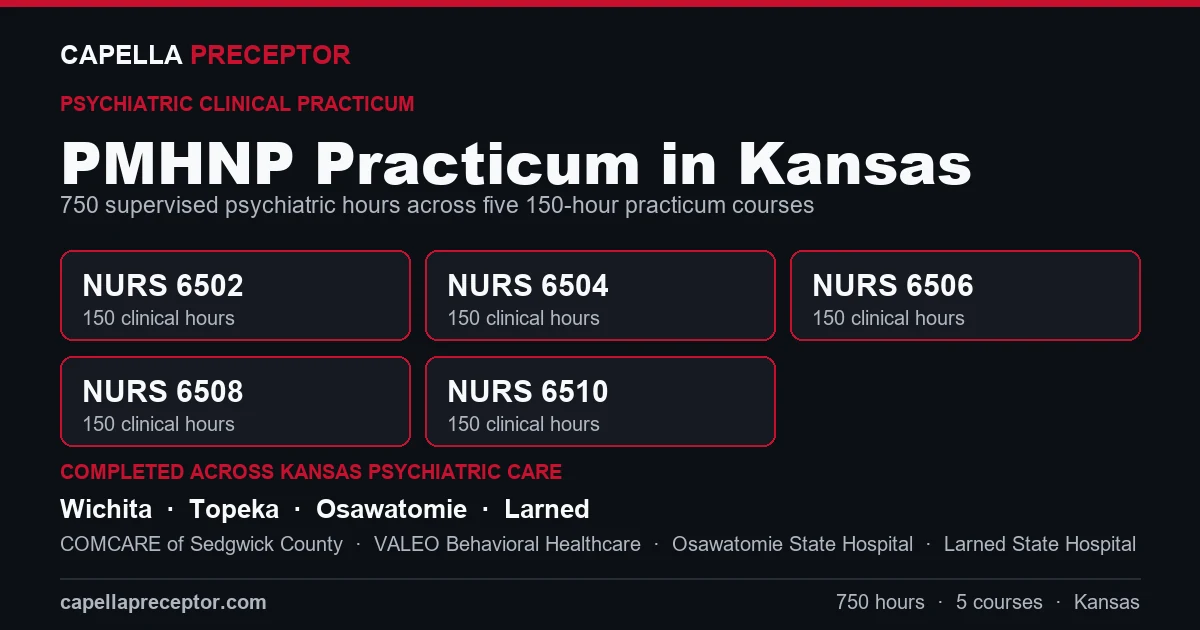
A Capella PMHNP practicum in Kansas requires 750 supervised psychiatric clinical hours across five practicum courses of 150 hours each, completed under an on-site psychiatric-mental-health preceptor at an approved Kansas behavioral-health site. Kansas grants nurse practitioners full practice authority, so a licensed Kansas PMHNP can prescribe controlled psychiatric medications independently, but Capella still expects you to secure your own preceptor and submit the placement for review. This page covers the Kansas board rules, the prescribing reality, the real psychiatric settings here, and how to find a psych preceptor in a state with a genuine shortage.
Last updated: June 28, 2026 · Reviewed by the Capella Preceptor placement team
What does the Capella PMHNP practicum require in Kansas?
The Capella MSN Psychiatric Mental Health Nurse Practitioner specialization requires a minimum of 750 practicum hours, completed as 150 clinical hours in each of five practicum courses, NURS6502 Practicum I, NURS6504 Practicum II, NURS6506 Practicum III, NURS6508 Practicum IV, and NURS6510 Practicum V (Capella, MSN-PMHNP courses). The coursework is online; the psychiatric practicum is completed in person, in your own community, under an on-site preceptor. None of that changes because you live in Kansas. What changes is the regulatory backdrop you train into and the specific psychiatric settings within reach, and both of those are worth understanding before you start calling clinics.
Note that this is a psychiatric practicum, not primary care. The PMHNP five-course, 150-hour structure is different from the Capella FNP track, which spreads its 750 hours across six 125-hour primary-care courses. An FNP placement in Kansas lands you in family medicine; a PMHNP placement has to land you in behavioral health, which is a smaller and busier pool in this state. For the program mechanics that apply nationwide, see the broader Capella PMHNP page; for placement geography across the state, see the Kansas page. This page is where the two meet.
What does Kansas full practice authority mean for a psych preceptor?
The American Association of Nurse Practitioners classifies Kansas as a full practice authority state (AANP, State Practice Environment). Kansas reached this status when Governor Laura Kelly signed Senate Substitute for House Bill 2279, effective July 1, 2022, which amended K.S.A. 65-1130 to remove physician supervision, collaboration, and the "responsible physician" concept from the statute (Foulston Siefkin, Bill Authorizing Independent Practice for APRNs; AANP, Kansas Law Strengthens Patient Access to Health Care).
For psychiatric training specifically, the practical effect is this: a board-certified PMHNP in Kansas can run an independent psychiatric panel without a physician on the chart. That widens the supervisor pool. Many of the clinicians who can precept you are PMHNP-owned or PMHNP-led practices, telepsychiatry groups, and community mental health centers staffed by independent APRNs, not only psychiatrist-supervised practices. Because the supervising APRN does not need a collaborative agreement of their own, the affiliation agreement between Capella and a Kansas psychiatric site can sometimes execute faster than in a state that still layers physician oversight on top. None of this relaxes Capella's rule that your preceptor and site clear review before any hour counts.
Who regulates PMHNP practice and preceptors in Kansas?
Advanced practice nursing in Kansas is regulated by the Kansas State Board of Nursing (KSBN) in Topeka (Kansas State Board of Nursing). When you propose a psychiatric preceptor, both Capella and our team confirm the clinician holds a current, unencumbered Kansas APRN license in the psychiatric-mental-health role, and you can verify any license yourself through the Board's portal (KSBN, License Status Verification). For PMHNP work, the credential that matters is psychiatric scope: a PMHNP-BC or a psychiatrist, not a primary-care provider, because the hours have to be earned in mental-health practice.
One Kansas nuance to keep separate from your student practicum: a newly licensed Kansas APRN must complete a transition-to-practice period, and that rule governs your own future independent practice, not the hours you log as a Capella student. While you are a student, your supervising preceptor signs every clinical decision; the Kansas transition rule is something you plan for after you graduate and seek your own license.
Can a Kansas PMHNP preceptor prescribe controlled psychiatric medications?
Yes, and for a psychiatric practicum this matters more than it does for primary care, because so much of psychiatric prescribing is controlled. In Kansas, an APRN who holds a license with prescriptive authority may prescribe Schedule II through V controlled substances once they register with the federal Drug Enforcement Administration and meet DEA requirements (KSBN Update, April 2022). Since the 2022 statute change, that authority no longer requires a written protocol with a physician (Foulston Siefkin, APRN independent practice).
In a real Kansas psychiatric panel that means a DEA-registered PMHNP preceptor can manage the controlled medications you most need to see handled: Schedule II stimulants for ADHD, benzodiazepines for acute anxiety and certain other indications, and buprenorphine for opioid use disorder and co-occurring psychiatric conditions. You do not prescribe as a student; you do not hold prescriptive authority and your preceptor signs every order. But training under a preceptor who independently carries that authority lets you watch the full prescribing and monitoring workflow, including the federal and state prescription-monitoring steps, that you will own after you are licensed. A preceptor whose practice never touches controlled substances leaves a real gap in psychiatric training, so it is a fair question to ask when you evaluate a site.
Can Kansas PMHNP hours be done by telepsychiatry?
Partly, and Kansas is a reasonable place for it. Kansas law lets telemedicine establish a valid provider-patient relationship, and it applies the same prescribing rules to telemedicine that it applies to in-person care, including for controlled substances (Center for Connected Health Policy, Kansas). Telepsychiatry is well established across the state, in part because the rural west has too few in-person prescribers, so video psychiatric care is genuinely how a lot of Kansans receive treatment. Capella also names telepsychiatry directly within the Practicum III experience (Capella, MSN-PMHNP courses).
That does not make the whole program remote. How many telehealth hours count toward your 750 depends on your specific course requirements, your preceptor's practice, and Capella's rules for supervised psychiatric training. Confirm the current allowance for each practicum against your course instructions before you assume hours can be earned entirely online. For most Kansas students the realistic answer is a blend: in-person hours where clinic density allows, telepsychiatry to stay on pace and to reach the rural counties where in-person sites are sparse.
Where do PMHNP students complete psychiatric hours in Kansas?
Kansas has real psychiatric infrastructure once you know where to look. The hours have to be earned in behavioral and mental-health practice under a credentialed supervisor, and these are the setting types that fit:
Kansas operates a network of community mental health centers across the state (KDADS, Community Mental Health Centers), including COMCARE of Sedgwick County in Wichita and VALEO Behavioral Healthcare in Topeka. These carry broad adult psychiatric caseloads.
Capella's Practicum II focuses on child and adolescent care, so you need a youth psychiatric source. The Family Service and Guidance Center in Topeka is one of the state's dedicated children's behavioral-health providers.
Osawatomie State Hospital serves eastern Kansas and Larned State Hospital serves the western two-thirds of the state, both administered by KDADS (KDADS, State Hospitals). They offer acute inpatient psychiatric exposure.
Substance-use and medication-for-opioid-use-disorder programs, including buprenorphine clinics tied to systems such as the University of Kansas Health System, pair co-occurring psychiatric and addiction care.
Video psychiatric practices serving Kansans statewide, a strong fit for students in Garden City, Dodge City, and the rural counties, where your program allows telehealth hours.
Private and group psychiatric practices in Wichita, the Kansas City metro, Topeka, Lawrence, and Manhattan, where most independent PMHNP-led panels are concentrated.
Because the PMHNP sequence splits between adult and older-adult psychiatry (Practicum I) and child and adolescent psychiatry (Practicum II), most Kansas students need more than one site or preceptor across the five courses. One outpatient panel rarely covers both ends of the lifespan well, so plan for at least two sources early.
How hard is it really to find a PMHNP preceptor in Kansas?
Harder than for a primary-care track, and it is fair to be honest about why. Kansas has a documented behavioral-health and addiction-treatment workforce shortage. A 2025 University of Kansas review found the state lacks widespread access to medication for opioid use disorder, that rural areas face provider recruitment problems and hospital-closure risk, and that even telehealth leaves waitlists because there are not enough providers offering it (The Beacon, Kansas opioid addiction treatment). Psychiatric prescribers in Kansas are carrying full caseloads, and a clinician who is already stretched is the same clinician you are asking to take on a student.
That is the practical wall students hit. The PMHNP-BC who could precept you is busy; the community mental health center has a waitlist of its own; the child-and-adolescent option may be an hour's drive away. Cold-calling psychiatric clinics between shifts, then waiting on an affiliation agreement, is where a term gets lost. That is the specific gap we close in Kansas: we do the outreach, confirm the Kansas license and psychiatric scope, line up the adult and the child or adolescent sources you need, and prepare the placement so paperwork does not push your start date.
What clears before a Kansas PMHNP practicum starts?
Identifying a Kansas psychiatric preceptor is step one. Before any hour counts, Capella runs a clearance workflow that we manage end to end:
- Site and preceptor review. The Kansas psychiatric placement is submitted in Capella's practicum system, CORE ELMS, where Capella reviews and approves the proposed preceptor and site against its published requirements before you begin.
- Affiliation agreement. A signed agreement between Capella and the Kansas behavioral-health site must be in place before practicum begins.
- Background check and health records. Capella requires a background check through CastleBranch, alongside drug screening and immunization records, completed before you are cleared.
- Hour logging. You record hours in CORE ELMS and your Kansas preceptor approves them as you go, until each of the five courses reaches its 150-hour total.
Kansas PMHNP FAQ
Can a Capella PMHNP student in Kansas prescribe controlled psychiatric medications during practicum?
Not on their own. A student does not hold prescriptive authority; the supervising preceptor signs every order. In Kansas, a licensed APRN who holds DEA registration may prescribe Schedule II through V controlled substances independently, which includes the stimulants, benzodiazepines, and buprenorphine common in psychiatric care, so a Kansas PMHNP preceptor can demonstrate the full prescribing workflow you will use after licensure.
Does Kansas full practice authority remove the need for a PMHNP preceptor?
No. Full practice authority describes how a licensed Kansas APRN works after graduation. It does not change Capella's requirement that all 750 psychiatric practicum hours be completed under an on-site, credentialed preceptor whose site and license clear review first.
Can Capella PMHNP practicum hours in Kansas be completed by telepsychiatry?
Partly. Kansas applies the same prescribing rules to telemedicine as to in-person care and telepsychiatry is established across the state, and Capella names telepsychiatry within Practicum III. How many telehealth hours count toward your total depends on your course requirements and your preceptor's practice, so confirm the current allowance against your course instructions rather than assuming all hours can be remote.
Where do Capella PMHNP students complete psychiatric hours in Kansas?
In behavioral-health settings such as the community mental health centers including COMCARE of Sedgwick County in Wichita and VALEO Behavioral Healthcare in Topeka, child and adolescent clinics such as the Family Service and Guidance Center in Topeka, the state psychiatric hospitals in Osawatomie and Larned, telepsychiatry groups, and substance-use and medication-for-opioid-use-disorder programs, each under a credentialed PMHNP or psychiatrist.
Why is a PMHNP preceptor hard to find in Kansas?
Kansas has a documented psychiatric workforce shortage, with rural areas reporting waitlists and too few prescribers, especially for medication for opioid use disorder. The clinicians who could precept are already carrying full caseloads, so a working student calling clinics between shifts often stalls. That is the gap our placement work closes.
Sources
- Capella University, MSN-PMHNP courses and practicum hours
- AANP, State Practice Environment (full practice authority)
- Foulston Siefkin, Bill Authorizing Independent Practice for APRNs (HB 2279, K.S.A. 65-1130)
- Kansas State Board of Nursing, APRN prescriptive authority update
- Center for Connected Health Policy, Kansas telehealth rules
- KDADS, Kansas Community Mental Health Centers
- KDADS, Kansas State Psychiatric Hospitals (Osawatomie and Larned)
- The Beacon, Kansas lacks high-quality opioid addiction treatment (KU study)
How Capella Preceptor helps PMHNP students in Kansas
You now know the terrain: 750 psychiatric hours across five 150-hour courses, a full-practice state where a Kansas PMHNP can prescribe controlled medications independently, a real but stretched set of community mental health centers, state hospitals, and telepsychiatry groups, and Capella leaving the placement to you. We close that last gap. We secure a verified, Kansas-licensed psychiatric preceptor whose scope meets Capella's published requirements, cover the adult and the child or adolescent sources your sequence needs, prepare every CORE ELMS form and affiliation agreement, and submit the placement for Capella's review.
- Verified Kansas psychiatric preceptor, in person or telepsychiatry
- Adult and child or adolescent rotations covered across all five practicums
- Every CORE ELMS form prepared and the placement submitted for Capella's review
- No payment until you are matched
Get a Capella PMHNP preceptor in Kansas
Free 15-minute consult. No payment until matched. We map your entire psychiatric practicum plan, adult and child rotations included.
Get my free consult →