Home / MSN-PMHNP / PMHNP Preceptor in Maryland
PMHNP × MarylandCapella PMHNP preceptor and psychiatric practicum in Maryland
A Capella PMHNP practicum in Maryland requires 750 supervised psychiatric clinical hours across five practicum courses of 150 hours each, completed under an on-site psychiatric-mental-health preceptor at an approved Maryland site. Maryland is a full practice authority state, so a licensed psychiatric NP here diagnoses and prescribes under the sole authority of the Maryland Board of Nursing, with no standing physician collaboration agreement. The hard part is not the law, it is finding a psychiatric preceptor in a state where behavioral-health capacity is thin. This page maps the hours, the Maryland board rules, the controlled-substance and telepsychiatry limits that shape a psych rotation, and the real settings where students earn the time.
Last updated 2026-06-28 · Reviewed by the Capella Preceptor placement team
How many psychiatric hours does a Capella PMHNP practicum need in Maryland?
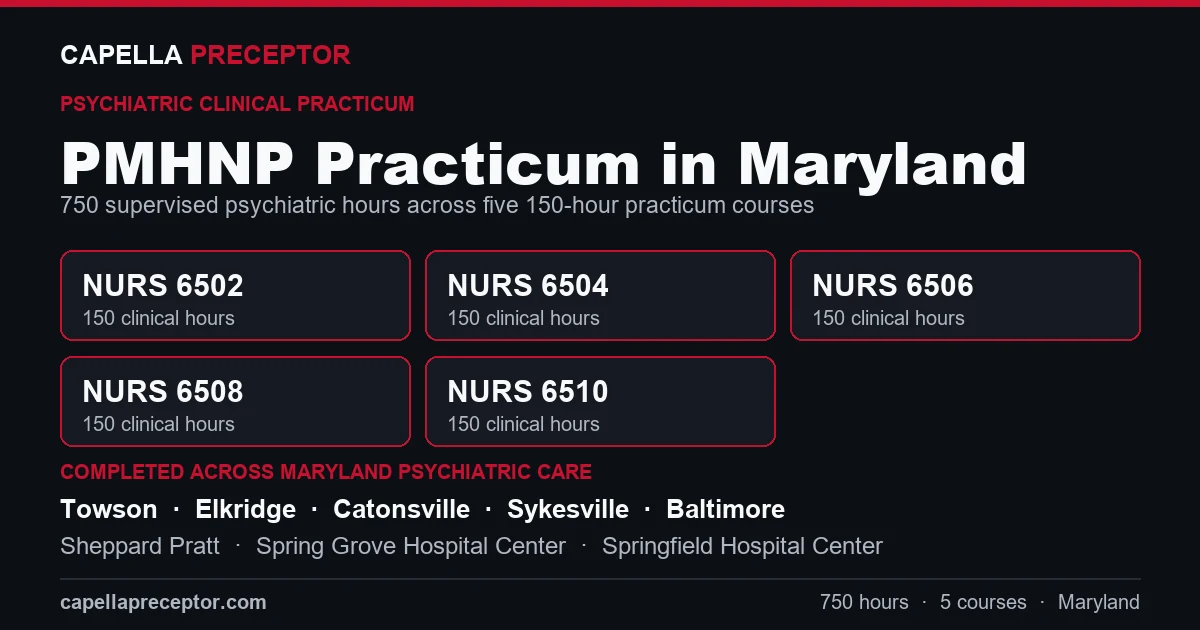
The number is the same everywhere Capella places a PMHNP student, Maryland included: a minimum of 750 practicum hours, completed as 150 clinical hours in each of five practicum courses, all in psychiatric and behavioral-health settings under a qualified on-site preceptor (Capella, MSN-PMHNP courses). The five courses are NURS6502 Practicum I, NURS6504 Practicum II, NURS6506 Practicum III, NURS6508 Practicum IV, and NURS6510 Practicum V. This 5 by 150 structure is specific to PMHNP. It is not the six 125-hour courses Capella uses for the FNP track, which is the difference between earning a psychiatric placement and a primary-care one. If you are weighing the family-practice route instead, see the FNP page; this page is psychiatric all the way through.
PMHNP is a lifespan specialty, so the sequence deliberately spreads your hours across adult, older-adult, child, and adolescent psychiatry. In Maryland that lifespan requirement is the first scheduling problem, because one practice rarely covers both ends well, and a child-and-adolescent psychiatry slot is the scarcer of the two. Plan for more than one site or preceptor across the five courses, and start the search before the practicum quarter opens.
What does Maryland full practice authority mean for a psychiatric NP?
The American Association of Nurse Practitioners lists Maryland in its full practice category, the most autonomous of the three levels (AANP, State Practice Environment). A certified Maryland NP evaluates, diagnoses, orders and interprets tests, and prescribes under the exclusive authority of the Maryland Board of Nursing, with no required physician collaboration agreement (Maryland Board of Nursing, Advanced Practice). For a psychiatric preceptorship that autonomy matters more than it does in primary care, because so much of psychiatric work is medication management. A full practice PMHNP runs the medication plan independently, which is exactly the decision-making a student needs to see modeled hour after hour.
Keep one distinction straight. Full practice authority describes what a licensed NP can do in Maryland. It does not loosen Capella's practicum rules or shorten your 750 hours, and it does not let an unlicensed student prescribe. While you are a Capella learner you observe and practice under a credentialed preceptor; you carry your own authority only after you are certified and licensed. What the Maryland law removes is a friction point, a willing psychiatric preceptor here is not bound to a separate supervision contract just to teach you, so the pool of clinicians who can precept is wider than in a reduced or restricted state.
How does controlled-substance prescribing work for a Maryland psych preceptor?
Psychiatry runs on scheduled drugs in a way primary care does not, so a psychiatric preceptor's prescribing credentials are central to what you will learn. Schedule II stimulants for ADHD, benzodiazepines for anxiety and withdrawal, and buprenorphine for opioid use disorder are everyday psychiatric prescriptions, and each is a controlled substance. In Maryland an NP cannot prescribe any of them on a nursing license alone.
To prescribe controlled substances, a Maryland NP first holds a state Controlled Dangerous Substances (CDS) registration through the Maryland Office of Controlled Substances Administration, and must register with the Maryland Prescription Drug Monitoring Program (PDMP) before that CDS is issued. The federal DEA number comes after the state CDS, using the state registration number (Maryland Office of Controlled Substances Administration). Maryland also requires a one-time two-hour training on prescribing and dispensing controlled substances tied to the CDS, and under a federal rule every DEA registrant completes a one-time eight-hour training on treating patients with opioid or substance use disorders before the first DEA renewal (DEA, MATE Act training requirement). For your practicum, this means a preceptor who actively manages psychiatric medications carries this full stack of credentials, and the value of the rotation is watching how they prescribe within it. You do not prescribe as a student; you learn the workflow you will own once you are licensed and registered yourself.
Can Maryland PMHNP hours be done by telepsychiatry?
Partly, and Maryland is friendlier to telepsychiatry than many states. Maryland made audio-only and video telehealth a permanent part of practice under the Preserve Telehealth Access Act of 2025, removing the pandemic-era expiration dates (Center for Connected Health Policy, Maryland telehealth laws). Capella names telepsychiatry directly inside the Practicum III experience, so supervised telepsych work can count toward your hours (Capella, MSN-PMHNP courses).
The limit is the controlled-substance piece, and it is where Maryland is stricter than the federal flexibilities. The federal DEA telemedicine flexibilities for controlled substances were extended through the end of 2026, but Maryland layers its own conditions: prescribing Schedule II psychiatric medications by telehealth generally requires an established treatment relationship and an appropriate in-person assessment, and there are narrower rules for opioids prescribed for pain (HHS, prescribing controlled substances via telehealth). For opioid use disorder there is more room: federal rules effective in 2025 let authorized practitioners start buprenorphine by telehealth, including audio-only, under set conditions, which is why a Maryland telepsych or addiction practice can be a genuine rotation site. The practical takeaway for a student is simple. Some of your 750 hours can be telepsychiatry, but the exact share depends on your course instructions and your preceptor's own practice, so confirm the current allowance for each practicum rather than assuming the whole program is remote.
Where do Capella PMHNP students complete psychiatric hours in Maryland?
Maryland packs a deep behavioral-health system into a small geography, and approved settings for PMHNP hours are real and specific. They have to be staffed by an appropriately credentialed supervising provider, a board-certified PMHNP or a psychiatrist, and the site and credential clear review before hours begin.
Sheppard Pratt in Towson and Elkridge, which runs an established PMHNP and DNP preceptorship across adult, child and adolescent, geriatric, eating-disorder, and co-occurring units, plus the state hospitals Spring Grove (Catonsville) and Springfield (Sykesville).
Outpatient psychiatry and community behavioral-health clinics across Baltimore City, Montgomery, Prince George's, Howard, and Anne Arundel counties, the deepest pool of medication-management hours.
Addiction and MOUD clinics where buprenorphine and co-occurring care are the work, a strong fit for the substance-use focus the PMHNP sequence expects.
Maryland-licensed telepsych and addiction practices, useful for the Eastern Shore and Western Maryland where in-person psychiatric sites are scarce, within the telehealth limits above.
State psychiatric facilities such as Spring Grove and Springfield train hundreds of mental-health professionals a year and add forensic and high-acuity exposure that an outpatient clinic cannot (Maryland Behavioral Health Administration, state psychiatric facilities). A named program such as the Sheppard Pratt PMHNP preceptorship also shows what these sites require of a student: enrollment in an accredited PMHNP program at an institution that already holds an affiliation agreement with the site, an active Maryland or compact RN license, and prior psychiatric nursing experience (Sheppard Pratt, PMHNP/DNP preceptorship). The affiliation-agreement requirement is the quiet blocker, because a site cannot take you until Capella and the site have a signed agreement in place.
Why is a PMHNP preceptor so hard to find in Maryland?
Honestly, because there are not enough psychiatric preceptors to go around, and the shortage is sharper than in primary care. PMHNP enrollment has grown faster than any other NP specialty, while the clinical-training pipeline has not kept pace, and many psychiatric providers have cut back on teaching under workload and burnout pressure (NPHub, why PMHNP preceptors are hard to find). Capacity is also uneven across Maryland: it is far heavier around Baltimore and the Washington suburbs than on the Eastern Shore or in Western Maryland, so a student in Salisbury or Cumberland competes for a much thinner pool than one in Towson. Because Capella, like its peers, makes the learner responsible for securing the preceptor, that search lands entirely on you (Capella, MSN-NP program).
The realistic timeline reflects that. Students who start six to nine months ahead and work multiple channels at once secure psychiatric placements far faster than those who cold-email one clinic at a time. The recurring failure mode is waiting until the practicum quarter is close, then discovering the practices with open capacity are nowhere near home. Start early, line up the child and adolescent rotation separately, and verify your preceptor's Maryland psychiatric credential before you submit the proposal.
What Capella requires before your Maryland psychiatric hours count
Securing the psychiatric preceptor is step one. Before a single Maryland hour is recorded, Capella runs an approval workflow, and skipping any part means hours that do not count.
- Propose the psychiatric site and preceptor in Capella's practicum system, CORE ELMS, with the preceptor's Maryland credential, so faculty can approve the placement.
- Get an affiliation agreement signed between Capella and the Maryland psychiatric site before practicum begins, the document that legally permits you to train there.
- Clear compliance through CastleBranch, the background check, drug screen, and health records, then add anything the individual behavioral-health site requires.
- Log and submit hours in CORE ELMS, where your preceptor approves each entry, until every one of the five courses reaches its 150-hour total.
We confirm a preceptor's active Maryland credential before we present them, and you can check any RN license or NP certificate yourself through the board's public lookup (Maryland Board of Nursing, license verification). For the program-wide picture of the practicum and the portal, see the broader PMHNP page; for everything that applies to placement across the state regardless of specialty, see the Maryland page.
Maryland PMHNP FAQ
How many psychiatric hours does a Capella PMHNP practicum need in Maryland?
A minimum of 750 supervised psychiatric clinical hours, completed as 150 hours in each of five practicum courses (NURS6502, NURS6504, NURS6506, NURS6508, NURS6510), under an on-site psychiatric-mental-health preceptor at an approved Maryland site. Maryland's full practice authority does not change the hour count; Capella sets the hours, the Maryland Board of Nursing sets the practice rules.
Can Maryland PMHNP practicum hours be done by telehealth?
Some can. Maryland made audio-only and video telehealth permanent under the Preserve Telehealth Access Act of 2025, and Capella names telepsychiatry inside Practicum III, so supervised telepsych can count. The share that counts depends on your course instructions and your preceptor's practice, and Maryland's controlled-substance telehealth limits still apply, so confirm the current allowance for each practicum rather than assuming all 750 hours can be remote.
Does a Maryland PMHNP preceptor prescribe controlled psychiatric medications?
Often, yes. To prescribe scheduled psychiatric medications such as stimulants for ADHD, benzodiazepines, or buprenorphine for opioid use disorder, a Maryland NP holds a state Controlled Dangerous Substances registration through the Office of Controlled Substances Administration plus a federal DEA number, and must be enrolled in the Maryland PDMP. Your hours are supervised by that preceptor; you prescribe under your own authority only after you are licensed and registered.
Where do Capella PMHNP students complete psychiatric hours in Maryland?
At approved behavioral-health settings: outpatient psychiatry and community mental health centers, inpatient psychiatric hospitals such as Sheppard Pratt, Spring Grove Hospital Center, and Springfield Hospital Center, child and adolescent psychiatry practices, substance-use and opioid-treatment programs, and telepsychiatry groups. The setting and the preceptor's credential are proposed and approved before hours begin.
Why is a PMHNP preceptor so hard to find in Maryland?
Psychiatric preceptor supply is tight and PMHNP enrollment has grown faster than the clinical pipeline. Capacity is thin and uneven across the state, far heavier around Baltimore and the Washington suburbs than on the Eastern Shore or in Western Maryland, so students often spend months contacting practices. That is the gap we close with a vetted Maryland psychiatric match.
Sources
- Capella University, MSN-PMHNP courses (750 hours, five 150-hour practicums)
- American Association of Nurse Practitioners, State Practice Environment (Maryland full practice)
- Maryland Office of Controlled Substances Administration (CDS registration)
- Center for Connected Health Policy, Maryland telehealth laws (Preserve Telehealth Access Act of 2025)
- HHS Telehealth, prescribing controlled substances via telehealth
- Maryland Behavioral Health Administration, state psychiatric facilities
- Sheppard Pratt, PMHNP/DNP preceptorship program
How Capella Preceptor helps with a Maryland PMHNP placement
You now have the full picture: 750 psychiatric hours across five 150-hour practicums, a full practice state, real controlled-substance and telepsychiatry rules that shape a psych rotation, and a genuine shortage of psychiatric preceptors that hits hardest outside the Baltimore and Washington corridors. The hardest part is finding a credentialed psychiatric preceptor and a site that will sign an affiliation agreement. That is what we do. We match you with a verified preceptor who meets Capella's published requirements, submit the placement for Capella's review, prepare every CORE ELMS form, and keep your hours logged and submitted, across adult and child and adolescent psychiatry alike.
- Verified Maryland psychiatric preceptor matched in 7 days, no payment until matched
- Adult and child and adolescent rotations covered across all five practicums
- In-person across the metros or telepsych for rural Maryland, with every CORE ELMS form and affiliation agreement handled
Get a Capella PMHNP preceptor in Maryland
Free 15-minute consult. No payment until matched. We map your entire Maryland psychiatric practicum plan.
Get my free consult →