Capella PMHNP preceptor in Massachusetts
A Capella PMHNP practicum in Massachusetts requires 750 supervised psychiatric clinical hours across five practicum courses of 150 hours each, completed under an on-site psychiatric-mental-health preceptor. Massachusetts gives nurse practitioners full practice authority, but a PMHNP prescribes psychiatric controlled substances only after a supervised-practice threshold, holds both a federal and a state controlled-substance registration, and works under behavioral-health rules that differ from primary care. Here is how those Massachusetts rules meet Capella's requirements, and how we secure the psychiatric preceptor for you.
Last updated 2026-06-28 · Reviewed by the Capella Preceptor placement team
How many psychiatric hours does a Capella PMHNP need in Massachusetts?
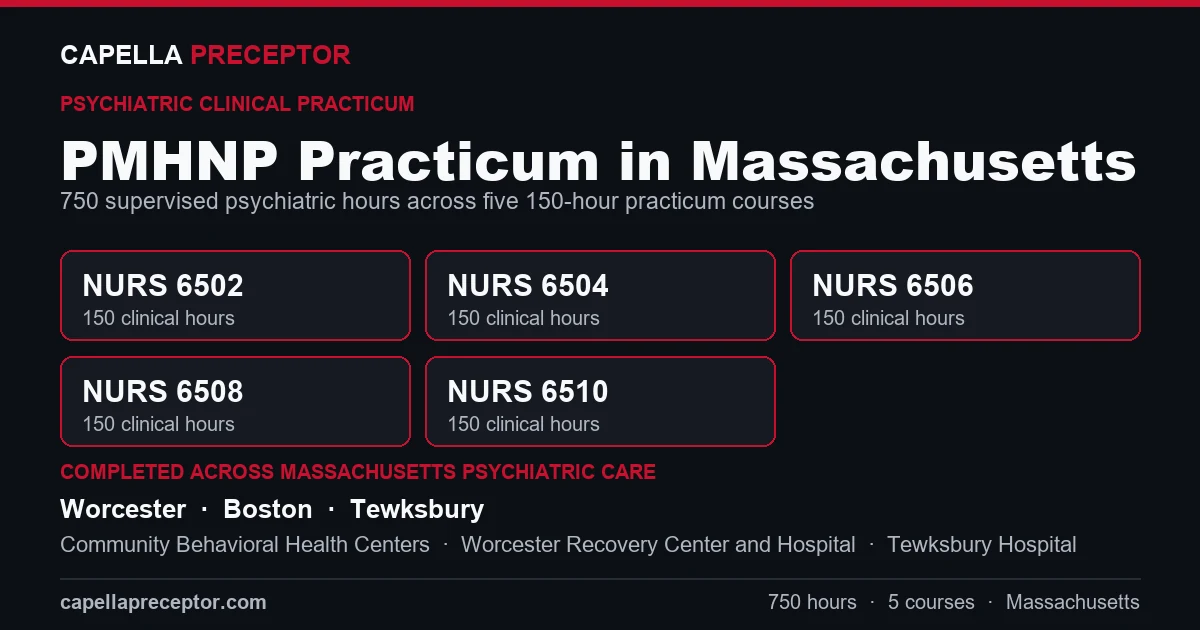
The hour count is fixed nationally: the Capella MSN Psychiatric-Mental Health Nurse Practitioner specialization requires a minimum of 750 practicum hours, completed as 150 clinical hours in each of five practicum courses, NURS6502, NURS6504, NURS6506, NURS6508, and NURS6510 (Practicum I through V), all in psychiatric and behavioral-health settings (Capella, MSN-PMHNP courses). That five-by-150 structure is specific to PMHNP and is the reason this page is different from the family-practice page for the same state. A Capella FNP practicum in Massachusetts is primary care, runs across a different course sequence, and answers a separate set of board and prescribing questions. The full PMHNP course-by-course breakdown lives on our Capella PMHNP page; the broader Massachusetts placement landscape across all specialties is on our Massachusetts page. This page is only the intersection: psychiatric hours, in Massachusetts.
What changes from state to state is not the 750 figure but the regulatory environment your psychiatric preceptor practices in: who may supervise, what they may prescribe, and how much of the work can happen by video. In Massachusetts those answers are favorable but specific, and they are worth understanding before you assume any local psych NP can sign off on your hours.
Can a Massachusetts PMHNP precept you without a physician attached?
The American Association of Nurse Practitioners classifies Massachusetts as a full practice authority state, so an experienced nurse practitioner can evaluate, diagnose, and prescribe under the exclusive licensure authority of the state board rather than under a contracted physician (AANP, State Practice Environment). Massachusetts reached that status when "An Act Promoting a Resilient Health Care System That Puts Patients First" took effect on January 1, 2021.
There is a psychiatric-specific nuance that decides whether a given preceptor can supervise you cleanly. Under the Board of Registration in Nursing rules at 244 CMR 4.07, an advanced practice nurse, including a psychiatric-mental health certified specialist, may engage in prescriptive practice without supervision only after a minimum of two years of supervised practice and an attestation filed with the board (244 CMR 4.07, prescriptive practice). Below that threshold the NP still prescribes under mutually agreed guidelines with a qualified health care professional. For you that is the practical screen: a board-certified PMHNP who has cleared the two-year mark can supervise your psychiatric rotation and prescribing experience on their own authority, while a recently licensed NP may still be tied to a collaborating physician's guidelines. We match preceptors who can supervise a Capella student cleanly under the current Massachusetts rules.
Verify it yourself. Before your first psychiatric shift, look the preceptor up on the Commonwealth's free Check a nursing license tool, confirm the license is active and discipline-free, and confirm the national certification is PMHNP, not a primary-care population. A family NP cannot anchor your psychiatric hours.
What does prescriptive authority mean for a psychiatric preceptorship here?
Psychiatry is a controlled-substance specialty, so prescriptive authority matters more on a PMHNP rotation than on most primary-care placements. To prescribe scheduled medications in Massachusetts, an NP must hold both a federal DEA registration and a Massachusetts Controlled Substances Registration (MCSR); every prescriber of Schedule II through V drugs in the Commonwealth registers with the state Drug Control Program in addition to the DEA (Mass.gov, MCSR for practitioners). The medications you will watch a psych preceptor manage map directly to those schedules:
- Schedule II stimulants for ADHD, such as amphetamine products, which carry the tightest prescribing controls.
- Schedule IV benzodiazepines for anxiety and acute agitation, managed with an eye on dependence.
- Schedule III buprenorphine for opioid use disorder, central to the co-occurring SUD work that fills many Massachusetts psychiatric panels.
Two Massachusetts-specific points shape what you will see. First, the federal X-waiver is gone: the Consolidated Appropriations Act of 2023 removed the separate waiver, so any clinician with Schedule III DEA authority may now prescribe buprenorphine for opioid use disorder where state law allows (SAMHSA, MAT Act and waiver elimination). That has pulled medication for opioid use disorder squarely into PMHNP scope, and Massachusetts community behavioral health work leans on it. Second, the Commonwealth runs the Massachusetts Prescription Awareness Tool, MassPAT, the state prescription-monitoring database your preceptor queries before prescribing scheduled medications (Massachusetts Medical Society, MassPAT). A PMHNP rotation here is partly a lesson in how that monitoring and dual registration work in daily practice, which is content a primary-care FNP placement simply does not cover the same way.
Can PMHNP practicum hours be completed by telepsychiatry in Massachusetts?
Massachusetts is one of the better states for supervised telepsychiatry, but the answer is "some, not all." The Commonwealth made behavioral-health telehealth permanent: Chapter 260 of the Acts of 2020 requires behavioral-health services delivered by interactive audio-video, and certain audio-only care, to be covered on par with in-person services in perpetuity (Mass.gov, MassHealth telehealth). Capella names telepsychiatry directly inside the Practicum III experience, so logging some supervised telepsychiatry hours is realistic here (Capella, MSN-PMHNP courses).
On the prescribing side, the federal telemedicine flexibilities that let controlled substances be prescribed without a prior in-person exam were extended again, now in effect through December 31, 2026, with a dedicated pathway for buprenorphine via telemedicine (DEA, telemedicine flexibilities extension). That keeps telepsych prescribing viable while you train. None of it makes the whole practicum remote, though. How many of your 750 hours can be telehealth depends on your specific course instructions, your preceptor's actual practice mix, and the hands-on psychiatric assessment each rotation has to demonstrate. Confirm the current telehealth allowance for each practicum against your course requirements rather than assuming the full program can be done from home.
Where do Capella PMHNP students complete psychiatric hours in Massachusetts?
PMHNP hours must be earned in behavioral and mental-health practice, not general primary care, and Massachusetts has a deeper bench of public psychiatric infrastructure than most states. Settings that typically qualify when staffed by an appropriately credentialed supervising provider:
The state designated 25 CBHCs that launched in January 2023 as one-stop sites for outpatient, urgent, and crisis behavioral health and substance-use care, a large and growing source of supervised psychiatric volume (Mass.gov, CBHCs).
Department of Mental Health hospitals such as Worcester Recovery Center and Hospital and the psychiatric units at Tewksbury Hospital offer inpatient and acute experience.
Medication-management and psychotherapy practices across Greater Boston, Worcester, and the Pioneer Valley, several of which run hybrid in-person and telepsychiatry panels.
Substance-use and opioid-treatment settings where buprenorphine and co-occurring psychiatric care are central, well suited to the dual-diagnosis hours PMHNP students need.
A separate setting is usually needed for the younger-population hours, since one adult practice rarely covers both ends of the lifespan well.
Federally qualified centers in shortage areas, where the state's PMHNP Fellowship has placed psychiatric NPs to expand access.
The supervising provider must hold an active Massachusetts license and the scope to oversee psychiatric care, a PMHNP-BC or a psychiatrist. Your site and preceptor are proposed and approved before you can log a single hour, so both the credential and the setting clear review first.
The reality of finding a psychiatric preceptor in Massachusetts
Honest framing first: psychiatric preceptors are in acute short supply across Massachusetts, more so than family-practice preceptors. The shortage is real enough that the Executive Office of Health and Human Services created a dedicated PMHNP Fellowship to grow the psychiatric NP workforce, and community health centers in federally designated mental health professional shortage areas are explicitly prioritized for it (Massachusetts League of Community Health Centers, PMHNP Fellowship). Demand for the new Community Behavioral Health Centers has been heavy since they opened, which means experienced psych providers are busy and selective about adding a student.
Capella adds a second hurdle: the university does not assign your preceptor. Capella is explicit that learners are responsible for finding an appropriate preceptor to oversee the practicum, and recommends completing those hours in your own local community (Capella, MSN-NP program). A dedicated Capella team offers support resources, but the outreach and the commitment land on you. In a market where teaching hospitals route placement requests to their own affiliated residents and NP programs first, an independent online student can spend months cold-emailing psychiatric clinics and still come up empty. That gap, psychiatric specialty plus self-placement plus a tight Massachusetts market, is exactly what this service closes. We hold relationships with PMHNP preceptors who already accept Capella students, so instead of chasing availability you get a confirmed, requirements-checked match.
What clears before your Massachusetts psychiatric practicum starts
Once a Massachusetts psychiatric preceptor and site are lined up, a clearance sequence has to finish before any hour counts. Capella manages practicum application, site and preceptor approval, hour tracking, and evaluations through CORE ELMS, its practicum-management system (Capella, MSN-PMHNP overview).
- Submit the site and preceptor in CORE ELMS for Capella's review and approval. Capella reviews and approves a proposed placement; we match preceptors who meet Capella's published requirements and submit the placement for that review.
- Execute the affiliation agreement between Capella and the Massachusetts psychiatric site before day one.
- Clear compliance through Capella's background-check vendor, CastleBranch, completed by the end of your first billing session or quarter.
- Log and submit hours in CORE ELMS, where your preceptor approves what you record, until each of the five courses reaches its 150-hour total.
Start early. Psychiatric affiliation agreements can take weeks to execute, behavioral-health preceptors are in high demand, and the lifespan requirement usually means securing one source for adult and older-adult hours and a separate option for child and adolescent hours.
Massachusetts PMHNP FAQ
How many hours does a Capella PMHNP practicum need in Massachusetts?
A minimum of 750 psychiatric direct-patient-care hours, completed as 150 clinical hours in each of the five Capella practicum courses (NURS6502, NURS6504, NURS6506, NURS6508, NURS6510), all under an on-site psychiatric-mental-health preceptor at an approved Massachusetts site. The same total applies in every state; what changes in Massachusetts is the board and prescribing rules your preceptor practices under.
Can a Massachusetts PMHNP precept Capella students without a physician?
Yes, once the preceptor has cleared the state's threshold. Massachusetts is a full-practice-authority state, but a PMHNP prescribes independently only after two years of supervised practice and an attestation filed under 244 CMR 4.07. A seasoned board-certified PMHNP past that threshold can supervise your psychiatric hours on their own authority; a newer NP may still be tied to a collaborating physician. We screen for preceptors who can supervise cleanly.
Can PMHNP practicum hours in Massachusetts be done by telepsychiatry?
Partly. Massachusetts made behavioral-health telehealth parity permanent under Chapter 260 of the Acts of 2020, and Capella names telepsychiatry inside Practicum III, so some supervised telepsychiatry hours are realistic. How much counts depends on your specific course instructions, your preceptor's practice, and the in-person psychiatric assessment skills each rotation must demonstrate, so confirm the current allowance per practicum rather than assuming all 750 hours can be remote.
What controlled substances will I see a Massachusetts PMHNP prescribe?
Common psychiatric controlled substances include Schedule II stimulants for ADHD, Schedule IV benzodiazepines, and Schedule III buprenorphine for opioid use disorder. To prescribe any of them a Massachusetts PMHNP must hold both a federal DEA registration and a Massachusetts Controlled Substances Registration, and prescribers query the MassPAT database. The X-waiver is gone, so a PMHNP with Schedule III DEA authority may prescribe buprenorphine where state law allows.
Where do PMHNP students complete psychiatric hours in Massachusetts?
Real settings include the 25 designated Community Behavioral Health Centers, state psychiatric facilities such as Worcester Recovery Center and Hospital and Tewksbury Hospital, outpatient psychiatry and telepsychiatry groups, child and adolescent practices, and addiction and MOUD programs. Psychiatric preceptors are in short supply statewide, which is why we hold relationships with providers who already accept Capella students.
Sources
- Capella University, MSN-PMHNP courses (750 hours, five 150-hour practicum courses, telepsychiatry in Practicum III)
- Capella University, MSN-NP program (learner responsibility for the preceptor)
- AANP, State Practice Environment (Massachusetts full practice authority)
- 244 CMR 4.07, APRN prescriptive practice (two-year supervised-practice threshold)
- Mass.gov, Massachusetts Controlled Substances Registration (MCSR)
- SAMHSA, MAT Act (X-waiver elimination for buprenorphine)
- DEA, telemedicine flexibilities extended through December 31, 2026
- Mass.gov, Community Behavioral Health Centers (25 designated sites, January 2023)
- Massachusetts League of Community Health Centers, PMHNP Fellowship (psychiatric workforce shortage)
How Capella Preceptor helps PMHNP students in Massachusetts
You now have the landscape: 750 psychiatric hours across five practicum courses, full practice authority gated by a two-year supervised-practice threshold, dual DEA and MCSR registration behind every prescription, permanent behavioral-health telehealth, and a psychiatric preceptor market that is genuinely tight. We close the last gap. We match you with a psychiatric-mental health preceptor who meets Capella's published requirements and is licensed in Massachusetts, in person or hybrid, and we prepare every CORE ELMS form and affiliation agreement so your hours start on time.
- PMHNP preceptor matched in 7 days, no payment until matched
- Adult and child or adolescent psychiatric rotations covered across all five practicums
- Every CORE ELMS form, affiliation agreement, and CastleBranch step handled
Get a Capella PMHNP preceptor in Massachusetts
Free 15-minute consult. No payment until matched. We map your full psychiatric practicum plan.
Get my free consult →