Capella PMHNP preceptor in Minnesota
A Capella PMHNP practicum in Minnesota requires 750 supervised psychiatric clinical hours across five practicum courses of 150 hours each, completed under an on-site psychiatric-mental-health preceptor. Minnesota is a full practice authority state, so that preceptor is often an independently practicing APRN who can prescribe controlled psychiatric medications, which shapes the kind of hours you can earn. Capella does not assign you the preceptor or the psychiatric site. We do, with a verified, Minnesota-licensed match.
Last updated 2026-06-28 · Reviewed by the Capella Preceptor placement team
How many psychiatric practicum hours does a Capella PMHNP need in Minnesota?
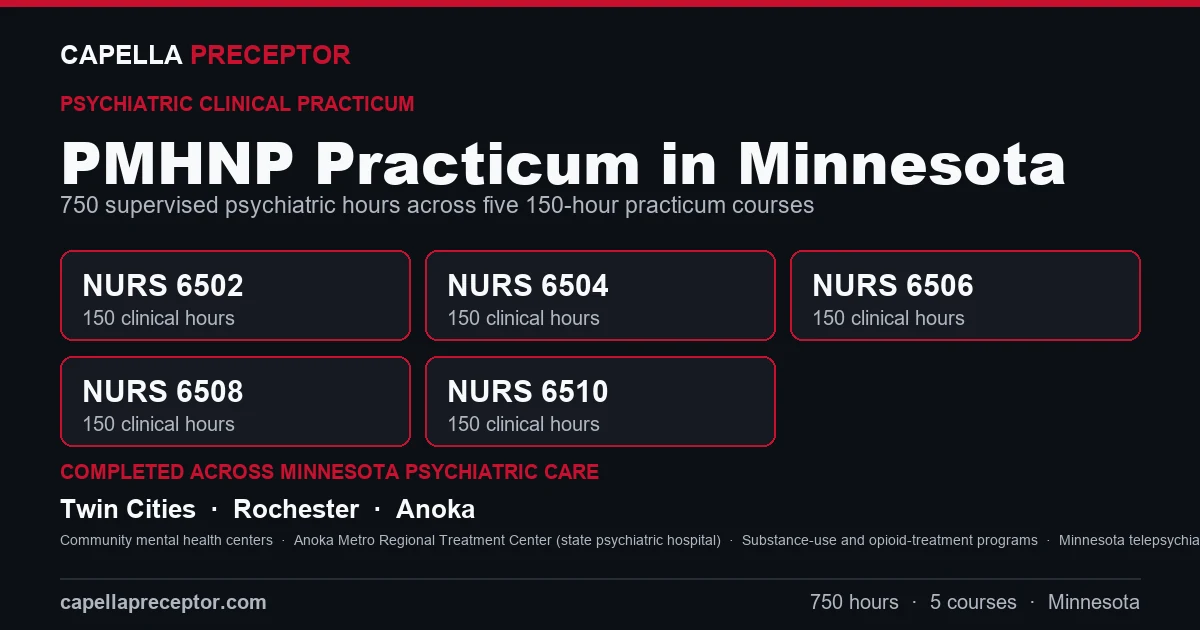
The number does not change because you are in Minnesota, but the rules and settings you complete it under do. Capella's MSN Psychiatric-Mental Health Nurse Practitioner specialization requires a minimum of 750 practicum hours, completed as 150 clinical hours in each of five practicum courses: NURS6502 Practicum I, NURS6504 Practicum II, NURS6506 Practicum III, NURS6508 Practicum IV, and NURS6510 Practicum V (Capella, MSN-PMHNP courses). Every one of those hours is direct psychiatric patient care, supervised on site by a credentialed psychiatric provider, and earned in your own Minnesota community while the coursework stays online (Capella, MSN-NP program).
This is a different shape of practicum from the primary-care tracks. A Capella FNP student in Minnesota logs 750 hours across six practicum courses in family and primary care; a PMHNP student logs the same total across five 150-hour courses, all in behavioral and mental-health practice, and the population deliberately shifts from adult and older-adult psychiatry to child and adolescent work as the sequence advances. That is why this page is not the same as the all-programs Minnesota page or the FNP version: a psychiatric placement answers to psychiatric board rules and needs psychiatric settings. For the program mechanics in full, see the PMHNP specialty page.
What does Minnesota full practice authority mean for a psychiatric preceptor?
The American Association of Nurse Practitioners classifies Minnesota as a full practice state (AANP, Minnesota). For a PMHNP placement that matters in a concrete way. A psychiatric nurse practitioner in Minnesota is licensed by the Minnesota Board of Nursing as an Advanced Practice Registered Nurse holding national certification as a Certified Nurse Practitioner, so a preceptor's credential reads "APRN, CNP" with a psychiatric-mental-health certification behind it. Because the state does not require ongoing physician supervision, many Minnesota PMHNPs run their own psychiatric panels or independent behavioral-health practices, which widens the pool of clinicians who can legally take you on without first clearing it through a supervising physician.
One Minnesota rule is worth knowing even though it does not gate you as a student. A Certified Nurse Practitioner who began practicing after July 1, 2014 must complete at least 2,080 hours in a collaborative management setting before practicing fully independently (Minn. Stat. 148.211). It is a transition-to-practice period, not lifelong supervision, and it is part of why Minnesota is still a full practice state. You are not a licensed CNP yet, so it does not touch your practicum, but it does shape who can precept you: a newer psychiatric APRN may still be inside a collaborative hospital or clinic setting, while a more established one is often independent.
Can a Minnesota PMHNP preceptor prescribe controlled psychiatric medications?
Yes, and this is one of the most useful things about a Minnesota psychiatric placement. Under Minnesota Statute 148.235, a licensed APRN may "prescribe, procure, sign for, record, administer, and dispense over-the-counter, legend, and controlled substances," and must comply with federal DEA requirements and file every DEA registration and number with the Board of Nursing. In practice that means a Minnesota PMHNP preceptor with the appropriate DEA authority can prescribe across the controlled-substance schedules that psychiatric care actually turns on:
- Schedule II stimulants for ADHD, such as methylphenidate and amphetamine formulations, where careful diagnosis and monitoring are the teaching points.
- Benzodiazepines for anxiety and acute agitation, where you learn short-course prescribing, tapering, and the risks of long-term use.
- Buprenorphine for opioid use disorder (medication for opioid use disorder, MOUD), central to the co-occurring substance-use cases that fill real psychiatric practice.
For a PMHNP student this is the difference between watching and doing. A preceptor who carries DEA prescribing authority can let you work up real psychopharmacology and substance-use cases under supervision, which is exactly the experience the Practicum III and IV course descriptions point at. Co-occurring substance use is the norm in psychiatric care rather than the exception, so a Minnesota placement that includes MOUD prescribing is genuinely strong preparation for the certification exam and for practice. We verify a preceptor's license and confirm their prescribing scope before you commit hours.
Can Minnesota PMHNP hours be done by telepsychiatry?
Partly, and Minnesota is a reasonable place for it. Psychiatry is one of the more telehealth-friendly specialties because intake interviews, medication management, and psychotherapy are routinely delivered by video, and Capella names telepsychiatry directly inside the Practicum III experience (Capella, MSN-PMHNP courses). Minnesota recognizes telehealth as a legitimate way to establish and continue a clinical relationship, and the state has a real ecosystem of telepsych groups that supervise care across the whole state, which helps students who live far from a metro psychiatric clinic.
That does not make the program remote. The share of telehealth that counts toward your hours depends on your specific course requirements, your preceptor's practice, and the supervision rules that apply to a training relationship, and federal controlled-substance prescribing by telehealth carries its own evolving conditions, including prescription-drug-monitoring checks for buprenorphine (Telehealth.HHS.gov, prescribing controlled substances via telehealth). Confirm the current telehealth allowance for each practicum against your course instructions before assuming a block of hours can be done entirely online. A blended placement, some in person and some telepsych, is usually the realistic answer in Minnesota. See virtual preceptorship and in-person placement for how each works.
Where do PMHNP students complete psychiatric hours in Minnesota?
PMHNP hours must be earned in behavioral and mental-health practice, supervised by a credentialed psychiatric provider, not in general primary care. Minnesota has real psychiatric settings across the state, though they are unevenly distributed:
County and nonprofit behavioral-health clinics across the Twin Cities and Greater Minnesota, the backbone of outpatient psychiatric hours.
The state system, including the Anoka Metro Regional Treatment Center, the largest state behavioral-health hospital, staffs psychiatrists and advanced practice nurses on complex inpatient cases.
Inpatient and behavioral-health units within the larger Twin Cities and Rochester health systems, strong for acute and crisis exposure.
Substance-use and opioid-treatment programs where buprenorphine and co-occurring care are the daily work, valuable for the substance-use competencies.
Pediatric mental-health practices, needed to cover the younger population that the Practicum II rotation requires.
Statewide telepsych practices that supervise outpatient psychiatric care by video, often the best fit for students outside a metro.
Because the lifespan requirement splits your hours between adult or older-adult psychiatry and child or adolescent work, most PMHNP students need more than one Minnesota site or preceptor across the five-course sequence. Plan for that early rather than assuming one practice covers both ends.
How hard is it to find a PMHNP preceptor in Minnesota, honestly?
Harder than for any primary-care track, and it is worth being plain about that. Psychiatric preceptors are the scarcest clinicians in this field. Much of Minnesota, including many rural counties, sits inside a federally designated mental-health professional shortage area, where there are simply too few psychiatric providers for the population (Minnesota Department of Health, shortage designations; Rural Health Information Hub, Minnesota mental-health HPSAs). The few psychiatric APRNs and physicians who could precept are often already carrying full panels or students from local university programs, and burnout has pulled some of them out of clinical work or down to part-time, which shrinks the pool further.
The practical reality is that a PMHNP student who starts cold-emailing clinics a few weeks before the practicum term opens frequently comes up empty, even in the Twin Cities. Capella's own policy makes the search yours: the university states that "learners are responsible for finding an appropriate preceptor to oversee the practicum experience," and while a support team helps connect learners with site opportunities, securing the psychiatric preceptor and site is the student's job for all 750 hours (Capella, MSN-PMHNP overview). That gap, between a demanding psychiatric requirement and a thin supply of preceptors, is the entire reason a placement service exists.
What has to clear before you log a Minnesota psychiatric hour?
Finding a willing psychiatric preceptor is step one. Before any hour counts, Capella runs the same clearance workflow everywhere, managed through CORE ELMS, its practicum-management system (Capella, CORE ELMS). Capella reviews and approves the placement you propose; it does not pre-approve a preceptor for you.
- Propose the Minnesota psychiatric site and preceptor in CORE ELMS, so Capella can review whether the preceptor and setting meet its published requirements.
- Verify the credential and prescribing scope against the Minnesota Board of Nursing license record, confirming an active APRN, CNP with psychiatric certification and, where relevant, DEA authority.
- Get an affiliation agreement signed between Capella and the psychiatric site before practicum begins. This is where Minnesota placements most often stall, because a busy clinic administrator has to read and sign a university contract.
- Clear compliance through Capella's background-check vendor, CastleBranch, with the drug screen and health records psychiatric sites require for access.
- Log and submit hours in CORE ELMS as you go, with your preceptor approving each 150-hour course total.
We prepare every CORE ELMS form, run the license verification, and chase the affiliation-agreement signature so it does not sit in an inbox while your psychiatric start date slips.
Minnesota PMHNP FAQ
How many psychiatric practicum hours does Capella PMHNP require in Minnesota?
A minimum of 750 supervised psychiatric clinical hours, completed as 150 clinical hours in each of five practicum courses (NURS6502 Practicum I, NURS6504 Practicum II, NURS6506 Practicum III, NURS6508 Practicum IV, and NURS6510 Practicum V), under an on-site psychiatric-mental-health preceptor at a Minnesota site that meets Capella's published requirements. The total is the same in Minnesota as anywhere; what changes is the Minnesota board rules and settings the hours are completed under.
Can a Minnesota PMHNP preceptor prescribe controlled psychiatric medications like stimulants and buprenorphine?
Yes. Under Minnesota Statute 148.235, a licensed APRN may prescribe, procure, sign for, record, administer, and dispense over-the-counter, legend, and controlled substances, and must hold a DEA registration on file with the Minnesota Board of Nursing. That includes Schedule II stimulants for ADHD, benzodiazepines, and buprenorphine for opioid use disorder when the preceptor holds the appropriate DEA authority, so a Minnesota PMHNP placement can expose you to real psychiatric prescribing rather than observation only.
Can Capella PMHNP practicum hours in Minnesota be done by telepsychiatry?
Partly. Capella names telepsychiatry directly within the Practicum III experience, and Minnesota recognizes telehealth as a way to establish and continue a clinical relationship, so a Minnesota telepsych group can be a legitimate part of your hours. The share of telehealth that counts depends on your course requirements and your preceptor's practice, so confirm the current allowance for each practicum against your course instructions rather than assuming all 750 hours can be remote.
What psychiatric settings in Minnesota count for PMHNP practicum hours?
Behavioral and mental-health practice supervised by a credentialed psychiatric provider: community mental health centers and county behavioral-health clinics, the state psychiatric hospital system such as the Anoka Metro Regional Treatment Center, hospital psychiatry and behavioral-health units in the Twin Cities and Rochester, substance-use and opioid-treatment programs, child and adolescent psychiatry practices, and Minnesota telepsychiatry groups. General primary care does not count for PMHNP hours.
Why is a PMHNP preceptor so hard to find in Minnesota?
Psychiatric preceptors are the scarcest in the field. Much of Minnesota, including many rural counties, sits in a federally designated mental-health professional shortage area, the psychiatric workforce is stretched, and the clinicians who could precept are often already carrying full patient panels or students from local programs. That is why a Minnesota PMHNP placement usually takes longer to secure than a primary-care one and why starting early matters.
Sources
- Capella University, MSN-PMHNP courses and practicum hours
- Capella University, MSN-PMHNP overview (student secures the preceptor; CastleBranch)
- AANP, Minnesota state practice environment (full practice)
- Minnesota Statutes 148.235, APRN prescribing of controlled substances and DEA filing
- Minnesota Statutes 148.211, APRN collaborative-management transition hours
- Telehealth.HHS.gov, prescribing controlled substances via telehealth
- Minnesota Department of Health, health professional shortage designations
- Minnesota DHS, Anoka Metro Regional Treatment Center
- Capella University, CORE ELMS practicum management
How Capella Preceptor helps with your Minnesota PMHNP placement
You now have the lay of the land: Minnesota grants NPs full practice authority, your psychiatric preceptor is a Minnesota Board of Nursing APRN, CNP who can prescribe controlled medications under their DEA authority, the real settings run from community mental health centers to the state hospital system to telepsych, and the psychiatric preceptor shortage is real. Capella reviews and approves the placement, but leaves the search to you. We close that gap. We secure a verified, Minnesota-licensed psychiatric preceptor whose setting and prescribing scope match your practicum, prepare every CORE ELMS form, push the affiliation agreement to signature, and keep your hours logged and submitted on time.
- Verified Minnesota psychiatric preceptor matched in 7 days, in person or telepsych
- Adult and child or adolescent psychiatric rotations covered across all five practicums
- Every CORE ELMS form, license check, affiliation agreement, and CastleBranch step handled, with no payment until you are matched
Get a Capella PMHNP preceptor in Minnesota
Free 15-minute consult. No payment until matched. We map your entire psychiatric practicum plan.
Get my free consult →