Home / MSN-PMHNP / PMHNP Preceptor in Mississippi
PMHNP · MississippiCapella PMHNP preceptor in Mississippi
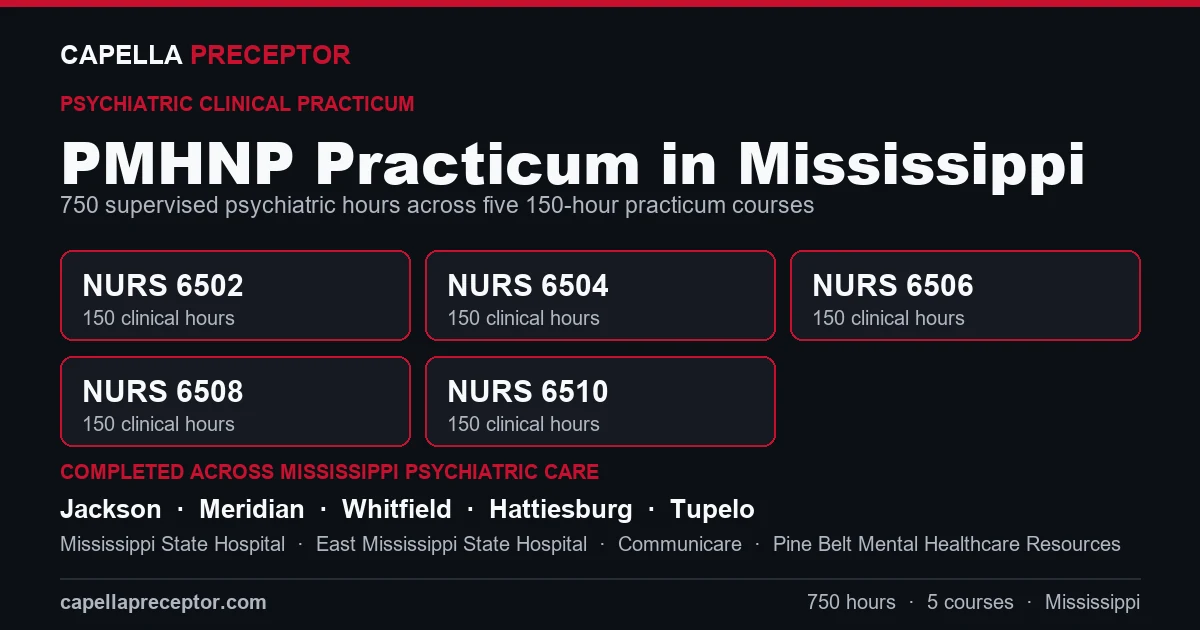
A Capella PMHNP practicum in Mississippi requires 750 supervised psychiatric clinical hours across five practicum courses of 150 hours each, completed in person under an on-site psychiatric-mental-health preceptor. Mississippi is a reduced-practice state, so that preceptor works under a collaborative agreement with a physician and meets that physician face to face every quarter, and any controlled psychiatric prescribing they teach you runs through the Mississippi board's controlled-substance rules and the state prescription monitoring program. Here is how the program, the board, and the real psychiatric sites fit together, and how we secure the preceptor.
Last updated 2026-06-28 · Reviewed by the Capella Preceptor psychiatric placement team
What does the Capella PMHNP practicum require in Mississippi?
The Capella MSN Psychiatric-Mental Health Nurse Practitioner specialization requires a minimum of 750 supervised practicum hours, earned as 150 clinical hours in each of five practicum courses, NURS6502, NURS6504, NURS6506, NURS6508, and NURS6510, Practicum I through V (Capella, MSN-PMHNP courses). That five-course, 150-hour pattern is specific to PMHNP and is not the same as the six-course primary-care FNP track, so a Mississippi psychiatric placement and a Mississippi family-practice placement are not interchangeable. Every one of these hours has to be earned in a behavioral or mental-health setting, never a general clinic, under an on-site preceptor who is a board-certified PMHNP or a psychiatrist.
Capella delivers the coursework online while you complete the psychiatric practicum in your own Mississippi community (Capella, MSN-NP program). The all-programs picture for the state is on our Mississippi placement page, and the all-states version of these PMHNP requirements is on the Capella PMHNP page. This page is the intersection of the two: what the PMHNP practicum actually looks like once you put it on the ground in Mississippi.
How does Mississippi reduced practice shape a psychiatric preceptor?
The American Association of Nurse Practitioners classifies Mississippi as a reduced practice state (AANP, State Practice Environment). For psychiatry that has a concrete shape. A Mississippi APRN must hold a written collaborative or consultative agreement with a physician who carries an unrestricted Mississippi license, and must file a protocol or practice guidelines that the Mississippi Board of Nursing reviews and approves (Mississippi Board of Nursing, APRN). The detail that catches students off guard is the meeting cadence: the rules require the nurse practitioner to meet face to face with the collaborating physician once each quarter for a documented quality-assurance review (Mississippi State Board of Medical Licensure, APRN collaboration rules).
Why this matters when you choose a psychiatric preceptor: the collaboration has to fit the APRN's role and population, which for a PMHNP means it must be psychiatric, not a borrowed family-practice agreement. A preceptor worth your term is a PMHNP-BC or psychiatrist whose Mississippi collaboration is active and whose protocol genuinely covers mental-health care. When we vet a Mississippi psychiatric preceptor, confirming that current collaboration and its psychiatric scope is part of the check, so a lapsed agreement does not surface in the middle of Practicum III.
Can your Mississippi preceptor prescribe controlled psychiatric medications?
This is the question that separates a psychiatric rotation from a primary-care one, because so much of psychiatric prescribing is controlled. In Mississippi an APRN may prescribe Schedules II through V, but the authority is not automatic: the prescriber must first complete a board-approved controlled-substance educational program, including controlled-substance pharmacology coursework, and then be granted the authority by the board, with a separate DEA registration (30 Miss. Code R. 2840-1.5, Prescribing Controlled Substances by APRNs). The Mississippi rule that shapes daily psychiatric work is the monitoring mandate: the prescriber must query the Mississippi Prescription Monitoring Program (MPMP) at every encounter where an opioid or benzodiazepine is prescribed, reviewing at least six months of history on an initial controlled-substance prescription (30 Miss. Code R. 2840-1.5).
For a PMHNP learner that translates into the real medications you will watch managed during hours, and into the documentation habit you will pick up at the desk:
Because co-occurring substance use runs through so much psychiatric practice, the buprenorphine line is worth a closer look: Mississippi folds APRN controlled-substance prescribing into the board-granted authority and the collaborative protocol rather than treating it as a free-standing privilege (Spetz et al., supervision requirements for buprenorphine prescribing, PMC). If addiction-treatment hours are part of your plan, we confirm the preceptor's controlled-substance and MOUD authority specifically, not just an active license, before you log against that site.
Can Mississippi PMHNP hours be done by telepsychiatry?
Partly, and psychiatry is the specialty where telehealth carries the most weight. Mississippi permits care by real-time, two-way audio-video telehealth once a valid provider-patient relationship is established, and videoconferencing is specifically required if a medication is to be prescribed by telehealth (Mississippi State Board of Medical Licensure, Part 2635, Practice of Telemedicine). Capella names telepsychiatry directly inside the Practicum III experience, so a share of your supervised hours can legitimately be earned remotely under your preceptor.
Two Mississippi-specific limits keep it from becoming an all-remote program. First, the state's telemedicine rule states that telehealth shall not be used to manage chronic pain with controlled-substance prescriptions, which is a sharper line than most states draw and shapes which controlled-prescribing days have to happen in person (Mississippi State Board of Medical Licensure, Part 2635). Second, how many telehealth hours count toward your 750 still depends on your course requirements and your preceptor's practice, so confirm the current allowance for each practicum against your course instructions. In practice, telepsychiatry covers a meaningful share of medication-management and therapy hours while controlled prescribing and acute work stay in person.
Where do Capella PMHNP students complete psychiatric hours in Mississippi?
Mississippi has real psychiatric infrastructure, it is just thin and unevenly spread. The settings that typically qualify for PMHNP hours, when staffed by an appropriately credentialed supervising provider, include:
- Regional community mental health centers. Mississippi is divided into 14 mental-health regions, each served by a community mental health center that delivers most of the state's outpatient psychiatric care, for example Communicare in the north, Weems and Pine Belt Mental Healthcare Resources, and the other regional centers (Mississippi Department of Mental Health, Community Services).
- State psychiatric hospitals: Mississippi State Hospital at Whitfield in Rankin County, southeast of Jackson, which runs acute, continued-treatment, forensic, and child and adolescent psychiatric services plus a substance-use unit, and East Mississippi State Hospital in Meridian, a regional center serving 31 counties (Mississippi Department of Mental Health, behavioral programs).
- Outpatient psychiatry and medication-management practices in the Jackson metro, the Gulf Coast, Hattiesburg, Tupelo, and Oxford, including child and adolescent psychiatry for the lifespan rotation.
- Substance-use and opioid-treatment programs, where co-occurring psychiatric and addiction care is the daily work and MOUD prescribing can be observed under a preceptor with current authority.
- Telepsychiatry groups serving the Delta and other rural counties, which can supply a share of supervised hours where local in-person psychiatry is scarce.
The lifespan requirement still applies: Practicum I leans adult and older-adult while Practicum II is child and adolescent, so many Mississippi students need more than one site or preceptor across the sequence. Child and adolescent psychiatry is especially thin outside the Jackson metro and the Whitfield child unit, so plan that rotation early rather than discovering the gap at Practicum II.
How hard is it really to find a PMHNP preceptor in Mississippi?
Honestly, hard, and harder than for primary care. The psychiatric workforce is the binding constraint, and Mississippi is one of the most acute mental-health deserts in the country. The state carries roughly nine geographic mental-health professional shortage areas covering on the order of 70 counties, with close to a third of residents living in an area without enough mental-health services, and Mississippi ranks near the very bottom nationally for mental-health access (Rural Health Information Hub, Mental Health HPSA map; KFF, Mental Health Care HPSAs). Fewer psychiatric providers means fewer potential preceptors, and the ones who do precept fill their slots fast.
That is not a reason to panic, but it is a reason to start early and stay realistic. The students who avoid a lost term tend to do two things: begin the search months before the practicum quarter, since an affiliation agreement with a psychiatric site can take weeks to execute, and line up the child or adolescent option separately from the adult one rather than assuming a single Mississippi practice covers both. Where a specialty-matched preceptor is genuinely out of reach in a rural county, a supervised telepsychiatry placement keeps you on schedule instead of waiting months for a local opening.
Who secures the PMHNP preceptor, and what clears first?
Capella is direct that the learner secures the preceptor and site: "learners are responsible for finding an appropriate preceptor to oversee the practicum experience," and a support team helps connect students with site opportunities rather than assigning one (Capella, MSN-PMHNP overview). In a shortage state that responsibility is exactly where a placement service earns its keep. Whatever route you take, the same gates have to clear before your Mississippi psychiatric hours count, and missing one stalls your start:
- Propose your psychiatric site and preceptor in Capella's practicum system, CORE ELMS, for review and approval before the practicum opens.
- Confirm the preceptor's Mississippi authorization, including a current APRN or physician license, a filed psychiatric collaborative protocol, and, where psychiatric prescribing is involved, board-granted controlled-substance authority.
- Get the affiliation agreement signed between Capella and the Mississippi psychiatric site before practicum begins.
- Clear compliance, the background check and health records, through Capella's third-party vendor (CastleBranch) before your start date.
- Log and submit hours in CORE ELMS, where the preceptor approves what you record toward each 150-hour course total.
To be clear about what approval means: Capella reviews and approves the placement you propose. A preceptor or site is never "Capella endorsed." We match a psychiatric preceptor who meets Capella's published requirements and submit the placement for Capella's review, and no honest service can promise the university's approval in advance or guarantee that a given placement clears.
Mississippi PMHNP FAQ
How many psychiatric practicum hours does Capella PMHNP require in Mississippi?
A minimum of 750 supervised psychiatric clinical hours, completed as 150 hours in each of the five practicum courses (NURS6502, NURS6504, NURS6506, NURS6508, NURS6510). The hours are earned in person at a Mississippi psychiatric site under an on-site PMHNP or psychiatrist preceptor, while the coursework stays online. That five-course, 150-hour structure is specific to PMHNP and differs from the FNP primary-care track.
What does Mississippi reduced practice mean for a psychiatric preceptor?
Mississippi is a reduced-practice state. A psychiatric APRN must hold a collaborative or consultative agreement with an unrestricted Mississippi physician, file a board-reviewed protocol, and meet face to face with the collaborating physician once each quarter for a documented quality-assurance review. A good PMHNP preceptor is a PMHNP-BC or psychiatrist whose Mississippi collaboration is current and psychiatric in scope.
Can a Mississippi PMHNP preceptor prescribe controlled psychiatric medications?
Yes, within limits. A Mississippi APRN may prescribe Schedules II through V, but only after completing a board-approved controlled-substance educational program and receiving that authority from the board. At every encounter that involves an opioid or benzodiazepine the prescriber must query the Mississippi Prescription Monitoring Program, reviewing at least six months of history on an initial controlled-substance prescription. That covers Schedule II stimulants for ADHD, Schedule IV benzodiazepines, and buprenorphine for opioid use disorder.
Can Capella PMHNP hours in Mississippi be completed by telepsychiatry?
Partly. Mississippi allows psychiatric care by real-time audio-video telehealth with a valid provider-patient relationship, and Capella names telepsychiatry within Practicum III, so some hours can be earned remotely under supervision. Two limits apply: how many telehealth hours count depends on your course requirements and your preceptor's practice, and Mississippi telemedicine rules bar using telehealth to manage chronic pain with controlled substances, so confirm the current allowance against your course instructions.
Is it hard to find a PMHNP preceptor in Mississippi?
Yes. Mississippi ranks among the worst states for mental-health access, with nine geographic mental-health shortage areas covering roughly 70 counties and close to a third of residents underserved, so psychiatric preceptors are scarce and fill quickly. Starting the search months ahead and using a placement service are the two things that most reliably prevent a lost term.
Sources
- Capella University, MSN-PMHNP courses and practicum hours
- Capella University, MSN-PMHNP overview (learner secures preceptor)
- 30 Miss. Code R. 2840-1.5, Prescribing Controlled Substances and Medications by APRNs (Schedules II-V, MPMP query)
- Mississippi State Board of Medical Licensure, APRN collaboration rules (quarterly face-to-face meeting)
- AANP, State Practice Environment (Mississippi reduced practice)
- Mississippi State Board of Medical Licensure, Part 2635, Practice of Telemedicine (chronic-pain controlled-substance limit)
- Mississippi Department of Mental Health, Community Services (14 regional CMHCs)
- Mississippi Department of Mental Health, behavioral programs (state psychiatric hospitals)
- Rural Health Information Hub, Mental Health Professional Shortage Area map
How Capella Preceptor helps Mississippi PMHNP students
You now know the three things that make a Mississippi psychiatric placement its own problem: 750 hours that must be psychiatric across the lifespan, a reduced-practice rule that ties your preceptor to a collaborative protocol, a quarterly physician meeting, and board-granted controlled-substance authority with an MPMP check at every opioid or benzodiazepine encounter, and one of the deepest mental-health shortages in the country thinning the pool of preceptors. We work all three. We match a verified psychiatric preceptor whose Mississippi authorization fits PMHNP, confirm their controlled-substance and MOUD authority where your hours need it, prepare every CORE ELMS form and affiliation agreement, and keep your hours logged toward each 150-hour course.
- Verified Mississippi psychiatric preceptor matched in 7 days, in person or telepsychiatry
- Adult and child or adolescent psychiatric rotations covered across all five practicums
- No payment until you are matched, with your exact quote at the free consult
Get a Capella PMHNP preceptor in Mississippi
Free 15-minute consult. No payment until matched. We map your entire Mississippi psychiatric practicum plan.
Get my free consult →