Capella PMHNP Preceptor in Nebraska
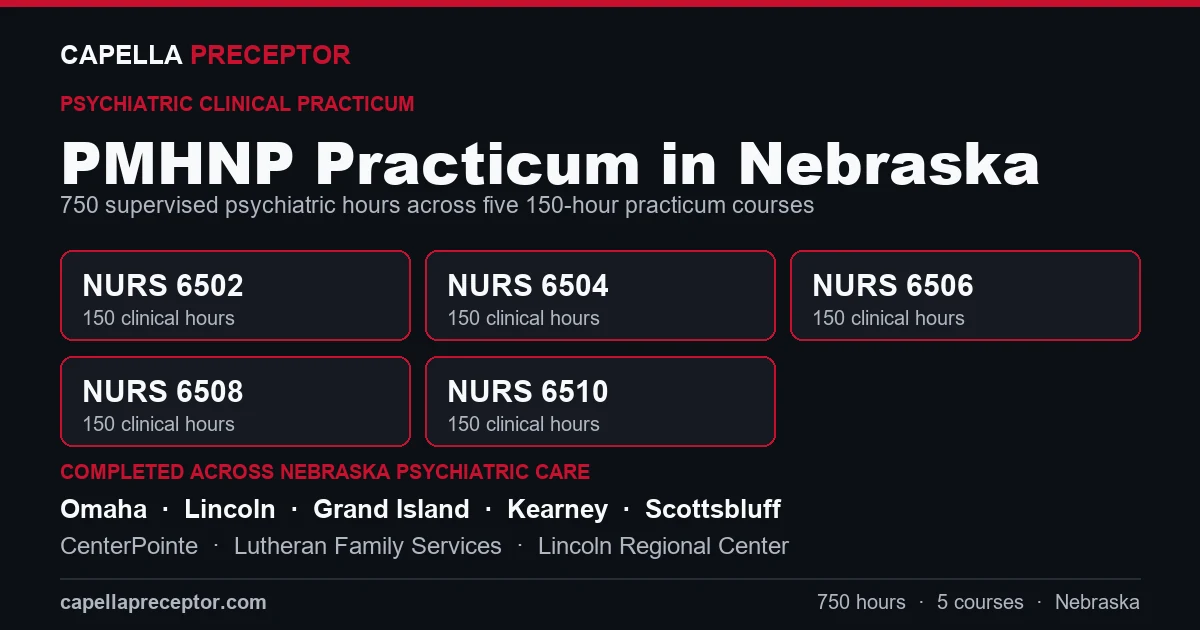
A Capella PMHNP practicum in Nebraska requires 750 supervised psychiatric clinical hours across five 150-hour practicum courses, completed under an on-site psychiatric-mental-health preceptor that you secure yourself. Nebraska is a full practice authority state, so an experienced PMHNP can diagnose and prescribe psychiatric medication on their own license. The catch is supply: 88 of Nebraska's 93 counties are federally designated mental-health shortage areas, which makes a psych preceptor far harder to find here than a primary care one. We secure a verified, Nebraska-licensed psychiatric preceptor whose practice meets Capella's published requirements within 7 days, in person or by telepsychiatry, and prepare the CORE ELMS submission for Capella's review.
Last updated: June 28, 2026 · Reviewed by the Capella Preceptor placement team
What does a Capella PMHNP need, and why is Nebraska a hard psychiatric placement?
Two facts shape every Nebraska PMHNP placement, and neither is the one that shapes the primary care tracks. First, the Capella requirement: a minimum of 750 practicum hours across five psychiatric-mental-health practicum courses at 150 hours each, completed in person at a behavioral-health site under an on-site PMHNP preceptor you secure yourself (Capella, MSN-PMHNP courses). Note the structure: five courses of 150 hours, not the FNP pattern of six 125-hour courses. Second, the Nebraska reality: while the state grants nurse practitioners full practice authority (AANP, Nebraska), psychiatric prescribers are scarce, with 88 of Nebraska's 93 counties designated as mental-health professional shortage areas (UNMC Behavioral Health Education Center of Nebraska).
Put those together and the picture is specific to psychiatry. The full practice authority is a real advantage, because a qualified PMHNP here can take you on and sign your hours without a physician in the chain. But the shortage is the dominant problem: there are simply fewer psychiatric prescribers in Nebraska to ask, and the FNP-friendly federally qualified health centers that see adults, children, and women's health under one roof are not where psychiatric hours live. Your search runs through a thinner, more specialized supply, which is exactly why PMHNP candidates stall here. For the program-wide breakdown of the five courses and what each population covers, see the Capella PMHNP page; for statewide board rules that apply to every track, see the Nebraska placement page.
Can a PMHNP precept my psychiatric hours in Nebraska?
Yes, and that is the one structural advantage Nebraska hands you. Because the state is full practice, an experienced board-certified PMHNP (PMHNP-BC) evaluates, diagnoses, and prescribes psychiatric medication on their own license, so they can serve as your on-site preceptor and approve your hours directly, without a supervising psychiatrist co-signing the arrangement. A psychiatrist (MD or DO) can precept you as well. The supervising provider must hold an active Nebraska license and the scope to oversee psychiatric care, and the proposed placement is submitted for Capella's review in CORE ELMS before you log an hour.
There is a Nebraska rule that students routinely misread, so it is worth being exact. Under the Nurse Practitioner Practice Act, a newly licensed APRN-NP first completes a transition-to-practice agreement of 2,000 practice hours with a supervising provider before practicing fully independently (Nebraska DHHS, Nurse Practitioner Practice Act). That clock attaches to your own license after you graduate, not to your student practicum. Your Capella psychiatric hours run under your preceptor and Capella's approval workflow, separate from the transition-to-practice requirement.
What does full practice authority change for a psychiatric prescriber?
For psychiatry specifically, prescriptive authority is the whole point, because the work is medication management as much as therapy. In Nebraska, an APRN with prescriptive authority prescribes Schedule II through V controlled substances under their own DEA registration once they have completed the transition-to-practice period, with no separate state controlled-substance registration required (Nebraska DHHS, Nursing Controlled Substance Information). That matters for a PMHNP rotation because nearly every controlled-substance category your preceptor handles is psychiatric:
Two Nebraska details follow from this. First, a precepting PMHNP who treats opioid use disorder prescribes buprenorphine under their own DEA registration; since the federal X-waiver was eliminated, any DEA-registered prescriber can treat MOUD, which has widened the pool of Nebraska preceptors who run addiction-psychiatry panels. Second, Nebraska requires controlled-substance prescribers, including APRNs, to complete continuing education in opioid prescribing and the Prescription Drug Monitoring Program each renewal cycle (Nebraska opioid-prescribing CE under LB731). You will see your preceptor check the PDMP before writing a controlled prescription, which is a routine you should expect to learn during your hours. None of this changes your student requirements, but it tells you what a Nebraska psychiatric preceptor actually does day to day, and why their independent prescribing authority is the reason they can precept you without a physician attached.
Where do Nebraska PMHNP students earn psychiatric hours?
PMHNP hours must be earned in behavioral and mental-health practice, not general primary care, so the FNP playbook of "find one family clinic" does not apply. Nebraska's psychiatric capacity concentrates in a handful of named systems and the regional behavioral health network, with telepsychiatry filling the rural gaps. Settings that commonly host or employ psychiatric prescribers include:
CenterPointe runs integrated mental-health, substance-use, and crisis care in Lincoln and Omaha; Lutheran Family Services operates outpatient psychiatric clinics that prescribe psychotropic medication and provide therapy.
The Lincoln Regional Center is the state's roughly 250-bed psychiatric hospital, the kind of structured inpatient setting that suits an acute-care rotation when a placement can be arranged.
Nebraska's regional behavioral health authorities and community mental-health centers cover Grand Island, Kearney, Norfolk, North Platte, and Scottsbluff, with telepsychiatry reaching the shortage-area counties.
Because PMHNP is a lifespan specialty, the practicum sequence deliberately splits hours between adult and older-adult psychiatry and child and adolescent psychiatry. Child and adolescent psychiatric prescribers are the scarcest of all in Nebraska, so a single Lincoln or Omaha clinic that covers both age bands is rare. Plan for more than one preceptor or site across the five courses, and confirm a child and adolescent source early.
Why is a psychiatric preceptor so hard to find here, honestly?
It is worth being candid, because students who assume a Nebraska PMHNP placement works like a primary care one lose a term to that assumption. The University of Nebraska Medical Center's Behavioral Health Education Center reports that 88 of Nebraska's 93 counties are mental-health professional shortage areas, and that psychiatrists and addiction counselors are among the professions closest to retirement (UNMC BHECN, behavioral health workforce report). The workforce has grown over the last decade, but from a low base, and it remains concentrated in the two metros.
Three things follow for your search. The pool of psychiatric prescribers who can precept is small to begin with. The ones in Omaha and Lincoln already receive requests from UNMC, Creighton, and other in-state PMHNP programs. And outside those two cities, you may be an hour or more from any psychiatric prescriber at all, which is what pushes most rural Nebraska students toward a telepsychiatry placement. This is the gap we exist to close: rather than cold-calling clinics that are already full, we match against a screened network of Nebraska psychiatric preceptors and submit a placement that meets Capella's published requirements for the university's review.
Can Nebraska PMHNP hours be done by telepsychiatry?
Partly, and psychiatry is the specialty where this matters most. Much of psychiatric care, intake interviews, medication management, and psychotherapy, is delivered by video in real Nebraska practice, and Capella names telepsychiatry directly within its advanced PMHNP practicum experience. Nebraska's telehealth law permits a credential holder to prescribe to a patient during a telehealth visit when the prescriber is authorized under state and federal law (Great Plains Telehealth Resource Center, Nebraska telehealth policy), and the originating site can be wherever the patient is, which is why telepsychiatry reaches the shortage-area counties at all.
A caution that is specific to controlled substances: psychiatric prescribing leans on Schedule II stimulants and Schedule IV benzodiazepines, and federal rules on telemedicine prescribing of controlled substances have been in flux, with the DEA extending and revising the telehealth flexibilities. Your Nebraska preceptor manages that compliance on the prescribing side. For your hours, the share that can be telehealth depends on your specific practicum course, your preceptor's practice, and Capella's current course rules, so confirm the allowance with your faculty rather than assuming the whole rotation can be remote.
What clears before a Nebraska PMHNP practicum starts?
Once you have a Nebraska psychiatric preceptor and site, Capella's clearance runs through CORE ELMS before you log a single hour. You can verify the preceptor's active Nebraska license through the State of Nebraska license search (Nebraska License Information System search), and we confirm it as well. Three things gate the start date.
- Site and preceptor submitted for Capella's review in CORE ELMS, where your Nebraska preceptor later approves the psychiatric hours you record. We confirm the preceptor meets Capella's published requirements before we put them in front of you.
- A signed affiliation agreement between Capella and the Nebraska behavioral-health site. A solo psychiatric practice may sign in days; a hospital system like a regional center routes it through legal, so we start this early.
- Compliance cleared through Capella's background-check and health-records vendor, CastleBranch (myCB). Psychiatric inpatient sites sometimes add their own fingerprinting or facility requirements, so confirm site-specific steps with your program.
None of this is Nebraska-specific paperwork, but the affiliation agreement is the step that drags when a rural community mental-health center has never hosted a Capella PMHNP student before. Starting it early is the whole game. We do not guarantee a placement, and Capella, not us, reviews and approves the final site and preceptor.
In-person or telepsychiatry for Nebraska PMHNP hours?
Nebraska geography makes this a real decision, and for psychiatry it is sharper than for primary care because the prescriber supply is thinner statewide. The Omaha and Lincoln corridor holds most of the psychiatric capacity; the Panhandle and Sandhills can be hours from any psychiatric prescriber.
Best near Omaha or Lincoln, where outpatient psychiatry, integrated systems like CenterPointe, and inpatient settings such as the Lincoln Regional Center give you hands-on adult and, in some sites, child and adolescent psychiatric hours.
Built for the shortage-area counties where local psychiatric prescribers are scarce. Hours run under a qualified Nebraska psychiatric preceptor and log in CORE ELMS the same way, subject to your course's telehealth allowance.
Confirm with your faculty which PMHNP practicum courses permit telehealth-based hours, since that varies by course and by the population each course targets.
Nebraska PMHNP FAQ
Can a PMHNP precept my Capella psychiatric hours in Nebraska?
Yes. Nebraska is a full practice authority state, so an experienced board-certified PMHNP evaluates, diagnoses, and prescribes psychiatric medication, including controlled substances under their own DEA registration, without a supervising physician. A qualified PMHNP-BC or psychiatrist can serve as your on-site preceptor and approve your hours directly. The preceptor must meet Capella's published requirements and your proposed placement is submitted for Capella's review in CORE ELMS.
Why is a psychiatric preceptor so hard to find in Nebraska?
Because the supply is genuinely thin. The University of Nebraska Medical Center reports that 88 of Nebraska's 93 counties are federally designated mental-health professional shortage areas, and psychiatrists are among the professions closest to retirement. Outside Omaha and Lincoln there are few psychiatric prescribers to begin with, and the ones who exist already field requests from UNMC and Creighton students, which is why PMHNP placements stall here more than primary care ones.
Can Capella PMHNP hours in Nebraska be done by telepsychiatry?
Some can. Nebraska permits a credential holder to prescribe during a telehealth visit when authorized under state and federal law, and telepsychiatry is widely used across the rural counties. How much of your 750 hours can be telehealth depends on your specific practicum course, your preceptor's practice, and Capella's current course rules, so confirm the allowance with your faculty before assuming hours can be remote.
Does Nebraska's 2,000-hour transition-to-practice rule affect my PMHNP practicum?
No. Under Nebraska statute, the 2,000-hour transition-to-practice agreement applies to your own APRN-NP license after you graduate, before you prescribe independently. It does not govern the student psychiatric hours you log under your preceptor in Capella's CORE ELMS workflow. The two are separate.
How fast can you secure a Nebraska PMHNP preceptor?
We match a verified, Nebraska-licensed psychiatric preceptor whose practice meets Capella's published PMHNP requirements within 7 days, in person or by telepsychiatry, with no payment until you are matched. We then prepare the CORE ELMS submission and the affiliation agreement for Capella's review.
Sources
- Capella University, MSN-PMHNP courses (750 hours, five 150-hour practicum courses)
- AANP, Nebraska state practice page (full practice authority)
- UNMC Behavioral Health Education Center of Nebraska (88 of 93 counties are mental-health shortage areas)
- Nebraska DHHS, Nursing Controlled Substance Information (Schedule II to V, DEA registration)
- Nebraska DHHS, Nurse Practitioner Practice Act (2,000-hour transition-to-practice)
- Great Plains Telehealth Resource Center, Nebraska telehealth policy
- State of Nebraska, License Information System search
Get a Nebraska PMHNP preceptor secured
You now have the full picture: 750 hours across five 150-hour psychiatric courses, a full practice state where a PMHNP can precept you directly, and a workforce where 88 of 93 counties are mental-health shortage areas. The placement is still on you, and in psychiatry that is the part that costs Nebraska students a term. We match a verified, Nebraska-licensed psychiatric preceptor whose practice meets Capella's published PMHNP requirements, prepare every CORE ELMS form and the affiliation agreement for Capella's review, and keep your hours logged and submitted on schedule.
- Verified Nebraska psychiatric preceptor matched in 7 days, no payment until matched
- Adult and child/adolescent psychiatric rotations sourced across the five practicums
- In person in Omaha and Lincoln or telepsychiatry for shortage-area counties
Get a Capella PMHNP preceptor in Nebraska
Free 15-minute consult. No payment until matched. We map your entire 750-hour psychiatric practicum plan across Nebraska.
Get my free consult →