Capella PMHNP preceptor in New Jersey
A Capella PMHNP practicum in New Jersey requires 750 supervised psychiatric clinical hours across five 150-hour practicum courses, completed under an on-site psychiatric-mental-health preceptor. New Jersey adds its own layer: a Board of Nursing that certifies advanced practice nurses by population, a 2026 law that reshaped independent practice for behavioral-health APNs, and state controlled-substance and telehealth rules that change how a psychiatric rotation actually runs. Here is how the program and the state fit together, and how we secure your psych preceptor.
Last updated: June 28, 2026 · Reviewed by the Capella Preceptor placement team
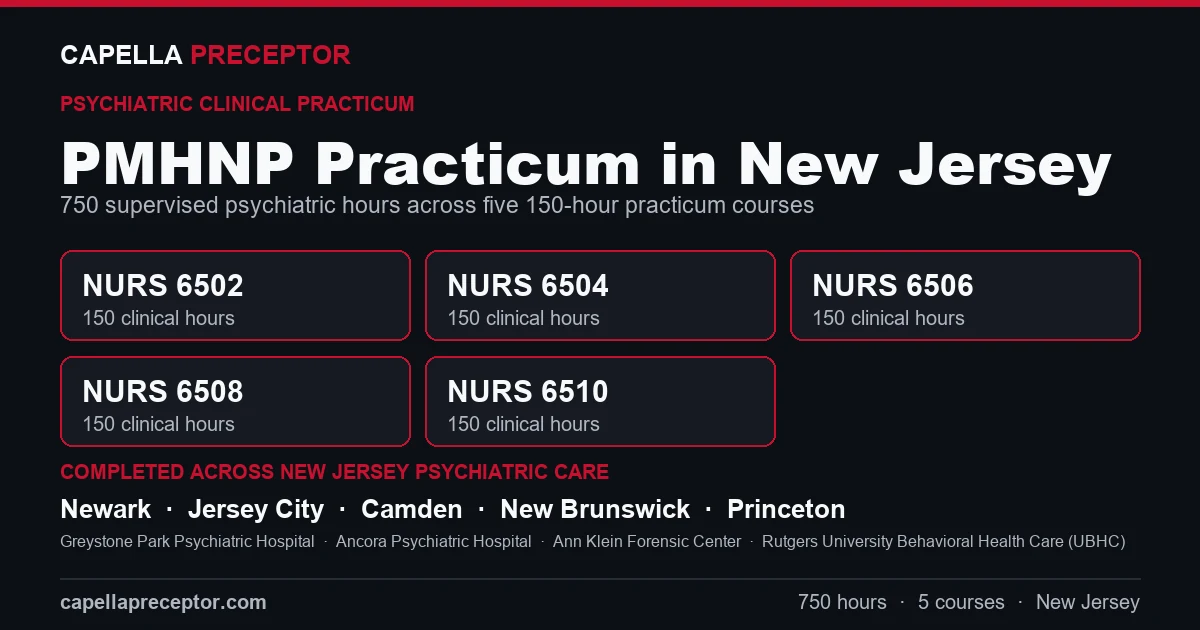
How many psychiatric practicum hours does the Capella PMHNP need in New Jersey?
The hour requirement does not change at the state line. The Capella MSN Psychiatric-Mental Health Nurse Practitioner specialization requires a minimum of 750 practicum hours, completed as 150 clinical hours in each of five practicum courses, NURS6502, NURS6504, NURS6506, NURS6508, and NURS6510 (Practicum I through V), all in psychiatric settings under a qualified preceptor (Capella, MSN-PMHNP courses). That five-by-150 structure is specific to PMHNP; it is not the same as the Capella FNP track, which spreads 750 hours across a different set of primary-care practicum courses. The full course-by-course breakdown lives on our PMHNP page, so we will not repeat it here.
What New Jersey changes is the regulatory environment your preceptor practices in and the rules that govern the psychiatric care you observe and document. PMHNP is a lifespan specialty, so the sequence deliberately spreads your hours across adult, older-adult, child, and adolescent psychiatry, which in a state like New Jersey usually means more than one site over the five courses. The sections below cover the New Jersey-specific pieces: board certification, the 2026 practice-authority change, controlled-substance prescribing, telepsychiatry limits, and where the real psychiatric sites are.
Does a New Jersey psychiatric preceptor still need a collaborating physician?
Historically, yes. The American Association of Nurse Practitioners classifies New Jersey as a reduced-practice state, where at least one element of nurse-practitioner practice is limited by a required collaborative relationship (AANP, State Practice Environment). In New Jersey that element was prescribing: before writing for a medication or device, an advanced practice nurse had to maintain a written joint protocol with a collaborating New Jersey physician (NJ Board of Nursing, APN Certification). For a psychiatric APN, whose entire scope is built on prescribing and managing psychotropic medication, that collaborating-physician requirement shaped how the practice ran.
That changed in 2026. On March 30, 2026, New Jersey enacted S2996/A4052, which makes independent practice permanent for qualifying APNs who deliver primary or behavioral health care and lets those APNs prescribe without a joint protocol (State of New Jersey, Office of the Governor). The behavioral-health carve-out is the relevant one for PMHNP: a psychiatric APN is squarely the kind of provider the law was written to free from the collaborating-physician model. Eligibility is tied to factors such as the care provided and accumulated hours of active advanced practice, and the rules are still settling, so confirm current status for your preceptor's situation directly with the Board.
For you as a student, the headline matters less than the preceptor's actual credential. You are not prescribing yet. What has to be true is that your preceptor holds an active New Jersey APN certification in the psychiatric-mental-health population and a scope that covers the patients your Capella courses require. You can verify any New Jersey RN or APN yourself through the Division of Consumer Affairs license-verification portal (NJ Division of Consumer Affairs, license verification); we verify every preceptor there and document it for your Capella site-approval file.
What controlled-substance rules will a New Jersey psych preceptor work under?
Psychiatric practice is medication-heavy, and a large share of what a PMHNP prescribes is controlled: Schedule II stimulants for ADHD, benzodiazepines, and buprenorphine for opioid use disorder. New Jersey layers a state Controlled Dangerous Substances (CDS) registration on top of the federal DEA registration. To prescribe Schedule II through V substances in New Jersey, a prescriber needs both, with the state CDS registration administered through the New Jersey Drug Control Unit (NJ Controlled Dangerous Substances Act). New Jersey also requires advanced practice nurses to complete six contact hours of continuing education in controlled-substance pharmacology, including addiction prevention and management, tied to that authority (NJ Board of Nursing, APN Certification).
This is not paperwork you are responsible for as a student, but it shapes the rotation. A preceptor with full CDS and DEA authority and an active medication-for-opioid-use-disorder panel can show you the part of psychiatric practice the certification exam tests hardest, and it is exactly the experience that is hard to find. When we match a New Jersey psychiatric preceptor, scope of prescribing is one of the things we screen for, because a placement where you only observe therapy and never see psychopharmacology management leaves a gap your Capella courses expect you to fill.
Can Capella PMHNP hours be done by telehealth in New Jersey?
Some can, with real limits. New Jersey regulates telehealth under its Telemedicine and Telehealth Act (N.J.S.A. 45:1-61 et seq.), and behavioral health gets favorable treatment: a provider performing mental-health screening by telehealth does not need a separate authorization or a waiver to do so (NJ Rev. Stat. 45:1-62). Much of psychiatric care, intake interviews, medication management, and psychotherapy, is genuinely delivered by video, and Capella names telepsychiatry directly in its Practicum III experience.
But New Jersey tightened the rules on controlled substances by telehealth. Effective February 16, 2026, a practitioner may prescribe a Schedule II controlled substance by telehealth only after an initial in-person examination, followed by an in-person visit at least once every three months (Frier Levitt, on N.J.S.A. 45:1-62(e)). The statute carries a narrow exception for Schedule II stimulants prescribed to patients under 18, using real-time audio-visual technology and with written guardian consent. That directly affects a psychiatric rotation built around stimulants and other Schedule II medications, so a fully remote PMHNP placement in New Jersey is not realistic if your preceptor's panel relies on those drugs.
The practical answer: New Jersey allows meaningful telepsychiatry, but a credible PMHNP rotation here is hybrid, not fully virtual, and the controlled-substance work that the certification exam leans on is largely an in-person experience under current law. The amount of telehealth that counts toward your hours also depends on your specific Capella course instructions, so confirm both the course allowance and the state rule before assuming a remote plan. Where a student in a thinly served county genuinely cannot reach an in-person site, our virtual preceptorship covers eligible hours with the same CORE ELMS logging.
What psychiatric settings in New Jersey count for PMHNP practicum?
PMHNP hours must be earned in behavioral and mental-health practice, not general primary care, and supervised by an appropriately credentialed provider. New Jersey has a deep psychiatric infrastructure to draw on, which is a real advantage once you can get into it:
- The four state psychiatric hospitals. New Jersey operates Greystone Park, Trenton, and Ancora psychiatric hospitals plus the Ann Klein Forensic Center, a system of inpatient psychiatric care (NJ Department of Health, Division of Behavioral Health Services).
- Academic behavioral-health systems. Rutgers University Behavioral Health Care (UBHC) offers a broad range of outpatient, intensive-outpatient, addiction, and first-episode-psychosis services across the state (Rutgers UBHC).
- Community mental-health and outpatient psychiatry clinics in the northern metro core (Newark, Jersey City, Paterson), the central corridor (Edison, New Brunswick, Princeton), and South Jersey (Camden, Cherry Hill).
- Child and adolescent psychiatry practices, needed for the population focus of Practicum II, which is often the hardest psychiatric setting to source.
- Substance-use and medication-for-opioid-use-disorder programs, where you see buprenorphine management and dual-diagnosis care firsthand.
The supervising provider must hold an active New Jersey license and the scope to oversee psychiatric care, a PMHNP-BC, a psychiatrist, or an equivalent. Both the credential and the setting clear Capella's review before you log a single hour, so we confirm them upfront rather than letting a site fail review after you have started.
Why is it so hard to find a PMHNP preceptor in New Jersey?
Because psychiatric preceptors are the scarcest category in nurse-practitioner education, and New Jersey concentrates the competition. The behavioral-health preceptor shortage is well documented: psychiatric sites willing to host students are limited, the student-to-preceptor ratio has tightened as cohorts grow, and many psychiatric providers have cut back on clinical teaching because of caseload and burnout (NPHub, on the PMHNP preceptor shortage). New Jersey then adds density and competition: Rutgers, Seton Hall, Fairleigh Dickinson, and the large hospital systems already place their own PMHNP students, so unaffiliated psychiatric slots fill early.
Capella does not assign you a preceptor or a psychiatric site. The university is explicit that the learner is responsible for securing an appropriate preceptor, while a support team helps connect learners with site opportunities (Capella, MSN-PMHNP overview). In a market this tight, that responsibility is heavier than it sounds, and it is where psychiatric students lose terms. We carry an active New Jersey psychiatric preceptor network and place across the state, not one corner of it, with the adult/older-adult and child/adolescent rotations covered separately because one practice rarely covers both well.
Clearing the Capella workflow for a New Jersey site
Securing the psychiatric preceptor is step one. Before you log a single hour in New Jersey, the Capella clearance workflow has to close. Capella manages practicum application, site and preceptor approval, hour tracking, and evaluations through CORE ELMS, its practicum-management system. Three things have to be in place:
- Site and preceptor approval in CORE ELMS. You propose your New Jersey psychiatric site and preceptor, and Capella reviews the credentials before clearing the placement. We meet Capella's published requirements and submit for the university's review; we never represent a preceptor as endorsed by Capella.
- A signed affiliation agreement. Capella and the New Jersey psychiatric site must execute an affiliation agreement before practicum begins. Larger systems and state hospitals route these through legal, which adds lead time, so we start early.
- Third-party compliance. A background check and health records clear through CastleBranch before your start date. Inpatient and forensic psychiatric sites in New Jersey can carry additional clearance steps, so front-load this.
New Jersey PMHNP FAQ
How many psychiatric practicum hours does the Capella PMHNP require in New Jersey?
A minimum of 750 supervised psychiatric clinical hours, completed as 150 hours in each of five practicum courses (NURS6502, NURS6504, NURS6506, NURS6508, NURS6510 / Practicum I to V) at an approved New Jersey site under an on-site psychiatric-mental-health preceptor. The requirement is the same in New Jersey as anywhere else; what changes by state is the board rules your preceptor practices under.
Does a New Jersey psychiatric preceptor still need a collaborating physician?
Historically yes. New Jersey is classified by the AANP as a reduced-practice state, and an advanced practice nurse needed a written joint protocol with a collaborating New Jersey physician before prescribing. On March 30, 2026 the state enacted S2996/A4052, which makes independent practice permanent for qualifying APNs delivering primary or behavioral health care and lets them prescribe without a joint protocol. For a student, the preceptor's own license and scope matter more than the category label, so confirm current status with the New Jersey Board of Nursing.
Can Capella PMHNP psychiatric hours be done by telehealth in New Jersey?
Some can. New Jersey recognizes telehealth for behavioral health, and mental-health screening by telehealth does not require a separate authorization. But effective February 16, 2026, New Jersey law (N.J.S.A. 45:1-62) requires an initial in-person exam plus an in-person follow-up at least every three months before a Schedule II controlled substance, including stimulants, is prescribed by telehealth, with a narrow exception for stimulants to patients under 18. The share of telehealth that counts toward your hours also depends on your Capella course instructions, so confirm both before assuming hours can be remote.
What psychiatric settings in New Jersey count for PMHNP practicum?
Behavioral and mental-health practice supervised by a credentialed provider: outpatient psychiatry and community mental health, inpatient psychiatric units, the four state psychiatric hospitals (Greystone Park, Trenton, Ancora, and the Ann Klein Forensic Center), academic systems such as Rutgers University Behavioral Health Care, child and adolescent psychiatry practices, substance-use and medication-for-opioid-use-disorder programs, and telepsychiatry groups.
Why is it so hard to find a PMHNP preceptor in New Jersey?
Psychiatric preceptors are the scarcest in nurse-practitioner education nationally, and New Jersey is a dense, competitive market where Rutgers, Seton Hall, and large hospital systems already place their own students. Many psychiatric providers have cut back on teaching because of caseload and burnout, so unaffiliated PMHNP slots fill early. We carry an active New Jersey psychiatric preceptor network for exactly this reason.
Sources
- Capella University, MSN-PMHNP courses and practicum hours
- New Jersey Board of Nursing, Advanced Practice Nurse Certification
- State of New Jersey, Office of the Governor, on S2996/A4052 (March 30, 2026)
- New Jersey Revised Statutes 45:1-62, Telemedicine and Telehealth
- Frier Levitt, New Jersey Schedule II telehealth prescribing rules (effective Feb 16, 2026)
- New Jersey Department of Health, Division of Behavioral Health Services (state psychiatric hospitals)
- Rutgers University Behavioral Health Care (UBHC)
- NPHub, on the PMHNP preceptor shortage
How Capella Preceptor helps with a New Jersey PMHNP placement
You now know the New Jersey psychiatric landscape: a reduced-practice category reshaped by the 2026 behavioral-health law, controlled-substance and Schedule II telehealth rules that keep a credible PMHNP rotation mostly in person, a deep set of psychiatric sites that are hard to get into, and a Capella placement the university leaves entirely to you. That last part is where psychiatric students lose weeks. We secure a verified, New Jersey-licensed psychiatric preceptor whose scope meets Capella's published requirements, prepare every CORE ELMS form and affiliation agreement, submit the placement for Capella's review, and keep your 750 hours logged and submitted on schedule.
- Verified New Jersey psychiatric preceptor matched in 7 days, adult and child/adolescent rotations covered
- Every CORE ELMS form, affiliation agreement, and CastleBranch step handled and submitted for Capella's review
- No payment until you are matched
Need the full program breakdown or the statewide picture? See Capella PMHNP preceptor and psych clinical placement for the five-course hour structure, and Capella practicum and preceptors in New Jersey for board rules across every specialty.
Get a Capella PMHNP preceptor in New Jersey
Free 15-minute consult. No payment until matched. We map your entire psychiatric practicum plan.
Get my free consult →