Home / MSN-PMHNP / North Dakota
PMHNP · North DakotaCapella PMHNP Preceptor in North Dakota
A Capella PMHNP practicum in North Dakota requires 750 supervised psychiatric clinical hours across five 150-hour practicum courses, completed in person under an on-site psychiatric-mental-health preceptor. North Dakota is a full practice authority state, so a North Dakota PMHNP can diagnose and prescribe controlled psychiatric medications independently, which widens who can precept you. The hard part here is not the law. It is that psychiatric providers are scarce and spread across a large, rural state, which is exactly what this page maps out.
Last updated: 2026-06-28 · Reviewed by the Capella Preceptor placement team
What does a Capella PMHNP practicum require, and what does North Dakota add?
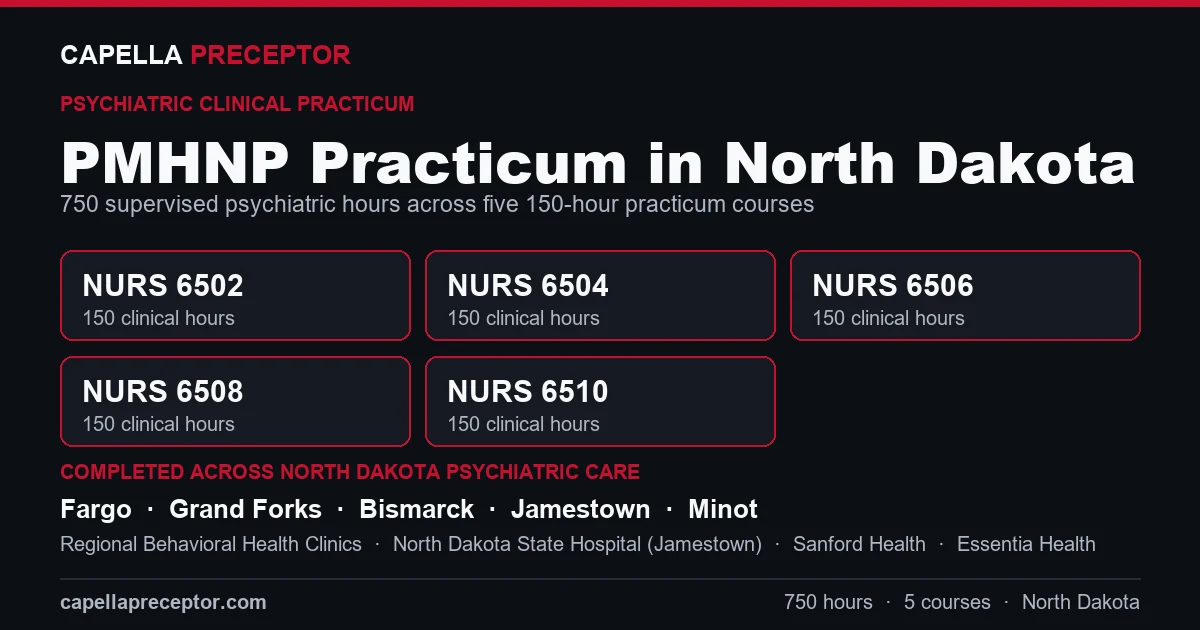
The Capella MSN Psychiatric Mental Health Nurse Practitioner specialization requires a minimum of 750 practicum hours, completed as 150 clinical hours in each of five practicum courses, NURS6502 (Practicum I), NURS6504 (Practicum II), NURS6506 (Practicum III), NURS6508 (Practicum IV), and NURS6510 (Practicum V) (Capella, MSN-PMHNP courses). That five-by-150 structure is specific to the psychiatric track; it is not the six-by-125 pattern of the primary care FNP, and the hours have to be earned in behavioral and mental-health practice, not general primary care. The coursework is online and the psychiatric practicum is completed in person at an approved site in your own community, under an on-site PMHNP or psychiatrist preceptor. For the full program-wide breakdown, see our Capella PMHNP page.
North Dakota is a full practice authority state, classified that way by the American Association of Nurse Practitioners (AANP, North Dakota). For a psychiatric student that has a sharper consequence than it does in primary care. A licensed North Dakota PMHNP can assess, diagnose, and manage a psychiatric medication regimen, including controlled medications, under the sole authority of the state board. So an independently practicing psychiatric nurse practitioner can take you on as a preceptor without first stacking a physician supervision contract on top of the teaching relationship. For the statewide board detail that applies to every specialty, see our North Dakota page; the sections below are about what changes once the practicum is psychiatric.
Can a North Dakota PMHNP prescribe controlled psychiatric medications independently?
Yes, and this matters for psychiatric placement more than for any other specialty, because so much of psychiatric care is controlled-substance prescribing. North Dakota repealed the rule that tied APRN prescribing to a written physician collaboration arrangement effective October 1, 2011 (North Dakota Board of Nursing, APRN FAQs). Under North Dakota Administrative Code 54-05-03.1-10, an APRN with prescriptive authority prescribes a therapeutic regimen independently, and "each licensee must apply for and receive a drug enforcement administration number before writing prescriptions for controlled substances." In practice, a board-certified North Dakota PMHNP can independently start and manage Schedule II stimulants for ADHD, benzodiazepines, and buprenorphine for opioid use disorder, once that DEA registration is in place.
There is a documentation duty that comes with it, and your preceptor will model it for you. A North Dakota prescriber who prescribes controlled substances "must access and utilize the North Dakota prescription drug monitoring program," and must evaluate and document a PDMP report for any new client needing a controlled substance and at least every six months during ongoing controlled-substance treatment (North Dakota Board of Nursing, prescription drug monitoring). For a PMHNP learner that is not red tape, it is core psychiatric prescribing practice you will be expected to demonstrate, and a preceptor whose own panel includes controlled-medication management gives you real exposure to it.
Where are the real psychiatric clinical settings in North Dakota?
Psychiatric capacity in North Dakota is concentrated, and a PMHNP placement has to land in one of these channels rather than in a primary care clinic. The state runs a network of eight Regional Behavioral Health Clinics (formerly called Human Service Centers), the public backbone of community psychiatric care, located in Bismarck, Devils Lake, Dickinson, Fargo, Grand Forks, Jamestown, Minot, and Williston (North Dakota HHS, Regional Behavioral Health Clinics). These deliver outpatient psychiatric medication management, therapy, crisis services, and substance-use treatment, and they are where much of the state's prescriber capacity sits.
The largest behavioral health markets, with the Southeast and Northeast regional clinics plus outpatient psychiatry at systems such as Sanford Health and Essentia Health.
The West Central regional clinic and the capital region's outpatient psychiatry and medication management.
The North Dakota State Hospital, the state's primary inpatient psychiatric and addiction facility, plus the South Central regional clinic.
The North Central regional clinic, anchoring psychiatric access for a wide north-central catchment.
The Badlands and Northwest regional clinics in the west, where in-person psychiatric preceptors are hardest to find and telepsychiatry fills the gap.
The Lake Region clinic and rural outreach sites for smaller communities across the state.
Inpatient psychiatric experience usually routes through the North Dakota State Hospital in Jamestown, the state's primary institution for psychiatric treatment since 1885, which provides short-term inpatient psychiatric care, substance-use treatment, and forensic services (North Dakota HHS, State Hospital; North Dakota Monitor). Substance-use and addiction hours, which PMHNP students need, are available both there and through the regional clinics' SUD programs.
How hard is it really to find a PMHNP preceptor in North Dakota?
Harder than for a primary care track, and it is worth being honest about why. North Dakota is one of the most psychiatrically underserved states in the country. Most of its counties are designated mental health professional shortage areas, and roughly 65 percent of nonmetropolitan counties nationally have no psychiatrist at all, a pattern North Dakota's rural geography fits closely (North Dakota HHS, shortage designations; HRSA, behavioral health workforce). When the supply of psychiatric prescribers is this thin, the ones who exist are already carrying full panels, and an unpaid preceptorship competes for their scarce time.
Child and adolescent psychiatry, your NURS6504 Practicum II population, is the tightest squeeze of all. Experts describe North Dakota as "desperately short" of psychiatrists statewide, with child psychiatry the scarcest sub-specialty, which is why the state built school-based pediatric telehealth to reach kids who cannot otherwise see a provider (STAT, telepsychiatry in North Dakota; North Dakota Pediatric Mental Health Care Access). The practical takeaway is the same one Capella's lifespan requirement implies: plan for more than one preceptor. A realistic North Dakota PMHNP plan often pairs a local adult psychiatric preceptor for the bulk of the hours with a separate, frequently virtual, source for child and adolescent psychiatry.
Can North Dakota PMHNP practicum hours be done by telepsychiatry?
North Dakota is, unusually, a national leader in psychiatric telehealth, which works in a PMHNP student's favor. By the state's own reporting, around a quarter of its psychiatrists see patients by video, against a national figure closer to five percent, and its eight regional clinics deliver psychiatric care across the state by telepsychiatry as a matter of routine (STAT, telepsychiatry in North Dakota). Capella's own Practicum III description lists telepsychiatry as part of the advanced clinical experience, so supervised telehealth is a recognized part of the PMHNP track, not a workaround.
That said, telepsychiatry is not an unlimited escape hatch from the 750-hour count. How many telehealth hours count toward your total depends on your specific course requirements, your preceptor's practice, and how the supervised relationship is structured, so confirm the current allowance against your course instructions before assuming a practicum can be done entirely online. North Dakota also requires that a prescriber establish a valid prescriber-client relationship through a documented assessment before treatment, including over telehealth, which is part of what a telepsychiatry preceptor will teach you to do correctly (North Dakota Board of Nursing, nursing practice). For the program-wide view of telehealth in this specialty, see the telepsychiatry section of our Capella PMHNP page.
What does Capella require before North Dakota psychiatric hours count?
Once you have a psychiatric preceptor and site, there is a clearance sequence to finish before your first hour counts, and it is the same whether you are at a Fargo behavioral health clinic or a rural telepsychiatry practice. Capella runs the practicum application, site and preceptor approval, and hour logging through CORE ELMS, its practicum-management system. Capella reviews and approves the placement you propose; it does not assign or endorse a preceptor, and a match is never guaranteed until Capella approves it.
- Submit your psychiatric site and preceptor in CORE ELMS for Capella's review and approval, with a preceptor who meets Capella's published requirements (a PMHNP-BC, psychiatrist, or equivalent psychiatric scope).
- Get an affiliation agreement signed between Capella and the psychiatric site before practicum begins. A behavioral health clinic that has never hosted a Capella student often hesitates here, and that delay is what eats a North Dakota start date.
- Clear compliance through CastleBranch, Capella's background-check and health-records vendor, before you are cleared for a psychiatric site.
- Confirm preceptor licensure with the North Dakota Board of Nursing, then log and submit each course's 150 hours in CORE ELMS for your preceptor to approve.
North Dakota PMHNP FAQ
Can a Capella PMHNP preceptor prescribe controlled psychiatric medications independently in North Dakota?
Yes. North Dakota is a full practice authority state that repealed its APRN physician collaboration rule effective October 1, 2011, so an independently practicing PMHNP can prescribe controlled psychiatric medications such as stimulants and benzodiazepines once they hold a DEA registration. Under North Dakota Administrative Code 54-05-03.1, an APRN must obtain a DEA number before prescribing any controlled substance, and a prescriber who prescribes controlled substances must access and document the North Dakota prescription drug monitoring program.
Can Capella PMHNP practicum hours be done by telepsychiatry in North Dakota?
Telepsychiatry is well established in North Dakota, which leads the nation in psychiatric telehealth use, and Capella lists telepsychiatry within Practicum III. How many telehealth hours count toward your 750 depends on your specific course requirements, your preceptor's practice, and how the supervised relationship is structured, so confirm the current allowance against your course instructions rather than assuming all hours can be remote.
Where do Capella PMHNP students find psychiatric preceptors in North Dakota?
Psychiatric clinical capacity in North Dakota concentrates in the eight state Regional Behavioral Health Clinics in Bismarck, Devils Lake, Dickinson, Fargo, Grand Forks, Jamestown, Minot, and Williston, the North Dakota State Hospital in Jamestown for inpatient and addiction care, and outpatient behavioral health at systems such as Sanford Health and Essentia Health. Child and adolescent psychiatry is especially scarce statewide, so many students combine a local adult psychiatric preceptor with a telepsychiatry rotation.
How many practicum hours does the Capella PMHNP require, and how are they split?
A minimum of 750 supervised psychiatric practicum hours, completed as 150 clinical hours in each of five practicum courses, NURS6502 Practicum I, NURS6504 Practicum II, NURS6506 Practicum III, NURS6508 Practicum IV, and NURS6510 Practicum V, in behavioral and mental-health settings under an on-site PMHNP or psychiatrist preceptor.
Does Capella find my North Dakota psychiatric preceptor for me?
No. Capella offers support resources but states that learners are responsible for finding an appropriate preceptor to oversee the practicum experience. You secure the psychiatric preceptor and site, then submit them in CORE ELMS for Capella's review and approval. We match a preceptor who meets Capella's published requirements and submit the proposal on your behalf; placement is never guaranteed until Capella approves it.
Sources
- Capella University, MSN-PMHNP courses (750 hours, five 150-hour practicum courses)
- AANP, North Dakota (full practice authority)
- North Dakota Administrative Code 54-05-03.1-10, authority to prescribe (DEA number for controlled substances)
- North Dakota Board of Nursing, prescription drug monitoring (PDMP duty)
- North Dakota HHS, Regional Behavioral Health Clinics (eight regions)
- North Dakota HHS, North Dakota State Hospital (Jamestown inpatient psychiatric and addiction care)
- STAT, telepsychiatry in North Dakota (psychiatrist shortage and telehealth use)
How Capella Preceptor helps with a North Dakota PMHNP placement
North Dakota clears the legal path with full practice authority, but the state's psychiatric provider shortage makes the placement itself the hard part, especially the child and adolescent hours. We match a verified, North Dakota-licensed psychiatric preceptor who meets Capella's published requirements, in person or by telepsychiatry, and submit the proposal for Capella's review while we run every CORE ELMS form, affiliation agreement, and compliance step so your hours start counting on time.
- Verified psychiatric preceptor matched in 7 days, with no payment until matched
- Adult and the scarce child/adolescent psychiatric hours covered across all five practicums
- Every CORE ELMS form and affiliation agreement prepared and submitted for Capella's review
Get a Capella PMHNP preceptor in North Dakota
Free 15-minute consult. No payment until matched. We map your full psychiatric practicum plan, including the hard-to-source child and adolescent hours.
Get my free consult →