Capella PMHNP Preceptor in Rhode Island
A Capella PMHNP practicum in Rhode Island requires 750 supervised psychiatric clinical hours across five 150-hour practicum courses, completed under an on-site psychiatric-mental-health preceptor. Rhode Island is a full practice authority state, so an experienced PMHNP can precept you on their own license, and the state nursing regulations carve out a specific list of psychiatric controlled substances such a preceptor may prescribe. This page explains what that environment means for your hours, the controlled-substance and telepsychiatry rules that shape them, where students actually earn psychiatric hours in Rhode Island, and how to secure a psych preceptor in a state where they are genuinely scarce.
Last updated 2026-06-28 · Reviewed by the Capella Preceptor placement team
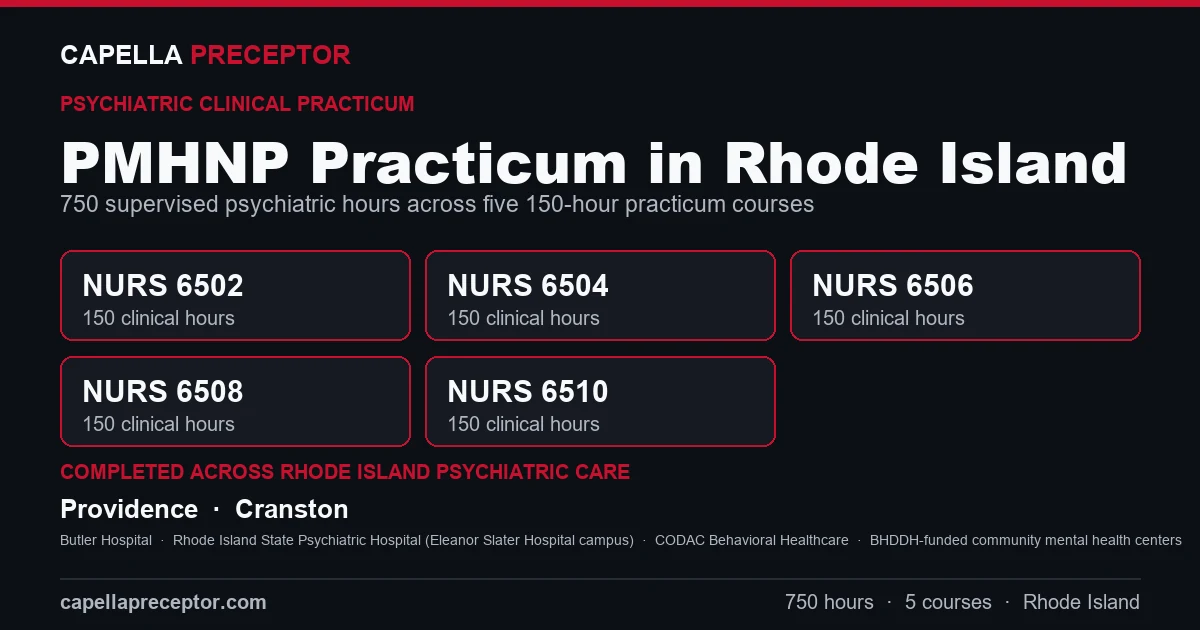
How many psychiatric hours does a Capella PMHNP need in Rhode Island?
Crossing into Rhode Island does not change the number. The Capella MSN-PMHNP specialization requires a minimum of 750 practicum hours, earned as 150 clinical hours in each of five practicum courses, NURS6502, NURS6504, NURS6506, NURS6508, and NURS6510 (Practicum I through V), every hour in a psychiatric or behavioral-health setting under a qualified preceptor (Capella, MSN-PMHNP courses). That five-course, 150-hour structure is unique to PMHNP and is not the six-course primary-care pattern an FNP follows, so do not lay out your Rhode Island schedule from an FNP plan. Coursework is online; the supervised hours are completed in person in your own community (Capella, MSN-NP program).
What Rhode Island actually changes is the clinical reality underneath that count: which clinician can sign your hours, what your preceptor is allowed to prescribe while you watch, and how much of your psychiatric care can happen over video. Those three things, supervision authority, controlled-substance scope, and telepsychiatry, are where a Rhode Island PMHNP practicum reads differently from the same practicum in a restricted state, and from a Rhode Island FNP placement, which sits in primary care rather than psychiatry. The population focus of each of the five practicums is broken down on the all-states PMHNP page; the wider Rhode Island picture across every Capella program, including the family-practice track, is on the Rhode Island placement page.
What does full practice authority mean for a PMHNP preceptor in Rhode Island?
The American Association of Nurse Practitioners classifies Rhode Island as a full practice authority state (AANP, State Practice Environment). For a psychiatric placement that classification carries real weight. A licensed PMHNP in Rhode Island evaluates patients, orders and interprets diagnostics, and prescribes psychiatric medication under the authority of the state Board of Nurse Registration and Nursing Education, not under a supervising psychiatrist. State regulation defines independent practice as an APRN working without a formal collaborative agreement, and states plainly that collaboration "does not require such relationship to be evidenced by a written collaboration agreement, to be with a specific designated physician, or for services to be performed at the same physical location" (216-RICR-40-05-3.2).
For your hours, that means a board-certified PMHNP in Rhode Island is a complete, self-sufficient preceptor. They can supervise and sign off on your psychiatric hours on their own license, with no collaborating physician needed to authorize the arrangement, which widens the pool of clinicians who can legally take you. The catch in Rhode Island is not the law; it is supply, covered further down. The board recognizes the certified nurse practitioner role and requires an active Rhode Island RN license, a graduate APRN program from an accredited institution, and current national certification in the role and population focus (216-RICR-40-05-3.3); for a psychiatric preceptor that population focus is psychiatric-mental health.
What can a Rhode Island PMHNP preceptor prescribe in front of you?
Psychiatric training is largely training in controlled-substance prescribing, so the state's drug rules shape what you actually see day to day. Rhode Island is unusual here: rather than granting psychiatric APRNs the same broad authority as every other NP, the nursing regulations write a psychiatric-specific carve-out directly into the rule. A psychiatric or mental-health APRN's prescriptive privileges "shall include prescription of certain psychotropic and certain legend medications, controlled substances from Schedule II classified as stimulants, and controlled substances from Schedule III and IV," and "shall not include controlled substances from Schedules I, II, and V" outside that stimulant carve-out (216-RICR-40-05-3.7). That is a narrower, more sharply defined list than most full-practice states publish, and it is written specifically for the psychiatric role you will be precepted in.
Read against a real psychiatric caseload, the carve-out covers the three drug classes a PMHNP rotation lives in:
Two practical points sit on top of the carve-out. To prescribe any controlled substance, a Rhode Island APRN must hold a state Controlled Substance Registration through the Department of Health on top of a federal DEA registration (216-RICR-40-05-3.7), and any DEA-registered prescriber must complete the eight-hour MATE Act training on opioid and substance-use-disorder treatment (SAMHSA, MATE Act training). None of this changes where you can do hours; it explains the prescribing world your preceptor operates in, which is the substance of a psychiatric practicum and the clearest line between this placement and an FNP one.
Can Capella PMHNP hours be done by telepsychiatry in Rhode Island?
Psychiatry is the most telehealth-native of the NP specialties, and Rhode Island has a settled legal framework for it. Under the state Telemedicine Coverage Act, telemedicine means care delivered "by means of real time, two-way electronic audiovisual communications," and the act explicitly does not count "an audio-only telephone conversation, email message, or facsimile transmission" as telemedicine (Center for Connected Health Policy, Rhode Island; Rhode Island Department of Health, Telemedicine). APRNs are named among the providers who can deliver telehealth, so telepsychiatry over secure video is a normal, covered part of how psychiatric care is delivered statewide, and a 2024 Rhode Island law also lets qualifying out-of-state practitioners provide telehealth to patients located in Rhode Island.
What the state permits sets the outer limit, not your actual hour mix. Capella names telepsychiatry directly within the Practicum III experience, but how much of your 750 hours can be earned remotely depends on your specific course requirements, your preceptor's practice, and the school's clinical-hour rules (Capella, MSN-PMHNP courses). Confirm the current telehealth allowance for each practicum against your course instructions before assuming the whole sequence can be virtual. Because Rhode Island is geographically tiny, the usual pattern is a blend: an in-person anchor site within a short drive of Providence for most hours, with a telepsych practice filling a population, such as child and adolescent, that the local site cannot cover.
Where do Capella PMHNP students complete psychiatric hours in Rhode Island?
For a state its size, Rhode Island has a dense and well-defined behavioral-health system, which helps a psychiatric student because the named sites are few and findable. The state Department of Behavioral Healthcare, Developmental Disabilities and Hospitals (BHDDH) operates the public psychiatric and addiction system and funds the community mental health centers across the state (Rhode Island BHDDH). Real Rhode Island settings where PMHNP students earn psychiatric hours, when staffed by an appropriately credentialed supervising provider, include:
- Butler Hospital in Providence, the state's only free-standing nonprofit psychiatric hospital, offering specialized assessment and treatment for major psychiatric illness and substance use across adults, seniors, and adolescents (Butler Hospital), a long-standing psychiatric training environment.
- The Rhode Island State Psychiatric Hospital on the Eleanor Slater Hospital campus in Cranston, which treats psychiatric and court-ordered forensic patients with serious mental illness, for acute, inpatient, and forensic exposure (BHDDH, RI State Psychiatric Hospital).
- Addiction and MOUD programs, including CODAC Behavioral Healthcare, which runs community-based opioid treatment programs across Rhode Island (CODAC Behavioral Healthcare), central to the co-occurring substance-use disorders a psychiatric caseload carries.
- The BHDDH-funded community mental health centers serving Providence and the surrounding mill cities and shore towns, which cover outpatient psychiatry and medication management for the adult and older-adult populations the practicum sequence requires.
- Private outpatient, child-and-adolescent, and telepsychiatry practices concentrated in the Providence metro and on Aquidneck Island, which cover the lifespan rotations and fill gaps a single site cannot.
The supervising provider must hold an active, unencumbered Rhode Island license with the scope to oversee psychiatric care, typically a board-certified PMHNP or a psychiatrist. You can confirm an APRN or physician credential through the Rhode Island Department of Health licensing portal (RIDOH, Nurses licensing); we run that check on every preceptor we propose. Whatever the setting, your chosen site and preceptor go into CORE ELMS for Capella to review before any hour counts.
Why is a PMHNP preceptor so hard to find in Rhode Island?
It is worth being honest about this rather than optimistic. Psychiatric preceptors are the scarcest in the field for reasons that have nothing to do with Rhode Island law, which, as above, is favorable. Fewer than one in ten nurse practitioners specialize in psychiatric-mental health, so the pool of clinicians who can precept a PMHNP student is small to begin with, and many of those who could are stretched thin or have stepped back from teaching because of caseload pressure and burnout. PMHNP students report placement delays more often than almost any other NP specialty (Psychiatric Times, on PMHNP clinical placements).
Rhode Island sharpens that national problem in a specific way: it is a small market. There are only so many psychiatric practices, and the named public sites, Butler, the state psychiatric hospital, CODAC, the BHDDH centers, are already absorbing students from Rhode Island's own university programs and from neighboring Massachusetts and Connecticut. The practicum sequence also wants both adult and child-and-adolescent exposure, and one practice rarely covers both well, so most students end up needing more than one preceptor across the five courses. The realistic plan is to start the search well before the practicum quarter opens, line up an adult-or-older-adult source and a separate child-and-adolescent option, and verify each preceptor's psychiatric scope before you submit the proposal. That sequencing is exactly the work we take off your plate.
Rhode Island PMHNP FAQ
How many psychiatric hours does a Capella PMHNP need in Rhode Island?
A minimum of 750 supervised psychiatric clinical hours, completed as 150 hours in each of five practicum courses (NURS6502, NURS6504, NURS6506, NURS6508, NURS6510), under an on-site psychiatric-mental-health preceptor at an approved Rhode Island behavioral-health site. The hour total is the same in every state; what Rhode Island changes is the prescribing and practice environment your preceptor works in.
Can a Rhode Island NP precept a PMHNP student on their own authority?
Yes. Rhode Island is a full practice authority state, so a licensed psychiatric-mental-health NP can evaluate, diagnose, and prescribe independently, without a written collaborative agreement tied to a supervising physician. That makes a board-certified PMHNP a complete preceptor for your psychiatric hours; you are not limited to psychiatrist-led practices the way a restricted state would force you.
What can a Rhode Island PMHNP preceptor prescribe?
Rhode Island's nursing regulations give psychiatric and mental-health APRNs a specific prescriptive carve-out: certain psychotropic and legend medications, Schedule II controlled substances classified as stimulants, and Schedules III and IV, but not non-stimulant Schedule II drugs and not Schedule V. In practice that covers the stimulants used for ADHD, the benzodiazepines used in anxiety, and buprenorphine for opioid use disorder, all of which a primary-care FNP rotation rarely touches. Prescribing also requires a Rhode Island Controlled Substance Registration on top of a federal DEA registration.
Can Capella PMHNP practicum hours be done by telepsychiatry in Rhode Island?
Rhode Island's Telemedicine Coverage Act recognizes real-time, two-way audiovisual telehealth and names APRNs among covered providers, so telepsychiatry is an established part of Rhode Island psychiatric practice; audio-only telephone, email, and fax do not count as telemedicine. How many of your 750 hours can be earned remotely still depends on your specific Capella course requirements and your preceptor's practice, so confirm the current allowance against your course instructions rather than assuming all hours can be virtual.
Where do Capella PMHNP students complete psychiatric hours in Rhode Island?
At approved behavioral-health sites: Butler Hospital in Providence, the state's only free-standing nonprofit psychiatric hospital; the Rhode Island State Psychiatric Hospital on the Eleanor Slater Hospital campus in Cranston for inpatient and forensic exposure; CODAC and other opioid-treatment and MOUD programs; the community mental health centers funded through BHDDH; and private outpatient, child-and-adolescent, and telepsychiatry practices. Whichever site you choose, the preceptor and placement go into CORE ELMS for Capella to review before your hours can begin.
Sources
- Capella University, MSN-PMHNP courses and practicum hours (750 hours, five 150-hour practicums)
- AANP, State Practice Environment (Rhode Island, full practice authority)
- 216-RICR-40-05-3.7, psychiatric APRN prescriptive carve-out and controlled-substance registration
- 216-RICR-40-05-3.2, definitions of independent practice and collaboration
- 216-RICR-40-05-3.3, APRN licensing and population-focus requirements
- Center for Connected Health Policy, Rhode Island telehealth law (Telemedicine Coverage Act)
- Rhode Island Department of Health, Nurses licensing and verification
- Rhode Island BHDDH, State Psychiatric Hospital and behavioral-health system
- SAMHSA, MATE Act eight-hour training requirement
How Capella Preceptor helps with a Rhode Island PMHNP placement
Rhode Island law is on your side, but the psychiatric preceptor pool here is small and already spoken for. That is the gap we close. We match a verified, Rhode Island-licensed psychiatric-mental-health preceptor whose scope and license meet Capella's published requirements, confirm the behavioral-health site qualifies, and prepare every CORE ELMS form and affiliation agreement so your 750 hours start on time. We submit the placement for Capella's review; we never promise Capella's approval, because that decision is the university's.
- Verified Rhode Island psychiatric preceptor matched in 7 days, no payment until matched
- Adult and child/adolescent rotations covered across all five practicum courses
- Every CORE ELMS form and affiliation agreement prepared and submitted for Capella's review
On the family nurse practitioner track instead? See Capella FNP preceptor requirements in Rhode Island for the primary-care practicum hours, board rules, and local settings, or read the all-states Capella PMHNP requirements for the full practicum breakdown.
Get a Capella PMHNP preceptor in Rhode Island
Free 15-minute consult. No payment until matched. We map your entire psychiatric practicum plan.
Get my free consult →