Home / PMHNP Preceptor in South Dakota
PMHNP · South DakotaCapella PMHNP Preceptor in South Dakota
A Capella PMHNP practicum in South Dakota requires 750 supervised psychiatric clinical hours across five 150-hour practicum courses, completed in person under an on-site psychiatric-mental-health preceptor. South Dakota is a full practice authority state, so an experienced nurse practitioner here can prescribe controlled psychiatric medications and precept you without a supervising physician attached. The harder part is that psychiatric prescribers are scarce statewide. This page covers both: the PMHNP requirements, and the South Dakota board rules and real settings that decide where your hours happen.
Last updated: June 28, 2026 · Reviewed by the Capella Preceptor placement team
What does a Capella PMHNP practicum require in South Dakota?
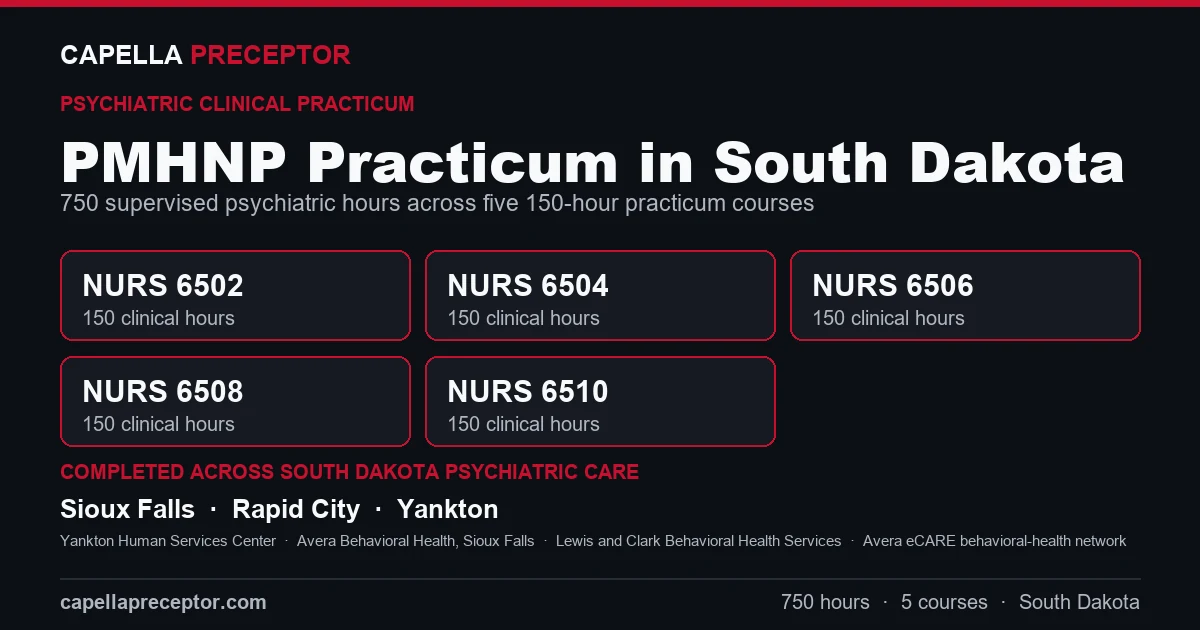
The hour count is set by Capella, not by South Dakota. The MSN Psychiatric Mental Health Nurse Practitioner specialization requires a minimum of 750 practicum hours, completed as 150 clinical hours in each of five practicum courses: NURS6502 (Practicum I), NURS6504 (II), NURS6506 (III), NURS6508 (IV), and NURS6510 (V) (Capella, MSN-PMHNP courses). That structure is different from the Capella FNP track, which spreads 750 hours across six primary-care courses of 125 hours; if you are weighing the family route instead, see our FNP preceptor in South Dakota page, which covers primary-care settings rather than psychiatric ones. Every PMHNP hour must be earned in a behavioral or mental-health setting under a credentialed psychiatric preceptor, and the coursework is online while the psychiatric practicum is completed in person in your own community. For the program-wide breakdown of the five courses and their population focus, see our Capella PMHNP preceptor and hours page.
What South Dakota changes is not the number. It is who is allowed to precept you, what they can prescribe in front of you, where the real psychiatric sites are, and how thin the supply of psychiatric prescribers runs across a frontier state. Those four things are the rest of this page.
Who can precept a PMHNP student in South Dakota?
South Dakota licenses nurse practitioners as Certified Nurse Practitioners (CNPs) through the South Dakota Board of Nursing (SDBON), based in Sioux Falls (SDBON, CNP practice). The American Association of Nurse Practitioners classifies the state as full practice authority, meaning an experienced CNP can evaluate, diagnose, and prescribe independently on their own license (AANP, South Dakota). For a psychiatric placement, the preceptor you want is a board-certified PMHNP (PMHNP-BC) or a psychiatrist whose license and scope cover psychiatric care; a primary-care NP cannot anchor your psychiatric hours.
Full practice authority removes a common scheduling bottleneck. A seasoned South Dakota PMHNP can sign on as your preceptor without looping in a collaborating physician, which simplifies the affiliation paperwork compared with a restricted state. Newer CNPs in South Dakota generally complete a defined block of practice under a written collaborative agreement before the agreement is retired, so an established psychiatric NP who is already independent is usually the cleaner match. We confirm any preceptor's active, unencumbered license through the board's public lookup, which the board treats as primary-source verification (SDBON license verification), and you can run the same check yourself before you commit to anyone.
What can a South Dakota psychiatric preceptor prescribe in front of you?
This matters more in psychiatry than in most specialties, because so much of the work is controlled-substance management. In South Dakota a CNP may prescribe controlled substances in Schedules II through IV on their own authority once they are registered with the federal DEA, hold a South Dakota Controlled Substance Registration, and are enrolled in the state Prescription Drug Monitoring Program (PDMP) (SDBON, CNP practice). In practical terms, that covers the medications you will actually learn to manage on a psychiatric rotation here: Schedule II stimulants for ADHD, benzodiazepines for acute anxiety, and buprenorphine for opioid use disorder.
South Dakota also requires a PDMP check for every Schedule II or III opioid prescription, each time it is written, with narrow exceptions for hospice and palliative care (South Dakota Department of Health, PDMP). For a PMHNP learner that is not a footnote: medication-assisted treatment and stimulant management are core psychiatric competencies, and you want a preceptor who prescribes them so your hours include the controlled-substance workflow, not just talk therapy. A preceptor who actively runs a buprenorphine panel or an ADHD clinic gives you exposure a general counseling site cannot.
Where are the real psychiatric settings in South Dakota?
PMHNP hours have to be earned in behavioral and mental-health practice, not general primary care, and South Dakota has a smaller, more concentrated set of those sites than a large state. The verifiable ones worth knowing:
- Yankton Human Services Center. The state psychiatric hospital, with 277 beds spanning adult acute psychiatry, geriatric, adolescent psychiatric, and an adult substance-use program, which is one of the few places in the state to log inpatient and child/adolescent psychiatric exposure in one system (South Dakota DSS, Human Services Center).
- Avera Behavioral Health, Sioux Falls. An inpatient and outpatient psychiatric hospital that includes child and adolescent psychiatry and addiction recovery, useful for the lifespan range PMHNP requires (Avera Behavioral Health Hospital).
- Community mental health centers. Regional CMHCs such as Lewis and Clark Behavioral Health Services, which serves fourteen counties in southeastern South Dakota, are the outpatient backbone for psychiatric care outside the two metros (Lewis and Clark Behavioral Health Services).
- Telepsychiatry networks. South Dakota leans on virtual psychiatry harder than most states; the Avera eCARE behavioral-health network was built specifically to reach rural emergency departments and clinics across a roughly 71,000-square-mile service area in the eastern half of the state (Avera, virtual behavioral health).
Can PMHNP hours be done by telepsychiatry in South Dakota?
Partly, and South Dakota is a better-than-average place to ask the question. Psychiatry is one of the most telehealth-adaptable specialties because intake interviews, medication management, and psychotherapy translate well to video, and Capella names telepsychiatry directly inside its Practicum III experience (Capella, MSN-PMHNP courses). South Dakota has invested heavily in telepsychiatry infrastructure, which means a real share of working psychiatric prescribers here practice at least partly by video, so a telehealth-capable preceptor is genuinely findable.
That does not mean the whole practicum can be remote. How many telehealth hours count toward your 750 depends on your specific course requirements, your preceptor's practice, and the supervision rules in force when you start. Telehealth prescribing of controlled substances in particular sits under federal rules that have shifted in recent cycles, so confirm the current telehealth allowance for each practicum against your course instructions rather than assuming every hour can be done online. For how virtual placement works mechanically, the same way for in-person and remote hours, see our South Dakota placement page.
Why is finding a PMHNP preceptor in South Dakota so hard?
Honest answer: the psychiatric preceptor shortage here is real and acute, not a sales line. South Dakota is a largely rural state, and large parts of it are federally designated mental-health professional shortage areas; nationally, the majority of rural counties have no practicing psychiatrist, and South Dakota's geography mirrors that (Rural Health Information Hub, mental health HPSA map). The small number of psychiatric prescribers in the state are in heavy demand, frequently already precepting other students, and concentrated in Sioux Falls, Rapid City, and Yankton.
Layer on Capella's own policy. The university is explicit that "learners are responsible for finding an appropriate preceptor to oversee the practicum experience" (Capella, MSN-PMHNP courses); the support team helps connect you with site opportunities, but the search is yours. In a dense metro that is workable. In South Dakota, where a single rural town may have no psychiatric prescriber at all, it is where most students stall. That is the gap we close, with a verified in-person match where the density supports one and a virtual psychiatric placement where it does not.
What Capella clears before your first psychiatric hour
Finding the right South Dakota psychiatric clinician is step one. Capella reviews and approves the proposed placement before any hour counts, and skipping a step stalls your start date.
- Propose the psychiatric site and preceptor in CORE ELMS, Capella's practicum-management system, so the placement can be submitted for the university's review and approval.
- Get the affiliation agreement signed between Capella and the South Dakota site before the practicum begins. Smaller rural behavioral-health clinics often have no template on file, so this step takes the longest if you start it late.
- Clear the background check through CastleBranch, which the PMHNP program requires by the end of the first billing session or quarter (Capella, MSN-PMHNP overview).
- Log hours in CORE ELMS for preceptor approval. Each of the five practicum courses must reach its 150-hour total, and the lifespan requirement means you may need adult and child/adolescent psychiatric exposure across the sequence.
To be clear about what approval means: a preceptor we propose is one who meets Capella's published requirements and is submitted for the university's review. We do not describe any preceptor or site as Capella-endorsed or affiliated, and no service can guarantee that a particular placement is approved. Capella makes that decision.
In-person or virtual for South Dakota PMHNP students
Geography drives this more in South Dakota than in most states. If you are in or near Sioux Falls, Rapid City, or Yankton, an in-person psychiatric placement is usually realistic, and we match you locally so your hours are face to face in an inpatient unit, a behavioral-health hospital, or a community mental-health center. If you are in a central county or a small town where the nearest psychiatric prescriber is hours away, a telepsychiatry-based placement keeps you moving without a daily drive.
Best near Sioux Falls, Rapid City, and Yankton, where psychiatric-site density supports a local PMHNP or psychiatrist match.
Built for the rural reality here. Telepsychiatry hours are logged and approved in CORE ELMS the same way, within your course's telehealth allowance.
South Dakota PMHNP FAQ
How many psychiatric practicum hours does Capella PMHNP require in South Dakota?
A minimum of 750 supervised psychiatric clinical hours, completed as 150 hours in each of the five practicum courses NURS6502, NURS6504, NURS6506, NURS6508, and NURS6510. The total is the same in South Dakota as anywhere else, because it is set by Capella, not the state. What South Dakota changes is who can precept and where you complete the hours.
Can a South Dakota nurse practitioner preceptor prescribe controlled psychiatric medications independently?
Yes. South Dakota is a full practice authority state, and a certified nurse practitioner can prescribe controlled substances in Schedules II through IV on their own license once registered with the federal DEA, the South Dakota Controlled Substance Registration, and the South Dakota Prescription Drug Monitoring Program. That covers the stimulants, benzodiazepines, and buprenorphine you will see managed in a psychiatric rotation.
Can Capella PMHNP hours be done by telepsychiatry in South Dakota?
Some can. South Dakota is a telepsychiatry-heavy state, and Capella names telepsychiatry inside the Practicum III experience. The share of telehealth hours that counts depends on your specific course requirements, your preceptor's practice, and the supervision rules in force, so confirm the current allowance against your course instructions rather than assuming every hour can be remote.
Where can I do a psychiatric practicum in South Dakota?
Real psychiatric settings in South Dakota include the Yankton Human Services Center (the 277-bed state psychiatric hospital with adolescent psychiatric and adult substance-use units), Avera Behavioral Health in Sioux Falls, community mental health centers such as Lewis and Clark Behavioral Health Services in the southeast, addiction and medication-assisted treatment programs, and telepsychiatry groups including the Avera network. Each placement still has to clear Capella's review before your hours count.
Why is a PMHNP preceptor so hard to find in South Dakota?
South Dakota is a largely rural, federally designated mental health shortage state where many counties have no practicing psychiatrist, so the small number of psychiatric prescribers are in heavy demand and often already supervising other learners. Capella also requires you to secure your own preceptor. That combination is why a verified match or a virtual psychiatric placement matters more here than in a dense metro.
Sources
- Capella University, MSN-PMHNP courses and practicum hours
- Capella University, MSN-PMHNP overview (CastleBranch background check)
- South Dakota Board of Nursing, CNP practice and prescriptive authority
- AANP, South Dakota state practice page (full practice authority)
- South Dakota Department of Health, Prescription Drug Monitoring Program
- South Dakota DSS, Human Services Center (Yankton state psychiatric hospital)
- Rural Health Information Hub, mental health professional shortage areas
How Capella Preceptor helps PMHNP students in South Dakota
South Dakota's full practice authority works in your favor, an experienced PMHNP can precept you and prescribe independently, but it does not solve the real problem: psychiatric prescribers are scarce and spread out, and Capella still leaves the search to you. We match a verified, board-confirmed South Dakota psychiatric preceptor, in Sioux Falls, Rapid City, Yankton, or fully virtual where local options run out, then submit the placement for Capella's review and handle CORE ELMS, the affiliation agreement, and the CastleBranch background check so your hours start on time.
- Verified PMHNP-BC or psychiatrist preceptor who meets Capella's published requirements
- In person near the metros or telepsychiatry across rural and frontier counties
- CORE ELMS submission, affiliation agreement, and CastleBranch handled; no payment until matched
On the family nurse practitioner track instead? See Capella FNP preceptor requirements in South Dakota for primary-care practicum hours and local clinical settings, or the program-wide PMHNP requirements and South Dakota placement pages.
Get a Capella PMHNP preceptor in South Dakota
Free 15-minute consult. No payment until matched. We map your entire psychiatric practicum plan.
Get my free consult →