Home / PMHNP / PMHNP Preceptor in Texas
Program & StateCapella PMHNP Preceptor in Texas
A Capella PMHNP practicum in Texas requires 750 supervised psychiatric clinical hours across five 150-hour practicum courses, completed in person under an on-site psychiatric-mental-health preceptor. Texas is a restricted nurse practitioner practice state, so your preceptor prescribes psychiatric medication under a prescriptive authority agreement with a delegating physician, and most Schedule II controlled substances sit outside that agreement. This page explains how those two facts collide for a psych student, then how we secure a verified Texas preceptor who meets Capella's published requirements.
Last updated 2026-06-28 · Reviewed by the Capella Preceptor placement team
What does a Capella PMHNP practicum in Texas actually require?
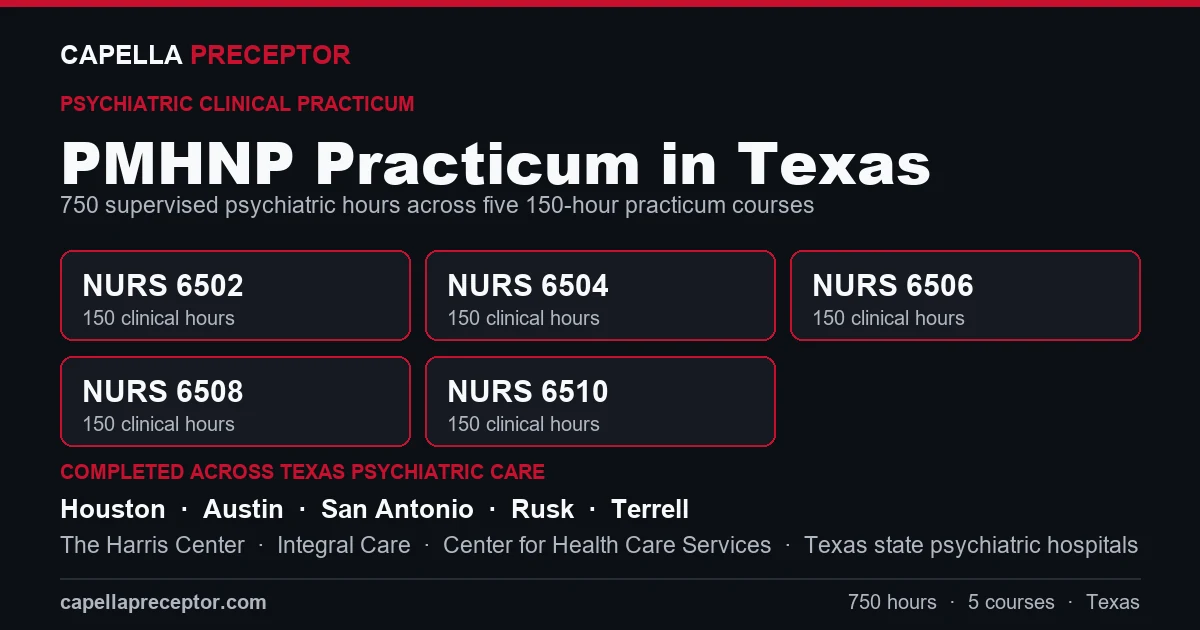
The Capella MSN Psychiatric Mental Health Nurse Practitioner specialization requires a minimum of 750 practicum hours, completed as 150 clinical hours in each of five practicum courses, NURS6502 (Practicum I), NURS6504 (Practicum II), NURS6506 (Practicum III), NURS6508 (Practicum IV), and NURS6510 (Practicum V) (Capella, MSN-PMHNP courses). The coursework is online; the psychiatric practicum is in person, completed at an approved site in your own Texas community under a credentialed psychiatric preceptor. The full hour-by-hour breakdown lives on our Capella PMHNP page; this page is about what changes when that practicum happens in Texas.
Two Texas facts reshape the search. First, PMHNP is a lifespan specialty, so your hours have to cover adult, older-adult, child, and adolescent psychiatry, which usually means more than one preceptor. Second, Texas is a restricted practice state, so a psychiatric clinic that hosts you is already running a physician-delegation model, and that physician is part of who has to agree to take a student. A Texas FNP rotation lands in family medicine and primary care; a Texas PMHNP rotation lands in behavioral health, where the prescribing rules below are tighter and the preceptor pool is smaller.
How does Texas restricted practice change a psychiatric preceptorship?
The American Association of Nurse Practitioners classifies Texas as a restricted practice state, its most limited category (AANP, State Practice Environment). In Texas the restricted element is prescribing: an advanced practice registered nurse can only prescribe psychiatric medication under a written prescriptive authority agreement with a delegating physician (Texas Board of Nursing, APRN practice). For a primary care FNP that mostly governs antibiotics and blood-pressure scripts. For a psychiatric NP it governs the daily work of the specialty, antidepressants, mood stabilizers, antipsychotics, and the controlled medications below, so the delegation framework is felt much more directly in a psych rotation than in a primary care one.
The practical effect on your search is that the practice you join already runs on these physician agreements. A behavioral-health clinic comfortable supervising APRNs is usually comfortable taking a graduate student, but the supervising physician and the preceptor both have to sign off, and in psychiatry that physician is sometimes off-site or part-time. That extra approval is exactly the negotiation we take off your plate.
What can a Texas PMHNP preceptor prescribe, and why does it matter for your hours?
This is where a psychiatric Texas practicum looks nothing like a primary-care one. Under a Texas prescriptive authority agreement, an APRN generally cannot prescribe Schedule II controlled substances, the category that includes the stimulants used for ADHD such as amphetamine and methylphenidate. The narrow exceptions are a hospital inpatient admission of 24 hours or longer, the emergency department, and hospice care for a patient with a written terminal-illness certificate (Texas Board of Nursing, APRN practice FAQ). Texas also applies the same one-month prescribing limit to Schedule II stimulants that it applies to opioids (Texas Medical Association).
Schedules III through V, which cover a lot of real psychiatric practice, are different. A Texas APRN may prescribe them under the agreement, but a single prescription including refills cannot exceed a 90-day supply; beyond that, a refill requires consulting the delegating physician with a note in the chart, and prescribing one of these drugs to a child under age two also requires that consultation first (Texas Board of Nursing, APRN practice FAQ). Buprenorphine for opioid use disorder, a Schedule III medication, falls in this tier; since the federal X-waiver was eliminated, any clinician with a standard DEA registration may prescribe it where state law allows (SAMHSA, buprenorphine prescribing).
For your practicum, the takeaway is concrete: if you want to learn stimulant management for ADHD, an outpatient clinic alone may not show you that workflow, because the prescribing sits with the delegating physician; an inpatient or hospital-affiliated rotation often will. We factor this in when we propose a Texas site, so your hours match the clinical experiences your courses expect.
Can Texas PMHNP hours be done by telehealth or telepsychiatry?
Partly. Psychiatry is one of the more telehealth-friendly specialties, and Capella names telepsychiatry directly inside the Practicum III experience (Capella, MSN-PMHNP courses). Texas backs that up: it permits mental-health care by telemedicine, and it allows audio-only (telephone) outpatient mental-health services, including psychiatric diagnostic evaluation, psychotherapy, and pharmacological management, for a patient with an established clinical relationship (at least one in-person or audiovisual visit within the prior six months, and one such visit every rolling 12 months) (Center for Connected Health Policy, Texas). Texas also treats telemedicine as care delivered under physician delegation and supervision, and the telehealth standard of care matches in-person care (Texas Medical Association, telemedicine).
What that does not mean is that all 750 hours can be remote. How much telehealth counts toward your supervised hours depends on your specific course instructions, your preceptor's practice, and the program's clinical requirements, so confirm the current allowance for each practicum rather than assuming the whole degree is virtual. Where a county has no in-person psychiatric seat, a verified Texas telepsychiatry preceptor can keep your hours moving while you log them through Capella's system.
Which Texas psychiatric settings count for PMHNP practicum?
PMHNP hours have to be earned in behavioral and mental-health practice, supervised by an appropriately credentialed provider such as a board-certified PMHNP or a psychiatrist. Texas has more public psychiatric infrastructure than most students realize. The Texas Health and Human Services Commission operates ten state psychiatric hospitals and contracts with 37 local mental health authorities and two local behavioral health authorities that serve all 254 counties (Texas HHS, local mental and behavioral health authorities). Those, plus private behavioral-health practices, are your real settings:
Community mental health centers such as The Harris Center in Houston, Integral Care in Austin, and the Center for Health Care Services in San Antonio, the backbone of public outpatient psychiatry.
The ten Texas state hospitals (for example Austin, San Antonio, Rusk, Terrell, and Kerrville) for inpatient and acute psychiatric exposure, where Schedule II inpatient prescribing is also visible.
Pediatric behavioral-health clinics and youth programs needed for the Practicum II child-and-adolescent population, which a general adult clinic will not cover.
Addiction and medication-assisted treatment clinics, including buprenorphine programs, across the metros and along the border.
Private psychiatry practices and Texas telepsychiatry networks for medication management and psychotherapy hours.
Underserved counties where a verified preceptor plus a telepsychiatry option keeps your hours on schedule when local seats are scarce.
Why is a PMHNP preceptor so hard to find in Texas?
Be honest with yourself about this one, because it is the reason students land on this page at 11pm. Fewer than one in ten nurse practitioners specialize in psychiatric mental health, so the preceptor pool is small to begin with (NPHub, finding PMHNP preceptors). The providers who do qualify often see 20 to 30 patients a day on tight telehealth schedules with little room to teach, and PMHNP enrollment has grown faster than any other NP track, so demand for those few preceptors keeps climbing while supply does not. Layer Texas restricted practice on top, where a delegating physician is part of the yes, and a cold email to a busy psychiatric clinic is slow going.
None of that means you are stuck. It means the search is real work, and Capella leaves that work to you. The university says a "dedicated Capella support team helps connect you with practicum site opportunities," but it states plainly that "learners are responsible for finding an appropriate preceptor to oversee the practicum experience" (Capella, MSN-PMHNP overview). That responsibility, in a thin psychiatric market and a restricted-practice state, is what we take on.
How do you verify and approve a Texas psychiatric site?
Securing the preceptor is the start, not the finish. Once you name a Texas site and preceptor, there is a clearance workflow before a single psychiatric hour counts, and Capella runs it through CORE ELMS, its practicum-management system (Capella, CORE ELMS). We prepare the paperwork and keep it on schedule:
- Verify the preceptor's Texas license through the Board of Nursing online verification before the site is proposed (Texas Board of Nursing, license verification).
- Confirm the psychiatric scope, that the preceptor is a board-certified PMHNP or psychiatrist with the right to oversee psychiatric care, and that any delegating physician is in place.
- Submit the site and preceptor in CORE ELMS for Capella's own review and approval. We match preceptors who meet Capella's published requirements and submit for Capella's review; the university approves the placement, not us.
- Execute the affiliation agreement between Capella and the Texas psychiatric site before day one.
- Clear compliance through Capella's vendor (CastleBranch, via DISA Healthcare on the myCB platform): background check, drug screen, and health records.
- Log hours per course in CORE ELMS, with your preceptor approving each course toward its 150-hour total.
A placement is never guaranteed, and we never claim a preceptor is endorsed by the university. We line up a verified, Texas-licensed psychiatric preceptor who meets Capella's published requirements, then submit the site for Capella's review so the university makes the final call.
Texas PMHNP FAQ
Can a Capella PMHNP student do psychiatric practicum hours by telehealth in Texas?
Sometimes, but not the whole 750. Capella lists telepsychiatry inside Practicum III, and Texas allows mental-health care by telemedicine and even audio-only telephone for an established patient. How many of your supervised hours can be remote depends on your specific course instructions and your preceptor's practice, so confirm the current telehealth allowance for each practicum before assuming hours can be done entirely online.
Can my Texas PMHNP preceptor prescribe ADHD stimulants and other Schedule II drugs?
Generally no, except in narrow settings. Texas advanced practice registered nurses prescribe under a prescriptive authority agreement with a delegating physician, and that agreement does not extend to most Schedule II controlled substances such as stimulants for ADHD, except in a hospital admission, an emergency department, or hospice care. Schedule III to V drugs, including buprenorphine for opioid use disorder, are limited to a 90-day supply before a documented physician consultation.
Does the Texas Board of Nursing or Capella place me with a psychiatric preceptor?
No. The Texas Board of Nursing licenses and verifies APRNs but does not assign preceptors or run clinical sites, and Capella makes the student responsible for securing the preceptor and the psychiatric site for all 750 hours. That search is the part we handle, matching a verified, Texas-licensed psychiatric preceptor who meets Capella's published requirements and submitting the site for Capella's own review.
What psychiatric settings in Texas count for Capella PMHNP hours?
Behavioral and mental-health practice, not primary care. Texas options include outpatient psychiatry, the state's local mental health authorities and community mental health centers, the ten Texas state psychiatric hospitals, inpatient behavioral-health units, child and adolescent clinics, substance-use and medication-assisted treatment programs, and telepsychiatry groups, each supervised by an appropriately credentialed provider.
Is Texas a hard state to find a PMHNP preceptor in?
Yes. Fewer than one in ten nurse practitioners specialize in psychiatric mental health, psychiatric providers often see 20 to 30 patients a day with little room to teach, and PMHNP enrollment has grown faster than the supply of preceptors. In Texas the restricted prescriptive-authority model adds a delegating physician to the approval, so the search is the slowest part of the degree. That is the gap we close.
Sources
- Capella University, MSN-PMHNP courses and practicum hours
- AANP, State Practice Environment (Texas restricted)
- Texas Board of Nursing, APRN practice and prescriptive authority
- Texas Board of Nursing, APRN practice FAQ (controlled substances)
- Texas Medical Association, Schedule II stimulant prescribing limit
- Center for Connected Health Policy, Texas telehealth (audio-only mental health)
- Texas HHS, local mental and behavioral health authorities
- Capella University, MSN-PMHNP overview (student secures preceptor)
How Capella Preceptor helps PMHNP students in Texas
In a restricted state with a thin psychiatric preceptor market, the search is the slowest part of your degree, and Capella hands it to you. We close that gap. We match a verified, Texas-licensed psychiatric preceptor who meets Capella's published requirements, cover adult, geriatric, child, and adolescent rotations across all five practicums, prepare every CORE ELMS form and the affiliation agreement, and submit the site for Capella's review. A placement is never guaranteed, and no payment is due until you are matched.
- Verified Texas psychiatric preceptor, in person or telepsychiatry
- Adult and child/adolescent psychiatry covered across all 750 hours
- CORE ELMS, affiliation agreement, and CastleBranch handled
Want the program details or the wider state rules? See the Capella PMHNP hours and courses page and the Capella preceptor in Texas overview for primary-care tracks and statewide coverage.
Get a Capella PMHNP preceptor in Texas
Free 15-minute consult. No payment until matched. We map your entire Texas psychiatric practicum plan.
Get my free consult →