Capella PMHNP Preceptor in Utah
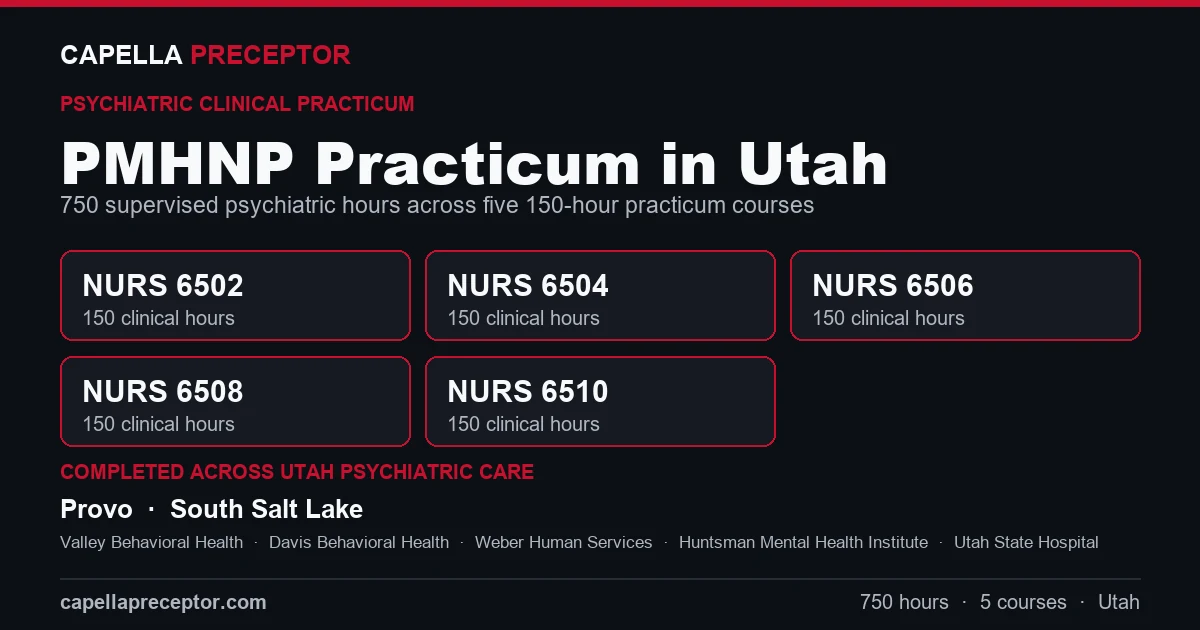
A Capella PMHNP practicum in Utah requires 750 supervised psychiatric clinical hours across five 150-hour practicum courses, completed under an on-site psychiatric-mental-health preceptor. Utah gives licensed nurse practitioners full practice authority, but a new PMHNP still prescribes controlled psychiatric medications under a consultation and referral plan at first, and the state's psychiatric preceptor pool is thin. Here is how the hours, Utah board rules, telepsychiatry, and real psychiatric settings fit together, and how we secure a verified psych preceptor for you.
Last updated 2026-06-28 · Reviewed by the Capella Preceptor placement team
How many psychiatric hours does a Capella PMHNP practicum in Utah require?
The Capella MSN Psychiatric-Mental Health Nurse Practitioner specialization requires a minimum of 750 practicum hours, completed across five psychiatric practicum courses at 150 clinical hours each (NURS6502 Practicum I, NURS6504 Practicum II, NURS6506 Practicum III, NURS6508 Practicum IV, and NURS6510 Practicum V) (Capella, MSN-PMHNP courses). That total is set by the program, not the state, so it is the same in Utah as anywhere else. What changes in Utah is the legal and clinical environment those hours happen in, which is the subject of this page. For the full course-by-course breakdown and the lifespan rotation requirement, see our Capella PMHNP preceptor and psych practicum page.
This is a psychiatric practicum, not a primary-care one. Every one of the 750 hours has to be earned in a behavioral or mental-health setting under a credentialed psychiatric supervisor, which is a materially harder placement to find in Utah than a family-medicine rotation. If you are on the family track instead, that is a different search with different settings; see Capella FNP preceptor in Utah.
Does Utah's full practice authority change the PMHNP preceptor requirement?
Utah is a full practice authority state. Since Senate Bill 36 took effect in 2023, the American Association of Nurse Practitioners lists Utah as Full Practice, meaning a licensed Utah NP evaluates, diagnoses, and prescribes without a supervising or collaborating physician (AANP, State Practice Environment; AANP, Utah's new law). That status is genuinely good news for your career, but it does not touch your practicum. Practice authority describes what a licensed clinician may do; a Capella student in Utah still has to secure a qualified psychiatric preceptor and an approved site and log supervised hours, exactly as a student in a restricted state does. The independence arrives after you are licensed, not during NURS6502.
APRN licenses in Utah, including nurse practitioner licenses, are issued by the Utah Division of Professional Licensing (DOPL) under the Department of Commerce, with the Utah Board of Nursing setting professional standards (Utah DOPL, Nursing). Before you propose a preceptor, you can confirm their license and standing through DOPL's public lookup (Utah DOPL, License Lookup). We verify every Utah psych preceptor there before we ever submit them for Capella's review.
How does Utah handle controlled-substance prescribing in psychiatry?
This is where psychiatry differs sharply from primary care, and where Utah's rules matter to you. A large share of psychiatric practice is prescribing scheduled drugs: Schedule II stimulants for ADHD, controlled medications for anxiety and sleep, and buprenorphine for opioid use disorder. Under Utah Code 58-31b-803, an APRN who has been licensed less than one year or has fewer than 2,000 hours of practice must prescribe Schedule II and III controlled substances in accordance with a consultation and referral plan with a physician or an experienced APRN; the plan is no longer required once that threshold is met (Utah Code 58-31b-803; Utah Code 58-31b-803 (codified text)).
For your practicum this has a practical upshot. Most working PMHNPs and psychiatrists who would precept you already hold DEA registration and prescribe these medications daily, so a real psychiatric site gives you direct exposure to controlled-substance management and the Utah Controlled Substance Database checks that go with it. It also explains why your first job after graduation may start under a consultation and referral plan even in a full-practice state, which is worth understanding before you choose where to do your hours.
Can PMHNP telepsychiatry hours in Utah be done remotely?
Partly, and Utah's rules are specific. Capella names telepsychiatry directly inside the Practicum III experience, and psychiatry is one of the more telehealth-suited specialties because intake interviews, medication management, and psychotherapy are routinely delivered by video. Utah recognizes live-video telehealth for mental, behavioral, and substance-use services, but the state does not permit a provider to diagnose, treat, or prescribe based solely on an online questionnaire, an email, or any asynchronous, store-and-forward exchange; a real-time provider-patient encounter is required (CCHP, Utah telehealth laws; Utah Telehealth Act, Title 26 Ch. 60).
So any telepsychiatry hours your Utah preceptor supervises must be synchronous, with the preceptor present and overseeing live encounters, not you reviewing charts after the fact. How many of your 750 hours can come from telehealth still depends on your specific Capella course instructions and your preceptor's practice, so confirm the current allowance per practicum rather than assuming the whole sequence can be remote.
Which Utah psychiatric settings count for the practicum?
Your hours must come from behavioral-health practice, not a general clinic, and Utah's psychiatric care is concentrated in a handful of public and university systems. Settings that typically qualify, when staffed by a credentialed psychiatric supervisor who agrees to precept and clears Capella's review:
Naming these is not the same as having access to them. A site qualifying on paper is only useful if a credentialed clinician inside it will take a student and sign an affiliation agreement, which is exactly the bottleneck below (Huntsman Mental Health Institute; Utah State Hospital; Utah DHHS, Local Mental Health Authority map).
Why is finding a psychiatric preceptor in Utah so hard?
Be honest with yourself about this part. Capella tells learners they are responsible for finding an appropriate preceptor and completing practicum in their own community; the university does not assign one (Capella, MSN-PMHNP overview). For a primary-care student that is hard. For a psychiatric student in Utah it is harder, for three concrete reasons:
- The supervisor pool is small. A PMHNP preceptor must be a board-certified PMHNP, a psychiatrist, or an equivalent credentialed provider, not just any NP. Utah has a documented behavioral-health workforce shortage, so the eligible pool is a fraction of the primary-care one.
- They are concentrated and already spoken for. Most psychiatric capacity sits along the Wasatch Front and inside the same public and university systems that train Utah's own program students, so a Capella learner competes for placements that fill early.
- The lifespan split needs more than one site. Capella spreads your hours across adult, older-adult, child, and adolescent psychiatry, and a single Utah practice rarely covers all of it, so you may need two preceptors and two affiliation agreements rather than one.
None of that means it cannot be done. It means cold-emailing clinics the term before you start is a poor plan in psychiatry, and starting early, or handing the search to someone who already knows Utah's psychiatric sites, is the difference between starting on time and losing a term.
How a Utah psych placement clears Capella's process
The workflow runs through Capella's practicum-management system, CORE ELMS:
- Propose the Utah site and psychiatric preceptor in CORE ELMS, where Capella verifies the preceptor's credential and reviews the placement.
- Get an affiliation agreement signed between Capella and the Utah behavioral-health site before the rotation starts.
- Clear compliance through a third-party vendor such as CastleBranch (background check, drug screen, and health records), which psychiatric and forensic sites in particular take seriously.
- Log hours in CORE ELMS and have your preceptor approve them, until each of the five courses reaches its 150-hour total.
A preceptor we propose is one who meets Capella's published requirements and is submitted for Capella's review. We never describe a preceptor or site as endorsed by Capella, and matching is never a guarantee of placement, only a serious, verified effort to secure one.
Utah PMHNP FAQ
How many hours does a Capella PMHNP practicum in Utah require?
A minimum of 750 supervised psychiatric clinical hours, completed as 150 hours in each of the five practicum courses (NURS6502, NURS6504, NURS6506, NURS6508, NURS6510), in Utah behavioral-health settings under an on-site psychiatric-mental-health preceptor. The hour requirement comes from the program and is the same in Utah as in any state.
Does Utah full practice authority let a new PMHNP prescribe psychiatric controlled substances on their own?
Not immediately. Utah grants nurse practitioners full practice authority, but under Utah Code 58-31b-803 an APRN who has been licensed less than one year or has fewer than 2,000 hours of practice must prescribe Schedule II and III controlled substances under a consultation and referral plan. Many psychiatric medications, including stimulants for ADHD, fall in those schedules, so a new PMHNP graduate in Utah typically starts under a plan. This applies after licensure and does not change what a student must do during practicum.
Can Capella PMHNP telepsychiatry hours in Utah be done by phone or asynchronously?
No. Utah requires a real-time provider-patient encounter for telehealth; the state does not recognize asynchronous, store-and-forward, or online-questionnaire-only care for establishing a relationship or prescribing. Live-video telepsychiatry is recognized for behavioral health, so telepsychiatry hours your preceptor supervises must be synchronous, and how many of your 750 hours can be telehealth still depends on your Capella course instructions.
What psychiatric settings in Utah count for a Capella PMHNP practicum?
Behavioral-health settings staffed by a credentialed psychiatric supervisor, such as the county Local Mental Health Authorities (for example Valley Behavioral Health, Davis Behavioral Health, Weber Human Services), Huntsman Mental Health Institute and its crisis services, the Utah State Hospital in Provo for inpatient and forensic experience, outpatient psychiatry, child and adolescent practices, and substance-use and addiction programs.
Why is a PMHNP preceptor so hard to find in Utah?
Utah has a documented behavioral-health workforce shortage, the pool of board-certified PMHNPs and psychiatrists who can precept is small and concentrated on the Wasatch Front, and those clinicians are already in demand from Utah's own university programs. A Capella student competes for the same limited psychiatric preceptors, which is why securing one early, or using a placement service, matters more than in primary care.
Sources
- Capella University, MSN-PMHNP courses and practicum hours
- Utah Code 58-31b-803, APRN Schedule II prescriptive authority and consultation and referral plan
- Center for Connected Health Policy, Utah telehealth laws and synchronous behavioral-health rules
- AANP, State Practice Environment (Utah listed as Full Practice)
- Utah Division of Professional Licensing, Nursing
- Utah Department of Health and Human Services, Local Mental Health Authority map
- Utah State Hospital, adult and forensic psychiatric services
How Capella Preceptor helps PMHNP students in Utah
You now know the landscape: Utah gives NPs full practice authority, but your 750 psychiatric hours still depend on a credentialed psych preceptor and a behavioral-health site that Capella expects you to find on your own, in a state with a real shortage of them. We close that gap. We match a verified, DOPL-licensed preceptor who meets Capella's published psychiatric supervision requirements, prepare the CORE ELMS proposal and affiliation agreement, and submit the placement for Capella's review, in person along the Wasatch Front or by synchronous telepsychiatry where your course permits.
- Verified Utah psychiatric preceptor, no payment until matched
- Adult and child/adolescent psychiatry covered across all five practicums
- Every CORE ELMS form and affiliation agreement prepared and submitted
Want the program details without the Utah specifics? See Capella PMHNP preceptor and psych practicum requirements. Need the broader state picture across specialties? See Capella preceptor and clinical placement in Utah.
Get a Capella PMHNP preceptor in Utah
Free 15-minute consult. No payment until matched. We map your entire psychiatric practicum plan.
Get my free consult →