Capella PMHNP Preceptor in Washington
A Capella PMHNP practicum in Washington requires 750 supervised psychiatric clinical hours across five 150-hour practicum courses, completed under an on-site psychiatric-mental-health preceptor. Washington is a full practice authority state, so a board-certified psychiatric ARNP can precept on their own license, with no physician agreement, and can model independent prescribing of controlled psychiatric medications. This page covers the Washington board rules, the controlled-substance and telepsychiatry questions specific to psych practice, where psychiatric hours are actually earned in this state, and how a preceptor is secured.
Last updated 2026-06-28 · Reviewed by the Capella Preceptor placement team
How many psychiatric hours does a Capella PMHNP need in Washington?
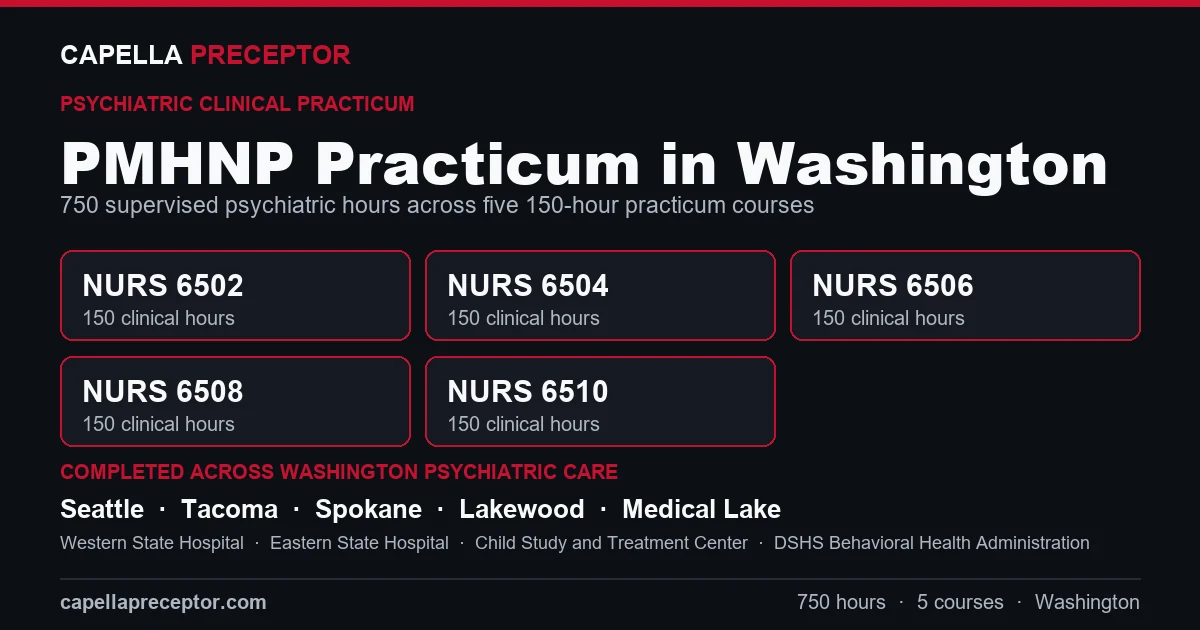
Your hour total comes from the program, not the state, and it is identical whether you place in Seattle or in a small town in the Palouse. The Capella MSN-PMHNP requires a minimum of 750 practicum hours, completed as 150 clinical hours in each of five practicum courses, NURS6502, NURS6504, NURS6506, NURS6508, and NURS6510 (Practicum I through V), all in psychiatric and behavioral-health settings under a qualified preceptor (Capella, MSN-PMHNP courses). That five-by-150 structure is specific to PMHNP; it is not the family-practice pattern, and the population focus shifts from adult and older-adult psychiatry through child and adolescent psychiatry across the sequence. Our full breakdown of the courses and approved psychiatric settings lives on the Capella PMHNP preceptor page, and the general Washington picture for every specialty is on the Washington practicum page. This page is the intersection of the two: PMHNP requirements plus Washington psychiatric board rules.
One Washington-specific planning note. Because the sequence demands both adult and child or adolescent psychiatry, and child psychiatry is the scarcest behavioral-health specialty in the state, most Washington PMHNP students need more than one site or preceptor across the five courses. Plan the child and adolescent rotation early; it is the hours that strand students here.
Does a Washington ARNP need a physician agreement to precept a psych student?
No. The American Association of Nurse Practitioners classifies Washington as a full practice authority state (AANP, State Practice Environment). For psychiatric practice that has a concrete meaning: a Psychiatric-Mental Health Nurse Practitioner here evaluates, diagnoses, orders and interprets testing, and starts and manages psychiatric treatment under the licensing authority of the Washington State Board of Nursing alone, with no statutory collaborative or supervisory physician agreement (Washington State Board of Nursing, ARNP guidance). The advanced credential in this state is the Advanced Registered Nurse Practitioner (ARNP), with the statutory basis in RCW 18.79 and WAC 246-840.
The practical effect for a Capella student is that a practicing PMHNP in Tacoma, Spokane, or Vancouver can agree to precept you on their own psychiatric license without first lining up a physician to co-sign the relationship. That is a real advantage over restricted states, where a psychiatric NP may need a supervising physician of their own before they can take a student. A psychiatrist can also precept depending on the course and population. What full practice authority does not do is place you: Capella still leaves it to the student to find the preceptor, and the university then reviews and approves the proposed psychiatric site before any hour counts.
Can a Washington PMHNP preceptor prescribe controlled psychiatric medications?
Yes, and this matters more for a psych practicum than for any primary-care rotation, because so much of psychiatric prescribing is scheduled. A Washington ARNP who holds a valid DEA registration may prescribe Schedule II through V controlled substances independently, with no joint practice agreement (Washington DOH, who may prescribe; RCW 18.79.250). In practice that covers the medications a PMHNP manages every day:
- Schedule II stimulants for ADHD, where a Washington ARNP may write up to a 90-day supply, so a student sees real stimulant management rather than just observation.
- Benzodiazepines and other scheduled anxiolytics and hypnotics, prescribed and tapered under the preceptor's own authority.
- Buprenorphine for opioid use disorder. After the federal X-waiver was eliminated in 2022, any DEA-registered prescriber with Schedule III authority can prescribe it, so a Washington ARNP in an addiction practice precepts MOUD directly.
Independent prescribing authority is the reason a full practice state is a strong place to learn psychopharmacology. You want a preceptor who actually owns the prescribing decision, not one who routes every controlled-substance order through a supervising physician. When we propose a Washington psychiatric preceptor for your Capella file, we confirm the ARNP or physician license is active through the Department of Health credential search and Nursys, and that the setting matches the population your course requires.
Can Washington PMHNP hours be earned by telepsychiatry?
Partly, and Washington is one of the better states to ask the question in. Washington was the first state to adopt the Uniform Telemedicine Act, effective June 6, 2024, which lets a practitioner deliver telehealth to a patient in the state as long as the care meets the same scope and standard as in-person care (CCHP, Washington telehealth policy). Psychiatry is the specialty most suited to it: intake interviews, medication management, and psychotherapy are routinely delivered by secure video in real Washington practice, and Capella names telepsychiatry directly within the Practicum III experience (Capella, MSN-PMHNP courses).
Two caveats keep this honest. First, telehealth-based hours are accepted to the extent your specific course allows; the share that counts depends on your course requirements and your preceptor's practice, so confirm it against your course instructions rather than assuming the whole practicum can be remote. Second, controlled-substance prescribing over telehealth carries its own rules: a Washington prescriber must check the Prescription Drug Monitoring Program before issuing a controlled prescription, and federal DEA telemedicine flexibilities for prescribing scheduled medications without a prior in-person visit are extended through December 31, 2026 (Telehealth.HHS.gov, prescribing controlled substances via telehealth). For students east of the Cascades or on the Olympic Peninsula, a partial telepsychiatry placement is often what keeps the schedule moving when no in-person psychiatric site is within a reasonable drive.
Where are psychiatric practicum hours actually earned in Washington?
PMHNP hours have to come from behavioral and mental-health practice, not general primary care. Washington has a real and varied psychiatric infrastructure, which helps, but it concentrates around the two metro hubs. Settings that typically qualify when staffed by an appropriately credentialed supervising provider:
Western State Hospital in Lakewood, near Tacoma, and Eastern State Hospital in Medical Lake, near Spokane, run by the DSHS Behavioral Health Administration for inpatient and forensic psychiatry.
County and nonprofit behavioral-health agencies across King, Pierce, Spokane, and rural counties, the workhorse outpatient setting for med management.
Including the Child Study and Treatment Center on the Western State campus, serving ages 5 to 18, which is where the scarce Practicum II population hours can come from.
Addiction and opioid-treatment practices across the state where buprenorphine and dual-diagnosis care are managed directly.
Private psychiatric and behavioral-health practices concentrated in Seattle, Bellevue, Tacoma, Olympia, and Spokane.
Washington-licensed virtual psychiatry practices that reach rural and eastern counties, used for partial-telehealth hours.
The supervising provider must hold an active license and the scope to oversee psychiatric care, a PMHNP-BC, a psychiatrist, or equivalent. Your site and preceptor are proposed and approved before you log a single hour, so both the credential and the setting clear review first.
Why is a PMHNP preceptor hard to find in Washington?
Because psychiatric preceptors are scarce everywhere, and Washington's behavioral-health workforce shortage is well documented. Full practice authority widens the pool of clinicians who are legally able to precept, but it does not change the underlying supply. Three things make psych placement harder than a primary-care one here:
- The lifespan requirement. Few practices cover both adult and child or adolescent psychiatry well, so you often need two sites; child psychiatry is the hardest of all to secure in Washington.
- Geographic concentration. Most psychiatric capacity sits in the Seattle-Tacoma corridor and around Spokane. East of the Cascades, in the Olympic Peninsula, and in the central farm counties, a willing psychiatric preceptor can be an hour or more away.
- Demand from other programs. Washington trains PMHNP students at several universities, all competing for the same limited bench of behavioral-health preceptors each term.
That is the honest picture, and it is why students start the search late and lose a term. The answer is to begin early, line up the child and adolescent hours first, and use a partial telepsychiatry placement to bridge geography where no in-person site is reachable.
The Washington clearance sequence before hours count
Whatever your setting, the same compliance sequence has to close before a single psychiatric hour is logged. Washington adds nothing exotic, but the affiliation step is often the slowest:
- Propose the Washington psychiatric site and preceptor in Capella's practicum system, CORE ELMS, so the placement can be reviewed and approved.
- Verify the preceptor's license through the Washington Department of Health credential search and Nursys, confirming the ARNP or physician scope covers psychiatric supervision.
- Get the affiliation agreement signed between Capella and the Washington psychiatric site before practicum begins. Behavioral-health agencies and state facilities can be slow to execute these, so start early.
- Clear the background check through CastleBranch, which Capella requires by the end of the first billing session or quarter.
- Log and submit hours in CORE ELMS, where your preceptor approves what you record before each of the five courses reaches its 150-hour total.
Washington PMHNP FAQ
How many psychiatric practicum hours does a Capella PMHNP need in Washington?
A minimum of 750 supervised psychiatric hours, completed as 150 clinical hours in each of the five practicum courses (NURS6502, NURS6504, NURS6506, NURS6508, NURS6510). The hour total is set by Capella, not by Washington, and is the same in every state.
Can a Washington ARNP precept a Capella PMHNP student without a physician agreement?
Yes. Washington is a full practice authority state, so a psychiatric ARNP diagnoses, treats, and prescribes under the Washington State Board of Nursing alone, with no collaborative or supervisory physician agreement required. That lets a board-certified PMHNP precept on their own license. Capella still reviews and approves the proposed placement before hours count.
Can a Washington PMHNP preceptor prescribe controlled psychiatric medications?
Yes. A Washington ARNP with a valid DEA registration may prescribe Schedule II through V controlled substances, including stimulants for ADHD, benzodiazepines, and buprenorphine for opioid use disorder, with no joint practice agreement required. Precepting in a practice that prescribes these gives a PMHNP student exposure to real psychiatric prescribing.
Can Capella PMHNP hours in Washington be done by telepsychiatry?
Partly. Washington adopted the Uniform Telemedicine Act in June 2024, and telehealth must meet the same standard of care as in-person care. Capella names telepsychiatry within Practicum III, but how much telehealth counts toward your hours depends on your course requirements and your preceptor's practice, so confirm the current allowance against your course instructions.
Is it hard to find a PMHNP preceptor in Washington?
Yes. Psychiatric preceptors are scarcer than primary care preceptors everywhere, and Washington's behavioral-health workforce shortage is well documented, especially for child and adolescent psychiatry and outside the Seattle and Spokane metros. Full practice authority widens the pool, but a willing, credentialed psychiatric preceptor still has to be found, vetted, and run through the affiliation paperwork.
Sources
- Capella University, MSN-PMHNP courses and practicum hours
- AANP, State Practice Environment (Washington: full practice authority)
- Washington State Board of Nursing, ARNP guidance (RCW 18.79, WAC 246-840)
- Washington DOH, who may prescribe and administer prescriptions
- Center for Connected Health Policy, Washington telehealth law (Uniform Telemedicine Act)
- Telehealth.HHS.gov, prescribing controlled substances via telehealth
- Washington DSHS, Behavioral Health Administration state hospitals
How Capella Preceptor helps in Washington
Washington's full practice authority widens the field of psychiatric clinicians who can precept, but it does not place you, and the behavioral-health shortage means the search is harder than a primary-care one. That is what we do. We match a verified, Washington-licensed, board-certified psychiatric preceptor whose credential and setting meet Capella's published requirements, in person or by telepsychiatry, confirm the license with the state board, run the affiliation agreement with the site, prepare every CORE ELMS form, and keep your hours logged and submitted across all five practicum courses. Every preceptor we propose meets Capella's published requirements, and Capella itself reviews and approves the placement we submit. We never guarantee a placement.
- Verified Washington psychiatric preceptor matched in 7 days, no payment until matched
- Adult and child or adolescent psychiatry rotations covered across all five practicums
- In-person across the metros or partial telepsychiatry for rural and eastern counties
Need the program details without the state lens? See the Capella PMHNP preceptor and psych placement page. Want the wider Washington picture for any specialty? See Capella practicum and preceptors in Washington.
Get a Capella PMHNP preceptor in Washington
Free 15-minute consult. No payment until matched. We map your entire psychiatric practicum plan.
Get my free consult →