Home / Can't Find a Preceptor
GuideCan't find a preceptor? Why it happens, and what to do next.
If you have searched and come up empty, or keep getting declined, you are in the majority: in one published survey, 61% of nurse practitioner students rated finding a preceptor an 8, 9, or 10 on a 10-point difficulty scale. The fix is a wider, ordered search and correct CORE ELMS paperwork, both laid out below.
Last updated: June 28, 2026 · Reviewed by the Capella Preceptor placement team
First, this is not a you problem
Repeated declines feel personal at 11pm when your term is approaching and your inbox is full of no's. The data says otherwise. In a student survey reported in the Online Journal of Issues in Nursing, 61% of NP students rated the difficulty of finding a preceptor an 8, 9, or 10 on a 10-point scale. A national survey of NP programs led by Doherty and colleagues found that roughly 40% of students do all or most of the work of locating their own preceptor, and almost 14% of programs require students to find sites entirely on their own (Journal of Professional Nursing). The shortage is structural: in one California survey of 1,430 licensed NPs, only 277 said they precept students at all (OJIN, 2021). The pool of willing preceptors is small, and you are competing for it. So a string of declines is the expected starting point of this search, not the verdict on it.
Capella adds to that picture in a way worth naming plainly: the university does not assign you a preceptor. Its official courses pages state that "learners are responsible for finding an appropriate preceptor to oversee the practicum experience" (Capella, MSN AGPCNP courses). There is real support around that responsibility, but the match itself is yours to land. That is exactly why a methodical, wider search beats sending more of the same emails.
Why clinics and providers keep declining you
Knowing the real reasons changes how you ask. When researchers surveyed practicing NPs about why they do not precept, the barriers were almost never about the individual student. The most cited reason was simply a lack of time, followed by productivity pressure, no employer support, no physical space, electronic-health-record limits, burnout, and the fact that precepting is usually unpaid (Supporting NP education, PMC). Two of those you can directly defuse in your first message.
The single most common own goal is leaving liability and cost unaddressed. Many providers assume hosting a student exposes their practice. Capella's practicum model uses a signed affiliation agreement between the university and the clinical organization, which carries the formal relationship. Saying that in sentence one removes an objection most students never even hear voiced.
Know your real target before you widen the search
Part of why a search stalls is aiming at the wrong thing. You are not looking for one person to cover everything at once. Capella's three MSN nurse practitioner specializations each require a minimum of 750 documented practicum hours completed under an on-site preceptor, and those hours are spread across a sequence of practicum courses, so more than one approved preceptor can carry the load over time (Capella, MSN FNP courses).
Two practical takeaways. First, because the requirement is the same 750 across all three NP tracks, your search size is the same regardless of specialty; only the setting and provider type change. Second, since the hours split across courses, you can secure a preceptor for the next course block now and line up the rest in parallel rather than holding out for one provider to commit to the full total. For a full breakdown of how the hours fall by course, see the NP clinical hours breakdown.
The ordered next steps that actually secure one
If your search has stalled, the problem is almost always that it has been too narrow, too generic, or stopped at the wrong step. Work this list in order. Each step widens the pool or removes a reason to say no.
- Reopen your own workplace. If you work in healthcare, start with providers you already know. Capella's AGPCNP materials list your current healthcare employer among possible practicum locations. A clinician who is not your direct supervisor, in a setting that matches your specialty, is the fastest yes available.
- Rewrite the ask to defuse the top two objections. Lead with the time and liability answers: a short, specific request that names your program, your specialty, the number of hours you need from them, the term window, and the fact that Capella signs a formal affiliation agreement at no cost or liability to the site, with you handling every form. If you want that message written for you, our how to ask a preceptor guide has copy-paste email, follow-up, and phone scripts built on exactly this structure. Keep it to a few sentences a busy provider can read on a phone.
- Widen past direct providers. Add urgent care, retail and employer clinics, community health centers, the VA, and group practices in your specialty within commuting distance. Many students only email a handful of contacts; the students who get placed work a list of 20 to 40 and treat each no as routine.
- Use warm intros, not just cold email. Ask former clinical instructors, coworkers, your own primary-care provider, and classmates a cohort ahead of you who their preceptor was. A personal introduction clears the trust barrier that cold outreach cannot, and willing preceptors usually know other willing preceptors.
- Verify eligibility before you celebrate a yes. Confirm an active, unrestricted license, a specialty and setting that match your course, and that the site will sign the affiliation agreement. A yes from a clinician at a site that will not contract does not clear you, so check the site, not just the person.
- Get it into CORE ELMS immediately. Capella manages practicum applications, site and preceptor approval, and your hours log in CORE ELMS, and that paperwork must be approved before you are cleared into the practicum course. A confirmed preceptor who is never submitted does not count, so file the Site Prospector proposal the day you have a commitment. Our how it works page lists exactly what gets filed and approved in the system.
- Clear compliance in parallel. Capella requires a background check through CastleBranch, completed by the end of your first billing session or quarter, managed on the secure myCB platform. Start it early so it is not the thing holding up an otherwise approved placement (Capella, MSN PMHNP program).
Common mistakes that keep the search stuck
- Sending one generic email to a few clinics. Volume and specificity both matter. A targeted message to a long, specialty-matched list beats a polished note to five contacts.
- Waiting on a single maybe. Keep two or three conversations alive at once. The shortage means even genuine interest falls through, and a backup is what saves the term.
- Pitching a site that cannot match your specialty. A PMHNP cannot bank primary-care hours. Screen for setting and provider type before you invest weeks courting a clinic.
- Leaving the affiliation agreement unmentioned. Liability and cost are silent dealbreakers. Name the no-cost agreement before they ask.
- Starting too late. The affiliation agreement, CORE ELMS approval, and the CastleBranch background check each take time. Begin months ahead of the practicum course opening.
When your situation is different
This page is for an open-ended search that has not landed yet. Two related situations need a different play:
Your term is starting now
If the practicum course is opening or already open and you still have no confirmed preceptor, this is urgent. See need a preceptor fast for what to do right now and how quickly a placement can realistically come together.
A confirmed preceptor fell through
If someone who already agreed backed out, ghosted, or the site collapsed mid-term, you need a fast replacement, not a fresh search. See preceptor dropped out: finding a replacement.
FAQ
Is it normal to not be able to find a preceptor?
Yes. In a published student survey, 61% of nurse practitioner students rated finding a preceptor an 8, 9, or 10 on a 10-point difficulty scale. A national survey of NP programs found that roughly 40% of students do all or most of the work of finding their own preceptor, and almost 14% of programs require students to find sites entirely on their own. Capella places that responsibility on the learner too, so repeated declines are common and are not a reflection of you.
Why do clinics and providers keep declining me?
The most common reasons are not about you. Surveyed preceptors cite lack of time, productivity pressure, no employer support or space, electronic-health-record limits, burnout, and no compensation for the teaching role. Many providers also do not know your school signs a formal affiliation agreement that covers liability at no cost to them, so addressing that in your first message removes a frequent objection.
How many preceptors does a Capella MSN NP practicum need?
Capella's FNP, PMHNP, and AGPCNP specializations each require a minimum of 750 documented practicum hours under an on-site preceptor, per Capella's official courses pages. You may complete those hours under more than one approved preceptor across the practicum course sequence, so you are not searching for a single person to cover all 750 hours at once.
Can my employer or a coworker be my preceptor?
Often yes, if the clinician meets your program's preceptor criteria, the site will sign an affiliation agreement, and the person does not directly supervise your paid role. Capella's AGPCNP materials list your current healthcare employer among possible practicum locations. Confirm the specific eligibility rules with your faculty and through CORE ELMS site approval before you rely on it.
What if my practicum term is about to start and I still have no one?
That is an urgent situation, not the general search this page covers. If your term is starting or already open without a confirmed preceptor, see our need a preceptor fast page. If a preceptor you already confirmed dropped out or a site fell through, see our preceptor dropped out: finding a replacement page. Either way, a free consult here gets a coordinator on it the same day.
Sources
- Online Journal of Issues in Nursing, The Significance of the NP Preceptorship Shortage (61% rated difficulty 8 to 10; 277 of 1,430 California NPs precept)
- Journal of Professional Nursing, NP student clinical placement processes: a national survey (about 40% of students find their own preceptor; almost 14% of programs require it entirely)
- Supporting nurse practitioner education: preceptorship recruitment and retention (barriers: time, productivity, employer support, space, burnout)
- Capella University, MSN FNP courses (750 practicum hours, on-site preceptor, learner responsible)
- Capella University, MSN AGPCNP courses (learner preceptor-responsibility statement, employer and partner sites)
- Capella University, MSN PMHNP program (CastleBranch background check by end of first billing session or quarter)
If the search is wearing you down, hand it to us
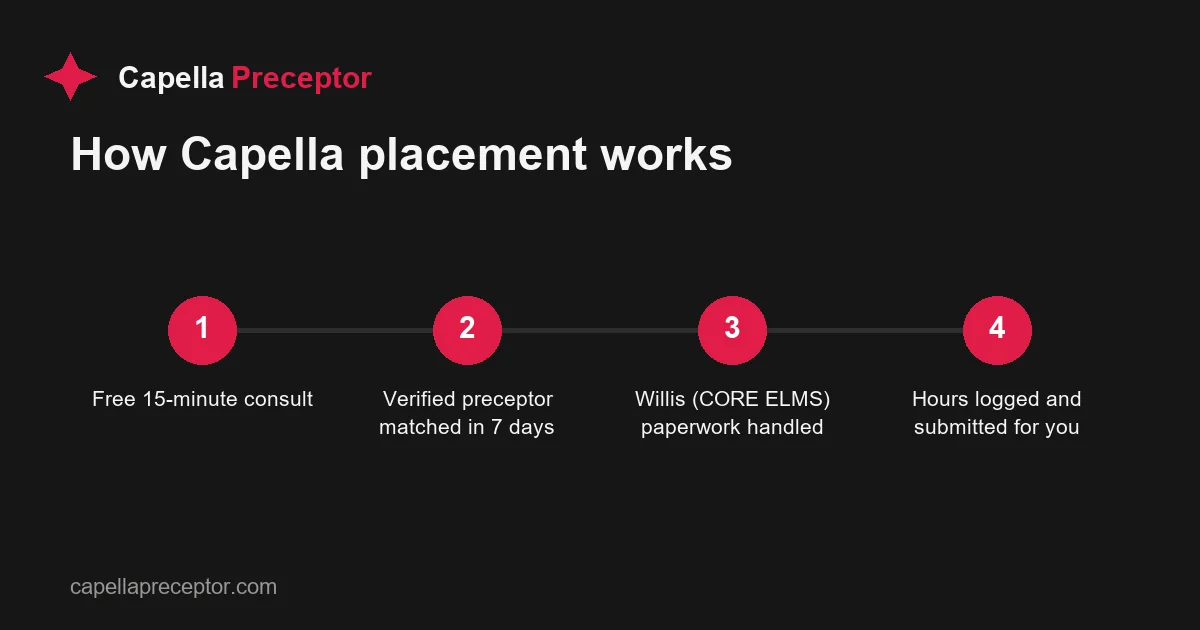
You now have the whole method. The reason students hand the search to us is the same reason it stalls: a small preceptor pool, the same Capella responsibility on your shoulders, and the affiliation agreement plus CORE ELMS approval that have to land before your course opens. We run a wide, specialty-matched search for you, verify license and site, and file every form. One free consult and we map your full plan: preceptor, paperwork, and 750 hours.
- A compliant preceptor matched in 7 days, no payment until matched
- Preceptors who meet Capella's published requirements, submitted for Capella's own approval
- Every CORE ELMS form and CastleBranch step handled for you
Stop sending the same email into silence
Free consult. We run the wide search, verify the site, and handle the paperwork. No payment until you are matched.
Get my free consult →