Home / Preceptor Dropped Out: Finding a Replacement
Mid-program helpMy Capella preceptor dropped out. How do I find a replacement?
Act on the same day: confirm and protect the hours you already logged, then submit a compliant replacement preceptor and site for Capella approval. We match a verified replacement within 7 days, and hours signed off before the drop normally stay on your record.
Last updated: July 11, 2026 · Reviewed by the Capella Preceptor placement team
What to do the day your preceptor backs out
A preceptor backing out mid-rotation is one of the most common ways a Capella practicum stalls, and it is recoverable if you move fast and in the right order. The goal in the first 48 hours is simple: lock down the hours you have, tell the right people in writing, and start sourcing a replacement so a new affiliation agreement (the slowest piece) begins as early as possible. Do these four things first.
Capture your hours now
Export or screenshot your current approved hours from the practicum portal and note any sessions not yet countersigned. This snapshot is your record if anything is disputed later.
Notify faculty in writing
Email your course faculty and practicum coordinator the same day. A dated written notice starts the clock on the school's process and protects you if hours are later questioned.
Ask the same-site question
If a colleague at the same organization can precept you, the existing affiliation agreement may carry over. That is the fastest replacement, so check it before assuming you start over.
Start the replacement search
Source a new preceptor immediately. A fresh affiliation agreement at a new organization can take 30 to 90 days, so the search has to begin today, not after faculty replies.
Do I lose the hours I already logged?
Generally, no. Hours that were completed at an approved site, under an approved preceptor, and signed off in the practicum portal before the drop are documented direct patient care hours. They belong to your record and do not vanish because the preceptor later leaves. This is the single most important thing to understand if you are mid-rotation with partial hours logged: a drop threatens your remaining hours, not the ones already approved.
Three categories of hours are at higher risk, which is exactly why the first move is to capture your record:
- Unsigned sessions. Hours you logged but the preceptor never countersigned are the most exposed. If a preceptor ghosts before signing, you need faculty involved quickly to validate them through the school's process.
- Hours logged after validity ended. Any time recorded after the preceptor or site stopped being approved is the kind of detail students find out about too late. Stop logging at a placement the moment it is no longer valid.
- Off-record hours. Sessions never entered in the portal at all. The portal log, not your memory, is what Capella grades your practicum against, so anything not in the system is hard to defend.
For the Capella nurse practitioner tracks (FNP, PMHNP, and AGPCNP), the program requires a minimum of 750 practicum hours, according to Capella's official courses pages. If you are, say, 300 hours in when the preceptor drops, the realistic task is protecting those 300 and securing a replacement for the remaining 450, not restarting at zero. Confirm your exact approved total with your faculty and in the portal, in writing, before you log another session anywhere.
How does replacement approval differ from the first time?
A replacement runs through the same Capella approval path as your original placement, but the work splits into two very different cases depending on whether the organization changes. Knowing which case you are in tells you how fast this can move.
| Replacement scenario | What has to be re-approved | Typical speed |
|---|---|---|
| New preceptor, same organization | New preceptor license verification and portal approval; existing affiliation agreement often reused | Fastest |
| New preceptor, new organization | New preceptor approval plus a new affiliation agreement between Capella and the new site | Slower (agreement-bound) |
| Same preceptor, new site | Site re-approval; new affiliation agreement if the new site is a different legal organization | Depends on the site |
The affiliation agreement is the slow gate in every "new organization" row. Industry practice puts a fresh agreement at 30 to 90 days, sometimes longer for hospital and inpatient sites, which is why a same-organization replacement is always worth checking first.
The other practical differences from your first placement:
- Your compliance is mostly done. The background check Capella requires through CastleBranch (via DISA Healthcare on the myCB platform), your immunizations, and your insurance were cleared for the first placement, so they usually carry forward rather than being redone from scratch.
- The clock is the difference. The first time you had months of runway. A mid-program drop has a term deadline attached, so the same approval steps now have to be compressed and run in parallel.
- The hour math is partial. The replacement only needs to cover your remaining hours and the right patient population for your course, which can widen the pool of clinicians who can realistically take you for a shorter stretch.
Why do preceptors drop out, and what does it mean for you?
Knowing why this happens helps you frame the replacement realistically and not take it personally. The common causes are structural, not about you:
- Workload and no compensation. Precepting slows a clinician's patient throughput and is usually unpaid, so a busy provider who agreed in a quieter month may pull out when their schedule tightens.
- Job or site changes. Preceptors change employers, go on leave, or the clinic restructures. When the provider leaves the organization, the site can fall through even if the person still wants to teach you.
- Administrative friction. Affiliation agreements, liability, and credentialing can stall a placement until the site or preceptor gives up waiting. This is a paperwork failure, not a clinical one.
- A nationwide preceptor shortage. NP enrollment has outpaced the number of clinicians willing to precept, so when one drop happens, replacing them is harder than it was a decade ago. That is the market, not your performance.
The practical takeaway: a same-organization replacement is sometimes possible when a provider leaves but the clinic stays, and a new-organization replacement is the norm when the whole site falls through. Either way, the requirement is identical to your first placement. Capella states that "learners are responsible for finding an appropriate preceptor to oversee the practicum experience," with a dedicated support team that helps connect learners to practicum site opportunities. A replacement is still yours to secure.
A clean handoff: a checklist for the new preceptor
Once you have a replacement lined up, a clean handoff is what keeps your remaining hours moving without a second stall. Bring these to the new preceptor and site so approval is not held up by missing pieces:
- Your approved hours to date, so the new preceptor knows exactly how many hours and which competencies remain.
- The new preceptor's license and credentials, matched to your specialty (for example an FNP-credentialed provider for a primary care course, a PMHNP for psychiatric hours), for portal verification.
- The site's signed affiliation agreement, reused if the organization is the same, or freshly initiated the moment a new organization is confirmed.
- Your current compliance file, the CastleBranch background check, health records, and insurance, ready to share so onboarding is not the bottleneck.
If your situation is different, two sibling guides go deeper. If your term is already underway and the issue is pure speed, read need a preceptor fast. If you never had a confirmed preceptor and are effectively starting the search from scratch, read can't find a preceptor: what to do.
Preceptor gone quiet mid-rotation: dropped or just busy?
Silence is not a drop, yet. A preceptor who has not answered messages for a week is usually buried, not gone, and the right response is an escalation ladder, not a panic restart. What turns silence into a drop is a missed commitment you can point to: hours sitting unsigned past a course deadline, canceled shifts with no reschedule offered, or the clinic telling you they no longer expect you.
- Days 1 to 5: switch channels, not volume. One text and one call to whichever channel the preceptor actually uses, each offering two specific dates you could work. Ten identical emails read as pressure; one message in the right channel reads as logistics.
- Days 5 to 10: go through the clinic. Call the front desk or practice manager and ask whether the provider is out or their schedule has changed. This one call resolves most scares, because the usual explanations are vacation, illness, or a rotation to another location that nobody thought to tell the student about.
- Day 10 and beyond: treat the placement as at-risk. Send your faculty a dated written note that the preceptor is unresponsive, keep attending only sessions that are actually supervised, and quietly start scouting a replacement. The outreach scripts work as well for the re-ask as for the first ask.
- The moment the clinic says you are not expected back, stop waiting and run the full drop playbook above, starting with capturing your hours. A soft no from the front desk is still a no.
Two things not to do while you wait. Do not keep attending unsupervised just to stay on pace, because hours logged without valid supervision are exactly the hours that get disputed later. And do not vent in messages, however earned it feels; a preceptor who resurfaces after a family emergency is still the person who signs your record. If the quiet stretch has already put your hour math behind, our catch-up triage plan covers what each remaining week needs to look like.
FAQ
Do I lose the clinical hours I already logged if my preceptor drops out?
Generally no. Hours that were logged at an approved site, under an approved preceptor, and signed off in the practicum portal before the drop are documented direct patient care hours. They do not disappear because the preceptor later leaves. The risk is hours that were never approved, were logged after the preceptor or site stopped being valid, or were never countersigned. Confirm your exact running total with your faculty and the portal in writing before you continue.
Does a replacement preceptor need a new approval at Capella?
Yes. A replacement preceptor and any new clinical site are submitted through Capella's practicum portal for approval the same way the original placement was, including license verification and, if the organization changes, a new affiliation agreement between Capella and that site. A new affiliation agreement typically takes 30 to 90 days, which is the slowest part, so the replacement should be sourced and submitted as early as possible.
How fast can I get a replacement preceptor?
We match a verified, compliant replacement within 7 days of your intake. If the replacement is at the same organization as your original site, the existing affiliation agreement can often be reused, which is the fastest path. If it is a new organization, the match is still made within 7 days while the new affiliation agreement and approval run in parallel.
Can I keep my remaining hours at a different site than where I started?
Usually yes. Capella practicum hours are tied to your course and patient population, not to a single building. Hours already approved at the first site stay on your record, and the remaining hours can be completed at a new approved site under a new approved preceptor. The new site goes through its own approval and, if it is a new organization, its own affiliation agreement.
My preceptor ghosted me and will not sign my final hours. What do I do?
Document every session you completed (dates, hours, patient encounters) and notify your faculty in writing right away that the preceptor is unresponsive. Schools have a process for handling unsigned hours when a preceptor becomes unreachable, which is why a written record matters. We help reconstruct the documentation and secure a replacement so your remaining hours are not held hostage by one person.
How long should I wait on a silent preceptor before acting?
Work an escalation ladder rather than one deadline. Switch contact channels in the first five days, call the practice manager between days five and ten, and put the situation in writing to your Capella faculty after roughly ten days of documented silence. Escalating to faculty is not disloyalty; it is a dated record that protects your logged hours if the silence turns out to be a drop, and it costs you nothing if the preceptor resurfaces with a good explanation.
Sources
- Capella University, MSN FNP courses (minimum 750 practicum hours, learner secures the preceptor)
- Capella University, MSN AGPCNP courses (750 hours, learner preceptor responsibility, support to connect with sites)
- Capella University, MSN PMHNP program (750 hours, CastleBranch background check requirement)
- NPHub, affiliation agreement guide (30 to 90 day processing, new site requires its own agreement)
- NPHub, the NP preceptor shortage (enrollment outpacing willing preceptors, burnout, no compensation)
- Walden University MSN practicum manual (factors outside the school's control: agreement negotiation, license verification, onboarding)
How Capella Preceptor helps
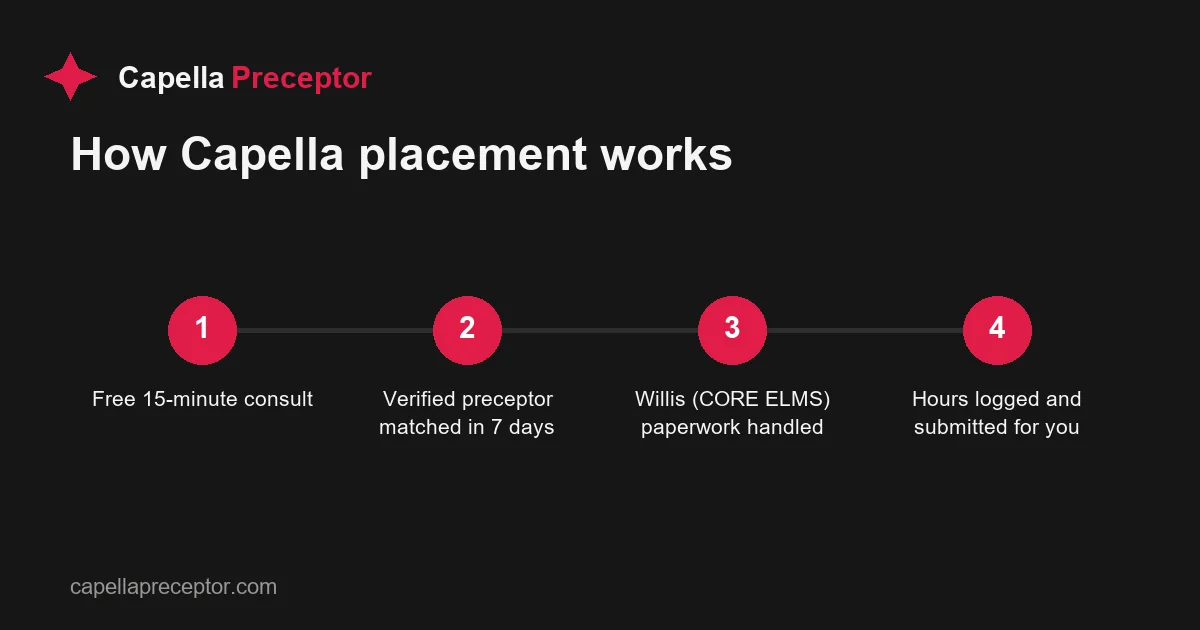
A drop is a clock problem, and the affiliation agreement is the part that eats the clock. We source a verified replacement who meets Capella's published requirements, submit them for Capella's own approval, and start any new affiliation agreement the same day so the slow gate opens as early as possible. Your already-approved hours stay yours; we focus the work on covering the remaining ones without losing your term. One free consult and we map the fastest compliant path from where you stand right now.
- Verified replacement matched in 7 days
- Same-organization path checked first to skip a new agreement
- Paperwork and hours protected, no payment until matched
Lost your preceptor mid-term? Move today.
Free consult. We protect your logged hours and match a verified replacement in 7 days, before your term slips.
Get my free consult →