Home / Behind on Clinical Hours
Catch-up planWhat happens if you are behind on clinical hours at Capella?
Nothing automatic happens mid-course, but a Capella practicum course cannot close until its required hours are logged and approved in CORE ELMS, so unfinished hours become a course problem and course problems become extra quarters. The right move depends on how many weeks are left, so start with the quarter math below, then run the triage plan for your week count.
Last updated: July 11, 2026 · Reviewed by the Capella Preceptor placement team
How does Capella structure the hours you are behind on?
Practicum hours at Capella attach to specific courses, not to your degree as one big pool. The MSN FNP, for example, spreads its 750-hour minimum across six practicum courses of 125 hours each, and each course's hours are logged in CORE ELMS and approved by your preceptor before that course can close. Being behind therefore has a precise meaning: the gap between the hours already approved in CORE ELMS and the hours your current course requires, on that course's calendar. Your program's exact totals are on our hours breakdown and the FNP guide.
What is the quarter math when you fall behind?
A GuidedPath practicum course runs inside a fixed 10-week quarter, so a 125-hour course averages 12.5 hours a week, and every week off pace pushes the remaining weekly load up quickly. The table below is nothing but arithmetic, your hours still owed divided by the weeks you have left, and it is the first thing to compute before talking to anyone.
| Hours still owed | 6 weeks left | 4 weeks left | 2 weeks left |
|---|---|---|---|
| 40 | ~6.7 per week | 10 per week | 20 per week |
| 60 | 10 per week | 15 per week | 30 per week |
| 80 | ~13.3 per week | 20 per week | 40 per week |
| 100 | ~16.7 per week | 25 per week | 50 per week |
Pure arithmetic against a 125-hour course; your own course dates and hour total control. FlexPath's 12-week sessions soften the divisor (125 hours over 12 weeks is about 10.4 per week) but not the logic.
Two thresholds are worth respecting. Anything above roughly 25 clinical hours a week on top of a job is where catch-up plans usually break, and anything above 40 is less a schedule than a signal that the conversation should be about options, not effort.
What actually happens if the course ends with hours unfinished?
There is no single automatic outcome we can honestly print, because grading, incomplete, and extension policies live in your course syllabus and the current Capella university catalog, and faculty hold real discretion. What is structurally true is this: each practicum course requires its hours logged and preceptor-approved in CORE ELMS for the course to complete, the practicum sequence is ordered, and in the common case a course that ends short is resolved by extending or repeating into another enrollment period, with the tuition that carries. Confirm your exact options with your faculty and the catalog before assuming either an easy extension or a forced restart, and read our delayed graduation cost breakdown to see what an extra quarter actually costs.
What is the triage plan with 6 or more weeks left?
Recover inside your current placement; this is the window where the problem is still a scheduling problem.
- Show your preceptor the math. Bring the hours-owed-over-weeks-left number and ask for specific added days, not vaguely more time. Clinicians respond to a concrete plan far better than to worry.
- Front-load, never back-load. Aim to be back on pace with two spare weeks, not by the final day. The last week of a quarter is when preceptors take leave, clinics slow down, and buffers save degrees.
- Audit your CORE ELMS log this week. Confirm every completed session is entered and approved, and chase unsigned sessions now. Discovering in week nine that week-three hours were never countersigned is the avoidable disaster.
- Name the bottleneck in writing. If the limit is preceptor availability rather than your schedule, tell your faculty by email now. A dated record in week four reads very differently from a surprise in week ten.
What changes with 3 to 5 weeks left?
Run two tracks in parallel, because one alone may not be enough. Track one is maximizing the current site exactly as above. Track two is an honest look at adding hours elsewhere: a second site only helps if it can be approved in time, and since an affiliation agreement with an organization new to Capella commonly takes 30 to 90 days, a brand-new clinic mid-quarter is usually calendar-impossible. Realistic additions are sites already under agreement or another provider inside your current organization. This is also the moment to ask faculty the precise question: if I finish the course X hours short by the end date, what are my options under current policy? Bring numbers, get the answer in writing.
What do you do inside the final 2 weeks?
Protect what you have and plan the landing; heroic scheduling rarely closes a big gap this late.
- Lock down approvals. Get every completed session preceptor-approved in CORE ELMS now. Approved hours are yours; unsigned hours are the ones that evaporate in a dispute.
- Send faculty a written summary. Hours approved, hours owed, why the gap exists, and your proposed plan. You are asking for guidance under policy, and the paper trail protects you.
- Fix the cause, not just the symptom. If the gap traces to a preceptor who vanished mid-rotation, our replacement guide is the playbook, and a replacement search should start today, not after grades post.
- Line up the next quarter now. If an extra enrollment period is the likely outcome, the worst version is spending it hunting for a preceptor again. Start that search immediately, or hand it to us and be matched in 7 days.
And the one thing you never do: never inflate a log or backfill hours you did not work. That converts a scheduling problem into an academic integrity case, and preceptor attestations are exactly the kind of record schools check.
How do you keep the next quarter from repeating this one?
Budget hours the way you budget money, with the buffer built in from week one. Divide the course's hours by two fewer weeks than the quarter actually has, so a 125-hour GuidedPath course plans to about 15.6 hours a week and finishes with two weeks spare. Confirm your preceptor's planned vacations and conference weeks in the first week and schedule around them. And line up the following rotation a quarter ahead while this one runs, using the outreach scripts, so the search is never the thing that eats your calendar again.
FAQ
Do unfinished hours from one practicum course roll into the next at Capella?
Treat the answer as no by default. Hours attach to specific courses with specific population requirements, the practicum sequence is ordered, and each course closes on its own hour count in CORE ELMS. Whether any accommodation exists in your situation is a faculty and catalog question, so ask it directly rather than planning around an assumption.
Can I catch up by logging very long weeks?
Sometimes, within real limits. The hours must be genuinely supervised by your approved preceptor on days they actually practice, and they must be the right kind of hours, since courses like pediatric primary care or reproductive health require specific patient populations. A 40-hour catch-up week in the wrong population closes nothing, so check what the course requires before you stack shifts.
My preceptor's schedule collapsed. Is that my problem?
Practically yes, formally recoverable. Document the missed sessions, notify your faculty in writing immediately, and start a replacement search in parallel. Hours your preceptor approved before the disruption remain yours, and a documented site failure is a very different conversation with faculty than an unexplained shortfall.
How many hours a week does a 125-hour GuidedPath course actually need?
The raw average is 12.5 hours a week across a 10-week quarter. Planning against 8 weeks instead, about 15.6 hours a week, builds a two-week buffer for canceled clinics and slow stretches. FlexPath's 12-week sessions average about 10.4 hours a week for the same 125-hour course.
Will Capella just extend my course if I ask?
No one can promise that, and be wary of anyone who does. Extensions and incompletes are governed by the university catalog and course policies and applied through faculty discretion. What reliably improves your position is asking early, in writing, with exact numbers and a concrete completion plan attached.
Sources
- Capella University, MSN FNP courses (750 minimum practicum hours across the practicum sequence)
- Capella University, MSN-NP program overview (learner responsibility for the practicum placement)
- NPHub, affiliation agreement guide (30 to 90 day processing, why a new mid-quarter site rarely lands in time)
How Capella Preceptor helps
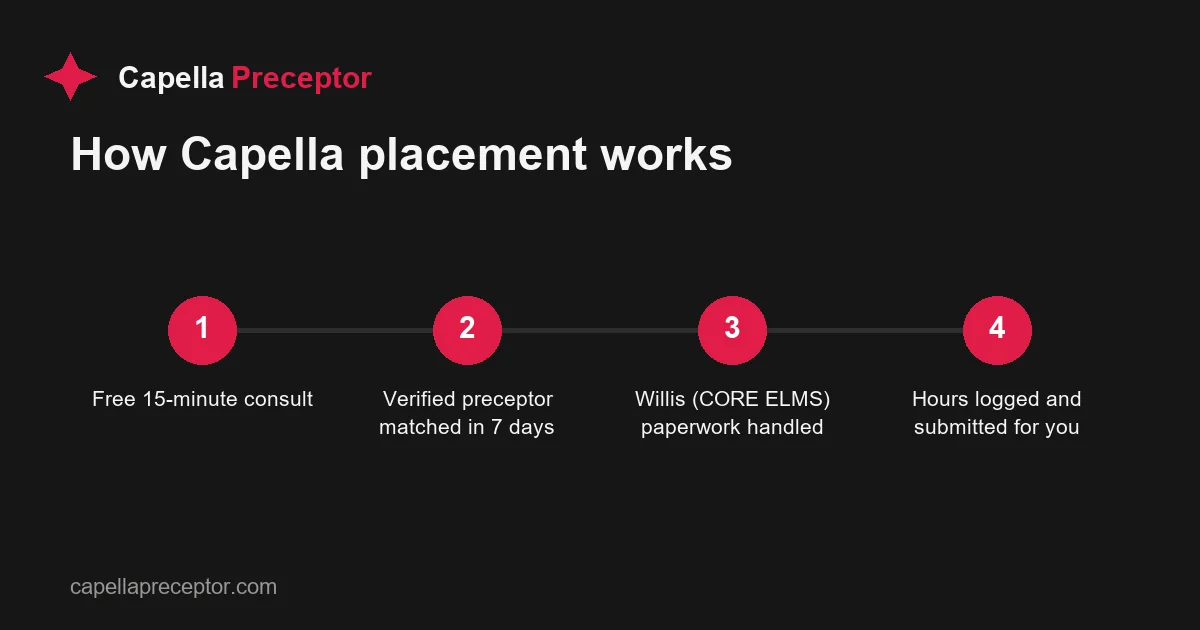
A mid-quarter stall is a race between your hour math and the calendar, and the slowest pieces, sourcing a clinician and clearing paperwork, are the pieces we run every day. As a preceptor matching service focused on Capella students, we can add a verified supplemental or replacement preceptor to your plan within 7 days, submit everything for CORE ELMS approval, and start any affiliation agreement the same day, while you keep logging hours where you are. The consult is free and the math conversation is honest: if catch-up in place is the better path, we will tell you.
- Replacement or supplemental preceptor matched in 7 days
- CORE ELMS and agreement paperwork started the same day
- No payment until you are matched
Behind on hours? Move this week.
Free consult. We map your remaining hours against your calendar and match a verified preceptor in 7 days.
Get my free consult →