Home / Delayed Graduation Cost
Cost mathWhat does a delayed graduation really cost at Capella?
A delayed graduation bills you on two lines at once: another enrollment period of tuition and fees at Capella's published rates, plus every month you keep earning your current pay instead of NP pay. Neither number is exotic. You can put your own figures into the arithmetic below in about five minutes, and the total is the number a placement fee should be judged against.
Last updated: July 11, 2026 · Reviewed by the Capella Preceptor placement team
Why does a Capella delay cost a quarter at a time?
Because Capella's calendar is built in billing-cycle blocks: GuidedPath runs on fixed 10-week quarters billed per course, and FlexPath charges a flat rate per 12-week session. A practicum stall almost never costs you a week; it costs you the enrollment period the stalled course spills into. The classic causes are all time-shaped, a preceptor search started late, an affiliation agreement that commonly needs 30 to 90 days for a new site, or a placement that falls through mid-rotation, and the money follows the time. The format mechanics are covered in our FlexPath vs GuidedPath guide and the affiliation agreement explainer.
What does one extra quarter cost in tuition?
It costs whatever your published Capella rate bills for the enrollment you would not otherwise need, and you should get that number from Capella, not from us. Rates change, vary by program, and differ between formats, so we deliberately do not print a dollar figure here. Getting your own number takes five minutes: open Capella's current tuition page for your program, find your per-credit GuidedPath rate or your flat FlexPath session rate, and multiply by what an extra period would bill for you, plus any resource or technology fees that recur. Write that number down and call it T. If you are unsure what a repeated or extended course would bill, your enrollment counselor can tell you exactly, and that answer in writing beats any estimate on the internet, including ours.
What does delay cost in NP pay you are not earning?
Every month between you and certification is a month you earn your current pay instead of NP pay, and that gap is usually the bigger line. We will not invent a salary figure for you either: the honest inputs are the NP offers actually posted in your market and your own current pay. The Bureau of Labor Statistics publishes median nurse practitioner wage data by state if you want a neutral reference point, and job postings in your city are even better data. Take the monthly NP pay you reasonably expect, subtract your current monthly pay, and call the difference G. Then count the delay in months, M: one GuidedPath quarter is 10 weeks, roughly two and a half months, before any gap between terms, and a delay that cascades across a sequence of practicum courses multiplies from there.
What is the whole calculation?
Delay cost = T + (M x G)
T = tuition and fees for the extra enrollment period, from Capella's published rates
M = months of delay (one GuidedPath quarter is 10 weeks, about 2.5 months)
G = monthly pay gap (expected NP pay minus your current monthly pay)
Run it with your own numbers and the result is usually uncomfortable, which is exactly why it is worth running before a stall happens rather than after. Note what the formula does not include: application and recertification timing, exam scheduling, and the compounding effect of a second delayed course. Those all push the real cost up, never down.
How does that compare with a placement fee?
A placement fee is a fixed, known number, and in the current market a single rotation typically runs $1,500 to $2,000 with flat packages advertised near $1,995, figures we break down line by line in our cost guide. The comparison is then plain arithmetic: if T plus M times G is larger than the fee, and you do not have a confirmed preceptor with time to spare, paying to remove the delay risk is the cheaper decision. The honest flip side: if you already have a solid free preceptor confirmed early, through your employer, your network, or Capella's site options, the free route wins on cost, full stop, and we say exactly that in our free vs paid comparison. A fee only earns its keep by buying back time.
What actually causes the delay, and how do you protect the timeline?
Almost every delayed Capella practicum we see traces to one of four time sinks, and each has a countermeasure you control.
- The search started late. Outreach begun a few weeks before the course start collides with the 30 to 90 day agreement window. Countermeasure: start asking one to two quarters ahead with the scripts in our outreach guide.
- The hard populations were left for last. Pediatric and women's health rotations draw from smaller preceptor pools than adult primary care. Countermeasure: secure those placements first, not last.
- The hour math slipped mid-quarter. A pace problem discovered in week eight is a quarter problem. Countermeasure: the weekly budget and triage plan in behind on clinical hours.
- A preceptor dropped mid-rotation. Drops are recoverable when the replacement search starts the same day. Countermeasure: the replacement playbook.
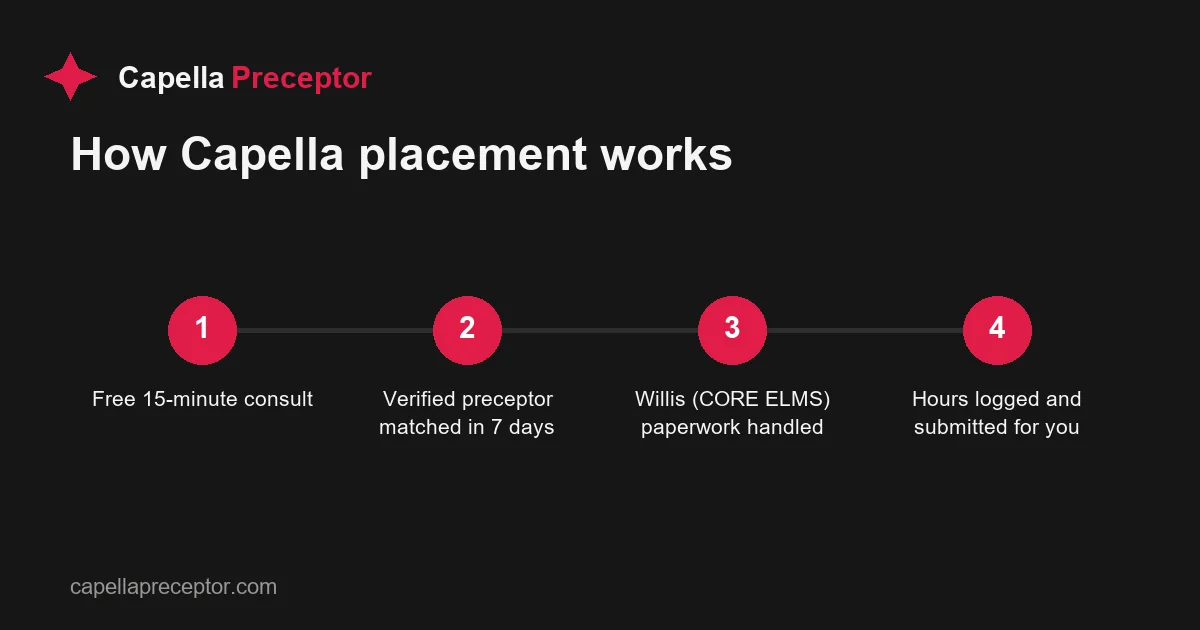
If the search itself is the bottleneck, that is the one piece you can buy: a preceptor matching service exists to compress the sourcing and paperwork weeks into days. Ours matches a verified Capella-compliant preceptor in 7 days with no payment until matched, and our pricing page explains the fee structure before you ever get on a call.
FAQ
How long is one quarter of delay in real time?
A GuidedPath quarter runs 10 weeks, roughly two and a half months, and any break between enrollment periods stretches the real-world delay further. FlexPath sessions run 12 weeks. A single delayed practicum course can also cascade, because the practicum sequence is ordered, so the calendar cost is a floor, not a ceiling.
Does a delayed graduation change my total required hours?
No. The hour requirement is fixed by your program, 750 minimum practicum hours for Capella's MSN NP tracks, and a delay changes when you finish them, not how many you owe. That is exactly why delay is pure cost: you pay for more time without any reduction in the work remaining.
Is paying a placement fee cheaper than a delayed quarter?
Run the arithmetic rather than taking anyone's word, including ours. Compare the fee against your extra-period tuition plus your monthly pay gap times the months of delay. For students with no confirmed preceptor and a course start approaching, the fee is usually the smaller number. For students with a solid free placement confirmed early, the free route is cheaper and we say so plainly.
Where do I find Capella's current tuition numbers?
On Capella's own published tuition and financial aid pages, or from your enrollment counselor, who can tell you precisely what an extended or repeated course would bill in your program and format. We intentionally do not print rates because they change and vary by program, and a stale number is worse than none.
Does FlexPath make a delay cheaper?
It changes the billing shape, not the physics. FlexPath charges a flat rate per 12-week session, so coursework you control can sometimes be compressed before a delay lands. Practicum hours cannot be compressed below real supervised clinical time, though, so a practicum stall costs a FlexPath student another session fee much the way it costs a GuidedPath student another quarter.
Sources
- Capella University, tuition and financial aid (current published per-credit and per-session rates by program)
- Capella University, MSN FNP program (750 minimum practicum hours, practicum site options)
- U.S. Bureau of Labor Statistics, Occupational Employment and Wage Statistics, nurse practitioners (median wage data by state)
- NPHub, affiliation agreement guide (30 to 90 day processing for a new site agreement)
How Capella Preceptor helps
The formula only argues for paying when payment shortens time, and shortening time is the entire product: as a preceptor matching service for Capella students, we compress the search and paperwork weeks into days, with a verified preceptor matched in 7 days, CORE ELMS submission handled, and any affiliation agreement started immediately. The free consult gives you the exact fee for your rotation so you can run T plus M times G against a real number instead of a guess, and if your free route is genuinely stronger, we will tell you to take it.
- Exact written quote for your rotation, before any commitment
- Verified preceptor matched in 7 days, paperwork run in parallel
- No payment until you are matched
Do the math with a real quote
Free 15-minute consult. Your exact placement quote against your timeline, no payment until matched.
Get my free consult →