Home / MSN-FNP / FNP Preceptor in Washington
FNP · WashingtonFinding a Capella FNP Preceptor in Washington
A Capella MSN-FNP student in Washington needs 750 primary care practicum hours under a preceptor who meets Capella's published requirements, and because Washington grants nurse practitioners full practice authority, a licensed ARNP can precept you on their own license with no physician agreement. The catch is supply: Washington's ARNP pool is clustered around Puget Sound, so finding one is the real work. This page covers the FNP hours, the Washington board rules, where the clinics are, and how we secure the placement.
Last updated: June 28, 2026 · Reviewed by the Capella Preceptor placement team
What does a Capella FNP practicum require in Washington?
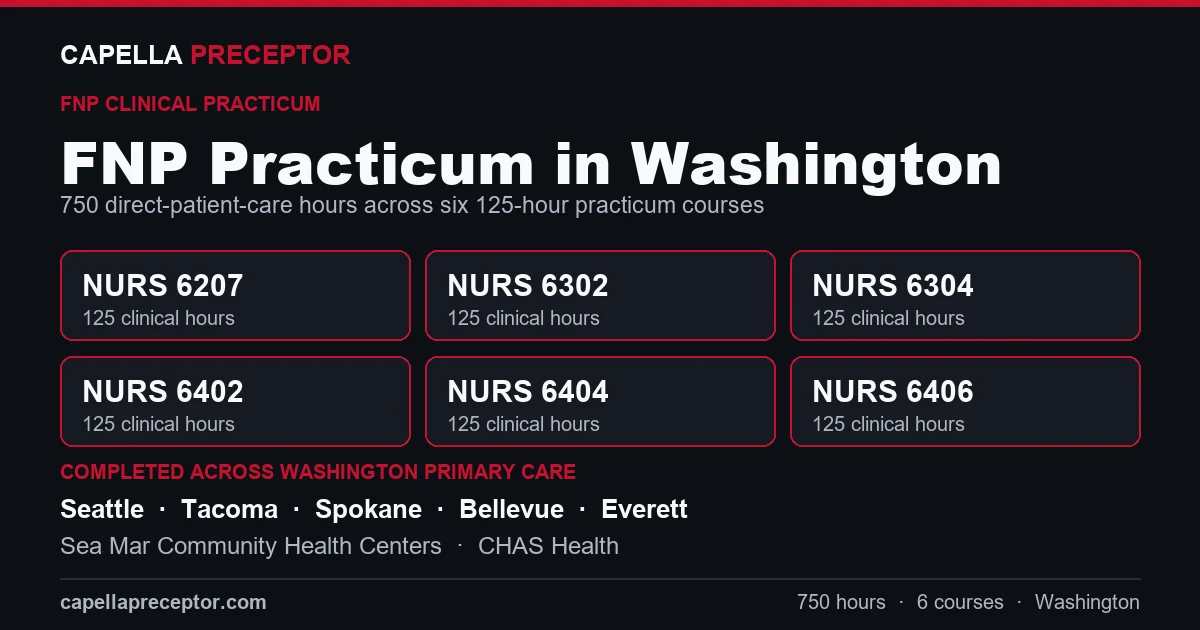
Your hour total is set by Capella, not by the state line you live on. The Capella MSN-FNP specialization requires a minimum of 750 practicum hours, split across six clinical courses that each carry 125 hours, and those hours must span primary care across the lifespan rather than a single age group (Capella, MSN-FNP courses). For the full course list, the FlexPath versus GuidedPath codes, and the population mix, see the Capella FNP program page; this page is about doing those hours in Washington.
Washington adds a floor of its own. The state board's preceptor rule for advanced practice students sets a minimum of 500 hours of direct patient care in the licensure designation you are pursuing, completed under preceptor supervision with faculty oversight (Washington State Board of Nursing, Student Nurse Preceptor). A Capella FNP plan at 750 hours already clears that bar, so the binding number for you is still Capella's 750. What Washington governs more directly is who may sign on as your preceptor and where they may practice.
Does full practice authority change who can precept an FNP here?
Yes, and in your favor. The American Association of Nurse Practitioners classifies Washington as a full practice authority state (AANP, State Practice Environment). In practical terms, the Washington State Board of Nursing says its "broadly written laws and rules allow nurses to practice to their full scope of practice in any setting" (Washington State Board of Nursing, ARNP guidance). Washington licenses its advanced practice nurses as Advanced Registered Nurse Practitioners (ARNP), a designation that covers nurse practitioners along with nurse-midwives, anesthetists, and clinical nurse specialists, under RCW 18.79 and WAC 246-840.
For an FNP student that matters concretely. A family or primary care ARNP in Olympia or Wenatchee can agree to precept you without first finding a physician to co-sign the relationship, which is the friction that slows placements in reduced and restricted states. Physicians can still precept, and certain courses may accept a clinician matched to the population, but the wide bench of independently practicing ARNPs is what makes Washington a comparatively workable state to place an FNP, provided you can reach one.
Who qualifies as my FNP preceptor under Washington rules?
Washington spells the eligibility out in WAC 246-840-533. A preceptor must hold an active, unencumbered license as an ARNP, RN, or physician, carry at least one year of relevant clinical experience, and practice at a site that holds an affiliation agreement with the nursing education program (Washington State Board of Nursing, Student Nurse Preceptor). For the FNP, which is a primary care credential, that almost always means a Washington-licensed ARNP or a physician working in one of the lifespan settings your courses require.
Before we propose anyone for your Capella file we confirm that ARNP or physician license is active and in good standing. You can run the same check for free through the Department of Health provider credential search, which the board points to for primary source verification (Washington State Board of Nursing, verify or check license status).
Is there a Washington program that pays preceptors to take students?
There is, and it is one reason Washington is worth understanding state by state. The Washington State Student Nurse Preceptorship Grant (WSSNPG) reimburses nurses who volunteer as preceptors, which gives a busy ARNP a concrete reason to say yes to a student. The rules carry detail that matters for an FNP: a preceptor must complete at least 80 qualifying hours of clinical instruction per student, and ARNP students "can be in any clinical cycle for reimbursement," unlike pre-licensure RN and LPN students whose hours have to fall in their final term (Washington State Board of Nursing, Student Nurse Preceptor; WSSNPG grant policy).
Two practical consequences for a Capella FNP student. First, because any of your six practicum courses can count, the grant is a usable incentive across your whole sequence, not just at the end. Second, the grant only reaches sites with an affiliation agreement to an approved Washington nursing education program, and the board notes that out-of-state programs running rotations in Washington do not qualify for it. That does not stop a Washington clinic from precepting a Capella student, but it does mean the grant incentive applies to in-state programs, so we lean on the practice authority and the affiliation agreement rather than the grant when placing Capella learners.
Why is finding an FNP preceptor in Washington still hard?
Full practice authority widens the pool on paper. Supply narrows it in practice. The Washington Center for Nursing projected that Washington would lose roughly 20 percent of its ARNP workforce to retirement by 2028, and the state's active ARNPs are concentrated in King, Pierce, and Snohomish counties, with family practice one of the largest specialties competing for those same preceptors (Washington Center for Nursing, 2022, reported by NPHub, paid NP preceptor in Washington). For a student in Yakima, the Tri-Cities, the Olympic Peninsula, or anywhere east of the Cascades, that concentration is the whole problem: there may be no qualified FNP preceptor within a reasonable drive.
That is why FNP students so often describe months of cold-calling clinics across the state with nothing confirmed. The course clock does not pause while you search, and an FNP needs coverage across three populations, not one, so a single willing family practice may still leave you short on pediatrics or women's health. The fix is to plan the population spread early and, where geography is against you, to use a virtual placement rather than wait for a nearby clinic to open a slot. The broader Washington picture, the board, the ARNP credential, and the metro-by-metro map, lives on the Washington practicum page.
Where do FNP students actually train in Washington?
Real primary care training sites exist across the state, and a few run structured advanced practice programs that show the kind of setting an FNP rotation fits. Naming them is not an endorsement and they set their own admission rules; they illustrate where family primary care is concentrated.
Sea Mar Community Health Centers has run a family nurse practitioner residency since 2015, with FNP residents split across its Seattle, Lynnwood, and Tacoma clinics (Sea Mar APP Residency).
CHAS Health is the Inland Northwest's largest community health center, with 14 primary care clinics in the Spokane area and an FNP-focused nurse practitioner residency (CHAS Health NP Residency).
Seattle, Bellevue, and Everett family medicine, internal medicine, pediatric, and women's health practices, the densest ARNP supply in the state.
Yakima, the Tri-Cities, Wenatchee, and the Olympic Peninsula, where in-person preceptors are scarce and a virtual placement often keeps you on schedule.
Inpatient or specialty-only rotations are a poor fit for the FNP because it is a primary care credential. If you are weighing a nonstandard site, confirm it with Capella faculty before you commit hours to it.
What has to clear before your Washington FNP hours count?
Once a Washington preceptor and site are identified, the same Capella clearance sequence applies before a single hour counts, and the affiliation agreement is usually the slowest part.
- Propose the Washington ARNP and site in Capella's practicum system, tracked in our workflow as CORE ELMS, so the placement can be reviewed and approved.
- Get the affiliation agreement signed between Capella and the Washington clinic before practicum begins. We manage this directly with the site.
- Clear third-party compliance through Capella's background-check and health-records vendor (such as CastleBranch); confirm the current vendor with your program.
- Log and submit each course's hours in CORE ELMS, where your preceptor approves what you record before that practicum course closes.
Washington FNP FAQ
Can a nurse practitioner precept a Capella FNP student in Washington without a physician?
Yes. Washington is a full practice authority state, so a licensed ARNP can precept an FNP student on their own license with no physician collaboration or supervision agreement required. The preceptor still has to meet Capella's published requirements and WAC 246-840-533, and a signed Capella affiliation agreement with the site is required before practicum begins.
How many FNP practicum hours do I need in Washington?
Your hour total is set by Capella, not by Washington. The Capella MSN-FNP requires a minimum of 750 practicum hours across six 125-hour clinical courses spanning adult-gerontology, pediatric, and reproductive or women's health. Washington's own preceptor rule sets a separate floor of 500 direct-patient-care hours, which the 750-hour FNP plan already exceeds.
Who has to qualify as my FNP preceptor under Washington rules?
Under WAC 246-840-533 the preceptor must hold an active, unencumbered ARNP, RN, or physician license, have at least one year of relevant clinical experience, and practice at a site that holds an affiliation agreement with the nursing program. For FNP primary care the preceptor is typically a Washington-licensed ARNP or physician in family medicine, internal medicine, pediatrics, or women's health.
Is it hard to find an FNP preceptor in Washington?
It can be, despite full practice authority. The Washington Center for Nursing projected Washington would lose about 20 percent of its ARNP workforce to retirement by 2028, and active ARNPs are concentrated in King, Pierce, and Snohomish counties, so students east of the Cascades and in rural areas often have no qualified preceptor within a reasonable drive. A virtual placement keeps those students on schedule.
Sources
- Capella University, MSN-FNP courses (750 hours across six courses)
- AANP, State Practice Environment (Washington: full practice authority)
- Washington State Board of Nursing, ARNP guidance (RCW 18.79, WAC 246-840)
- Washington State Board of Nursing, Student Nurse Preceptor (WAC 246-840-533, 80-hour rule)
- Washington State Student Nurse Preceptorship Grant policy
- NPHub, on the Washington ARNP preceptor supply (Washington Center for Nursing data)
How Capella Preceptor helps in Washington
Washington's full practice authority widens the field, but a retiring, Puget-Sound-clustered ARNP pool does not place you. We do. We match you with a verified, Washington-licensed preceptor who meets Capella's published requirements and whose panel covers the FNP lifespan populations, in person across the metros or fully virtual for eastern and rural counties, confirm the license with the state board, run the affiliation agreement with the site, prepare every CORE ELMS form, and keep all 750 hours logged and submitted on time.
- Verified Washington FNP preceptor matched in 7 days, no payment until matched
- Panel coverage across adult-gerontology, pediatric, and women's health for all six courses
- In-person across King, Pierce, Snohomish, and Spokane, or virtual east of the Cascades
Get a Capella FNP preceptor in Washington
Free 15-minute consult. No payment until matched. We map all 750 hours and your full Washington placement plan.
Get my free consult →