Capella PMHNP preceptor and psychiatric placement in Alabama
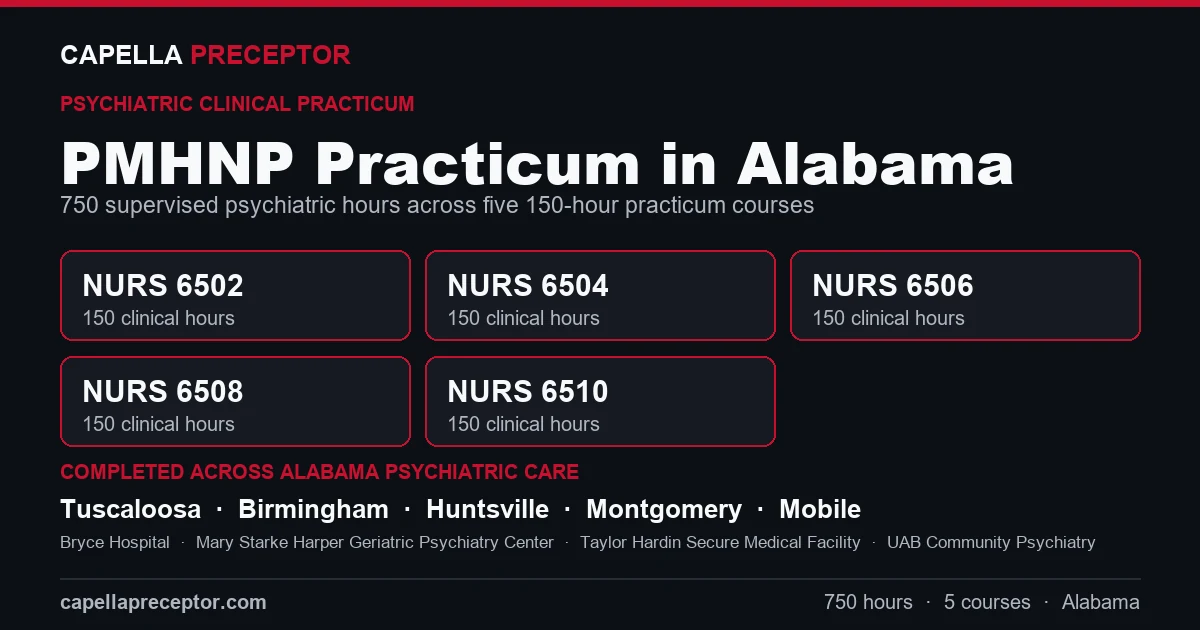
A Capella PMHNP practicum in Alabama requires 750 supervised psychiatric clinical hours across five practicum courses of 150 hours each, completed under an on-site psychiatric-mental-health preceptor. Alabama is a reduced practice state, so that preceptor is a Certified Registered Nurse Practitioner working under a physician collaborative agreement, and the way they prescribe controlled psychiatric medications here is unusually restricted. This page explains what that means for your hours, then how we secure the placement.
Last updated 2026-06-28 · Reviewed by the Capella Preceptor psychiatric placement team
What does a Capella PMHNP practicum in Alabama actually require?
The hour total is fixed and identical from state to state. For the Capella MSN-PMHNP, you owe a minimum of 750 supervised practicum hours, and they are not banked in one block: each of the program's five psychiatric practicum courses carries 150 clinical hours, NURS6502 (Practicum I), NURS6504 (Practicum II), NURS6506 (Practicum III), NURS6508 (Practicum IV), and NURS6510 (Practicum V), for five rotations of 150 that add to 750 (Capella, MSN-PMHNP courses). You take the coursework online and earn every psychiatric hour in person, at a local site, under a qualified preceptor. The full breakdown of the five courses and their population focus lives on the PMHNP specialty page, and the all-program Alabama overview is on the Alabama page. This page is the intersection: a psychiatric practicum, done in Alabama.
What changes from one state to the next is not the hour count. It is the supervising provider, the kind of site that can host you, and the state board rules that govern how psychiatric care is delivered there. In Alabama those rules are specific enough to a psychiatric rotation that they are worth understanding before you submit a site, because they determine what your preceptor can and cannot let you do.
Who can precept a PMHNP student in Alabama, and under what authority?
Alabama is a reduced practice state for nurse practitioners (AANP, State Practice Environment). A nurse practitioner here is called a Certified Registered Nurse Practitioner (CRNP) and must hold a collaborative practice agreement with a physician to deliver care, a requirement approved jointly by the Alabama Board of Nursing and the Alabama Board of Medical Examiners (ALBME, Collaboration). For a psychiatric rotation your preceptor will usually be a board-certified PMHNP working under that kind of agreement, or a psychiatrist.
The Alabama Board of Nursing recognizes psychiatric-mental health as a CRNP population focus and publishes a dedicated Psychiatric and Mental Health CRNP standard protocol for it, the document a collaborating practice files to define the CRNP's scope (Alabama Board of Nursing, CRNP standard protocols). You can confirm any preceptor's standing yourself through the board's free License Lookup, which returns primary-source verification of license status and any discipline. We verify every preceptor against the board before you meet them.
What the collaborative rule means for you as a student. The agreement governs your licensed CRNP preceptor, not you. You complete the 750 hours under an approved on-site preceptor, and your placement is governed by Capella's site and preceptor approval rather than any agreement of your own. The rule still matters because it shapes how your preceptor prescribes, documents, and escalates, which is precisely the psychiatric practice you are there to learn.
How does Alabama limit controlled psychiatric prescribing during your rotation?
This is the part that makes a psychiatric practicum in Alabama different from a primary-care one, and different from a PMHNP rotation in a full-practice state. Psychiatry runs on controlled substances, stimulants for ADHD, benzodiazepines for anxiety and acute agitation, and buprenorphine for opioid use disorder, and Alabama splits a CRNP's authority to prescribe them into two tiers.
A CRNP without an LPSP simply cannot prescribe a Schedule II stimulant in Alabama, and even with one, the limits are tight: for ADHD a CRNP may write a 30-day supply and the physician must see the patient before the medication is continued, and only a physician may initiate or escalate a long-acting Schedule II medication (ALBME, Limited Purpose Schedule II Permit; ALBME, Controlled Prescribing in Collaborative Relationships). Practically, that means on a stimulant-heavy day you will watch your preceptor hand certain decisions back to the collaborating physician, and you should ask early in the rotation which of your preceptor's prescribing tasks you can be hands-on for. It is a genuine part of the learning, not a footnote.
Can you complete PMHNP hours by telepsychiatry in Alabama?
Partly, and the boundary is sharper here than the general "PMHNP is telehealth-friendly" answer. Capella names telepsychiatry directly within the Practicum III experience, so video-delivered intake interviews, medication management, and psychotherapy can count toward hours when your preceptor practices that way (Capella, MSN-PMHNP courses). Alabama's 2022 telehealth law (Act 2022-302) even allows a provider to form the patient relationship by video without a prior in-person exam (ALBME, Telemedicine).
The catch is controlled substances, which is most of psychiatric prescribing. To issue a controlled-substance prescription by telehealth, Alabama requires synchronous audio or audio-visual contact and at least one in-person encounter with the patient within the preceding 12 months (ALBME, Prescribing Controlled Substances by Telehealth). Buprenorphine has its own narrower window: a patient may receive up to a six-month supply through telehealth before an in-person visit is required (SAMHSA, buprenorphine telemedicine prescribing). The takeaway: a fully remote PMHNP rotation will not expose you to the in-person controlled-substance management that defines the specialty, so plan for a blended placement and confirm the telehealth share allowed for each practicum against your course instructions.
Where do Capella PMHNP students complete psychiatric hours in Alabama?
Alabama has real psychiatric infrastructure, much of it run through the Alabama Department of Mental Health, plus academic and outpatient sites. These are the categories where PMHNP students find supervised hours, when a credentialed provider is on site to precept:
Bryce Hospital in Tuscaloosa for adult inpatient care, the Mary Starke Harper Geriatric Psychiatry Center on the Bryce campus for older adults, and Taylor Hardin Secure Medical Facility for forensic psychiatry (ADMH, facility operations).
The certified CMHCs governed by 310 boards are the state's designated entry points for outpatient, crisis, and day services across all 67 counties (ADMH, 310 boards).
Programs such as UAB Community Psychiatry in Birmingham, and outpatient psychiatry tied to the larger metro systems in Birmingham, Huntsville, Montgomery, and Mobile (ADMH directory, UAB Community Psychiatry).
Substance-use and medication-for-opioid-use-disorder programs, where buprenorphine management is core, give strong co-occurring-disorder exposure for the PMHNP scope.
The lifespan structure of the program still applies in Alabama: Practicum I leans adult and older-adult, Practicum II is child and adolescent, so you will likely need more than one site or preceptor to cover both ends. The geriatric center and a separate child-and-adolescent practice, for example, can together close that gap.
Why is a psychiatric preceptor so hard to find in Alabama?
Plainly, because there are not enough psychiatric prescribers to go around, and the ones in practice are stretched. Federal data designate large parts of Alabama as Mental Health Professional Shortage Areas, where the population-to-psychiatrist ratio crosses the threshold for an official shortage (Rural Health Information Hub, mental health HPSA map). A shortage of providers is also a shortage of preceptors: the same overstretched clinicians students need to learn from are the ones with the least free time to supervise.
Two Alabama-specific frictions make it harder than a primary-care search. First, the strongest psychiatric sites are physician-led collaborative practices and state facilities that move through their own credentialing and affiliation steps, which takes weeks. Second, the controlled-substance tiering above means not every CRNP can model the full prescribing picture, so you sometimes want a site where a psychiatrist and a CRNP work side by side. Cold outreach to a handful of overworked clinics, in a state where many counties have no psychiatrist at all, is where Capella students lose a term. That is the part we take off your plate.
Clearing a psychiatric placement through Capella, from Alabama
Securing the preceptor is step one. Before you log an hour, the placement has to clear Capella's practicum workflow. The steps are the same statewide; what differs is the Alabama site and provider you put through them:
- Propose your Alabama psychiatric site and preceptor in CORE ELMS, Capella's practicum-management system, so the placement can be reviewed before the practicum opens.
- Get a signed affiliation agreement in place between Capella and the Alabama site before practicum begins, which for a state facility can take longer than a private clinic.
- Clear compliance through Capella's background-check vendor, CastleBranch, including the drug screen and health records, which inpatient psychiatric facilities take seriously.
- Log and submit your hours in CORE ELMS, where your preceptor approves each block. Each of the five courses must reach its full 150 hours.
We never call a preceptor or site endorsed by the university. We match preceptors who meet Capella's published requirements and submit the placement for Capella's own review and approval. The university makes the call; we make sure the paperwork and the credential clear it the first time.
Alabama PMHNP FAQ
How many hours does a Capella PMHNP practicum in Alabama require?
A minimum of 750 supervised psychiatric clinical hours, completed as 150 hours in each of the five practicum courses (NURS6502, NURS6504, NURS6506, NURS6508, NURS6510), at an Alabama psychiatric site under an on-site PMHNP or psychiatrist preceptor. The hour count and structure are the same in Alabama as anywhere; what changes is the local site, the supervising provider, and the board rules they practice under.
Can a CRNP preceptor in Alabama prescribe ADHD stimulants and other controlled psychiatric medications?
Yes, but under tight limits that shape what you will see. An Alabama CRNP needs a Qualified Alabama Controlled Substances Certificate (QACSC) for Schedules III to V, which covers buprenorphine and most benzodiazepines, and a separate Limited Purpose Schedule II Permit (LPSP) for Schedule II stimulants such as methylphenidate and amphetamine. For ADHD, a CRNP may write a 30-day supply and the physician must see the patient before the medication is continued, and only a physician may initiate or escalate long-acting Schedule II medications.
Can Capella PMHNP hours be completed by telepsychiatry in Alabama?
Partly. Capella names telepsychiatry within Practicum III, and Alabama's 2022 telehealth law allows a provider-patient relationship to be formed by video. But to prescribe a controlled substance by telehealth, Alabama requires synchronous audio or audio-visual contact and at least one in-person encounter within the preceding 12 months, so a fully remote rotation will not cover the controlled-substance management that is central to psychiatry. Confirm the telehealth share allowed for each practicum with your course instructions.
Where do Capella PMHNP students complete psychiatric hours in Alabama?
Real Alabama psychiatric settings include the state hospitals run by the Alabama Department of Mental Health (Bryce Hospital in Tuscaloosa, the Mary Starke Harper Geriatric Psychiatry Center, and Taylor Hardin Secure Medical Facility), the certified community mental health centers governed by 310 boards, academic programs such as UAB Community Psychiatry, addiction and opioid-use-disorder treatment programs, and outpatient and telepsychiatry practices. The site and preceptor must be proposed and approved before you log hours.
Does the Alabama collaborative practice rule affect my PMHNP practicum?
Not directly. The collaborative practice agreement governs your licensed CRNP preceptor, not you as a student. You complete hours under an approved on-site preceptor, and the placement is governed by Capella's site and preceptor approval. The rule still matters because it shapes how your preceptor prescribes and documents, which is exactly the practice you are there to learn.
Sources
- Capella University, MSN-PMHNP courses and practicum hours
- AANP, State Practice Environment (Alabama reduced practice)
- Alabama Board of Nursing, CRNP standard protocols (psychiatric-mental health)
- Alabama Board of Medical Examiners, Limited Purpose Schedule II Permit (LPSP)
- Alabama Board of Medical Examiners, Controlled Prescribing in Collaborative Relationships
- Alabama Board of Medical Examiners, Prescribing Controlled Substances by Telehealth
- Alabama Department of Mental Health, facility operations
- Alabama Department of Mental Health, 310 boards (community mental health centers)
- Rural Health Information Hub, mental health professional shortage area map
How Capella Preceptor helps PMHNP students in Alabama
You now know the terrain: Alabama is a reduced-practice state where your preceptor is a CRNP under a physician agreement, controlled psychiatric prescribing is split across the QACSC and the LPSP, telepsychiatry only goes so far for controlled substances, and the real sites run from Bryce Hospital to the 310-board community centers. The hard part is lining up 750 psychiatric hours, across adult and child rotations, with a credentialed preceptor at a site that will sign an affiliation agreement, in a state with a psychiatric-provider shortage. That is what we do.
- A psychiatric preceptor who meets Capella's published requirements, matched in 7 days, in person or blended
- Adult and child/adolescent rotations covered across all five practicums, with the site submitted for Capella's review
- Every CORE ELMS form and Alabama affiliation agreement prepared, with no payment until you are matched
Get a Capella PMHNP preceptor in Alabama
Free 15-minute consult. No payment until matched. We map your full Alabama psychiatric practicum plan across all five practicums.
Get my free consult →