Capella PMHNP preceptor in Delaware
A Capella PMHNP practicum in Delaware requires 750 supervised psychiatric clinical hours across five practicum courses of 150 hours each, completed under an on-site psychiatric-mental-health preceptor. Delaware is a full practice authority state, so a licensed psychiatric APRN works under the Board of Nursing rather than a supervising physician, but prescribing the controlled medications psychiatry runs on, stimulants, benzodiazepines, and buprenorphine, takes a separate Delaware controlled-substance step. Here is how the hours, the board rules, and the psychiatric preceptor search actually work in Delaware.
Last updated 2026-06-28 · Reviewed by the Capella Preceptor placement team
How many psychiatric hours does a Capella PMHNP need in Delaware?
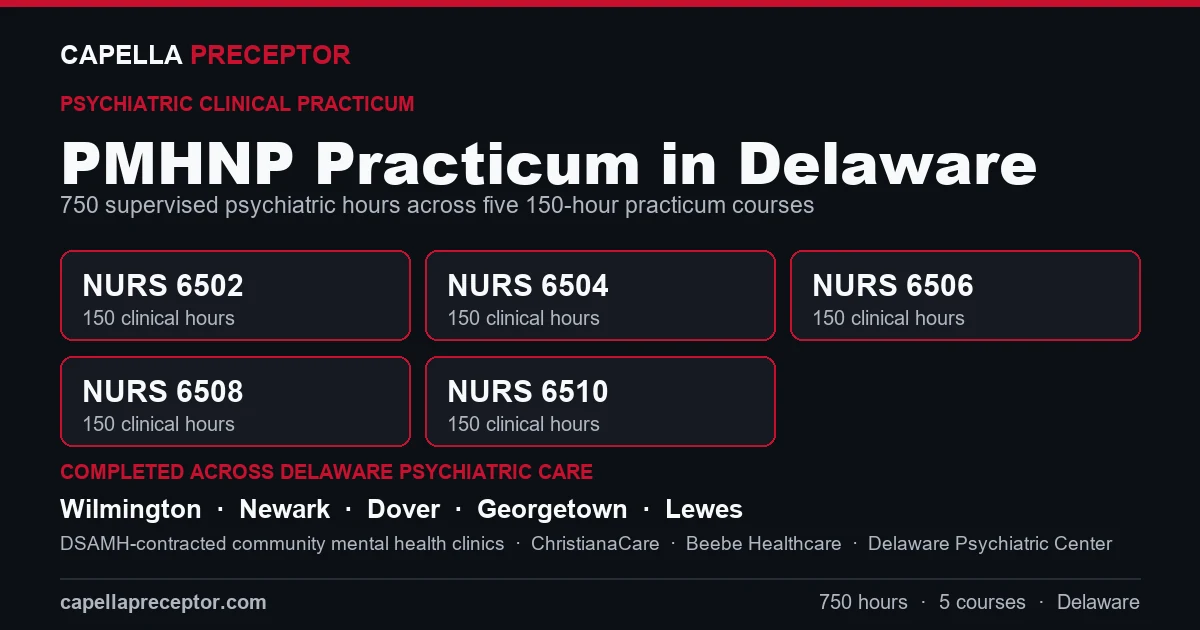
The number is the same as it is everywhere: a minimum of 750 practicum hours, but for the PMHNP every one of those hours is psychiatric-mental-health care, not primary care. Capella splits the 750 across five practicum courses of 150 clinical hours each, completed in person at an approved behavioral-health site under an on-site preceptor (Capella, MSN-PMHNP courses). That five-course, 150-hour structure is what makes this different from the Delaware FNP practicum, which runs as six 125-hour courses in family primary care. For a PMHNP in Delaware, the question is never just where to log hours, it is where you can log psychiatric hours under a credentialed psychiatric provider.
Because the sequence deliberately spans the lifespan, from adult and geriatric psychiatry in Practicum I to child and adolescent psychiatry in Practicum II, most Delaware students need more than one psychiatric site or preceptor over the program. Child and adolescent psychiatry is the scarcest population to cover in a small state, so plan that rotation first, not last. The full course-by-course breakdown lives on our PMHNP page; this page is about doing those hours inside Delaware's board rules.
What does full practice authority mean for a Delaware psychiatric preceptor?
The American Association of Nurse Practitioners classifies Delaware as a full practice state (AANP, Delaware). Under Title 24 of the Delaware Code, an APRN licensed by the Board of Nursing holds full-practice and prescriptive authority and, after approval from the APRN Committee and Board, practices independently rather than under a collaborative agreement (24 Del. C. § 1935). For your practicum, that has a concrete upside: a Delaware psychiatric-mental-health NP can serve as your on-site preceptor in their own right, diagnosing, prescribing, and managing psychiatric care without a physician co-signing every decision, which widens the pool of people legally qualified to precept you beyond psychiatrists alone.
Full practice authority does not remove the practicum paperwork. Capella still requires that you secure a qualified preceptor and an approved psychiatric site, and that an affiliation agreement is signed before you log a single hour. Independence at the state level and approval at the program level are two separate gates, and a preceptor who is fully independent under Delaware law still has to meet Capella's published requirements and be submitted for Capella's review.
Prescribing controlled psychiatric medications in Delaware
This is where a psychiatric placement diverges most sharply from a primary-care one, because psychiatry runs on controlled drugs: Schedule II stimulants for ADHD, benzodiazepines for acute anxiety, and buprenorphine for opioid use disorder in patients with co-occurring psychiatric conditions. In Delaware, full practice authority is not the whole story. A licensed APRN must separately hold a Delaware Controlled Substance Registration (CSR) and a Delaware DEA registration, and must complete a one-hour mandatory course on Delaware law, regulation, and programs for prescribing and distributing controlled substances, before writing for any scheduled medication (Delaware Division of Professional Regulation, APRN controlled-substance registration).
For a co-occurring substance-use rotation, the buprenorphine details matter. Federal law no longer requires the old waiver to prescribe buprenorphine for opioid use disorder, but since June 2023 a one-time eight-hour training on treating substance use disorders applies to new DEA registrations (SAMHSA, MATE Act training requirements). Delaware layers its own rules on top: the state's Uniform Controlled Substances Act regulations govern safe opioid prescribing, and Delaware now requires even out-of-state telehealth prescribers to obtain a Delaware CSR rather than relying on an interstate compact or another state's registration. None of this stops you from training in addiction psychiatry; it just means the preceptor supervising those hours has to be properly registered in Delaware, which is something we verify before a match.
Can Delaware PMHNP hours be done by telepsychiatry?
Partly, and Delaware is friendlier than most states about it. State rules permit an APRN to use telemedicine within an established APRN-patient relationship, except where it is impractical to see the patient in person first, and they hold a recommendation or prescription issued by telehealth to the same standard of practice as an in-person encounter. Prescriptions written through telemedicine inside that relationship may include controlled substances, subject to the Board's limits. Psychiatry is well suited to this: intake interviews, medication management, and psychotherapy are routinely delivered by video in real Delaware practice, and Capella names telepsychiatry directly inside the Practicum III experience (Capella, MSN-PMHNP courses).
That does not make the whole 750 hours remote. How much telehealth counts toward each practicum depends on your specific course requirements, your preceptor's practice, and the Board's standards for supervised training, so confirm the current allowance per course before you assume a hybrid plan works. In practice, telepsychiatry is most useful in Delaware for covering a population the local panel cannot supply, for example reaching child and adolescent psychiatry from a Sussex County base, while the bulk of your hours sit with an in-person Delaware site.
Where do PMHNP students complete psychiatric hours in Delaware?
Delaware is small and its behavioral-health capacity is concentrated, so it helps to know the real settings before you start asking. PMHNP hours have to come from psychiatric and behavioral-health practice, not general primary care, and the settings that typically qualify in Delaware, when staffed by a credentialed supervising provider, include:
- DSAMH-contracted community mental health clinics across New Castle, Kent, and Sussex counties, the backbone of public psychiatric care for serious mental illness in the state
- Hospital psychiatry and outpatient behavioral health at systems such as ChristianaCare in the Wilmington and Newark area and Beebe Healthcare in southern Delaware, both of which run behavioral-health services and employ psychiatric nurse practitioners
- Substance-use and medication-assisted-treatment programs, where buprenorphine and co-occurring-disorder care give you the addiction-psychiatry exposure the curriculum expects
- The Delaware Psychiatric Center near New Castle, the state-operated inpatient hospital providing secured acute care for adults with severe mental illness, for inpatient psychiatric exposure
- Telepsychiatry groups licensed to practice in Delaware, useful for filling a population gap your in-person site cannot cover
Geography shapes the search. The I-95 corridor around Wilmington and Newark in New Castle County holds most of the state's psychiatric volume, so adult outpatient and inpatient hours are most reachable there. Dover anchors Kent County, and Sussex County towns such as Georgetown, Lewes, and Seaford lean rural, where a single behavioral-health practice may already host another school's student. Whatever the setting, the supervising provider must hold an active Delaware license and the scope to oversee psychiatric care, a PMHNP-BC or a psychiatrist, and both the credential and the setting clear Capella's review before you log hours.
How hard is it to find a PMHNP preceptor in Delaware?
Honestly, harder than finding a primary-care preceptor, and it is worth being concrete about why. Psychiatric preceptors are scarcer than family-medicine preceptors to begin with, the national behavioral-health workforce is under documented strain, and much of Delaware is designated as a mental-health professional shortage area, so the providers who could precept are already carrying heavy clinical panels (Delaware Health Care Commission, Health Professional Shortage Areas). On top of that, Delaware sits in a dense corridor, so the same Wilmington and Newark psychiatric practices field placement requests from Delaware, southeastern Pennsylvania, Maryland, and New Jersey students at the same time, and the good preceptors fill early.
The practical consequences are predictable. Students who wait until the practicum term opens often find every nearby psychiatric site already committed, the child and adolescent rotation is the first to run out, and an affiliation agreement with a small Delaware practice that has never hosted a Capella student can take weeks to execute. The fix is not heroic, it is early and organized: line up the adult and the child or adolescent sources before the term, verify each preceptor's Delaware license and controlled-substance registration up front, and front-load the background check and health records so a paperwork gap does not stall your start.
The Delaware clearance sequence, step by step
Once you have a willing preceptor and a psychiatric site, the path to logging hours is the same order every time:
- Propose the site and preceptor in CORE ELMS, Capella's practicum-management system, for review and approval before the term starts.
- Verify the psychiatric credential. Confirm your preceptor holds an active Delaware license in the psychiatric role, and a CSR plus DEA registration if your hours involve controlled prescribing.
- Execute the affiliation agreement between Capella and the Delaware behavioral-health site before day one of practicum.
- Clear compliance through Capella's background-check and health-records vendor, CastleBranch, before you are cleared to start.
- Log and submit hours in CORE ELMS, where your preceptor approves each block until all five courses reach 150 hours.
Because the agreement is between Capella and the site rather than between you and your preceptor, a willing psychiatric provider is not enough on its own. A small Delaware practice that has never signed a Capella affiliation agreement sometimes stalls at that step, which is exactly the kind of delay a matching service clears, because the sites we work with already know the paperwork.
Delaware PMHNP FAQ
How many psychiatric hours does a Capella PMHNP need in Delaware?
A minimum of 750 supervised psychiatric clinical hours, completed as 150 hours in each of the five Capella practicum courses (NURS6502, NURS6504, NURS6506, NURS6508, NURS6510), all at a Delaware behavioral-health site under an on-site PMHNP or psychiatrist preceptor. The count is the same nationwide; what changes in Delaware is the board rules around prescribing and supervision.
Can a Delaware PMHNP preceptor prescribe controlled psychiatric medications?
Yes, once registered. Delaware is a full practice authority state, but a licensed APRN must hold a Delaware Controlled Substance Registration plus a Delaware DEA registration, and complete a one-hour mandatory course on Delaware controlled-substance law, before prescribing Schedule II stimulants, benzodiazepines, or buprenorphine. A separate eight-hour federal training on substance use disorders also applies to new DEA registrations.
Can Capella PMHNP hours be done by telepsychiatry in Delaware?
Partly. Delaware permits telemedicine within an established APRN-patient relationship and holds telehealth care to the same standard as in-person care, and Capella names telepsychiatry inside Practicum III. How much telehealth counts toward your hours still depends on your course requirements and your preceptor's practice, so confirm the allowance for each practicum rather than assuming all 750 hours can be remote.
Where do PMHNP students complete psychiatric hours in Delaware?
At Delaware behavioral-health settings: DSAMH-contracted community mental health clinics across New Castle, Kent, and Sussex counties, hospital psychiatry and outpatient behavioral health at systems such as ChristianaCare and Beebe Healthcare, substance-use and medication-assisted treatment programs, the state-operated Delaware Psychiatric Center for inpatient adult care, and telepsychiatry groups, each supervised by a credentialed psychiatric provider.
Is finding a PMHNP preceptor in Delaware harder than finding an FNP preceptor?
Usually, yes. Psychiatric preceptors are scarcer than primary-care preceptors, Delaware is a small state with much of its territory designated as a mental-health professional shortage area, and the same psychiatric sites field requests from Delaware, Pennsylvania, Maryland, and New Jersey students at once. That is why students secure a Delaware psychiatric placement early or use a matching service.
Sources
- Capella University, MSN-PMHNP courses and practicum hours
- 24 Del. C. § 1935, APRN authority and full practice in Delaware
- Delaware Division of Professional Regulation, APRN controlled-substance registration
- SAMHSA, MATE Act training requirements for buprenorphine prescribing
- AANP, Delaware practice environment (full practice)
- Delaware Health Care Commission, Health Professional Shortage Areas
How Capella Preceptor helps in Delaware
The hard part of a Delaware PMHNP is not the coursework, it is lining up 750 supervised psychiatric hours across adult and child rotations, with a preceptor who is properly licensed and controlled-substance registered in Delaware, at a behavioral-health site that will sign an affiliation agreement. That is what we do. We match a verified preceptor who meets Capella's published PMHNP requirements, in Wilmington, Newark, Dover, or across Kent and Sussex counties, in person or by telepsychiatry where it counts, and submit the placement for Capella's review.
- Verified Delaware psychiatric preceptor matched in 7 days, with no payment until you are matched
- Adult and child or adolescent psychiatric rotations covered across all five practicums
- Every CORE ELMS form and affiliation agreement handled, hours logged and submitted on schedule
Related: Capella PMHNP preceptor and hours · Capella preceptor in Delaware (all programs)
Get a Capella PMHNP preceptor in Delaware
Free 15-minute consult. No payment until matched. We map your entire Delaware psychiatric practicum plan, adult through child and adolescent.
Get my free consult →