Home / MSN-PMHNP / PMHNP Preceptor in Georgia
Program × StateCapella PMHNP preceptor in Georgia
A Capella PMHNP practicum in Georgia requires 750 supervised psychiatric clinical hours across five practicum courses of 150 hours each, completed under an on-site psychiatric-mental-health preceptor. Georgia is a restricted practice state, so that preceptor works inside a physician-delegated nurse protocol, the state's controlled-substance rules limit what they can prescribe, and the psychiatric preceptor pool here is genuinely thin. Below is how those Georgia rules shape a psych placement, then how we secure one.
Last updated 2026-06-28 · Reviewed by the Capella Preceptor placement team
What does a Capella PMHNP practicum require in Georgia?
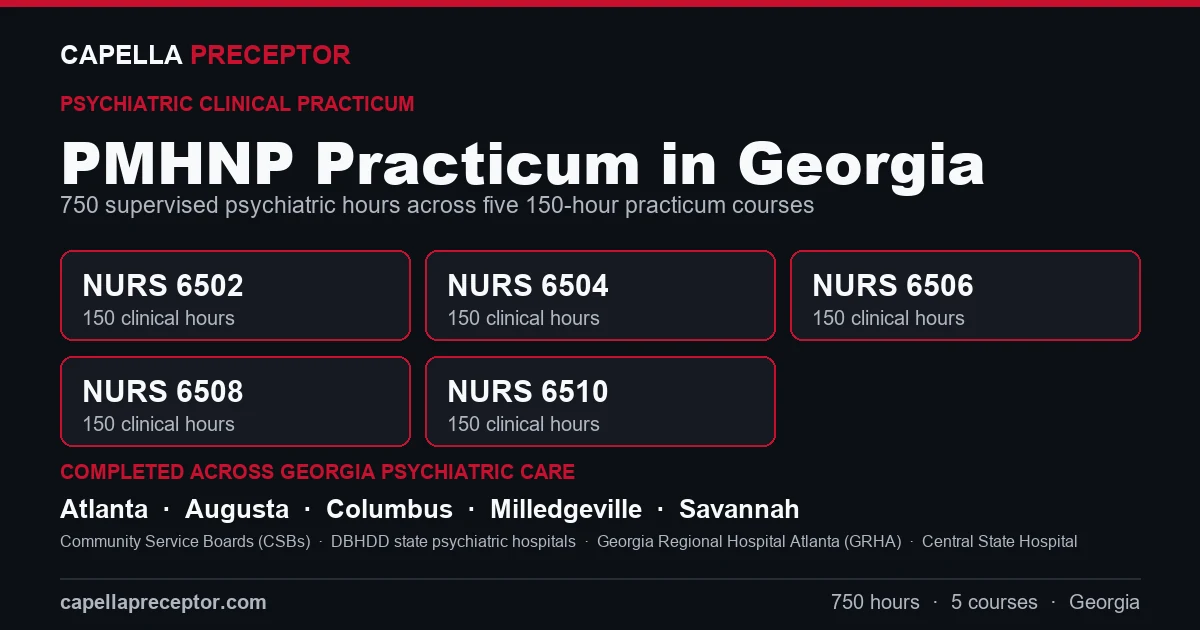
The same 750 psychiatric hours apply in Georgia as anywhere else, and they are completed locally. Capella's MSN-PMHNP carries a minimum of 750 practicum hours split as 150 clinical hours in each of five practicum courses, NURS6502 Practicum I, NURS6504 Practicum II, NURS6506 Practicum III, NURS6508 Practicum IV, and NURS6510 Practicum V (Capella, MSN-PMHNP courses). The coursework is online; the psychiatric practicum is in person at a Georgia site, under an on-site preceptor you are responsible for securing. This 5×150 psychiatric structure is not the same as the Capella FNP practicum, which runs primary-care hours across six courses, so a PMHNP placement in Georgia is built on different settings, a different supervising credential, and different prescribing rules than a family-practice placement here. For the full breakdown of the five courses and the lifespan population split, see the broader Capella PMHNP page.
750 psychiatric
Five courses, 150 hours each.
On-site PMHNP or MD
Board-certified in psychiatry.
Restricted
Physician-delegated protocol.
How does Georgia's restricted authority affect a psych preceptor?
The American Association of Nurse Practitioners places Georgia in the restricted tier, its most limited level of practice authority (AANP, State Practice Environment). A Georgia psychiatric NP cannot practice on their own authority. State law requires career-long collaboration with a delegating physician, captured in a written nurse protocol agreement under O.C.G.A. 43-34-25, and that protocol is registered with the Georgia Composite Medical Board (Georgia Composite Medical Board, APRN protocol registration). The Georgia Board of Nursing, under the Secretary of State, separately authorizes the APRN (Georgia Board of Nursing).
For a PMHNP student this matters more than it does for a primary-care track, because so much of psychiatric care is medication management. The clinicians who can precept you are practicing inside a physician-delegated framework, and their psychiatric prescribing scope, including the controlled substances central to psychiatry, is defined by their own protocol. That is normal for Georgia and does not block your hours. We screen for a preceptor whose protocol and patient panel line up with what your Capella psychiatric courses require, then verify their active Georgia license and PMHNP or psychiatry certification through the public Secretary of State portal at verify.sos.ga.gov before we present a match.
What can a Georgia psych preceptor actually prescribe?
Controlled-substance rules are the part of Georgia practice that touches psychiatry hardest, and they shifted recently. House Bill 557, effective July 1, 2024, lets a delegating physician authorize an APRN under protocol to prescribe certain Schedule II drugs, but the expansion is narrow: only hydrocodone or oxycodone, only as an initial emergency supply of up to 5 days with no refills, only for a patient 18 or older, only with at least one year of post-licensure experience and a continuing-education hour every two years (HunterMaclean, 2024 Georgia APRN scope expansion; O.C.G.A. 43-34-25).
For psychiatry the gap is the point. That 2024 change is aimed at acute pain, not behavioral health, and it does not extend Schedule II stimulants such as methylphenidate or amphetamine, the ADHD medications a psych panel leans on, and it does not touch the Schedule IV benzodiazepines used for anxiety and acute agitation. Those still run through the delegating physician's authority, so a Georgia preceptor's day-to-day stimulant and benzodiazepine prescribing is shaped by their protocol, not by independent NP authority. Buprenorphine for opioid use disorder sits in a different place: it is Schedule III, which a Georgia APRN can prescribe once the nurse protocol is approved, a DEA registration with Schedule III authority is active, and the one-time federal eight-hour training on substance-use treatment is complete (APNA, X-waiver elimination and MOUD prescribing). That makes Georgia medication-assisted-treatment and addiction programs realistic psychiatric practicum sites, which matters for the co-occurring substance-use work that runs through the PMHNP curriculum.
None of this is paperwork you manage as a student. It is context for choosing the right preceptor, because a site whose protocol matches the medications you need to see, stimulant management, benzodiazepine tapers, or buprenorphine inductions, gives you a richer Capella practicum than one that cannot.
Can telepsychiatry count toward Georgia PMHNP hours?
Often, yes, within limits, and Capella names telepsychiatry directly inside the Practicum III experience (Capella, MSN-PMHNP courses). Psychiatry is one of the more telehealth-deliverable specialties because intake interviews, medication management, and psychotherapy translate well to video, and in a state where 151 of 159 counties are mental-health shortage areas, telepsychiatry is how a lot of real Georgia care is delivered.
Georgia's telemedicine rule sets the guardrails. The Georgia Composite Medical Board requires a patient to be examined in person once before an initial controlled-substance prescription and to be seen in person at least once a year, and it does not authorize starting controlled substances for chronic pain by telemedicine alone (Georgia Composite Medical Board, telemedicine rule 360-3-.07). For a practicum that means a telepsychiatry site can carry a real share of your hours, but a fully psychiatric panel will still involve in-person encounters, especially where controlled medications are being started. How much telehealth counts toward each of your 750 hours depends on your specific course requirements and your preceptor's practice, so confirm the current allowance against your course instructions rather than assuming a rotation can be entirely remote.
Where do Capella PMHNP students complete psychiatric hours in Georgia?
PMHNP hours must be earned in behavioral and mental-health practice, not general primary care, and Georgia has real settings for it across the public and private systems. The backbone is public: Georgia runs 22 Community Service Boards (CSBs) that together cover all 159 counties and are often the only local behavioral-health provider, employing board-certified psychiatrists and psychiatric nurse practitioners (Georgia Pines, Community Service Boards). The state also operates five DBHDD psychiatric hospitals in Atlanta, Augusta, Columbus, Milledgeville, and Savannah, offering inpatient adult mental-health and forensic services (Georgia DBHDD, hospitals).
22 boards statewide covering all 159 counties; outpatient psychiatry and medication management, the workhorse of Georgia public behavioral health.
Inpatient adult and forensic units in Atlanta (GRHA), Augusta, Columbus, Milledgeville (Central State), and Savannah.
Georgia-certified CCBHCs deliver 24-hour crisis care plus mental-health and substance-use services across the lifespan.
Buprenorphine and substance-use treatment sites, viable for co-occurring-disorder hours given the Schedule III route above.
Private psychiatric practices across metro Atlanta and statewide, many offering video visits within the telemedicine rule.
The scarcest setting, needed for the Practicum II population; concentrated in metro Atlanta and worth securing early.
Whatever the setting, the supervising provider must hold an active Georgia license and the scope to oversee psychiatric care, a board-certified PMHNP or a psychiatrist, and both the credential and the site clear review before you log a single hour.
Why is finding a PMHNP preceptor in Georgia so hard?
Honestly, this is the hardest preceptor search on the site, and it is worth being concrete about why. Georgia ranks 49th of 50 states for mental-health access, 151 of its 159 counties are mental-health professional shortage areas, and nearly five million Georgians live in a community without enough mental-health professionals (Georgia Public Broadcasting, 2024). The clinicians who could precept you are already carrying heavy caseloads, and Capella still leaves the search to the student, so the structural shortage lands squarely on you.
Child and adolescent psychiatry is the sharpest pinch, and it collides directly with Practicum II's child and adolescent population requirement. There are roughly 240 child and adolescent psychiatrists in the whole state, most of them in metro Atlanta, and families routinely wait six to eight months for an appointment (Georgia Public Broadcasting, 2024). A single outpatient practice rarely covers both ends of the lifespan well, so many Georgia PMHNP students need more than one preceptor or site across the five-practicum sequence. Plan for that early. Cold-emailing clinics in a shortage market is slow, and a course clock does not wait. If you have already started declining replies, the broader can't-find-a-preceptor guide walks through next steps.
What clearance happens before you log a Georgia psych hour?
Identifying a Georgia psychiatric preceptor is step one. Capella runs every placement through a clearance workflow before any hour counts, the same in Georgia as anywhere, even though the supervision context here is physician-delegated.
- Propose the Georgia psychiatric site and preceptor in Capella's CORE ELMS practicum system so the placement can be submitted for Capella's own review and approval.
- Sign an affiliation agreement between Capella and the Georgia behavioral-health site, which must be in place before practicum starts and can take weeks at a public system like a CSB.
- Clear compliance through CastleBranch, the background check, drug screen, and health records, completed by the deadline your program sets.
- Log and submit hours in CORE ELMS, where your psychiatric preceptor approves what you record toward each course's 150-hour total.
Georgia PMHNP FAQ
Can a Georgia PMHNP preceptor prescribe ADHD stimulants or benzodiazepines under a nurse protocol?
Not under the 2024 Schedule II expansion. Georgia House Bill 557, effective July 1, 2024, lets a delegating physician authorize an APRN to prescribe only hydrocodone or oxycodone, and only as an initial emergency supply of up to 5 days with no refills for a patient 18 or older. Schedule II stimulants such as methylphenidate and amphetamine, and Schedule IV benzodiazepines, are not covered by that expansion, so your Georgia preceptor's scope for those medications still runs through the delegating physician. Buprenorphine for opioid use disorder is Schedule III and can be delegated when the protocol, DEA registration, and federal training are in place.
Do all 750 Capella PMHNP hours have to be in person in Georgia, or can telepsychiatry count?
Telepsychiatry counts toward Capella PMHNP hours where your course allows it, and Capella names telepsychiatry inside Practicum III. Georgia's telemedicine rule shapes how those hours run: the Georgia Composite Medical Board requires a patient to be examined in person once before an initial controlled-substance prescription and at least once a year in person. Confirm the telehealth share for each practicum against your course instructions rather than assuming all 750 hours can be remote.
Where do Capella PMHNP students actually complete psychiatric hours in Georgia?
Common settings include Georgia's 22 Community Service Boards that cover all 159 counties, the five DBHDD state psychiatric hospitals in Atlanta, Augusta, Columbus, Milledgeville, and Savannah, Georgia-certified community behavioral health clinics, addiction and medication-assisted-treatment programs, outpatient psychiatry groups, and telepsychiatry practices, each supervised by a board-certified PMHNP or psychiatrist.
Why is a PMHNP preceptor so hard to find in Georgia?
Georgia ranks 49th of 50 states for mental-health access, 151 of its 159 counties are mental-health professional shortage areas, and child and adolescent psychiatry is especially thin, with roughly 240 child and adolescent psychiatrists statewide concentrated in metro Atlanta and waits of six to eight months for an appointment. The clinicians who could precept are already carrying heavy caseloads, which is why Capella's policy that the student secures the preceptor is hardest for psychiatry here.
Sources
- Capella University, MSN-PMHNP courses (750 hours, five practicum courses, telepsychiatry in Practicum III)
- AANP, State Practice Environment (Georgia listed as restricted)
- O.C.G.A. 43-34-25, nurse protocol and APRN prescriptive authority
- HunterMaclean, 2024 Georgia APRN Schedule II scope expansion (HB 557)
- APNA, X-waiver elimination and buprenorphine prescribing for MOUD
- Georgia Composite Medical Board, telemedicine rule 360-3-.07
- Georgia DBHDD, state psychiatric hospitals
- Georgia Pines, Community Service Boards overview (22 CSBs, 159 counties)
- Georgia Public Broadcasting, mental-health access and child-psychiatry shortage (2024)
How Capella Preceptor helps with PMHNP placement in Georgia
You now know the hard part: Georgia is a restricted state, the controlled-substance rules that matter most for psychiatry are limited, and child and adolescent psychiatry is scarce, all while Capella leaves the search to you. We close that gap. We source a verified, Georgia-licensed psychiatric preceptor whose protocol and patient panel meet Capella's published PMHNP requirements, submit the placement for Capella's review, prepare every CORE ELMS form, affiliation agreement, and CastleBranch step, and keep your hours logged toward each course's 150-hour total, in person across the Atlanta metro and statewide, or by telepsychiatry where it fits your courses and Georgia's rules.
- Verified Georgia psychiatric preceptor matched in 7 days, license confirmed on the state portal
- Adult and child/adolescent rotations sourced across the five-practicum sequence
- No payment until you are matched, in person or telepsychiatry, anywhere in Georgia
Prefer the broader pages first? See the Capella PMHNP requirements and the all-programs Georgia placement page, then come back here when you are ready to line up the psychiatric site.
Get a Capella PMHNP preceptor in Georgia
Free 15-minute consult. No payment until matched. We map your full psychiatric practicum plan around the Georgia rules, then see our pricing.
Get my free consult →