Capella PMHNP preceptor in Hawaii: psychiatric practicum placement
A Capella PMHNP practicum in Hawaii requires 750 supervised psychiatric clinical hours across five practicum courses of 150 hours each, completed under an on-site psychiatric-mental-health preceptor. Hawaii grants full practice authority, so a licensed psychiatric NP can precept and prescribe independently here, but the state has a severe shortage of psychiatric prescribers, which makes the preceptor, not the coursework, the hard part. This page explains the Hawaii board rules, telepsychiatry and controlled-substance limits, the real settings on the islands, and how we secure the placement.
Last updated: June 28, 2026 · Reviewed by the Capella Preceptor placement team
How many psychiatric hours does Capella PMHNP need in Hawaii?
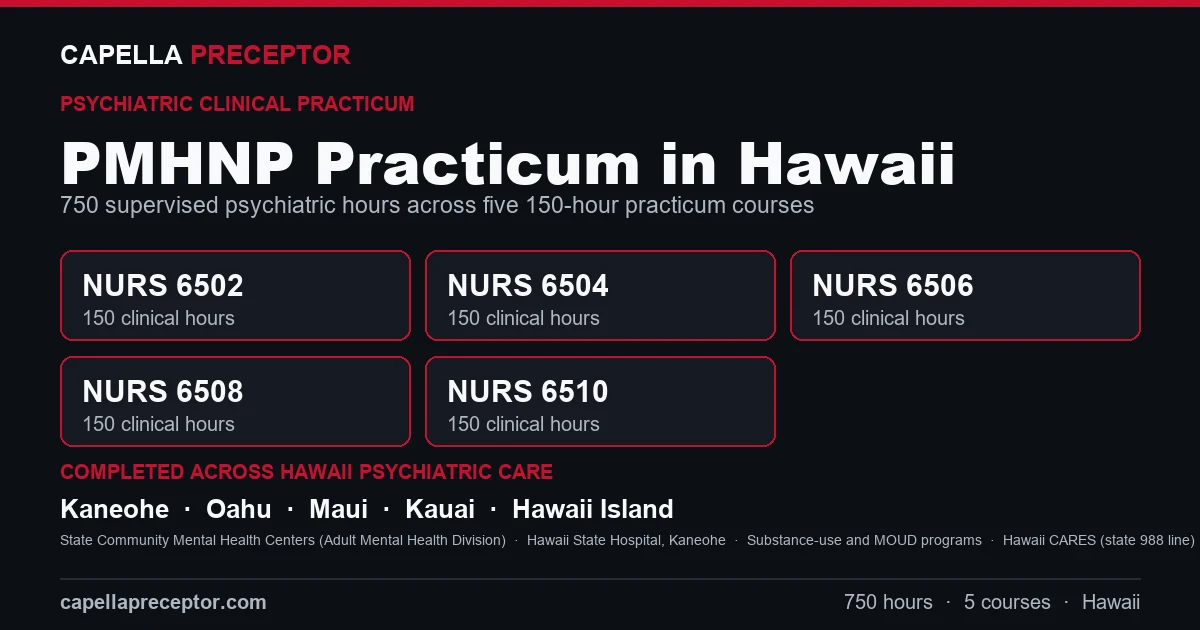
The Capella MSN Psychiatric Mental Health Nurse Practitioner specialization requires a minimum of 750 practicum hours, and that figure does not change because you complete it in Hawaii. The 750 hours are split as 150 clinical hours in each of five practicum courses, NURS6502 (Practicum I), NURS6504 (Practicum II), NURS6506 (Practicum III), NURS6508 (Practicum IV), and NURS6510 (Practicum V), every hour earned in a psychiatric or behavioral-health setting under an on-site preceptor (Capella, MSN-PMHNP courses). The coursework is online; the psychiatric practicum is done in person in your own community, which for a Hawaii student means an island site (Capella, MSN-NP program).
Note the structure. PMHNP is five courses of 150 hours, not the family-practice pattern of six courses at 125, so the planning unit in Hawaii is a 150-hour psychiatric rotation. Because PMHNP is a lifespan specialty, the sequence deliberately spreads your hours across adult, older-adult, child, and adolescent psychiatry. In a state where child and adolescent psychiatric providers are especially scarce, that lifespan split is the single most important thing to plan for, and the reason a Hawaii PMHNP student often needs more than one preceptor or site.
Can a Hawaii NP precept you without a collaborating physician?
Yes. The American Association of Nurse Practitioners places Hawaii in its Full Practice category, the most independent of the three classifications it uses (AANP, State Practice Environment). A Hawaii-licensed APRN can assess, diagnose, order and interpret tests, and prescribe psychiatric medications under their own license rather than under a contract with a supervising physician. The Hawaii Board of Nursing, which sits inside the Professional and Vocational Licensing Division of the Department of Commerce and Consumer Affairs, does not mandate a collaborative-practice agreement for a licensed APRN (Hawaii DCCA, Board of Nursing).
For a PMHNP student this widens the pool in a useful way. A board-certified psychiatric-mental-health NP (PMHNP-BC) can precept you in their own right, and so can a psychiatrist; you are not limited to clinics that happen to employ a supervising physician. Independent psychiatric NP practices, common in a full-practice state, are legitimate placement sites. One caution that matters for psychiatry specifically: full authority describes what a fully licensed Hawaii NP may do, not what you may do as a student. While precepting you practice under your preceptor's supervision and within Capella's practicum rules, even though Hawaii would let your preceptor work alone.
Prescriptive authority and controlled psychiatric medications in Hawaii
Psychiatry runs on controlled substances, Schedule II stimulants for ADHD, benzodiazepines for acute anxiety, and buprenorphine for co-occurring opioid use disorder, so how Hawaii handles APRN prescribing shapes what you will see in your rotations.
- A separate state controlled-substance registration. A Hawaii APRN who prescribes controlled substances must hold a Hawaii Controlled Substance Registration covering Schedules II through V, in addition to a federal DEA registration at the same address and schedules (Hawaii, APRN controlled-substance application instructions). Your preceptor will already hold both; it is part of what we verify.
- Advanced pharmacology behind the prescriptive designation. Hawaii's APRN-Rx authority requires advanced pharmacology coursework, with 30 contact hours of advanced pharmacology within the three years before applying for the state registration (Hawaii, APRN controlled-substance application instructions). The same independent prescribing your preceptor exercises is exactly the supervised psychopharmacology you are there to learn.
- Buprenorphine and medication-assisted treatment. Since the federal X-waiver was eliminated by the Consolidated Appropriations Act of 2023, any clinician with a current DEA registration, including a full-practice Hawaii NP, can prescribe buprenorphine for opioid use disorder, and new or renewing registrations now attest to 8 hours of substance-use-disorder training (SAMHSA, MAT Act waiver elimination). This makes substance-use and MOUD programs realistic PMHNP sites in Hawaii, where co-occurring disorders are common.
The board is the authority on its own current rules, so confirm anything specific to your placement against the DCCA page. We verify each preceptor's Hawaii license, national certification, and controlled-substance registration before we present them to you.
Does telepsychiatry count toward Hawaii practicum hours?
Partly, and the nuance is bigger in Hawaii than almost anywhere because of geography. Hawaii law expressly allows a bona fide APRN-patient relationship to be established by telehealth, with nothing requiring an in-person visit first for most care (CCHP, Hawaii telehealth laws). Much of psychiatry, intake interviews, medication management, and psychotherapy, is delivered by video in real practice, and Capella names telepsychiatry directly within its Practicum III experience (Capella, MSN-PMHNP courses). For a student on Kauai or rural Hawaii Island, where psychiatric clinics are few, a telepsychiatry preceptor can be the difference between finishing on time and waiting a term.
Two limits keep this from being a fully remote program. First, Hawaii draws a hard line on opioids: for opioid-related prescribing a prescriber-patient relationship must be established after an in-person consultation, so the buprenorphine and MOUD side of psychiatric care cannot be done entirely by video (CCHP, Hawaii telehealth laws). Second, how much telehealth counts toward your hours depends on your specific course requirements and your preceptor's practice. Confirm the current telehealth allowance for each practicum against your course instructions before assuming a rotation can be fully online.
Where do Hawaii PMHNP students actually complete psychiatric hours?
Hawaii's psychiatric care concentrates in a handful of systems, and your 150-hour rotations are matched to the population each course requires. The real settings here:
The Adult Mental Health Division operates CMHCs statewide, including on Oahu, Maui, Kauai, and Hawaii Island, delivering outpatient psychiatry and medication management for serious mental illness (Hawaii AMHD).
The state inpatient psychiatric hospital on Oahu, providing inpatient psychiatric care including for court-ordered patients, a setting for inpatient and crisis exposure (Hawaii State Hospital).
Independent psychiatric NP and psychiatrist practices, concentrated on Oahu, where most adult and older-adult medication-management hours are realistically found.
Addiction and medication-assisted-treatment programs, relevant for co-occurring disorders and now open to NP prescribers after the X-waiver repeal.
The scarcest setting in the state and the one to lock in first for your Practicum II population; often a separate site from your adult hours.
Video-based psychiatric practices that fill neighbor-island gaps for medication management and therapy, within the telehealth limits above.
Crisis and access infrastructure such as Hawaii CARES (the state 988 line) sits alongside these clinical sites. We match the setting to your course: adult and older-adult psychiatry for Practicum I, child and adolescent psychiatry for Practicum II, and the advanced, psychopharmacology, and transition-to-practice focus of Practicums III through V.
Why is a PMHNP preceptor in Hawaii so hard to find?
Because the prescribers are not there to spare. Hawaii has roughly a 67 percent shortage of adult psychiatrists and a 64 percent shortage of child and adolescent psychiatrists, and on some neighbor islands the shortfall for certain mental-health services exceeds 70 percent (University of Hawaii, PMHNP program needs assessment). The University of Hawaii at Manoa launched the state's first PMHNP program cohort only in Fall 2024, in direct response to that gap, which tells you how recently Hawaii has had to grow its own psychiatric prescribers (UH Manoa, PMHNP program).
For a Capella student the practical consequence is concrete. The few psychiatric prescribers willing and able to precept are already at capacity, the child and adolescent rotation is the hardest of all to secure, inter-island travel makes a single site rarely cover the whole lifespan, and Capella places the responsibility for finding the preceptor on you, not the university (Capella, MSN-PMHNP overview). This is not a reason to panic; it is a reason to start early and, often, to use help.
Getting a Hawaii psychiatric placement approved
Once you have identified a Hawaii preceptor and site, the placement runs through Capella's clearance workflow before a single hour counts. We do not call any preceptor or site "endorsed by Capella." Capella reviews and approves the proposed placement; we match preceptors who meet Capella's published requirements and submit the placement for Capella's own review.
For the broader program rules see our PMHNP preceptor and psych placement page, and for state-wide placement geography across every specialty see our Hawaii practicum and preceptors page. This page is the intersection of the two: PMHNP psychiatry, done in Hawaii.
FAQ
How many psychiatric practicum hours does a Capella PMHNP need in Hawaii?
A minimum of 750 supervised psychiatric clinical hours, completed as 150 hours in each of five practicum courses (NURS6502, NURS6504, NURS6506, NURS6508, NURS6510), under an on-site psychiatric-mental-health preceptor at a Hawaii site. The hour requirement is the same in Hawaii as anywhere; what changes is the local board rules and the small pool of psychiatric preceptors.
Can a Hawaii NP precept a Capella PMHNP student without physician supervision?
Yes. Hawaii is a full practice authority state, so a Hawaii-licensed APRN can diagnose, treat, and prescribe psychiatric medications independently and can serve as your preceptor without a collaborating physician. A board-certified psychiatrist may also precept. You still practice as a student under their supervision and within Capella's practicum rules.
Can Hawaii PMHNP practicum hours be completed by telepsychiatry?
Hawaii law allows an APRN to establish a patient relationship and prescribe many psychiatric medications by telehealth, and Capella names telepsychiatry within Practicum III. But opioid-related prescribing, which includes buprenorphine for opioid use disorder, requires an in-person consultation first under Hawaii law, and the share of telehealth hours that counts toward your practicum depends on your course instructions and your preceptor's practice. Confirm the current allowance before assuming hours can be fully remote.
What psychiatric settings in Hawaii count for PMHNP hours?
Behavioral-health settings supervised by a credentialed psychiatric provider: the state Community Mental Health Centers run by the Adult Mental Health Division, the Hawaii State Hospital in Kaneohe, outpatient psychiatry and private practice, substance-use and medication-assisted-treatment programs, child and adolescent clinics, and telepsychiatry groups. Neighbor-island options are thin, which is the main placement challenge here.
Why is finding a PMHNP preceptor in Hawaii so hard?
Hawaii has a roughly 67 percent shortage of adult psychiatrists and a 64 percent shortage of child and adolescent psychiatrists, worse than 70 percent on some neighbor islands. The few psychiatric prescribers are already at capacity, and Capella requires you to secure your own preceptor, so the search is real work, especially for the child and adolescent rotation.
Sources
- Capella University, MSN-PMHNP courses and practicum hours
- AANP, State Practice Environment (Hawaii is Full Practice)
- Hawaii DCCA, Board of Nursing (PVL Division)
- Hawaii, APRN controlled-substance registration application instructions
- Center for Connected Health Policy, Hawaii telehealth laws
- SAMHSA, Waiver Elimination (MAT Act) for buprenorphine
- University of Hawaii, Meeting Hawaii's Mental Health Needs (PMHNP program needs assessment)
- Hawaii Adult Mental Health Division (Community Mental Health Centers)
How Capella Preceptor helps in Hawaii
You now know the landscape: full practice authority that lets a psychiatric NP precept independently, a controlled-substance and telepsychiatry framework with real limits, and a psychiatric-prescriber shortage that makes the preceptor, not the coursework, your bottleneck. That last part is exactly where island PMHNP students lose terms. We match a verified, Hawaii-licensed, psychiatric preceptor who meets Capella's published requirements, cover both the adult and the child or adolescent rotation, prepare every CORE ELMS form and the affiliation agreement, and submit the placement for Capella's review.
- Verified Hawaii psychiatric preceptor matched in 7 days, no payment until matched
- Adult and child or adolescent psychiatric rotations covered across all five practicums
- Every CORE ELMS form, affiliation agreement, and CastleBranch step handled
Get a Capella PMHNP preceptor in Hawaii
Free 15-minute consult. No payment until matched. We map your full psychiatric practicum plan across all five courses.
Get my free consult →