Capella PMHNP preceptor in Kentucky
A Capella PMHNP practicum in Kentucky requires 750 supervised psychiatric clinical hours across five practicum courses of 150 hours each, completed under an on-site psychiatric-mental-health preceptor. Kentucky is a reduced-practice state where an APRN's controlled-substance prescribing runs through a collaborative agreement, which shapes the kind of psychiatric preceptor you need. This page explains the PMHNP hour structure, the Kentucky Board of Nursing rules that matter for psych prescribing, where students actually complete hours in the commonwealth, and how we secure a verified preceptor for you.
Last updated 2026-06-28 · Reviewed by the Capella Preceptor psychiatric placement team
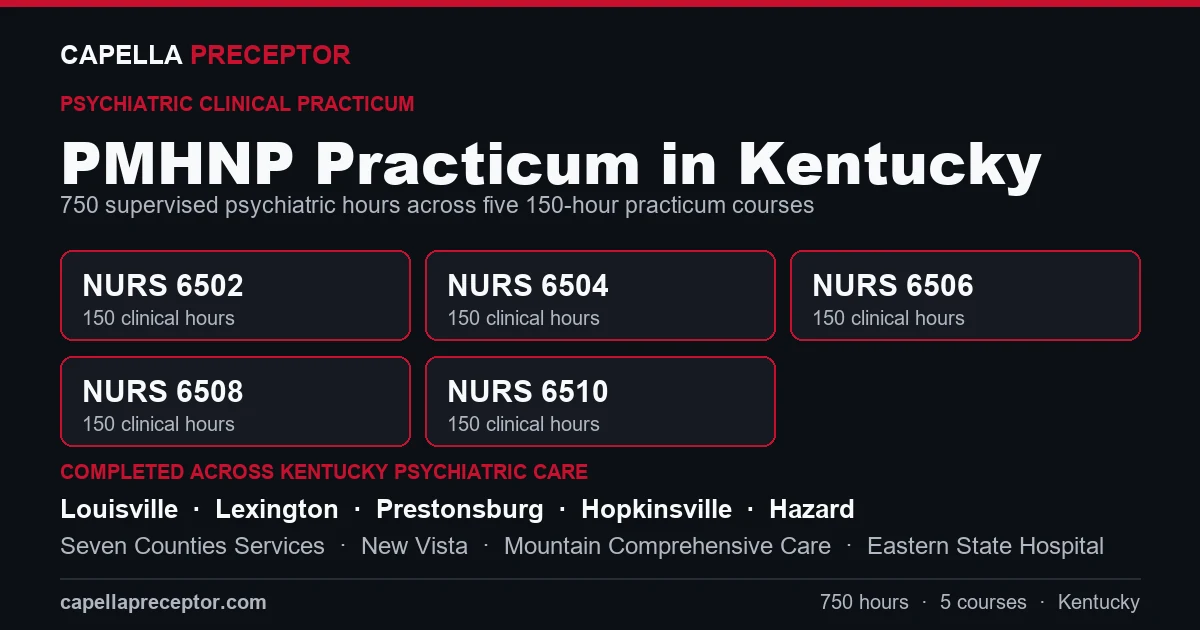
What does a Capella PMHNP practicum require in Kentucky?
The Capella MSN Psychiatric Mental Health Nurse Practitioner specialization requires a minimum of 750 practicum hours, completed across five practicum courses (Capella, MSN-PMHNP courses). Each course carries 150 clinical hours in a psychiatric setting under a qualified on-site preceptor: NURS6502 Practicum I, NURS6504 Practicum II, NURS6506 Practicum III, NURS6508 Practicum IV, and NURS6510 Practicum V. That is a five-by-150 structure, which is worth noting because it is not the same as the Capella FNP practicum, which runs six courses at 125 hours in primary-care settings. A PMHNP student in Kentucky needs psychiatric hours, not family-practice hours, so an FNP placement does not transfer.
The coursework is online and the psychiatric practicum is completed in person at an approved site in your own Kentucky community. Because PMHNP is a lifespan specialty, the sequence deliberately spreads your hours across adult, older-adult, child, and adolescent psychiatry, so most Kentucky students end up needing more than one preceptor or site to cover both ends of the age range. Plan for that from the start, because the providers who see children are scarcer in the commonwealth than those who see adults.
What does reduced practice mean for a psychiatric preceptor in Kentucky?
The American Association of Nurse Practitioners classifies Kentucky as a reduced practice state (AANP, Kentucky state practice environment). For psychiatry this matters more than it does for primary care, because so much of a PMHNP's work is prescribing. A Kentucky APRN assesses, diagnoses, and manages psychiatric care within their certification, but prescribing runs through two written agreements with a physician. A Collaborative Agreement for Prescriptive Authority for Nonscheduled Legend Drugs (CAPA-NS) covers non-controlled medications such as most antidepressants and antipsychotics, and a separate Collaborative Agreement for Prescriptive Authority for Controlled Substances (CAPA-CS) covers controlled psychiatric drugs (Kentucky Board of Nursing, APRN prescriptive authority). After four years of prescribing in good standing under a CAPA-NS, an APRN may notify the board and continue nonscheduled prescribing without it, while the CAPA-CS continues to govern controlled substances with no equivalent exemption.
Here is why this shapes your placement, and why it is easy to misread. The collaborative agreement governs a working APRN's own prescriptive license. As a student, you prescribe nothing under your own authority; you observe and practice under a preceptor who is already licensed. So reduced practice does not add a separate supervision contract to your student placement. What it does is shape which clinicians can teach you the full scope of psychiatric prescribing. A preceptor who holds an active CAPA-CS and routinely prescribes controlled psychiatric medications can show you stimulant titration, benzodiazepine stewardship, and medication for opioid use disorder, the exact decisions you will own after certification. A preceptor without one cannot. We screen for that.
How do Kentucky's controlled-substance rules touch psychiatric prescribing?
Psychiatry leans on controlled medications more than most specialties, so the Kentucky rules below are not background detail; they are the daily reality of the preceptor you will shadow.
- Schedule II stimulants. Kentucky NPs cannot independently prescribe a Schedule II drug for more than a 72-hour supply, and controlled prescriptions generally run in 30-day amounts (Barton Associates, Kentucky NP scope of practice). For an ADHD-heavy panel, that turns refill management of methylphenidate and amphetamine into a recurring, agreement-bound workflow you will see your preceptor run.
- Benzodiazepines and the KASPER query. Before prescribing controlled substances, a psychiatric-certified APRN must take a psychiatric history, perform a mental-health assessment, query the KASPER prescription-monitoring database for the preceding twelve months, and document a written treatment plan (201 KAR 20:065). You will watch that KASPER check happen on real patients.
- Buprenorphine for opioid use disorder. Kentucky sits at the center of the opioid crisis, so co-occurring substance use is common on psychiatric panels. An APRN prescribing buprenorphine for OUD must hold the proper DEA registration and an active KASPER account, and may prescribe it alongside a benzodiazepine, stimulant, or other opioid only to address a documented acute need for no more than a combined 30 days (201 KAR 20:065). A Kentucky preceptor who treats OUD gives you exposure most PMHNP students never get.
Quick reference: the regulator is the Kentucky Board of Nursing (KBN). For a PMHNP, the rule that matters most is the CAPA-CS, because controlled psychiatric prescribing (stimulants, benzodiazepines, buprenorphine) is gated by it. None of this is your responsibility as a student; it shapes which preceptor can teach you the full scope.
Can PMHNP hours be done by telepsychiatry in Kentucky?
Partly, and this matters in a state with large rural stretches. Kentucky permits APRN telehealth under KRS 314.155 and 201 KAR 20:520, but the rules have teeth: an electronic, online, or telephonic evaluation by questionnaire is considered inadequate for the initial or any follow-up evaluation, so live interactive audio-video is required, not a form (Kentucky Board of Nursing, APRN telehealth). Capella names telepsychiatry directly inside the Practicum III experience, which makes psychiatry one of the more telehealth-realistic NP specialties (Capella, MSN-PMHNP courses).
That does not make your whole practicum remote. How many of your 750 hours can be earned by telepsychiatry depends on your specific course requirements, your preceptor's practice, and what counts as supervised training for your population. A licensed Kentucky telepsych group can carry a meaningful share of your adult medication-management hours, especially for a student in an Appalachian or western county where the nearest in-person psychiatric clinic is an hour away. Confirm the current allowance for each practicum with your faculty before you assume a fully remote rotation.
Where do PMHNP students complete psychiatric hours in Kentucky?
PMHNP hours must be earned in behavioral and mental-health practice, not general primary care. Kentucky has a real public behavioral-health backbone you can place into, plus private psychiatry and telepsych. The settings that typically qualify, when staffed by an appropriately credentialed supervising provider:
Kentucky's 14 regional CMHCs, including Seven Counties Services (Louisville), New Vista (Lexington), and Mountain Comprehensive Care (Prestonsburg), are the workhorse public psychiatric sites (Kentucky DBHDID, community mental health centers).
Eastern State Hospital (Lexington), Western State Hospital (Hopkinsville), Central State (Louisville), and Appalachian Regional (Hazard) for acute inpatient psychiatric experience.
Private practices and clinics across the Louisville, Lexington, and Northern Kentucky metros where panels run on medication management.
Addiction and buprenorphine treatment programs, abundant given Kentucky's opioid burden, for co-occurring disorder exposure.
The hardest population to staff, concentrated in the metros and academic centers; line it up early for Practicum II.
Kentucky-licensed telepsych practices that carry a share of adult hours for students in shortage counties.
How hard is it really to find a psychiatric preceptor in Kentucky?
Honestly, harder than for primary care, and it helps to know that going in. Much of Kentucky is a designated mental-health professional shortage area, with the Appalachian east the most affected; a shortage area is short precisely because prescribing psychiatric providers do not practice there, which means preceptors do not either (Kentucky CHFS, Health Professional Shortage Areas). Psychiatric practices also tend to be small, often two or three providers rather than the ten or fifteen in a family-medicine clinic, so each one has little spare bandwidth to add a student without losing clinical throughput.
Capella requires the student to secure their own preceptor and clinical site; the university does not assign one, though a support team helps connect learners with site opportunities (Capella, MSN-PMHNP overview). For a Kentucky PMHNP student that means you, not the university, line up the psychiatric site and the supervising provider for all 750 hours. That single sentence is where most students lose a term, because cold-calling a two-provider psychiatry office in eastern Kentucky rarely produces a clinician who can commit 150 hours and clear Capella's paperwork. That is the gap we fill. We hold relationships with verified psychiatric preceptors across the commonwealth, match a provider whose certification fits your population, and prepare the placement for Capella's review so a willing clinician does not stall on forms.
How a Kentucky PMHNP placement clears Capella's review
Lining up a willing psychiatric clinician is only half the work. Before a single hour counts, the placement has to clear Capella's practicum system, CORE ELMS, with a Kentucky site and a KBN-licensed preceptor.
- Propose the Kentucky psychiatric site and preceptor in CORE ELMS, where Capella reviews and approves the placement. We submit a preceptor who meets Capella's published requirements; the university makes the approval decision.
- Verify the KBN license and psychiatric certification. We confirm an active, unencumbered Kentucky Board of Nursing license and a national PMHNP-BC certification (or a supervising psychiatrist's credential) before proposing anyone, and you can run the same check through the board.
- Execute the affiliation agreement between Capella and the Kentucky site before practicum begins.
- Clear the background check through Capella's compliance vendor, CastleBranch, which matters for the inpatient and forensic psychiatric settings common in Kentucky.
- Log and submit hours in CORE ELMS, where your Kentucky preceptor approves each of the five 150-hour blocks.
For the full breakdown of the PMHNP hour structure across every state, see the broader Capella PMHNP page. For the all-programs view of practicing in the commonwealth, including the FNP and other tracks, see the Kentucky placement page.
PMHNP in Kentucky FAQ
How many psychiatric practicum hours does a Capella PMHNP need in Kentucky?
A minimum of 750 supervised psychiatric clinical hours, completed as 150 hours in each of the five practicum courses NURS6502, NURS6504, NURS6506, NURS6508, and NURS6510, all in Kentucky behavioral-health settings under an on-site PMHNP-BC or psychiatrist preceptor. The structure is five courses of 150 hours, which differs from the Capella FNP pattern of six courses at 125 hours.
Does my Kentucky psychiatric preceptor need a CAPA-CS to teach me controlled-substance prescribing?
The CAPA-CS governs a practicing APRN's own controlled-substance prescribing in Kentucky, not your student role. As a Capella learner you prescribe nothing under your own authority; you observe and learn under a licensed preceptor. What matters for placement is that the preceptor holds an active Kentucky license, is certified for psychiatric-mental health, and clears Capella's review. A preceptor who already prescribes controlled psychiatric medications under a CAPA-CS gives you exposure to stimulant, benzodiazepine, and buprenorphine prescribing that you cannot get in a non-controlled setting.
Can Capella PMHNP hours be completed by telepsychiatry in rural Kentucky?
Some can. Kentucky permits APRN telehealth under KRS 314.155 and 201 KAR 20:520, and a questionnaire-only evaluation is not adequate, so live audio-video is required. Capella names telepsychiatry inside Practicum III. How many of your 750 hours can be remote depends on your course requirements and your preceptor's practice, so confirm the current allowance with your faculty before assuming a fully remote rotation.
Where do PMHNP students complete psychiatric hours in Kentucky?
Kentucky's 14 regional community mental health centers such as Seven Counties Services in Louisville, New Vista in Lexington, and Mountain Comprehensive Care in Prestonsburg, the state psychiatric hospitals including Eastern State in Lexington and Western State in Hopkinsville, outpatient psychiatry and medication-management practices, substance-use and buprenorphine treatment programs, and licensed telepsychiatry groups.
Why is a psychiatric preceptor so hard to find in Kentucky?
Much of Kentucky, especially the Appalachian east, is a designated mental-health professional shortage area, so prescribing psychiatric providers are scarce where students live. Psychiatric practices are also small, often two or three providers, so each one has little bandwidth to add a student. That is why we pre-secure verified Kentucky psychiatric preceptors rather than leaving you to cold-call clinics.
Sources
- Capella University, MSN-PMHNP courses (750 hours, five 150-hour practicums)
- Kentucky Board of Nursing, APRN prescriptive authority (CAPA-NS, CAPA-CS)
- 201 KAR 20:065, APRN controlled-substance and buprenorphine standards
- Kentucky Board of Nursing, APRN telehealth (KRS 314.155, 201 KAR 20:520)
- Kentucky DBHDID, regional community mental health centers
- AANP, Kentucky state practice environment (reduced practice)
How Capella Preceptor helps in Kentucky
You now know the lay of the land: 750 psychiatric hours across five 150-hour practicums, a reduced-practice state where controlled-substance prescribing runs through a CAPA-CS, telepsychiatry that is allowed but not unlimited, and a real psychiatric preceptor shortage in the rural counties. We close the last gap. We secure a verified, KBN-licensed psychiatric preceptor whose certification matches your population, submit the placement for Capella's review, prepare every CORE ELMS form and affiliation agreement, and keep your hours logged and approved, anywhere from Louisville to the eastern coalfields.
- Verified Kentucky psychiatric preceptor matched in 7 days, no payment until matched
- Adult and child/adolescent psychiatric rotations covered across all five practicums
- In-person across Kentucky metros or licensed telepsychiatry for shortage counties
Get a Capella PMHNP preceptor in Kentucky
Free 15-minute consult. No payment until matched. We map your entire psychiatric practicum plan.
Get my free consult →