Home / MSN-PMHNP / PMHNP Preceptor in Louisiana
PMHNP · LouisianaCapella PMHNP preceptor in Louisiana
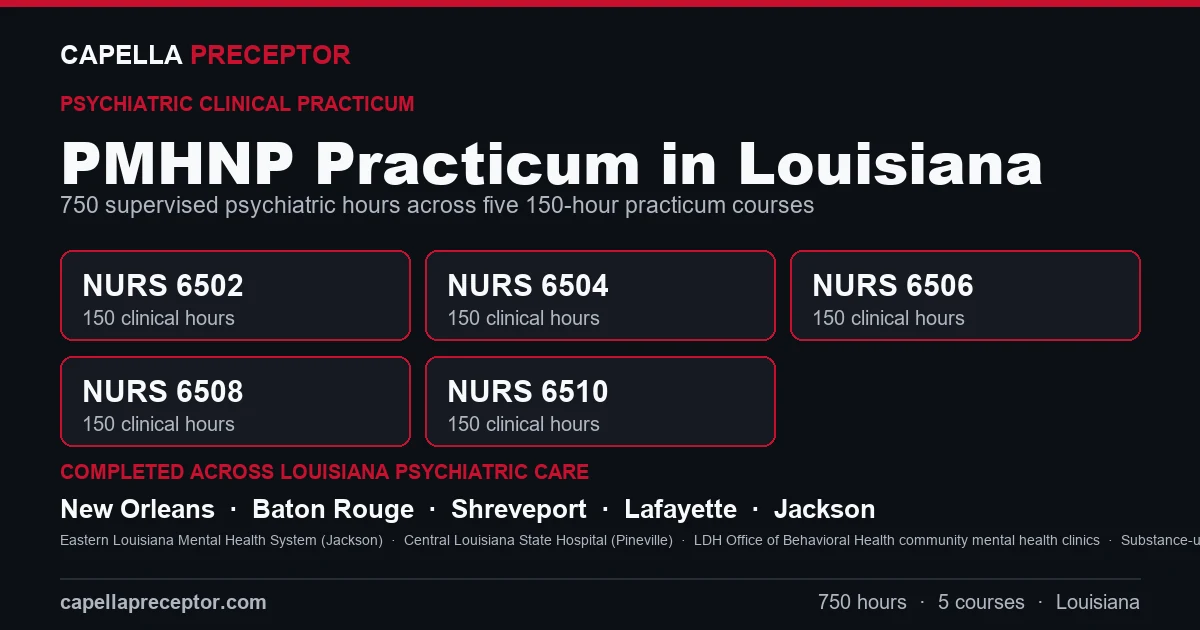
A Capella PMHNP practicum in Louisiana requires 750 supervised psychiatric clinical hours across five practicum courses of 150 hours each, completed in person under an on-site psychiatric-mental-health preceptor. Louisiana is a reduced-practice state, so that preceptor works under a collaborative agreement with a physician, and any controlled psychiatric prescribing they teach you follows the Louisiana board's controlled-substance rules. Here is how the program, the board, and the real psychiatric sites fit together, and how we secure the preceptor.
Last updated 2026-06-28 · Reviewed by the Capella Preceptor psychiatric placement team
What does the Capella PMHNP practicum require in Louisiana?
The Capella MSN Psychiatric-Mental Health Nurse Practitioner specialization requires a minimum of 750 supervised practicum hours, earned as 150 clinical hours in each of five practicum courses, NURS6502, NURS6504, NURS6506, NURS6508, and NURS6510, Practicum I through V (Capella, MSN-PMHNP courses). That five-course, 150-hour structure is specific to PMHNP and differs from the primary-care FNP track, so a Louisiana psychiatric placement is not interchangeable with an FNP one. Every one of those hours has to be earned in a behavioral or mental-health setting, not a general clinic, under an on-site preceptor who is a board-certified PMHNP or a psychiatrist.
Capella's coursework is delivered online while you complete the psychiatric practicum in your own Louisiana community (Capella, MSN-NP program). The broader picture for any program in the state is on our Louisiana placement page, and the all-states version of these PMHNP requirements is on the Capella PMHNP page. This page is the intersection: PMHNP requirements as they actually land in Louisiana.
How does Louisiana reduced practice shape a psychiatric preceptor?
The American Association of Nurse Practitioners classifies Louisiana as a reduced practice state (AANP, State Practice Environment). For psychiatric care that has a concrete meaning: a Louisiana psychiatric APRN must hold a written collaborative practice agreement with a physician who is actively in clinical practice in Louisiana and licensed by the state board of medical examiners, and the board approves no more than two collaborating physicians per practice site (La. Admin. Code tit. 46, XLVII-4513, Authorized Practice).
Why this matters when you are choosing a psychiatric preceptor: the regulation requires the collaborating physician's specialty to fit the APRN's role and population focus, which for a PMHNP means the collaboration is psychiatric. A genuinely good preceptor here is a PMHNP-BC or psychiatrist whose own Louisiana authorization is current and whose collaborative agreement actually covers psychiatric practice. When we vet a Louisiana psychiatric preceptor, confirming that current authorization is part of the check, so you are not surprised mid-rotation by a lapsed agreement.
Can your Louisiana preceptor prescribe controlled psychiatric medications?
This is the question that separates a psychiatric rotation from a primary-care one, because so much of psychiatric prescribing is controlled. In Louisiana, the controlled substances an APRN may prescribe include Schedule II, III, IV, and V, but that authority is not automatic: it is granted by the board, must be tied to the collaborative practice agreement, and stays "limited to, consistent with, and exclusively within" the collaborating physician's specialty and the APRN's population focus (La. Admin. Code tit. 46, XLVII-4513). To get there the APRN must also hold a Louisiana controlled dangerous substance permit and a DEA registration and complete a board-approved continuing-education course on controlled-substance prescribing.
For a PMHNP learner that translates into the real medications you will see managed during hours:
Because co-occurring substance use is so common in psychiatric practice, the buprenorphine line matters: Louisiana historically tied APRN buprenorphine prescribing to the collaborating physician's own authorization (Spetz et al., supervision requirements for buprenorphine prescribing, PMC). If addiction-treatment hours are part of your plan, we confirm the preceptor's controlled-substance and MOUD authority specifically, not just their license, before you log against that site.
Can Louisiana PMHNP hours be done by telepsychiatry?
Partly, and psychiatry is the specialty where this matters most. Louisiana Medicaid and the state's behavioral-health rules let a psychiatric APRN deliver covered services by telehealth when clinically appropriate, using a secure, HIPAA-compliant system with real-time two-way audio and video, provided the APRN holds an unrestricted Louisiana license and is a psychiatric or mental-health nurse practitioner or clinical nurse specialist (CCHP, Louisiana State Telehealth Laws). Capella names telepsychiatry directly within the Practicum III experience, so some of your supervised hours can legitimately be earned remotely.
Two limits keep it from being an all-remote program. First, how many telehealth hours count toward your 750 depends on your course requirements and your preceptor's practice, so confirm the current allowance for each practicum against your course instructions. Second, controlled-substance prescribing by telehealth still runs through the federal Ryan Haight framework, which generally expects an in-person evaluation before a controlled prescription unless a current federal flexibility applies (CCHP, online prescribing rules). In practice, telepsychiatry covers a meaningful share of medication-management and therapy hours, while controlled prescribing and acute work usually stay in person.
Where do Capella PMHNP students complete psychiatric hours in Louisiana?
Louisiana has real psychiatric infrastructure, it is just unevenly spread. The settings that typically qualify for PMHNP hours, when staffed by an appropriately credentialed supervising provider, include:
- Community mental health clinics run through the Louisiana Department of Health's local governing entities, which treat adults and children with serious mental illness across the state (LDH, Office of Behavioral Health).
- State psychiatric hospitals: the Eastern Louisiana Mental Health System in Jackson, with hundreds of licensed inpatient psychiatric beds and a forensic service, and Central Louisiana State Hospital in Pineville (LDH, Eastern Louisiana Mental Health System).
- Outpatient psychiatry and medication-management practices in the New Orleans, Baton Rouge, Shreveport, and Lafayette metros, including child and adolescent psychiatry for the lifespan rotation.
- Substance-use and opioid-treatment programs, where co-occurring psychiatric and addiction care is the daily work and MOUD prescribing can be observed.
- Telepsychiatry groups serving rural parishes, which can supply a share of supervised hours where local in-person psychiatry is thin.
The lifespan requirement still applies: because Practicum I leans adult and older-adult and Practicum II is child and adolescent, many Louisiana students need more than one site or preceptor across the sequence. Plan that early rather than discovering it at Practicum II.
How hard is it really to find a PMHNP preceptor in Louisiana?
Honestly, hard, and harder than for primary care. The psychiatric workforce is the binding constraint. Most of Louisiana sits inside a designated mental-health professional shortage area: the state has well over 150 mental-health shortage-area designations, and by one state count nearly four in five Louisiana residents live in an area without enough mental-health services (Well-Ahead Louisiana, Health Professional Shortage Areas). Fewer psychiatric providers means fewer potential preceptors, and the ones who do precept fill their slots fast.
That is not a reason to panic, but it is a reason to start early and be realistic. The students who avoid a lost term tend to do two things: begin the search months before the practicum quarter, since an affiliation agreement with a psychiatric site can take weeks to execute, and line up the child or adolescent option separately from the adult one rather than assuming a single practice covers both. Where a specialty-matched preceptor is genuinely out of reach in a rural parish, a supervised telepsychiatry placement keeps you on schedule instead of waiting months for a local opening.
Who secures the PMHNP preceptor, and what clears first?
Capella is direct that the learner secures the preceptor and site: "learners are responsible for finding an appropriate preceptor to oversee the practicum experience," and a support team helps connect students with site opportunities rather than assigning one (Capella, MSN-PMHNP overview). In a shortage state that responsibility is exactly where a placement service earns its keep. Whatever route you take, the same gates have to clear before your Louisiana psychiatric hours count, and missing one stalls your start:
- Propose your psychiatric site and preceptor in Capella's practicum system, CORE ELMS, for review and approval before the practicum opens.
- Confirm the preceptor's Louisiana authorization, including current APRN or physician licensure and, where psychiatric prescribing is involved, controlled-substance authority on the collaborative agreement.
- Get the affiliation agreement signed between Capella and the Louisiana psychiatric site before practicum begins.
- Clear compliance, the background check and health records, through Capella's third-party vendor (CastleBranch) before your start date.
- Log and submit hours in CORE ELMS, where the preceptor approves what you record toward each 150-hour course total.
To be clear about what approval means: Capella reviews and approves the placement you propose. A preceptor or site is never "Capella endorsed." We match a psychiatric preceptor who meets Capella's published requirements and submit the placement for Capella's review, and no honest service can promise the university's approval in advance.
Louisiana PMHNP FAQ
How many psychiatric practicum hours does Capella PMHNP require in Louisiana?
A minimum of 750 supervised psychiatric clinical hours, completed as 150 hours in each of the five practicum courses (NURS6502, NURS6504, NURS6506, NURS6508, NURS6510). The hours are earned in person at a Louisiana psychiatric site under an on-site PMHNP or psychiatrist preceptor, while the coursework stays online.
Does Louisiana let a PMHNP preceptor prescribe controlled psychiatric medications?
Yes, within limits. A Louisiana APRN may prescribe Schedule II, III, IV, and V controlled substances, but only after the board grants controlled-substance authority tied to the collaborative practice agreement, and the prescribing must stay within the collaborating physician's specialty and the APRN's population focus. That covers psychiatric drugs such as Schedule II stimulants for ADHD and Schedule IV benzodiazepines when authorized.
Can Capella PMHNP hours in Louisiana be completed by telepsychiatry?
Partly. Louisiana allows psychiatric APRNs to deliver care by real-time audio-video telehealth, and Capella names telepsychiatry within Practicum III, so some hours can be earned remotely under supervision. How many telehealth hours count depends on your course requirements and your preceptor's practice, and controlled-substance prescribing by telehealth still follows federal Ryan Haight rules, so confirm the current allowance against your course instructions.
Where do Capella PMHNP students complete psychiatric hours in Louisiana?
At community mental health clinics, outpatient psychiatry and medication-management practices, the state psychiatric hospitals (the Eastern Louisiana Mental Health System in Jackson and Central Louisiana State Hospital in Pineville), substance-use and opioid-treatment programs, and telepsychiatry groups, each supervised by an appropriately credentialed psychiatric provider.
Is it hard to find a PMHNP preceptor in Louisiana?
Yes. Most of Louisiana sits in a designated mental-health professional shortage area, so psychiatric preceptors are in short supply and the few who precept fill quickly. Starting the search months ahead and using a placement service are the two things that most reliably prevent a lost term.
Sources
- Capella University, MSN-PMHNP courses and practicum hours
- Capella University, MSN-PMHNP overview (learner secures preceptor)
- Louisiana Administrative Code tit. 46, XLVII-4513, APRN Authorized Practice and controlled-substance schedules
- AANP, State Practice Environment (Louisiana reduced practice)
- Center for Connected Health Policy, Louisiana State Telehealth Laws
- Center for Connected Health Policy, online prescribing of controlled substances (Ryan Haight)
- Louisiana Department of Health, Eastern Louisiana Mental Health System
- Well-Ahead Louisiana, Health Professional Shortage Areas (mental-health shortage)
- Spetz et al., supervision requirements for buprenorphine prescribing by NPs and PAs (PMC)
How Capella Preceptor helps Louisiana PMHNP students
You now know the three things that make a Louisiana psychiatric placement its own problem: 750 hours that must be psychiatric across the lifespan, a reduced-practice rule that ties your preceptor to a collaborative agreement and to controlled-substance authority for psych prescribing, and a mental-health shortage that thins the pool of preceptors. We work all three. We match a verified psychiatric preceptor whose Louisiana authorization fits PMHNP, confirm their controlled-substance and MOUD authority where your hours need it, prepare every CORE ELMS form and affiliation agreement, and keep your hours logged toward each 150-hour course.
- Verified Louisiana psychiatric preceptor matched in 7 days, in person or telepsychiatry
- Adult and child or adolescent psychiatric rotations covered across all five practicums
- No payment until you are matched, with your exact quote at the free consult
Get a Capella PMHNP preceptor in Louisiana
Free 15-minute consult. No payment until matched. We map your entire Louisiana psychiatric practicum plan.
Get my free consult →