Home / MSN-PMHNP / PMHNP Preceptor in Michigan
PMHNP · MichiganCapella PMHNP preceptor and psychiatric clinical placement in Michigan
A Capella PMHNP practicum in Michigan requires 750 supervised psychiatric-mental health clinical hours across five practicum courses of 150 hours each, completed under an on-site psychiatric preceptor at a Michigan behavioral-health site. Michigan is a restricted-practice state, so the psychiatric medications that define this specialty, the stimulants, benzodiazepines, and buprenorphine, are prescribed under a written physician delegation, and it is one of the harder states to find a psychiatric preceptor in because most of it is a mental-health shortage area. Here is exactly how the hours, the Michigan board rules, telepsychiatry, controlled-substance prescribing, and the real Michigan settings work, and how to secure a preceptor who meets Capella's published requirements.
Last updated: June 28, 2026 · Reviewed by the Capella Preceptor placement team
How many psychiatric hours does a Capella PMHNP need in Michigan?
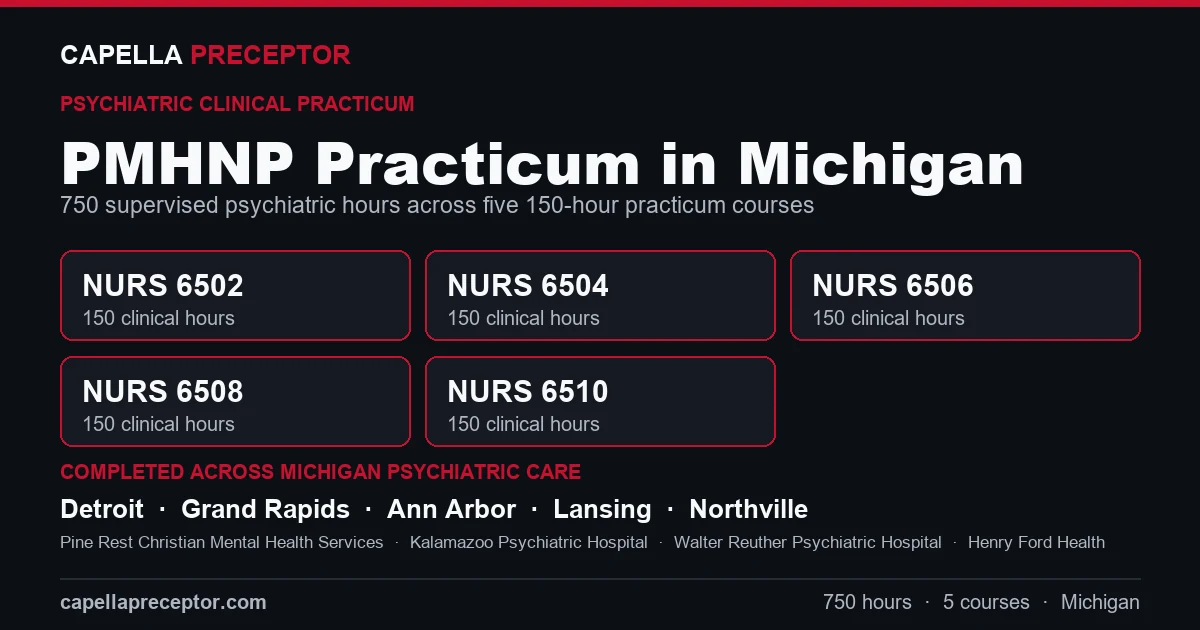
A Capella MSN-PMHNP requires a minimum of 750 supervised practicum hours, completed as 150 clinical hours in each of five psychiatric practicum courses, NURS6502, NURS6504, NURS6506, NURS6508, and NURS6510 (Practicum I through V), all in behavioral and mental-health settings under a qualified on-site preceptor (Capella, MSN-PMHNP courses). The coursework is online; the psychiatric hours are completed in your own Michigan community at an approved site. The 750-hour total is fixed and does not change because you live in Michigan. What Michigan changes is the supply of psychiatric preceptors and the way controlled psychiatric medications are prescribed, and both of those are covered below.
It is worth being precise about the structure, because the Capella PMHNP practicum is built differently from a primary-care track. The five courses are each 150 hours (a 5 x 150 pattern), not the 6 x 125 pattern used in Capella's FNP specialization. Because PMHNP is a lifespan specialty, the sequence deliberately moves through adult and older-adult psychiatry and then child and adolescent psychiatry, which in Michigan usually means lining up more than one psychiatric setting, since few sites cover the whole age range well. If you also want the primary-care view of practicum in this state, the broader Capella practicum in Michigan page covers all programs, and the all-states Capella PMHNP page covers the specialty nationally.
What does Michigan's restricted practice mean for a psychiatric preceptor?
The American Association of Nurse Practitioners places Michigan in the restricted practice category on its State Practice Environment map (AANP, Michigan). For a psychiatric track, restricted practice is not an abstract label. It directly shapes how your future prescribing will work, and it makes a supervising psychiatric preceptor central rather than optional. Michigan also does not issue a freestanding APRN license. The Michigan Board of Nursing, inside the Department of Licensing and Regulatory Affairs (LARA), grants nurse practitioners a specialty certification built on an active RN license, graduate education, and a national psychiatric certification such as the ANCC PMHNP-BC (Michigan Board of Nursing, LARA; NursingLicensure.org, Michigan NP requirements).
For your practicum, the practical effect is clean. Practicum is supervised psychiatric work by definition. Your preceptor observes your evaluations, co-signs your medication decisions, and takes responsibility for your clinical activity, which lines up exactly with the delegated model Michigan uses for advanced practice. The real task is not the legal framework. It is finding a Michigan psychiatric prescriber who will commit 150 hours per course and complete Capella's paperwork. Verify any candidate yourself before you commit, using the LARA public license lookup to confirm they are in good standing and certified in the psychiatric role. We verify every preceptor's Michigan license and psychiatric certification before we introduce them.
How does Michigan prescribe controlled psychiatric medications?
This is the part that makes a psychiatric placement in Michigan different from a primary-care one, and different from a full-practice state. Most of the psychiatric prescribing you will learn touches a controlled substance: Schedule II stimulants for ADHD, Schedule IV benzodiazepines for acute anxiety, and buprenorphine for opioid use disorder, which co-occurs with psychiatric illness constantly. In Michigan, an APRN may prescribe controlled substances in Schedules II through V only when a physician delegates that authority in writing, and both the APRN's and the delegating physician's DEA registration numbers must appear on the prescription (Chapman Law Group, Michigan APRN controlled-substance authority; Michigan Council of Nurse Practitioners, prescriptive authority).
During the practicum, this is genuinely useful rather than a hurdle, because you learn the delegated workflow on real charts. Your psychiatric preceptor is the prescriber of record, you draft and present the medication plan, and the delegated structure is exactly what you will operate inside as a Michigan PMHNP after graduation. It is one of several reasons a true psychiatric prescriber, a PMHNP-BC or a psychiatrist, is the right preceptor for these hours, not a general provider who happens to see some behavioral-health patients.
- Schedule II stimulants (ADHD): prescribed under physician delegation in Michigan.
- Schedule IV benzodiazepines (acute anxiety, alcohol withdrawal): same delegated authority.
- Buprenorphine for opioid use disorder: a high-value psychiatric skill, learned under your supervising prescriber.
Can PMHNP hours be done by telepsychiatry in Michigan?
Some of them can, and PMHNP is one of the more telehealth-friendly nursing specialties because so much psychiatric care, intake interviews, medication management, and therapy, is delivered by video in real Michigan practice. Capella names telepsychiatry directly inside the Practicum III experience (Capella, MSN-PMHNP courses). Michigan permits APRNs to provide psychiatric care by telehealth, and on the federal side the DEA and HHS extended the flexibilities that let controlled substances, including buprenorphine for opioid use disorder, be prescribed through a telemedicine encounter (SAMHSA, DEA and HHS telemedicine flexibilities).
That does not make the whole practicum remote. How much telepsychiatry counts toward your 750 hours depends on your specific course requirements, your preceptor's practice, and the current state and federal supervision rules for clinical training, which have been on rolling extensions. For a student in the Upper Peninsula or a thinly served rural county, a supervised telepsychiatry rotation can keep a course on schedule when no in-person psychiatric site is within reach. Confirm the current telehealth allowance for each practicum against your course instructions before you assume a course can be completed entirely online.
Where do PMHNP students actually complete psychiatric hours in Michigan?
Michigan has real depth in public and nonprofit behavioral health, which is where most of these hours are earned. The places that qualify, when staffed by an appropriately credentialed psychiatric supervisor, fall into a few clear groups:
Michigan operates inpatient psychiatric hospitals for severe mental illness: the Caro Center, Kalamazoo Psychiatric Hospital, and Walter Reuther Psychiatric Hospital for adults, plus the state child and adolescent hospital in Northville that is replacing the former Hawthorn Center (MDHHS).
The Community Mental Health Services Programs are the public safety net and the single point of entry into the public system, covering all 83 Michigan counties with crisis, medication, and outpatient psychiatric services (CMHA of Michigan, CMHSP directory).
Pine Rest Christian Mental Health Services near Grand Rapids is one of the largest freestanding behavioral-health systems in the country, with inpatient, outpatient, child and adolescent, and addiction services across more than twenty locations (Pine Rest).
Michigan runs 35 Certified Community Behavioral Health Clinics in its Medicaid demonstration, and opioid-use programs at systems such as Henry Ford Health and Hegira Health pair psychiatric care with medication-assisted treatment.
Geography drives the choice between in-person and virtual. A student in metro Detroit, Grand Rapids, Ann Arbor, or Lansing usually has psychiatric sites within a reasonable drive. A student in the northern Lower Peninsula or the Upper Peninsula may have very few psychiatric prescribers accepting students, which is where a supervised telepsychiatry rotation earns its place. Both routes log into the same CORE ELMS record.
Why is a psychiatric preceptor so hard to find in Michigan?
Because the shortage is real and it is specifically psychiatric. Most of Michigan is a federally designated Mental Health Professional Shortage Area, which is the same scarcity that makes psychiatric preceptors hard to secure. The few established psychiatric prescribers are often already committed to students from Michigan's own PMHNP programs, including Wayne State University in Detroit and Michigan State University, so a Capella student is competing for the same limited pool from outside an academic affiliation (Psychology Today, psychiatric nursing students and clinical training). Child and adolescent psychiatry, the population behind your Practicum II hours, is the tightest segment of all, and it is the one students most often leave to the last minute.
The honest picture is that cold outreach in a shortage state can stall for weeks, and Capella does not solve it for you. The university is explicit that the student secures their own preceptor and clinical site and that it does not assign one (Capella, MSN-PMHNP overview). A dedicated Capella support team can point you toward site opportunities, but lining up the psychiatric prescriber and the site is on you. That is the gap we close: we hold verified psychiatric preceptor relationships across Michigan so you are not starting the search from a blank inbox.
What has to clear before you log a psychiatric hour
Once a Michigan psychiatric preceptor and site are identified, Capella runs the placement through its practicum system, CORE ELMS. Nothing counts until that workflow is complete. We do not describe any preceptor as endorsed by Capella. Capella reviews and approves the proposed placement, and we match preceptors who meet Capella's published requirements and submit the placement for Capella's review.
- Propose the psychiatric site and preceptor in CORE ELMS for Capella's review and approval.
- Execute an affiliation agreement between Capella and the Michigan psychiatric site before day one.
- Clear compliance through a third-party background and health-records vendor such as CastleBranch.
- Log and submit hours in CORE ELMS, where your preceptor approves what you record toward each course's 150-hour total.
Michigan PMHNP FAQ
How many psychiatric hours does a Capella PMHNP need in Michigan?
A minimum of 750 supervised psychiatric-mental health practicum hours, completed as 150 clinical hours in each of the five practicum courses (NURS6502, NURS6504, NURS6506, NURS6508, NURS6510), all earned at Michigan behavioral-health sites under an on-site psychiatric preceptor. The 750-hour count is the same in every state. What changes in Michigan is the thin supply of psychiatric preceptors and the delegated way controlled psychiatric medications are prescribed.
Can Capella PMHNP practicum hours be done by telepsychiatry in Michigan?
Some can. Michigan permits APRNs to deliver psychiatric care by telehealth, and Capella names telepsychiatry inside its Practicum III experience, so part of your hours can be earned remotely with a qualified preceptor. The share that counts toward your 750 hours depends on your course requirements, your preceptor's practice, and the current state and federal telehealth rules for supervised training, so confirm the allowance against your course instructions rather than assuming all hours can be remote.
How does Michigan's delegated prescribing rule affect a psychiatric practicum?
Michigan is a restricted-practice state. An APRN may prescribe controlled substances in Schedules II through V, which covers most of the psychiatric formulary, only when a physician delegates that authority in writing, and both the APRN's and the delegating physician's DEA numbers must appear on the prescription. That governs how you will prescribe stimulants, benzodiazepines, and buprenorphine once you are a credentialed PMHNP. During the practicum you observe and prescribe under your supervising psychiatric preceptor, which is exactly the delegated model the state is built around.
Where do PMHNP students complete psychiatric hours in Michigan?
Michigan behavioral-health settings: the state-operated psychiatric hospitals (Caro Center, Kalamazoo Psychiatric Hospital, and Walter Reuther Psychiatric Hospital for adults, plus the state child and adolescent hospital in Northville); the Community Mental Health Services Programs that cover all 83 counties; large freestanding providers such as Pine Rest Christian Mental Health Services near Grand Rapids; Certified Community Behavioral Health Clinics; opioid and substance-use programs at systems like Henry Ford Health and Hegira Health; and telepsychiatry groups, each supervised by an appropriately credentialed psychiatric provider.
Is it hard to find a PMHNP preceptor in Michigan?
Yes. Most of Michigan is a federally designated Mental Health Professional Shortage Area, the same shortage that makes psychiatric preceptors scarce. Established psychiatric prescribers are often already committed to students from Michigan's own PMHNP programs at Wayne State, Michigan State, and others, and child and adolescent psychiatry is the tightest segment of all. That is why we carry verified psychiatric preceptor relationships across Michigan rather than leaving you to cold-email clinics.
Sources
- Capella University, MSN-PMHNP courses and practicum hours
- Capella University, MSN-PMHNP overview (student secures the preceptor)
- AANP, Michigan state practice environment (restricted practice)
- Michigan Board of Nursing, LARA
- Chapman Law Group, Michigan APRN controlled-substance prescribing authority
- SAMHSA, DEA and HHS telemedicine flexibilities for buprenorphine and controlled substances
- Pine Rest Christian Mental Health Services, about
- Psychology Today, psychiatric nursing students and the clinical-training shortage
How Capella Preceptor helps in Michigan
You now have the full picture: 750 psychiatric hours across five 150-hour courses, a restricted state where controlled psychiatric medications are prescribed under delegation, a specialty-certification board under LARA, named real settings from the state hospitals to Pine Rest and the CMHSP network, and a psychiatric preceptor search Capella leaves entirely to you in a shortage state. We secure a verified psychiatric preceptor whose setting matches your Practicum population, complete every CORE ELMS form and affiliation agreement, and keep your hours logged on schedule, in person across the Michigan metros or by supervised telepsychiatry for the rural counties and the U.P.
- Verified Michigan psychiatric preceptor matched in 7 days, no payment until matched
- Adult and child/adolescent psychiatry rotations covered across all five practicums
- Every CORE ELMS form and affiliation agreement handled, in person or by telepsychiatry
Get a Capella PMHNP preceptor in Michigan
Free 15-minute consult. No payment until matched. We map your entire psychiatric practicum plan.
Get my free consult →