Home / PMHNP / PMHNP Preceptor in Missouri
Program × StateCapella PMHNP Preceptor in Missouri
A Capella PMHNP practicum in Missouri requires 750 supervised psychiatric clinical hours across five 150-hour practicum courses, completed under an on-site psychiatric-mental-health preceptor. Missouri is a restricted practice state, so that preceptor works under a written collaborative practice arrangement with a physician, and Missouri's controlled-substance rules shape exactly what you will see prescribed on a psychiatric rotation. Here is how the program requirements and the Missouri board rules fit together, and how we secure a preceptor who meets Capella's published requirements.
Last updated 2026-06-28 · Reviewed by the Capella Preceptor placement team
What does a Capella PMHNP practicum require, and how does Missouri change it?
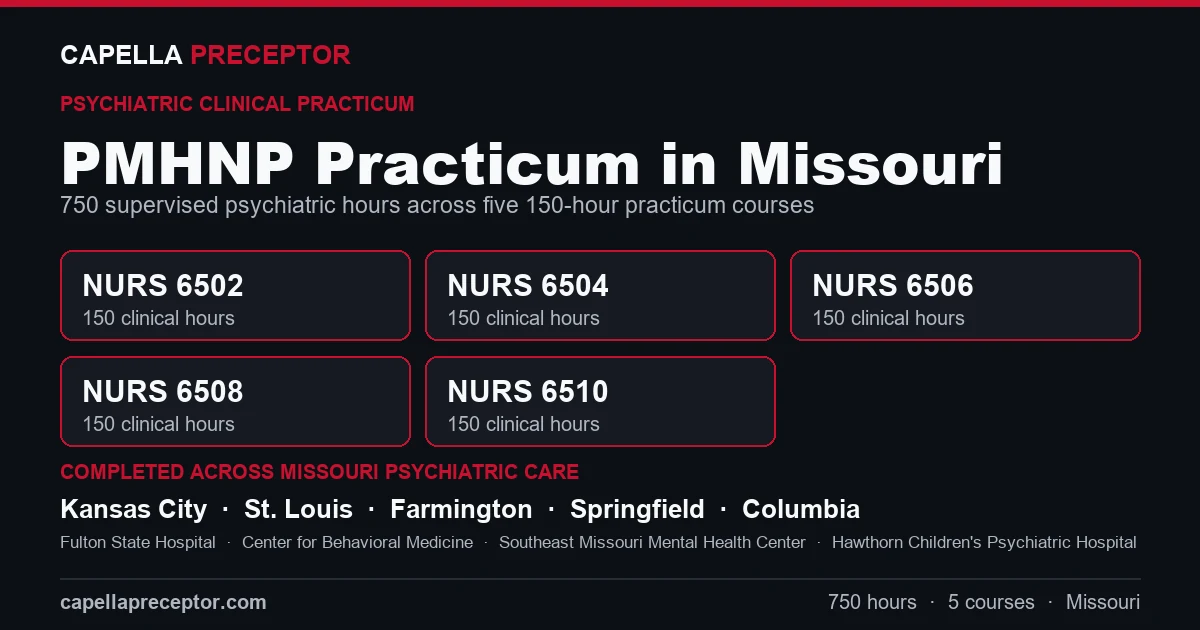
The Capella MSN Psychiatric Mental Health Nurse Practitioner specialization requires a minimum of 750 practicum hours, delivered as 150 clinical hours in each of five practicum courses, NURS6502, NURS6504, NURS6506, NURS6508, and NURS6510 (Practicum I through V), all in psychiatric and behavioral-health settings (Capella, MSN-PMHNP courses). That number is fixed by Capella and does not move because of where you practice. What Missouri changes is who can supervise those hours and what psychiatric care you will see, because Missouri sits at the most restrictive end of nurse practitioner regulation.
This page is the PMHNP-specific, Missouri-specific intersection. For the full course-by-course breakdown of the five practicums, the lifespan population split, and CORE ELMS logging, start from the Capella PMHNP preceptor page. For Missouri licensure, the Document of Recognition, and the FNP and primary-care side of placement here, see Capella practicum and preceptors in Missouri. Below we focus only on what is true when you put psychiatric practicum and Missouri together.
The one-line version. 750 psychiatric hours, five 150-hour practicum courses, supervised on site by a Missouri PMHNP or psychiatrist who holds a current collaborative practice arrangement, in a behavioral-health setting that will sign a Capella affiliation agreement. The scarce ingredient in Missouri is not the hours; it is the credentialed psychiatric preceptor.
Who can precept PMHNP hours in a restricted state like Missouri?
The American Association of Nurse Practitioners classifies Missouri as a restricted practice state, the most limited of its three categories (AANP, Missouri). A Missouri APRN cannot evaluate, diagnose, and prescribe on their own license; state law requires a career-long written collaborative practice arrangement with a physician, filed with the board, that defines the delegated medical acts (20 CSR 2200-4.200, collaborative practice). For a psychiatric practicum, that has two practical effects.
First, your preceptor must be a Missouri-credentialed psychiatric provider. In practice that is a board-certified PMHNP (PMHNP-BC) operating under a current collaborative arrangement, or a psychiatrist. A general family or adult NP, even a strong one, does not satisfy the psychiatric population focus that Practicum I through V are built around. Second, because the supervising APRN is themselves practicing under physician oversight, a compliant placement is really a behavioral-health practice with the right paperwork on file, not a single clinician working alone. A solo cash psychiatric practice with no collaborating physician of record generally will not clear review.
What psychiatric controlled substances can a Missouri PMHNP preceptor prescribe?
This is where a Missouri psychiatric rotation looks different from one in a full-practice state, and it is worth understanding before you start, because so much of psychiatric prescribing is controlled. Under a Missouri collaborative practice arrangement, an APRN who holds controlled-substance authority may be delegated Schedules III, IV, V, and Schedule II hydrocodone only (20 CSR 2200-4.200). For the psychiatric medications you will actually encounter, that breaks down as follows.
- Benzodiazepines (Schedule IV) such as lorazepam, clonazepam, and alprazolam can be prescribed by an APRN with delegated authority, so anxiety and acute agitation management is within reach on the rotation.
- Buprenorphine (Schedule III) may be prescribed by an APRN for up to a thirty-day supply without refill for patients in medication-assisted treatment for a substance-use disorder, so a Missouri addiction or MOUD setting is a viable PMHNP site.
- Schedule II stimulants for ADHD, such as methylphenidate, amphetamine salts, and lisdexamfetamine, are not within Missouri APRN prescriptive authority. Schedule II is limited to hydrocodone, so an APRN preceptor cannot independently write a stimulant prescription.
The stimulant limit is not a dead end for your training; it shapes who you learn it from. If your goal includes pediatric or adult ADHD management, a placement with a psychiatrist preceptor (or a site where a collaborating physician handles the stimulant workflow) lets you observe and document the full assessment and prescribing process you will use later in a full-practice state. When a Missouri APRN does prescribe a controlled substance, the collaborating physician must review at least 20 percent of those cases, so expect chart review to be a visible, routine part of the practice you join (20 CSR 2200-4.200).
Can Missouri PMHNP hours be done by telepsychiatry?
Partly, and Missouri is more accommodating here than for prescribing. Missouri authorizes PMHNPs and APRNs to deliver direct psychiatric services by telehealth (Center for Connected Health Policy, Missouri), which matters because telepsychiatry is named directly in Capella's Practicum III experience. Two Missouri-specific points are worth knowing.
The first is geographic. A Missouri collaborating physician and APRN normally must practice within 75 miles by road of each other, but that mileage limit does not apply when the APRN provides services through telehealth. That flexibility is part of why telepsychiatry groups can operate statewide and reach the rural counties where local psychiatric coverage is thin. The second is prescribing: to prescribe a controlled substance to a patient via telehealth, Missouri requires a previously established physician-patient relationship, so a telepsychiatry site that already manages established patients fits the rule cleanly (RSMo 334.108, telemedicine).
For your hours, the practical limit is Capella's, not Missouri's. How much telehealth counts toward your 750 depends on your specific course requirements and your preceptor's practice, so confirm the current allowance against your course instructions rather than assuming a rotation can be entirely remote. A common Missouri pattern is a hybrid: in-person intakes and acute work at a metro behavioral-health clinic, plus telepsychiatry medication-management visits that extend reach into outstate counties.
What real psychiatric settings count for the practicum in Missouri?
PMHNP hours have to be earned in behavioral and mental-health practice, not general primary care, and Missouri has a genuinely deep public and private psychiatric infrastructure to draw on once you can get a credentialed preceptor to take you. Missouri's Department of Mental Health operates a network of state psychiatric facilities and works through 25 service areas of community mental health centers, plus the state's private practices and telepsychiatry groups (Missouri DMH, community mental health centers).
The 25-service-area CMHC network is the backbone of outpatient adult psychiatry and medication management across the state.
Inpatient exposure at facilities such as Fulton State Hospital, the Center for Behavioral Medicine in Kansas City, and the Southeast Missouri Mental Health Center in Farmington.
Hawthorn Children's Psychiatric Hospital in St. Louis County is the state's only freestanding children's psychiatric hospital, relevant to your Practicum II population.
Substance-use and medication-assisted-treatment clinics, where the buprenorphine pathway above is in daily use.
Private behavioral-health groups concentrated in the Kansas City and St. Louis metros, plus Springfield and Columbia.
Statewide telehealth practices that reach the Ozarks and rural northern and southeastern counties under the no-mileage-limit telehealth rule.
Listing the named facilities is illustrative of the kind of setting that qualifies; it is not a claim that any specific hospital has agreed to host you. Each site still has to be willing to precept a student, sign a Capella affiliation agreement, and clear CORE ELMS review before any of it counts.
Why is it hard to find a PMHNP preceptor in Missouri, honestly?
Because the supply is genuinely short, and it is worth being plain about that rather than pretending otherwise. Federal data is blunt here: every county in Missouri is a mental health professional shortage area, except St. Louis county and city, which are partial shortage areas (HRSA designation, May 2023, summarized by Rockhurst University). When the providers themselves are scarce, the providers who also have the time, the credential, and the willingness to precept a student are scarcer still. PMHNP is already the hardest specialty to self-place; doing it in a shortage state compounds the problem.
Three pressure points show up again and again for Missouri students:
- The child and adolescent rotation (Practicum II) is the toughest to source, because pediatric psychiatry is the thinnest part of an already thin workforce. Plan a separate site for it early.
- Rural and outstate counties may have no local psychiatric site at all, which is exactly where the telepsychiatry no-mileage rule and a remote-friendly preceptor become the realistic path to compliant hours.
- The collaborative-arrangement check adds a step a full-practice state does not have: confirming the site's physician oversight is current, not just that the preceptor is licensed.
None of this makes a Missouri PMHNP placement impossible. It makes starting a full term ahead the single most important thing you can do, because affiliation agreements take weeks and a scarce psychiatric preceptor's calendar fills early.
How does a Missouri psychiatric site get approved through Capella?
The clearance workflow is the standard Capella process, run through CORE ELMS, with every step lined up against a Missouri psychiatric site. To be precise about the relationship: Capella does not supply or endorse preceptors and does not pre-approve a list. Capella reviews and approves a placement you propose. We match preceptors who meet Capella's published requirements and prepare the submission for Capella's own review; that is never a guarantee of placement or approval.
- Propose your Missouri psychiatric site and preceptor in CORE ELMS for Capella review, with the PMHNP-BC or psychiatrist credential documented.
- Confirm the collaborative practice arrangement is current, the Missouri-specific step. Verify the preceptor's credential through the Missouri State Board of Nursing's public license lookup.
- Get the affiliation agreement signed between Capella and the behavioral-health site before day one.
- Clear compliance through Capella's background-check and health-records vendor (CastleBranch) before you are cleared to start.
- Log and submit hours in CORE ELMS for preceptor approval until each of the five courses reaches its 150-hour total.
Missouri PMHNP FAQ
How many psychiatric hours does a Capella PMHNP need in Missouri?
A minimum of 750 supervised psychiatric clinical hours, completed as 150 hours in each of the five practicum courses (NURS6502, NURS6504, NURS6506, NURS6508, NURS6510), all in behavioral-health settings. The hour count is set by Capella and does not change because Missouri is a restricted practice state.
Can my Missouri PMHNP preceptor prescribe psychiatric controlled substances?
Partly. Under a Missouri collaborative practice arrangement an APRN may prescribe Schedule IV benzodiazepines and may prescribe buprenorphine, a Schedule III drug, for up to a thirty-day supply for medication-assisted treatment. Missouri does not let an APRN prescribe Schedule II stimulants such as Adderall or Vyvanse; Schedule II authority is limited to hydrocodone. A psychiatrist preceptor can model the full stimulant workflow, which is useful clinical exposure.
Can Missouri PMHNP practicum hours be done by telepsychiatry?
Some can. Missouri allows PMHNPs and APRNs to deliver psychiatric care by telehealth, and the 75-mile road-distance limit between the APRN and the collaborating physician does not apply when services are provided by telehealth. How many telehealth hours count toward your 750 still depends on your specific Capella course requirements, so confirm the current allowance against your course instructions.
Is it hard to find a PMHNP preceptor in Missouri?
Yes. Every Missouri county is a federally designated mental health professional shortage area except St. Louis county and city, which are partial shortage areas, so psychiatric preceptors are scarce statewide and the child and adolescent rotation is the hardest to source. Starting the search a full term ahead is the single most important step.
Does Capella approve my Missouri psychiatric site and preceptor?
Capella reviews and approves a proposed placement; it does not supply or endorse preceptors. You submit your Missouri psychiatric site and preceptor in CORE ELMS for Capella's review, and a signed affiliation agreement must be in place before any hour counts. We match preceptors who meet Capella's published requirements and prepare the submission, never a guarantee of approval.
Sources
- Capella University, MSN-PMHNP courses and 750 practicum hours
- AANP, Missouri state practice environment (restricted)
- 20 CSR 2200-4.200, Missouri collaborative practice (controlled substances, buprenorphine, 20% review)
- RSMo 334.108, Missouri telemedicine prescribing (established-patient rule)
- Center for Connected Health Policy, Missouri telehealth (PMHNP services, 75-mile telehealth exemption)
- Missouri Department of Mental Health, community mental health centers
- Rockhurst University, Missouri mental health shortage (HRSA HPSA data)
How Capella Preceptor helps with a Missouri PMHNP placement
The slow part of a Missouri psychiatric practicum is finding a credentialed PMHNP or psychiatrist who has a current collaborative arrangement, the time to precept, and a setting that will sign a Capella affiliation agreement, in a state where psychiatric providers are short almost everywhere. That is the exact problem we work on. We match a preceptor who meets Capella's published requirements, in person or by telepsychiatry, confirm the credential and the oversight arrangement, prepare every CORE ELMS form, and submit the placement for Capella's review.
- Psychiatric preceptor matched in 7 days, in person or by telepsychiatry
- Credential and collaborative-arrangement compliance checked before you start
- Adult and child/adolescent rotations planned across all five practicums; no payment until matched
On the primary-care track instead? See Capella FNP preceptor requirements in Missouri for FNP practicum hours and primary-care clinical settings, or read the full Capella PMHNP requirements and the Missouri licensure overview.
Get a Capella PMHNP preceptor in Missouri
Free 15-minute consult. No payment until matched. We map your entire psychiatric practicum plan.
Get my free consult →