Capella PMHNP Preceptor in Montana
A Capella PMHNP practicum in Montana requires 750 supervised psychiatric clinical hours across five 150-hour practicum courses, completed under an on-site psychiatric-mental health preceptor, and Capella leaves finding that preceptor to you. Montana is a full practice authority state, so a psychiatric NP here can precept you without a physician on the contract. The catch is supply: psychiatry is the specialty Montana is shortest on, with 39 of its 56 counties having had no practicing psychiatrist. This page maps the psychiatric board rules, controlled-substance and telepsychiatry realities, and the real settings, then how we secure the placement.
Last updated 2026-06-28 · Reviewed by the Capella Preceptor placement team
What does the Capella PMHNP practicum require in Montana?
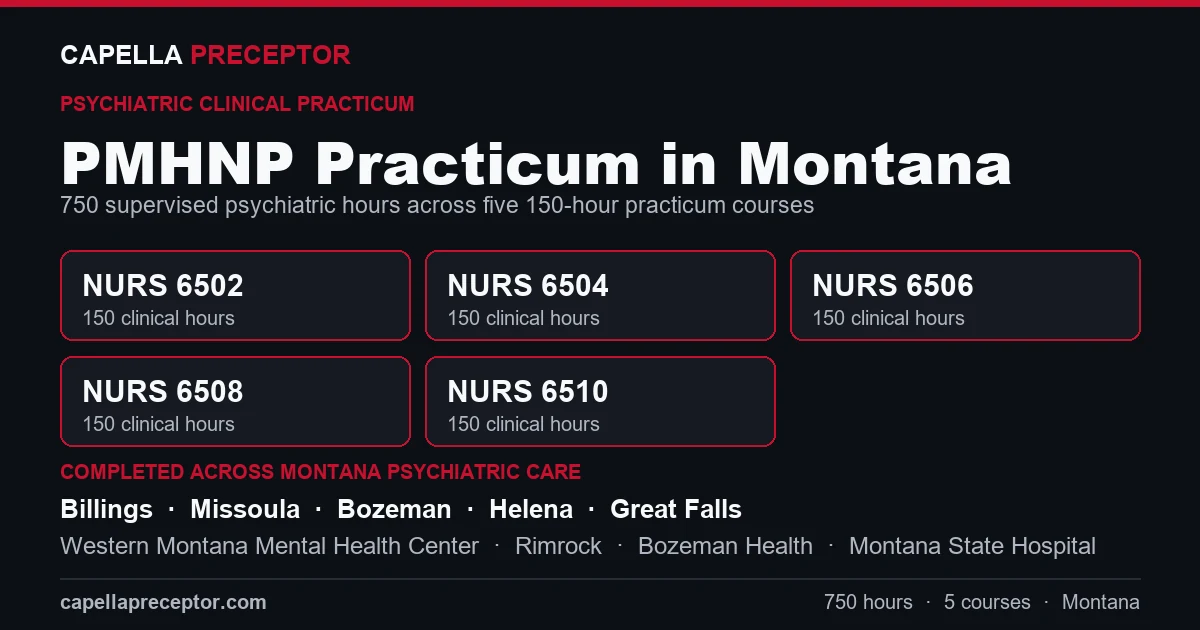
Your hour requirement is fixed nationally; only the search for a site is local. Capella's psychiatric-mental health NP specialization sets a floor of 750 practicum hours, structured as 150 clinical hours in each of five practicum courses, NURS6502, NURS6504, NURS6506, NURS6508, and NURS6510 (Practicum I through V), every one of them earned in a psychiatric or behavioral-health setting (Capella, MSN-PMHNP courses). The coursework stays online; the psychiatric practicum happens in your local community. That five-course, 150-hour structure is specific to PMHNP and differs from the Capella FNP, which splits its 750 hours across six 125-hour primary-care courses. The full course-by-course breakdown lives on our PMHNP program page; this page is about doing that psychiatric sequence specifically in Montana.
PMHNP is a lifespan specialty, so your hours have to span adult, older-adult, child, and adolescent psychiatry. In Montana the practical problem is rarely "what counts" and almost always "who, and where." One behavioral-health panel in Billings or Missoula may carry adult psychiatry comfortably, yet the same student living two counties east can be a long highway away from any clinic that takes pediatric or adolescent psychiatric patients. Psychiatric placement here is a workforce problem before it is a paperwork problem, which is exactly why so many Montana students stall partway through the five-course sequence.
How does full practice authority change a psychiatric preceptorship in Montana?
Montana carries a full practice designation from the American Association of Nurse Practitioners (AANP, State Practice Environment). Once licensed, a nurse practitioner in the state works under the sole authority of the Board of Nursing: assessing patients, reaching a diagnosis, ordering and reading diagnostics, and initiating and adjusting treatment and prescriptions, with no lifelong physician oversight and no collaborative contract bolted onto the role. For a psychiatric NP, that scope covers the medication management at the center of day-to-day PMHNP work.
For psychiatry, that detail does unusually heavy lifting. Montana has fewer than 100 practicing psychiatrists and roughly 40% fewer psychiatrists per capita than the national average, so much of the state's behavioral-health care is delivered by psychiatric nurse practitioners running their own panels (Montana DPHHS, shortage area designations). Because a full-practice PMHNP-BC owes no separate supervisory contract to a psychiatrist before taking on a learner, a working psychiatric NP can serve as your preceptor outright, so long as they satisfy Capella's published preceptor requirements. Elsewhere, in a reduced or restricted jurisdiction, that NP frequently has to loop in a collaborating physician before a student can start; Montana removes that layer, and the pool of usable psychiatric sites grows accordingly, most visibly in the smaller towns where an NP runs the only behavioral-health clinic for an hour in any direction. Where a psychiatrist is on hand, they can precept you as well.
What does the Montana Board of Nursing expect for psychiatric APRN practice?
The Montana Board of Nursing, housed in the Department of Labor and Industry's Business Standards Division, is the agency that credentials and oversees the state's advanced practice nurses (Montana Board of Nursing). Your eventual title here is Certified Nurse Practitioner (CNP) carrying a psychiatric-mental health population focus, sitting among the board's four APRN roles next to the nurse midwife, nurse anesthetist, and clinical nurse specialist (Montana Board of Nursing, APRN). These rules shape the license you will hold after graduation rather than your student practicum itself, but a few are worth knowing as you arrange a psychiatric site:
- Psychiatric certification drives the license. The board grants CNP licensure once you show national certification in the matching population, and for the PMHNP role that means sitting the ANCC psychiatric-mental health exam (PMHNP-BC); Capella sends your official graduate transcript straight to the board (Montana Board of Nursing, APRN).
- Prescriptive authority is its own paperwork, not a supervision tie. Montana issues it through a separate application: a graduate within five years documents advanced pharmacology coursework plus clinical practice integrating pharmacologic intervention, while a graduate further out can instead show three semester credits or 45 contact hours spanning pharmacodynamics, pharmacokinetics, and pharmacotherapeutics (Montana Board of Nursing, prescriptive authority). Practicum time spent managing psychiatric medications under a precepting prescriber feeds directly into that record.
- Check the credential before you commit. Run any prospective psychiatric preceptor through the board's license lookup or Nursys to confirm an active Montana RN and APRN credential in good standing, carrying the psychiatric-mental health focus, before a single hour is logged (Montana Board of Nursing, license information). Every preceptor we present has already cleared this step.
When a rule lands close to your own circumstances, the board's Helena office is the place to confirm it, rather than any third-party summary including this one.
What about controlled-substance prescribing in a Montana psychiatric practicum?
Psychiatric practice leans on controlled medications more than most outpatient specialties, so the prescribing picture is worth understanding before you pick a site. Much of what you will see your preceptor manage, Schedule II stimulants for ADHD, Schedule IV benzodiazepines for anxiety and acute agitation, and Schedule III buprenorphine for opioid use disorder, are scheduled drugs that require a federal DEA registration on top of state prescriptive authority. In a full-practice state like Montana, a psychiatric NP with DEA registration prescribes across Schedules II through V independently; since the 2023 removal of the separate federal waiver, any DEA-registered prescriber can treat opioid use disorder with buprenorphine, which has made medication for opioid use disorder (MOUD) a routine part of Montana psychiatric and addiction practice.
For your practicum, the relevance is concrete. A psychiatric site that manages stimulants, benzodiazepines, and MOUD will expose you to the controlled-substance workflows, prescription drug monitoring program checks, and risk documentation that the certification exam and real PMHNP practice both expect. When we match you, we look for a Montana preceptor whose panel actually covers this prescribing, not only talk therapy, so your psychiatric hours reflect the full scope of the role. You will not hold prescriptive authority as a student; you train under a preceptor who does.
Can Montana PMHNP hours be done by telepsychiatry?
Often, and in Montana this is more than a convenience. Psychiatry is one of the most telehealth-deliverable specialties, because intake interviews, medication management, and psychotherapy are routinely delivered by video, and Capella names telepsychiatry directly within its Practicum III experience (Capella, MSN-PMHNP courses). In a state where most counties are mental-health shortage areas and the nearest psychiatric clinic can be a long drive, a verified telepsychiatry preceptor is frequently the realistic way to keep a child-and-adolescent or specialty rotation on schedule.
Two boundaries are worth holding in mind. First, how much telehealth counts toward your hours depends on your specific course instructions, your preceptor's practice, and current state and federal rules, so confirm the allowance against your course each term rather than assuming all 750 hours can be remote. Second, the federal flexibility that lets a clinician prescribe controlled substances over telemedicine without a prior in-person visit, the pandemic-era exception to the Ryan Haight Act, has been extended by the DEA through December 31, 2026, and is subject to change (American Psychiatric Association, Ryan Haight Act). That timeline can affect how a telepsychiatry preceptor handles controlled prescriptions during your rotation, so it is a question we confirm with the site rather than assume.
Where do Capella PMHNP students find psychiatric sites in Montana?
This is the piece that falls squarely on you. Capella's policy is that "learners are responsible for finding an appropriate preceptor to oversee the practicum experience," with no university assignment of one (Capella, MSN-NP program). For psychiatry the search runs harder than it does for primary care: all 56 Montana counties carry a mental-health professional shortage designation, and 39 of them have gone without a single practicing psychiatrist, which leaves the bench of credentialed psychiatric preceptors thin statewide (Montana DPHHS, shortage area designations). The outreach is ours to do. The settings that actually generate psychiatric hours here are the community mental health centers, the addiction and co-occurring programs, and the handful of inpatient psychiatric units:
Western Montana Mental Health Center serves children, teens, and adults from Libby to Bozeman and Kalispell to Hamilton, a strong source of outpatient psychiatric and crisis hours.
Rimrock in Billings, a long-licensed Montana mental health center, runs inpatient and outpatient SUD and dual-diagnosis treatment, useful for substance-use and MOUD exposure.
Bozeman Health opened a 14-bed adult inpatient psychiatric unit in 2025, and the Montana State Hospital region near Warm Springs anchors public inpatient care.
The state's larger behavioral-health hubs, with outpatient psychiatry, medication-management clinics, and crisis services.
Capital-region and north-central clinics serving wide surrounding counties, plus the Board of Nursing office in Helena.
Verified remote psychiatric preceptors who cover frontier counties, often the only way to reach a child-and-adolescent rotation locally.
There is a real reason inpatient psychiatry is scarce here: for years the Montana State Hospital in Warm Springs was the state's only public psychiatric hospital, and after it lost federal certification in 2022, communities have been building local capacity, which is why a new unit like Bozeman Health's matters so much (Montana Free Press, Bozeman Health psychiatric unit). That same scarcity is what makes a psychiatric preceptor so hard to lock down solo, and it is also why full practice authority quietly unlocks so many NP-run behavioral-health clinics, once the calls actually get made.
In a frontier county with no reachable in-person psychiatry, we will not push you into a multi-hour drive each clinical day. The fallback is a vetted telepsychiatry preceptorship. The promise holds the same across the state: a verified Montana psychiatric preceptor inside 7 days, and nothing due from you until the match is made.
How do you clear a Montana psychiatric practicum with Capella?
Practicing independently as a licensed NP is one thing; clearing a student practicum is another, and full practice authority does not shortcut it. After you and we identify a psychiatric preceptor and site, Montana students run the same gate as everyone: the placement goes up for Capella's review and approval, an affiliation agreement gets signed, compliance is cleared, and hours start logging. The hub for all of it is Capella's practicum system, which we track as CORE ELMS, with a separate third-party handling the compliance checks.
For PMHNP the affiliation paperwork is where a two-site plan tends to snag. The lifespan requirement often pushes students to pick up child and adolescent psychiatry at a second Montana practice, and that practice has to carry its own executed agreement with Capella before you log an hour there. Getting both agreements moving at the same time, instead of discovering the second one mid-rotation, is the surest way to keep a psychiatric student on track in this state. One honesty note on language: we match preceptors who meet Capella's published requirements and put each placement in front of Capella for review. We never describe a preceptor as Capella-endorsed, and a match is not a promise that Capella will sign off on any particular placement.
In-person or telepsychiatry: which fits your part of Montana?
Between Montana's distances and its psychiatrist shortage, this choice is real rather than cosmetic. Either route clears Capella once the site and preceptor are approved; which one fits comes down to your location and which of the five psychiatric practicums you are in.
The stronger fit within reach of Billings, Missoula, Bozeman, Helena, or Great Falls, where a community mental health center, addiction program, or inpatient psychiatric unit is accessible. You build real psychiatric caseload exposure and a face-to-face preceptor relationship.
The realistic answer for frontier counties with no nearby psychiatry, and frequently the only route to a child-and-adolescent rotation at all. A vetted psychiatric NP supervises you over video, your hours record in CORE ELMS, and you hold your place in the five-course sequence without moving.
PMHNP-in-Montana FAQ
Can a PMHNP precept me independently in Montana?
Yes. Montana is a full practice authority state, so a board-certified psychiatric-mental health nurse practitioner can practice and precept without a physician on the contract. A PMHNP-BC who meets Capella's published preceptor requirements can supervise your psychiatric hours, which matters in Montana because psychiatrists are scarce and many behavioral-health visits are NP-delivered. A psychiatrist can also precept you. The site and preceptor are submitted for Capella's review and approval before you log any hours.
How many PMHNP practicum hours do I complete in Montana?
A minimum of 750 supervised psychiatric hours, completed as 150 hours in each of five practicum courses (NURS6502, NURS6504, NURS6506, NURS6508, NURS6510), spanning adult, older-adult, child, and adolescent psychiatry. The total is the same as anywhere; what changes in Montana is the thin local supply of psychiatric preceptors, which is why placement is the hard part.
Can Capella PMHNP hours in Montana be done by telepsychiatry?
Often, in part. Psychiatry is one of the most telehealth-deliverable specialties, and Capella names telepsychiatry within its Practicum III experience. How much telehealth counts toward your hours depends on your course instructions, your preceptor's practice, and current state and federal rules, so confirm the allowance against your course each term rather than assuming all 750 hours can be remote. In frontier Montana counties, a telepsychiatry-based preceptorship is often the realistic path.
Does Capella assign a psychiatric preceptor to students in Montana?
No. The university puts responsibility for finding an appropriate preceptor on the learner and expects the psychiatric practicum to happen near where you live; it assigns no one. We locate a verified Montana psychiatric preceptor who meets Capella's published requirements, then submit that placement for Capella's review, with no payment until you are matched.
Where do Capella PMHNP students find psychiatric sites in Montana?
Realistic anchors include community mental health centers such as Western Montana Mental Health Center, addiction and co-occurring programs such as Rimrock in Billings, inpatient psychiatric settings including the new Bozeman Health adult psychiatric unit and the Montana State Hospital region, and outpatient and telepsychiatry practices. Because 39 of Montana's 56 counties have had no practicing psychiatrist, we often combine an in-person psychiatric rotation with a verified telepsychiatry preceptor to cover the lifespan requirement.
Sources
- Capella University, MSN-PMHNP courses and practicum hours
- Capella University, MSN-NP program (practicum in your community)
- AANP, State Practice Environment (Montana full practice)
- Montana Board of Nursing, APRN licensure
- Montana Board of Nursing, prescriptive authority
- Montana DPHHS, health professional shortage area designations
- Montana Free Press, Bozeman Health adult psychiatric unit
- American Psychiatric Association, Ryan Haight Act and telemedicine prescribing
How Capella Preceptor helps with a PMHNP placement in Montana
The hard part of PMHNP in Montana is not the coursework, it is lining up 750 supervised psychiatric hours across adult and child psychiatry in a state with one of the worst psychiatrist shortages in the country, with a credentialed preceptor and a site that will sign an affiliation agreement. That is what we do. We match a verified psychiatric preceptor who meets Capella's published requirements, submit the placement for Capella's review, and keep your hours logged and submitted correctly.
- Verified, Montana-licensed psychiatric preceptor matched within 7 days, no payment until matched
- In-person across Billings, Missoula, Bozeman and more, or verified telepsychiatry for frontier counties
- Adult and child/adolescent rotations covered across all five practicums, every CORE ELMS form handled
On the family nurse practitioner track instead? See Capella FNP preceptor requirements in Montana for primary-care practicum hours and settings, or read the Montana placement overview and the full Capella PMHNP requirements.
Get a Capella PMHNP preceptor in Montana
Free 15-minute consult. No payment until matched. We map your entire psychiatric practicum plan.
Get my free consult →