Capella PMHNP Preceptor in Ohio
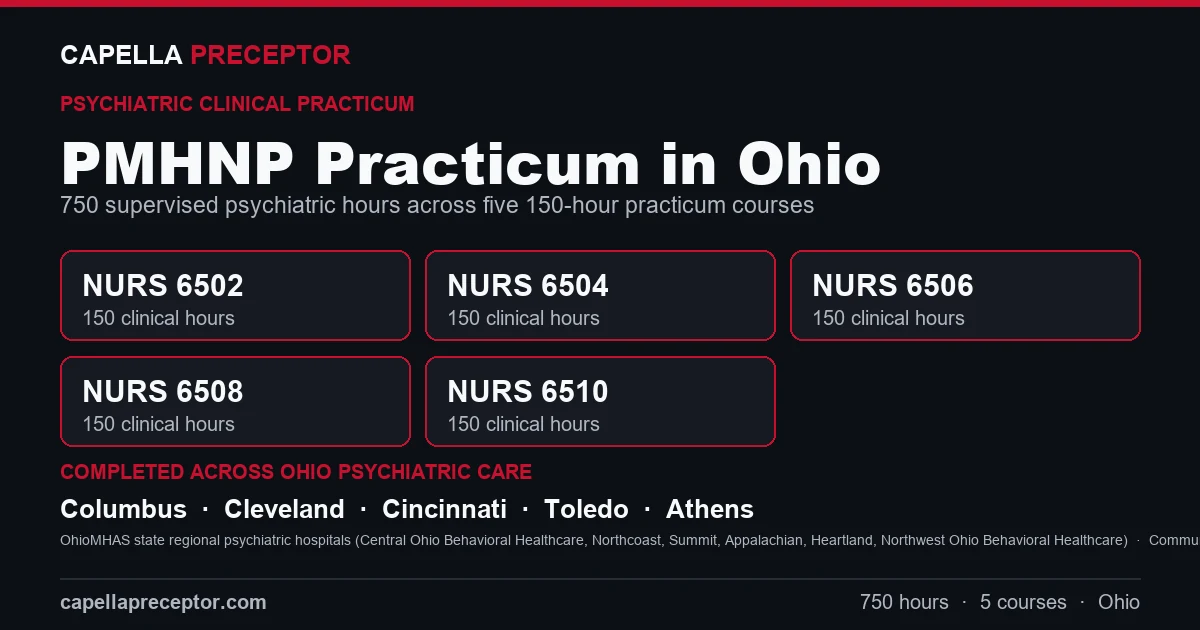
A Capella PMHNP practicum in Ohio requires 750 supervised psychiatric clinical hours across five 150-hour practicum courses, completed under an on-site psychiatric-mental-health preceptor at an approved Ohio site. Ohio is a reduced-practice state where a certified nurse practitioner prescribes under a standard care arrangement and faces tight Schedule II limits, so the kind of psychiatric site that can teach you well is narrower here than for a family-practice rotation. This page maps the PMHNP requirement against Ohio's psychiatric board rules, then how we secure your preceptor.
Last updated 2026-06-28 · Reviewed by the Capella Preceptor placement team
How many psychiatric hours does a Capella PMHNP need in Ohio?
The same 750 minimum that applies everywhere: a Capella MSN-PMHNP student completes a minimum of 750 supervised psychiatric practicum hours, structured as 150 clinical hours in each of five practicum courses, NURS6502 (Practicum I), NURS6504 (II), NURS6506 (III), NURS6508 (IV), and NURS6510 (V), under an on-site psychiatric-mental-health preceptor (Capella, MSN-PMHNP courses). The full course-by-course breakdown lives on our Capella PMHNP practicum page; this page is about what changes when those hours are earned in Ohio.
Two structural facts make the Ohio search harder than a primary-care rotation. First, every hour must be psychiatric, not general practice, so the site has to be a behavioral-health setting staffed by a credentialed psychiatric provider. Second, the PMHNP track is a lifespan specialty: the practicum sequence deliberately spreads hours across adult, older-adult, child, and adolescent psychiatry, which in Ohio usually means more than one preceptor or site, because a single Ohio practice rarely sees the full age range in volume. Plan for two sources of hours from the start.
Quick reference, Capella PMHNP in Ohio. Hours: 750 minimum. Structure: 5 practicum courses (NURS6502/6504/6506/6508/6510), 150 hours each. Setting: psychiatric and behavioral health only. Supervision: on-site PMHNP-BC or psychiatrist. Practice authority: reduced (standard care arrangement). Regulator: Ohio Board of Nursing. Portal: CORE ELMS. Background check: CastleBranch.
What does reduced practice mean for a psychiatric preceptor in Ohio?
Ohio is a reduced-practice state for nurse practitioners (AANP, State Practice Environment), which means a practicing certified nurse practitioner keeps a written standard care arrangement with a collaborating Ohio physician for as long as they see patients (OAAPN, Standard Care Arrangement). Our Ohio practice-authority page covers that arrangement in general terms. For a psychiatric placement specifically, the consequence is concrete: a PMHNP preceptor in Ohio operates inside a physician-collaborative structure, so the prescribing you observe, especially for the controlled substances that dominate psychiatry, is shaped by both the collaboration and Ohio's prescribing rules below.
As a student none of this is your own arrangement to hold. You learn under your preceptor's authority and Capella's approval. But it explains the Ohio psychiatric landscape: many of the strongest teaching sites are NP-led behavioral-health practices paired with a collaborating psychiatrist, plus the hospital and community systems where that collaboration is already built in.
Can an Ohio PMHNP preceptor prescribe Schedule II psychiatric medications?
This is the single most important Ohio-specific fact for a psychiatric rotation, because so much of psychiatry runs on controlled substances, stimulants for ADHD, benzodiazepines for anxiety, and buprenorphine for opioid use disorder. Ohio restricts a CNP's Schedule II authority tightly. Under Ohio Administrative Code 4723-9-10, a certified nurse practitioner may prescribe a Schedule II controlled substance only when the patient has a terminal condition, a physician initially prescribed the substance, and the prescription is for no more than a 72-hour supply. There is a meaningful exception: those limits do not apply when prescribing in a health care facility operated by the Ohio Department of Mental Health and Addiction Services or the Department of Developmental Disabilities.
What this means on the ground is specific to PMHNP work in Ohio. In a routine outpatient psychiatry clinic, an NP preceptor frequently cannot independently write the Schedule II stimulant a patient needs and instead routes it through the collaborating physician, so you will watch how that hand-off is documented. Inside a state psychiatric or addiction facility, the rules open up. Either way, the controlled-substance workflow you learn here is genuinely different from what a Capella FNP student sees in an Ohio primary-care clinic, where the prescribing mix and these board limits play out very differently. Compare the primary-care side on our Capella FNP preceptor in Ohio page.
How do benzodiazepines, OARRS, and buprenorphine factor into an Ohio psych rotation?
Three Ohio rules shape the psychiatric prescribing you will document, and none of them are primary-care concerns:
- OARRS before benzodiazepines. Ohio's prescribing rules require an APRN to obtain and review an Ohio Automated Rx Reporting System report before initially prescribing an opioid analgesic or a benzodiazepine, and at intervals not exceeding 90 days when continued (OAC 4723-9-12). Benzodiazepine management is everyday psychiatric work, so you will see OARRS queries built into the visit.
- Buprenorphine and the psych carve-out. Ohio caps sublingual buprenorphine for medication-assisted treatment at 24 mg per day, but allows a higher dose when the prescriber is a CNS or CNP with national certification in psychiatric-mental health, holds additional certification as a certified addictions APRN, or consults a board-certified addiction-medicine physician (OAC 4723-9-13). That carve-out is written specifically around PMHNP-style credentials, which is why opioid-use-disorder programs are strong PMHNP teaching sites in Ohio.
- Office-based opioid treatment standards. Ohio's office-based opioid treatment rule layers on lowest-effective-dose practice, scheduled visit frequency, random pill counts, and drug testing (OAC 4723-9-13). In a Suboxone or MAT clinic, much of your supervised time is spent learning exactly that protocol.
Can Ohio PMHNP practicum hours be done by telepsychiatry?
Partly, and Ohio is more telepsychiatry-friendly than many states. The State Medical Board's telehealth rule (OAC 4731-11-09) generally requires an in-person exam before prescribing controlled substances to a new patient, but carries explicit exceptions for mental health and medication-assisted treatment for addiction, the two pillars of psychiatric care. Capella names telepsychiatry directly inside its Practicum III experience, so the program clearly anticipates it as part of the clinical mix.
That does not mean all 750 hours can be remote. How much telehealth counts toward your hours depends on your specific course instructions, your preceptor's practice, and the supervised-training rules in effect when you rotate. We cover the general telehealth question on the PMHNP page; for Ohio, the practical upshot is that a telepsychiatry preceptor is a viable option for students in rural and Appalachian counties where in-person psychiatric sites are scarce. Confirm the per-course allowance against your course instructions before assuming an all-remote plan.
Where do PMHNP students actually do psychiatric hours in Ohio?
Ohio has a real, if oversubscribed, behavioral-health infrastructure. Psychiatric practicum sites that typically qualify, when staffed by a credentialed supervising provider, include:
OhioMHAS runs six: Central Ohio Behavioral Healthcare (Columbus), Northcoast (Northfield, near Cleveland), Summit (Cincinnati), Appalachian (Athens), Heartland (Massillon), and Northwest Ohio Behavioral Healthcare (Toledo). These are also where the Schedule II rules open up.
Every Ohio county is served through its county ADAMH board (Alcohol, Drug Addiction, and Mental Health), funding community behavioral-health providers statewide. CMHCs are the backbone of outpatient adult psychiatry rotations.
Suboxone and office-based opioid-treatment clinics, where the buprenorphine and OARRS rules above are the daily curriculum. Strong sites for substance-use-focused hours.
Behavioral-health units and pediatric psychiatry within the major Ohio systems in Columbus, Cleveland, and Cincinnati help cover the child and adolescent lifespan hours one outpatient clinic rarely supplies.
Naming a system does not mean it has an open preceptor slot; it means the setting type is appropriate. The work is finding a specific clinician at one of these who will take a student, sign on, and clear Capella's review.
Why is a PMHNP preceptor so hard to find in Ohio?
Honestly, because psychiatric preceptors are the scarcest type in nearly every state, and Ohio is no exception. The same prescriber shortage that makes PMHNPs valuable, too few psychiatrists and PMHNPs for the behavioral-health demand, means the clinicians qualified to precept you are already overbooked. Layer on three PMHNP-specific frictions and the search gets harder than an FNP placement:
- The lifespan split. You need adult and older-adult hours and separate child or adolescent hours; one Ohio practice rarely covers both in volume, so you are running two searches.
- Geography. Behavioral-health capacity clusters in Columbus, Cleveland, and Cincinnati; rural and Appalachian counties have thin in-person options, which is where a telepsychiatry preceptor becomes the realistic path.
- Affiliation lead time. A new affiliation agreement between Capella and an Ohio psychiatric site can take weeks to execute, so the calendar, not the preceptor's willingness, is often the real bottleneck.
The takeaway is not to be discouraged, it is to start months ahead of the practicum quarter and line up both ends of the lifespan before the term opens. Students who wait until enrollment confirms the term are the ones who scramble.
How clearance and approval work for an Ohio psychiatric placement
Once a preceptor and psychiatric site are identified, the Ohio placement runs the standard Capella pipeline, and a key point of honesty matters here: you secure the preceptor, and Capella reviews and approves the proposed placement. We match a preceptor who meets Capella's published requirements and submit the site and preceptor for Capella's review. No one can call a preceptor "endorsed by Capella" before that review clears, and no service can guarantee a placement.
- Propose the Ohio psychiatric site and preceptor in CORE ELMS for Capella's review and approval before any hours count.
- Execute the affiliation agreement between Capella and the Ohio behavioral-health site, signed before practicum begins.
- Clear the background check through CastleBranch, plus drug screen and health records, before your start date.
- Verify the credential. We confirm your preceptor's Ohio license through eLicense Ohio, so the clinician overseeing your psychiatric hours is verified, never taken on trust.
- Log and submit hours in CORE ELMS, where your Ohio preceptor approves each of the five 150-hour courses.
Ohio PMHNP FAQ
How many psychiatric practicum hours does a Capella PMHNP student in Ohio need?
A minimum of 750 supervised psychiatric clinical hours, completed as 150 hours in each of the five practicum courses NURS6502, NURS6504, NURS6506, NURS6508, and NURS6510, under an on-site psychiatric-mental-health preceptor at an approved Ohio site. The number is the same statewide; what changes in Ohio is the board context around prescribing and supervision.
Can a Capella PMHNP preceptor in Ohio prescribe Schedule II stimulants like Adderall?
Ohio limits a certified nurse practitioner's Schedule II prescribing sharply: under Ohio Administrative Code 4723-9-10 a CNP may prescribe a Schedule II drug only for a patient with a terminal condition, where a physician first prescribed it, and only up to a 72-hour supply, with an exception for facilities operated by the Ohio Department of Mental Health and Addiction Services. In routine outpatient psychiatry this means an NP preceptor often relies on a collaborating physician for Schedule II stimulant prescriptions, which is part of what you will observe.
Can Ohio PMHNP practicum hours be done by telepsychiatry?
Ohio telehealth rules carry specific exceptions for mental health and medication-assisted treatment, and Capella names telepsychiatry directly in its Practicum III experience. Whether telehealth hours count toward your 750 depends on your course instructions, your preceptor's practice, and the supervised-training rules in effect, so confirm the allowance per practicum rather than assuming all hours can be remote.
Is it hard to find a PMHNP preceptor in Ohio?
Yes. Psychiatric preceptors are the scarcest type in nearly every state, including Ohio, because the prescriber shortage that drives demand for PMHNPs also means the few practicing psychiatrists and PMHNPs are already overbooked. Add the lifespan requirement that splits your hours between adult and child or adolescent psychiatry, and most Ohio students need more than one site. Starting months early, or using a placement service, is how students avoid losing a term.
Does Capella approve my Ohio psychiatric preceptor, or do I?
You secure the preceptor and site; Capella reviews and approves the proposed placement. We match a preceptor who meets Capella's published requirements and submit the site and preceptor through CORE ELMS for Capella's review. No service can guarantee a placement, and we never describe a preceptor as endorsed by Capella before that review is complete.
Sources
- Capella University, MSN-PMHNP courses and practicum hours
- Ohio Administrative Code 4723-9-10 (APRN formulary and Schedule II prescribing limits)
- Ohio Administrative Code 4723-9-12 (OARRS review standards for APRNs)
- Ohio Administrative Code 4723-9-13 (office-based opioid treatment and buprenorphine)
- Ohio Administrative Code 4731-11-09 (telehealth prescribing rule and exceptions)
- Ohio Department of Behavioral Health, regional psychiatric hospitals
- AANP, State Practice Environment (Ohio reduced practice)
How Capella Preceptor helps Ohio PMHNP students
You now have the Ohio psychiatric picture: 750 hours over five practicum courses, a reduced-practice prescribing structure, tight Schedule II limits with a state-facility exception, OARRS and buprenorphine rules that live inside everyday psychiatry, and a real but oversubscribed network of CMHCs, MAT clinics, and state psychiatric hospitals. The hard part is a credentialed psychiatric preceptor who will take a student and clear Capella's review across both ends of the lifespan. That is what we do. We match a preceptor who meets Capella's published requirements, in person or by telepsychiatry, verify the Ohio license, prepare every CORE ELMS form and affiliation agreement, and submit the placement for Capella's review.
- Verified Ohio psychiatric preceptor matched in 7 days, no payment until matched
- Adult and child/adolescent rotations covered across all five practicums
- Every CORE ELMS form and affiliation agreement prepared and submitted for Capella's review
Need the program details or the statewide picture? See the Capella PMHNP practicum requirements and our Capella practicum and preceptors in Ohio overview.
Get a Capella PMHNP preceptor in Ohio
Free 15-minute consult. No payment until matched. We map your whole Ohio psychiatric practicum plan, hours, site, lifespan coverage, and paperwork.
Get my free consult →