Capella PMHNP Preceptor in South Carolina
A Capella MSN-PMHNP practicum in South Carolina requires 750 supervised psychiatric clinical hours across five 150-hour practicum courses, completed under an on-site psychiatric-mental-health preceptor at an approved behavioral-health site. South Carolina adds its own layer: it is a restricted-practice state, so your preceptor prescribes psychiatric controlled substances under a written physician practice agreement, and the state's psychiatric prescriber shortage is exactly why a qualified preceptor is so hard to land here. This page walks the board rules, the controlled-medication limits that matter most in psychiatry, telepsychiatry, the real settings, and how we secure the placement.
Last updated: June 28, 2026 · Reviewed by the Capella Preceptor placement team
What does a Capella PMHNP practicum in South Carolina actually require?
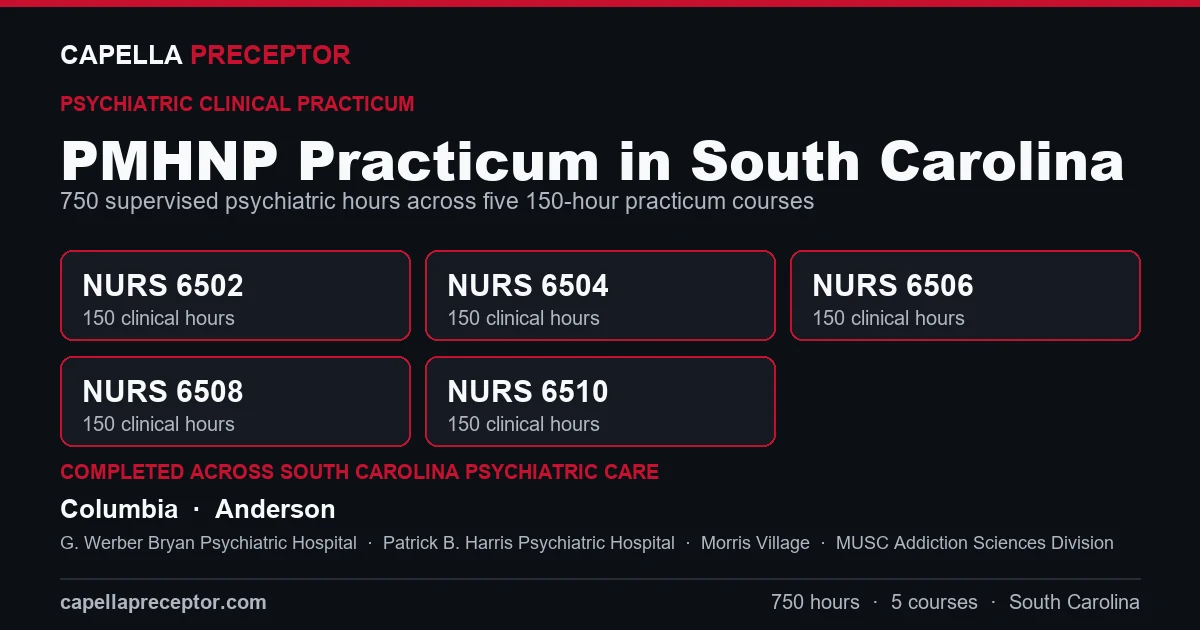
The Capella MSN Psychiatric Mental Health Nurse Practitioner specialization requires a minimum of 750 practicum hours, completed as 150 clinical hours in each of five sequential practicum courses, NURS6502, NURS6504, NURS6506, NURS6508, and NURS6510 (Practicum I through V), in psychiatric and behavioral-health settings under a qualified on-site preceptor (Capella, MSN-PMHNP courses). That hour count is national; it does not change because you live in Columbia rather than Charlotte. We keep the full course-by-course breakdown on the Capella PMHNP page so the numbers live in one place.
What South Carolina changes is everything around those hours: which clinician may supervise you, what they can prescribe while you observe, where telehealth fits, and how scarce psychiatric preceptors are in this state. Those are the four things this page exists to answer, and they are why a PMHNP placement here reads nothing like a family-practice placement. If you are on the primary-care track instead, the Capella FNP preceptor in South Carolina page covers that different world; this page is about psychiatry.
How does South Carolina restricted practice affect a psychiatric preceptor?
The American Association of Nurse Practitioners classifies South Carolina as a restricted-practice state, the most limited of its three tiers (AANP, South Carolina state practice environment). A practicing psychiatric APRN here cannot work independently; state law requires medical acts to be performed under a written practice agreement with a collaborating physician who is readily available for consultation, and that same agreement governs prescriptive authority (SC Code Title 40, Chapter 33, Section 40-33-34).
You are not the one signing that agreement during practicum, because you are not yet a licensed APRN. What restricted practice changes for you is who can sign off on your hours. Your preceptor must hold an active South Carolina license with the psychiatric scope to supervise behavioral-health care, typically a board-certified PMHNP (PMHNP-BC) practicing under a current physician practice agreement, or a psychiatrist. We confirm that license and authorization with the South Carolina Board of Nursing under the Department of Labor, Licensing and Regulation before you log a single hour, so the placement holds up when Capella reviews it (South Carolina Board of Nursing, APRN information).
What can your preceptor prescribe? South Carolina controlled-substance limits for psychiatry
This is where a psychiatric placement diverges sharply from a primary-care one. Psychiatry runs on controlled substances, ADHD stimulants, benzodiazepines, hypnotics, and medications for opioid use disorder, and South Carolina caps what an APRN may prescribe through the practice agreement. Under Section 40-33-34, a psychiatric APRN with a Board-issued prescriptive authorization may prescribe the following only if each drug class is listed in the practice agreement (SC Code 40-33-34):
A South Carolina APRN must also complete board-acceptable pharmacotherapeutics education and, to hold a DEA registration, at least fifteen of those contact hours in controlled substances (South Carolina Board of Nursing, prescriptive-authority application). For you as a student this matters in a practical way: a good PMHNP rotation should put you in front of stimulant titration, benzodiazepine tapering, and medication for opioid use disorder, so the preceptor you train under should actually carry those classes in their practice agreement. When we vet a South Carolina psychiatric preceptor, we confirm the prescribing scope is broad enough that your hours expose you to the medication management your certification exam will test.
Can PMHNP practicum hours be done by telepsychiatry in South Carolina?
Partly, and South Carolina is friendlier to this than most. The state permits live-video telepsychiatry under the South Carolina Telemedicine Act, and psychiatric care, intake interviews, medication management, and therapy, translates well to video (SC Code 40-47-37, practice of telemedicine). South Carolina leans on telepsychiatry heavily because its psychiatrist supply is thin, and there is a flagship example: the Medical University of South Carolina runs the PARTNER program, which pairs board-certified PMHNPs with patients in rural South Carolina by telemedicine and has delivered more than 1,600 clinical visits to date (MUSC, taking telepsychiatry to the back roads of South Carolina).
Two cautions keep this honest. First, telehealth prescribing of controlled substances is more restricted than in-person prescribing in South Carolina; buprenorphine for opioid use disorder is one of the explicit allowances, but many controlled-substance starts still expect an in-person component. Second, Capella, not the state, decides how many of your 750 hours can be telehealth. The share that counts depends on your specific course requirements and your preceptor's practice, so confirm the current telehealth allowance for each practicum against your Capella course instructions before assuming a rotation can be fully remote.
Where do PMHNP students actually train in South Carolina?
Approved hours must be earned in behavioral and mental-health practice, not general primary care. South Carolina has real psychiatric infrastructure, but most of it is already at capacity, which is the tension every PMHNP student here runs into. The settings that typically qualify, when staffed by an appropriately credentialed supervising provider:
The state mental-health system operates 16 community mental health centers across roughly 63 outpatient sites serving all 46 counties, the largest network of outpatient psychiatric care in the state.
Inpatient rotations at facilities such as G. Werber Bryan Psychiatric Hospital in Columbia and Patrick B. Harris Psychiatric Hospital in Anderson expose you to acute and forensic populations.
Programs such as Morris Village and academic addiction services like the MUSC Addiction Sciences Division cover substance-use care and medication for opioid use disorder.
Private psychiatric practices and statewide telepsychiatry networks reach the rural Pee Dee, Lowcountry, and Upstate counties where in-person options thin out.
Capella also requires the child and adolescent population (the Practicum II focus) alongside adult and older-adult hours, and one South Carolina practice rarely covers both ends of the lifespan well. Many students need more than one site or preceptor across the sequence. Naming the real settings is the easy part; getting one of their already-stretched prescribers to take you on is the hard part, which the next section is about.
Why is finding a PMHNP preceptor in South Carolina so hard?
Be honest with yourself about this one. South Carolina has a documented psychiatric workforce shortage, with mental-health Health Professional Shortage Areas concentrated in its rural counties, and the state mental-health system openly relies on telehealth to stretch its limited number of psychiatrists across all 46 counties (KFF, mental-health-care HPSAs by state). When prescribers are scarce, they are also busy, and a busy psychiatric provider has little slack to supervise, countersign notes, and mentor a student through 150 hours.
Layer Capella's self-placement policy on top of that and you see the squeeze. Capella does not assign you a preceptor; a "dedicated Capella support team helps connect you with practicum site opportunities," but securing the psychiatric site and the supervising provider is the student's responsibility for all 750 hours (Capella, MSN-PMHNP overview). So a South Carolina PMHNP student is asked to cold-source one of the scarcest provider types in one of the more shortage-burdened states, while also covering both adult and child psychiatry. That is the exact gap we close.
How does the South Carolina psychiatric placement process work?
Once a preceptor says yes, the paperwork chain is the same one every Capella practicum runs through, and none of it moves until you have a confirmed psychiatric site:
- Propose your South Carolina psychiatric site and preceptor in CORE ELMS, Capella's practicum-management system, so the placement can be reviewed and approved before you start.
- Confirm the preceptor's license and prescribing scope with the South Carolina Board of Nursing, including that the controlled-substance classes your rotation needs are in their practice agreement.
- Execute an affiliation agreement between Capella and your South Carolina behavioral-health site before the practicum quarter opens; these can take weeks at hospital systems.
- Clear compliance through Capella's third-party vendor, CastleBranch, for the background check, drug screen, and health records.
- Log and submit your 150 hours per course in CORE ELMS, where your South Carolina preceptor approves what you record.
We line up the preceptor first, then run this chain so the affiliation agreement is signed before your start date rather than after it has already slipped.
South Carolina PMHNP FAQ
How many psychiatric hours does a Capella PMHNP practicum require in South Carolina?
A minimum of 750 supervised psychiatric clinical hours, completed as 150 hours in each of five practicum courses (NURS6502, NURS6504, NURS6506, NURS6508, NURS6510), under an on-site psychiatric-mental-health preceptor at an approved South Carolina behavioral-health site. The hour count is the same in every state; what South Carolina changes is who may supervise and prescribe.
Does South Carolina restricted practice affect my PMHNP preceptor's prescribing?
Yes. South Carolina is a restricted-practice state, so a practicing psychiatric APRN prescribes under a written practice agreement with a physician. Under SC Code 40-33-34 a psychiatric APRN may prescribe Schedule II nonnarcotic drugs such as ADHD stimulants up to a thirty-day supply, Schedule II narcotic drugs only up to a five-day supply without further physician sign-off, and Schedule III to V drugs including buprenorphine when listed in the practice agreement. You observe and participate under your preceptor, who must hold an active, properly authorized South Carolina license.
Can Capella PMHNP practicum hours be completed by telepsychiatry in South Carolina?
Often partly. South Carolina permits live-video telepsychiatry under the South Carolina Telemedicine Act, and psychiatric care translates well to video. How many telehealth hours count toward your practicum depends on your specific Capella course requirements and your preceptor's practice, so confirm the current allowance against your course instructions rather than assuming all hours can be remote.
Why is a PMHNP preceptor so hard to find in South Carolina?
South Carolina has a documented psychiatric workforce shortage, with mental-health shortage areas concentrated in its rural counties. Most board-certified psychiatric prescribers are already at capacity inside the state mental-health system or busy telepsychiatry groups, so they have little room to take on a student. That scarcity, not the coursework, is the real bottleneck.
Does Capella assign a PMHNP preceptor in South Carolina?
No. Capella requires the student to secure their own preceptor and psychiatric site for all 750 hours and does not assign one. We match a verified preceptor who meets Capella's published requirements and submit the placement for Capella's review through CORE ELMS.
Sources
- Capella University, MSN-PMHNP courses and practicum hours
- AANP, South Carolina state practice environment (restricted)
- South Carolina Code Title 40, Chapter 33, Section 40-33-34 (APRN practice agreements and prescriptive authority)
- South Carolina Board of Nursing (LLR), APRN information and license verification
- South Carolina Code 40-47-37 (practice of telemedicine)
- MUSC, statewide telepsychiatry and the PARTNER PMHNP program
- KFF, mental-health-care Health Professional Shortage Areas by state
How Capella Preceptor helps PMHNP students in South Carolina
You now know the landscape: 750 psychiatric hours, a restricted-practice state where your preceptor prescribes controlled medications under a physician agreement, real but stretched psychiatric settings, and a genuine prescriber shortage. We close the last gap. We match you with a verified South Carolina psychiatric preceptor whose license, scope, and prescribing fit Capella's published requirements, confirm it with the board, submit the placement for Capella's review, and run every CORE ELMS form and affiliation agreement so your hours start on time.
- Verified South Carolina psychiatric preceptor matched in 7 days, in person or by telepsychiatry
- Adult and child/adolescent rotations covered across all five PMHNP practicums
- No payment until you are matched; every CORE ELMS form and CastleBranch step handled
Want the program details or the state rules on their own? See the Capella PMHNP preceptor and hours page for the full five-course breakdown, and Capella preceptor placement in South Carolina for the board rules across every specialty.
Get a Capella PMHNP preceptor in South Carolina
Free 15-minute consult. No payment until matched. We map your entire psychiatric practicum plan.
Get my free consult →