Capella PMHNP Preceptor in Tennessee
A Capella PMHNP practicum in Tennessee requires 750 supervised psychiatric clinical hours across five 150-hour practicum courses, completed under an on-site psychiatric-mental-health preceptor you secure yourself. Tennessee is a restricted nurse practitioner state, and its rules on prescribing psychiatric controlled substances shape who can supervise you. This page explains where the PMHNP requirements and Tennessee psychiatric law meet, then how we place you.
Last updated: June 28, 2026 · Reviewed by the Capella Preceptor placement team
How does Tennessee change a Capella PMHNP practicum?
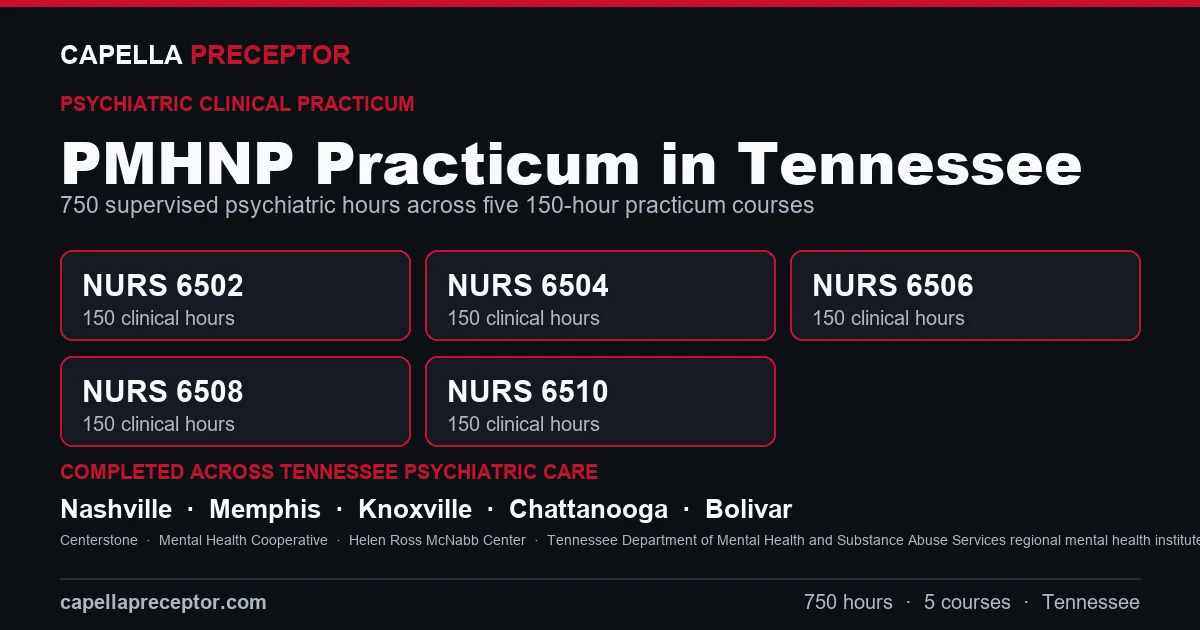
It does not change the hour count. The Capella MSN Psychiatric Mental Health Nurse Practitioner specialization requires a minimum of 750 practicum hours, completed as 150 clinical hours in each of five practicum courses (NURS6502, NURS6504, NURS6506, NURS6508, NURS6510, or Practicum I through V), each in a psychiatric setting under a qualified preceptor (Capella, MSN-PMHNP courses). That structure is the same in Memphis as anywhere else, and the full course-by-course breakdown lives on our Capella PMHNP page. Note the difference from the primary-care track: the PMHNP is five 150-hour courses, while the FNP is six 125-hour courses, so do not carry an FNP plan over to a psych practicum.
What Tennessee changes is who can precept you, how psychiatric controlled substances are prescribed, and how much of psychiatry can be done by video. The American Association of Nurse Practitioners classifies Tennessee as a restricted practice state, the most limited of its three tiers, so a nurse practitioner here cannot practice independently and is tied to a collaborating physician (AANP, Tennessee state practice environment). For a psych practicum, that collaboration matters more than it does in primary care, because most of what a PMHNP does day to day is prescribe scheduled medications. Our broader Tennessee placement page covers the cross-specialty picture, and the Capella FNP in Tennessee page covers the primary-care cell; this page is the psychiatric cell.
Who can precept a PMHNP student in Tennessee?
The Tennessee Board of Nursing sets the floor for any clinical preceptor: an unencumbered license to practice at or above the level for which the student is being prepared, in the jurisdiction where the precepting happens. For a Capella PMHNP student, a psychiatric population is the binding constraint, so the realistic preceptors are:
- A Tennessee-licensed PMHNP (board-certified, PMHNP-BC) whose own scope is psychiatric mental health. Because Tennessee is restricted, a PMHNP who prescribes scheduled psychiatric drugs works under a collaborating physician, which we confirm is in place when we vet the site.
- A psychiatrist (MD or DO), including child and adolescent psychiatrists. A physician preceptor sidesteps the collaboration question and is common on inpatient psychiatric units and in larger Tennessee behavioral-health systems.
- An appropriately credentialed psychiatric provider matched to the specific course population, again Tennessee-licensed and at or above the level you are training for, where Capella accepts them for that practicum.
A general FNP or adult primary-care provider does not satisfy a PMHNP practicum, because the hours have to be psychiatric. That single rule is why the Tennessee psych preceptor pool is far thinner than the primary-care pool, a point we return to below.
How does Tennessee handle psychiatric controlled-substance prescribing?
This is the rule that separates a psych practicum from any other specialty in Tennessee, because psychiatric prescribing leans heavily on scheduled drugs: Schedule II stimulants for ADHD, benzodiazepines for anxiety, and buprenorphine for opioid use disorder. An APRN who prescribes controlled substances in Tennessee must hold a certificate of fitness from the Board of Nursing, and that prescribing APRN works under a collaborating physician with a mutually approved formulary (Tenn. Comp. R. & Regs. 1000-04-.04). For Schedule II and III opioids on the formulary, a certificate-holding nurse practitioner is generally limited to a non-refillable, thirty-day course unless the collaborating physician specifically approves more after consultation (Tennessee APRN controlled-substance prescribing requirements).
Tennessee is also unusually strict on buprenorphine for opioid use disorder, which matters if you want addiction or medication-assisted-treatment hours. State law limits NP and PA buprenorphine prescribing for OUD to providers who are licensed and practicing as a family, adult, or psychiatric nurse practitioner and who are employed by a community mental health center or a federally qualified health center that employs at least one physician and has adopted medication-assisted-treatment protocols, with the prescription capped at a 16 mg daily dose of a naloxone-combination product and a Controlled Substance Monitoring Database check at every visit (University of Tennessee Institute for Public Service, MAT/MATE Acts summary). The practical takeaway for placement is that a Tennessee preceptor doing buprenorphine work is usually sitting inside a CMHC or FQHC, which narrows the list of sites that can offer those hours. We screen for the full certificate of fitness and the collaborating-physician relationship, since a preceptor on a temporary certificate practices under tighter supervision and may have less room to take a student across all five practicum courses.
The AANP tiers in one line. Full practice means an NP evaluates, diagnoses, and prescribes under the board of nursing alone. Reduced means a regulated agreement with another health professional is required for at least one element. Restricted, Tennessee's tier, means career-long supervision, delegation, or team management by an outside health professional is required. In psychiatry, where almost every visit involves a scheduled medication, that physician collaboration is the part you feel most.
Can Tennessee PMHNP hours be done by telepsychiatry?
Often, more than in any other specialty. Psychiatry is one of the most telehealth-native fields, because intake interviews, medication management, and psychotherapy are routinely delivered by video in real Tennessee practice, and Capella names telepsychiatry directly inside the Practicum III experience (Capella, MSN-PMHNP courses). That makes supervised telepsychiatry hours genuinely realistic for a Tennessee student, especially one in a rural county.
It does not make the program remote by default. How many telehealth hours count toward each practicum depends on your specific course requirements, your preceptor's practice, and the supervision your site provides, and a controlled-substance prescriber working by video still has to meet Tennessee's prescribing and monitoring rules. Confirm the current telehealth allowance for each of the five practicum courses against your Capella course instructions before assuming a rotation can be fully virtual.
Where do Capella PMHNP students do practicum in Tennessee?
PMHNP is a lifespan specialty, so your 750 hours need adult and older-adult psychiatry plus child and adolescent psychiatry, not a single age band. Tennessee has real psychiatric infrastructure for it, concentrated in the metros but reaching the regions through the public behavioral-health network. The settings that typically qualify, when staffed by an appropriately credentialed supervising provider:
Centerstone, Mental Health Cooperative, and the Helen Ross McNabb Center run outpatient psychiatry across Middle, West, and East Tennessee, and they are often where medication-assisted treatment is delivered.
The Tennessee Department of Mental Health and Substance Abuse Services operates four inpatient psychiatric hospitals: Moccasin Bend (Chattanooga), Western (Bolivar), Memphis, and Middle Tennessee (Nashville).
Substance-use and opioid-treatment settings for the addiction side of psychiatry, usually inside a CMHC or FQHC given Tennessee's buprenorphine rules.
Telepsychiatry groups and a fully virtual preceptorship by video for rural counties in the Upper Cumberland, West Tennessee, or the mountains east of Knoxville.
Outpatient psychiatry and counseling practices in the larger metros (Nashville and Middle Tennessee, Memphis and Shelby County, Knoxville and East Tennessee, Chattanooga, and the Tri-Cities) round out the in-person options. Because the lifespan requirement is split between adult and child or adolescent psychiatry, many Tennessee students need more than one site or preceptor over the five-course sequence, and we plan that coverage before you start so a child-and-adolescent gap does not surface mid-program.
Why is a PMHNP preceptor so hard to find in Tennessee?
Honestly, because the psychiatric preceptor shortage is the most acute of any NP specialty, and a restricted state sharpens it. Three things stack up. First, the eligible pool is small: only psychiatric providers count, so the much larger family and adult primary-care population that helps FNP students is off the table. Second, the restricted-state collaboration and certificate-of-fitness requirements mean a psych NP who prescribes is already operating inside a documented physician relationship, and adding a student to that arrangement is one more approval. Third, Tennessee's behavioral-health workforce is stretched thin against high demand, so the same handful of CMHCs, institutes, and outpatient psychiatry practices field a steady stream of student requests from multiple programs at once.
The result is that a Tennessee PMHNP student who self-places can lose a term waiting, especially for the child and adolescent hours, which are the scarcest of all. That is the gap a placement service closes: we carry the search, verify the credential and the collaboration, and line up coverage across all five courses before a clock starts.
PMHNP practicum approval, done in Tennessee
Securing the psychiatric preceptor is the start. Before you log a single hour, the same Capella clearance applies wherever you practice, and a restricted state adds no shortcut around it. Capella manages practicum application, site and preceptor approval, hour logging, and evaluations through CORE ELMS, its practicum-management system. We prepare each piece so a Tennessee approval does not stall on paperwork.
- Submit the Tennessee psychiatric site and preceptor in CORE ELMS for Capella review and approval, with the preceptor's Tennessee license and certificate of fitness confirmed.
- Execute an affiliation agreement between Capella and the Tennessee behavioral-health site before practicum begins.
- Clear compliance. A background check, drug screen, and health records run through CastleBranch (via the myCB platform); confirm the current vendor with your program.
- Log and submit hours in CORE ELMS across all five courses, where your Tennessee preceptor approves what you record before each 150-hour course closes.
Every site and preceptor is proposed and submitted for Capella's own review and approval; we match preceptors who meet Capella's published requirements, and the university decides each placement. We never present a preceptor as carrying any Capella affiliation or endorsement, and we never promise that a placement will be approved, only a verified, fully prepared submission for Capella's review and a fast match.
Tennessee PMHNP FAQ
How many practicum hours does the Capella PMHNP require in Tennessee?
A minimum of 750 psychiatric practicum hours across five practicum courses (NURS6502, NURS6504, NURS6506, NURS6508, NURS6510) at 150 hours each, the same nationwide. Tennessee does not add or subtract hours; what changes is who can precept you and how controlled-substance prescribing is supervised, because Tennessee is a restricted nurse practitioner state.
Can a PMHNP precept my Capella psychiatric practicum in Tennessee?
Yes. A Tennessee-licensed PMHNP with an unencumbered APRN license can precept you, and a psychiatrist (MD or DO) can as well. Because Tennessee is restricted, a PMHNP who prescribes psychiatric controlled substances works under a collaborating physician and a certificate of fitness, which we confirm when we vet the site.
Can Capella PMHNP hours in Tennessee be done by telepsychiatry?
Some can. Psychiatry is delivered by video in real Tennessee practice and Capella names telepsychiatry inside Practicum III, so supervised telepsychiatry hours are realistic here. How many telehealth hours count depends on your specific course requirements and your preceptor's practice, so confirm the current allowance against your course instructions before assuming a rotation can be fully remote.
Can a Tennessee PMHNP preceptor prescribe buprenorphine or Schedule II stimulants?
A Tennessee APRN needs a certificate of fitness and a collaborating physician with an approved formulary to prescribe Schedule II to V drugs, including ADHD stimulants and benzodiazepines. Buprenorphine for opioid use disorder is more restricted: an NP can prescribe it only when employed by a community mental health center or FQHC with medication-assisted-treatment protocols, capped at a 16 mg daily naloxone-combination dose. That is why MAT hours in Tennessee usually sit inside a CMHC or FQHC.
Where in Tennessee do you place PMHNP students?
Outpatient psychiatry, community mental health centers such as Centerstone, Mental Health Cooperative, and the McNabb Center, the state regional mental health institutes, addiction and MAT programs, and telepsychiatry groups across Nashville, Memphis, Knoxville, Chattanooga, and the Tri-Cities, plus a fully virtual option for rural counties.
Sources
- Capella University, MSN-PMHNP courses (750 hours, five 150-hour courses, telepsychiatry in Practicum III)
- AANP, Tennessee state practice environment (restricted)
- Tenn. Comp. R. & Regs. 1000-04-.04, APRN certificate of fitness and controlled-substance prescribing
- University of Tennessee Institute for Public Service, MAT/MATE Acts (NP buprenorphine limits)
- NetCE, Tennessee APRN controlled-substance prescribing and CE requirements
- Tennessee Department of Mental Health and Substance Abuse Services, regional mental health institutes
How Capella Preceptor helps
In a restricted state with a real psychiatric preceptor shortage, the hard part is finding a Tennessee PMHNP or psychiatrist who is available, properly credentialed, and whose controlled-substance collaboration is on file, then clearing Capella's approval without losing a term. We handle both. We match a verified psychiatric preceptor who meets Capella's published requirements, in person or by telepsychiatry, and prepare every CORE ELMS form and compliance step for Capella's review so your hours start on time.
- Verified Tennessee psychiatric preceptor matched in 7 days, no payment until matched
- Adult and child or adolescent psychiatry coverage planned across all five practicum courses
- In-person across Nashville, Memphis, Knoxville, and Chattanooga, or telepsychiatry for rural counties
On the family nurse practitioner track instead? See Capella FNP preceptor requirements in Tennessee for primary-care practicum hours, the 20% chart-review rule, and local clinical settings.
Get a Capella PMHNP preceptor in Tennessee
Free 15-minute consult. No payment until matched. We map your entire psychiatric practicum plan.
Get my free consult →