Home / MSN-PMHNP / PMHNP Preceptor in Vermont
Program × StateCapella PMHNP Preceptor in Vermont
A Capella MSN-PMHNP practicum in Vermont requires 750 supervised psychiatric-mental-health clinical hours across five 150-hour practicum courses, completed in person under an on-site psychiatric preceptor. Vermont adds its own layer: the Board of Nursing requires a preceptor whose role and population focus actually match psychiatric care, the state runs most of its behavioral-health capacity through ten nonprofit Designated Agencies, and full practice authority means your preceptor prescribes controlled psychiatric medications you can learn from. Here is how the hours, the board rules, telepsychiatry, the real Vermont settings, and the preceptor search fit together.
Last updated 2026-06-28 · Reviewed by the Capella Preceptor placement team
What does the Capella PMHNP require, and what does Vermont add on top?
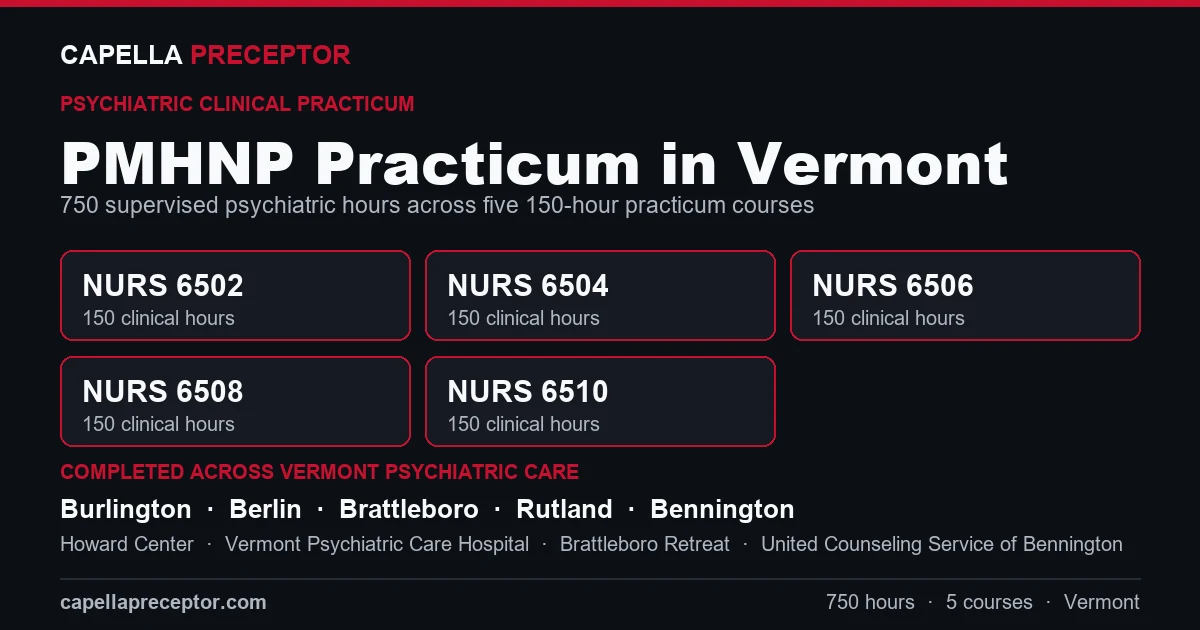
The Capella MSN Psychiatric-Mental Health Nurse Practitioner specialization requires a minimum of 750 practicum hours, completed as 150 clinical hours in each of five practicum courses: NURS6502 (Practicum I), NURS6504 (II), NURS6506 (III), NURS6508 (IV), and NURS6510 (V) (Capella, MSN-PMHNP courses). That five-by-150 structure is specific to PMHNP and differs from the Capella FNP, which spreads 750 hours across six 125-hour courses of primary care. The full course-by-course breakdown lives on our PMHNP specialty page; this page assumes that program substance and layers Vermont on top.
Two things are constant in every state: the 750-hour total and the requirement that the hours be earned in psychiatric and behavioral-health practice, not general primary care. What Vermont changes is everything around the preceptor: who is allowed to supervise you, what they can prescribe in front of you, how much of the work can be telepsychiatry, and where the real psychiatric sites are. Those four differences are why a PMHNP placement in Vermont reads nothing like an FNP placement here. For the primary-care version, see Capella FNP preceptor in Vermont; for the state-wide overview across all specialties, see our Vermont placement page.
Does my Vermont preceptor have to be psychiatric, or will any NP do?
It has to be psychiatric. The Vermont Board of Nursing administrative rules define a preceptor as an APRN or registered nurse who supervises student learning, and they require that an APRN serving as a preceptor hold an active, unencumbered Vermont license and experience in the same role and population focus as the student's certification (Vermont Board of Nursing, Administrative Rules). For a PMHNP student, the role and population focus is psychiatric-mental health across the lifespan, so a family nurse practitioner, an adult-gerontology primary care NP, or an internist does not satisfy the population match for your psychiatric hours.
The same Vermont rules add a hard limit that catches students off guard: a physician assistant may not serve as an APRN student preceptor in Vermont. In a small state where a PA often runs a rural behavioral-health clinic, that rules out a site you might otherwise assume works. Practically, your Vermont PMHNP preceptor needs to be a board-certified PMHNP (PMHNP-BC) or a psychiatrist with an active Vermont license and genuine psychiatric practice. We confirm both the license and the population focus through the Vermont Office of Professional Regulation's free Find a Professional lookup before we present a candidate, because a preceptor who clears Capella's published requirements still has to clear Vermont's, and a placement only goes through when both are submitted for Capella's review and approved.
Does full practice authority change what my Vermont psych preceptor can prescribe?
It changes a lot, and in a way that directly improves your learning. The American Association of Nurse Practitioners classifies Vermont as a full practice authority state (AANP, State Practice Environment). A fully licensed Vermont PMHNP evaluates, diagnoses, and prescribes, including controlled substances, under their own DEA registration without a standing physician agreement. For a psychiatric rotation that means you can observe the full range of psychopharmacology that defines the specialty:
- Schedule II stimulants for ADHD management, prescribed and monitored directly by your preceptor.
- Benzodiazepines and other controlled anxiolytics, with the prescribing caution and tapering decisions you need to see modeled.
- Buprenorphine for opioid use disorder. Buprenorphine is a Schedule III medication, and Vermont law limits prior authorization for medication-assisted treatment, so it is widely prescribed by NPs here (Scope of Practice Policy, Vermont).
There is one nuance about your preceptor's own status. Vermont layers a transition-to-practice period on new APRNs: an NP with fewer than 24 months and 2,400 hours of active advanced practice must hold a formal agreement with a collaborating provider, and a second role and population focus later requires at least 12 months and 1,600 hours (Vermont Statutes, Title 26 Chapter 28). A preceptor who has finished that period and holds full authority can supervise you on their own authority, which usually makes site approval cleaner. We check that status as part of vetting.
Can Vermont PMHNP hours be telepsychiatry, and how much?
Some of them, and Vermont is a better-than-average state for it. Psychiatry is one of the most telehealth-friendly specialties because intake interviews, medication management, and psychotherapy translate well to secure video, and Capella's own Practicum III description names telepsychiatry as part of the advanced clinical experience (Capella, MSN-PMHNP courses). In a rural state with long winters and thin provider coverage in the Northeast Kingdom, Vermont psychiatric practices lean on telepsychiatry heavily, so a Vermont preceptor is likely to be doing real video-based care you can take part in.
Telepsychiatry that touches controlled substances sits under federal rules too. The DEA and HHS have extended the COVID-era telemedicine flexibilities for prescribing controlled medications through December 31, 2026, which lets DEA-registered clinicians prescribe Schedule II to V medications, and buprenorphine for opioid use disorder, over audio-video telehealth without a prior in-person visit in many cases (Telehealth.HHS.gov, prescribing controlled substances via telehealth). That is the practice environment you would observe. It does not mean your whole practicum can be remote: how many telehealth hours count toward each of the five courses depends on your specific course requirements and your preceptor's practice, so confirm the current allowance against your course instructions before you plan around it.
Where do PMHNP clinical hours actually happen in Vermont?
Most of Vermont's psychiatric capacity is concentrated in a small set of named systems, which is exactly why it is hard to self-place. The backbone is a network of ten nonprofit Designated Agencies, the community mental health agencies that the Vermont Department of Mental Health contracts with to deliver care, organized statewide as Vermont Care Partners (Vermont Department of Mental Health, Designated Agencies). Each agency covers a region, so where you live narrows your realistic options:
Two of those deserve a note for PMHNP students. The Vermont Psychiatric Care Hospital in Berlin is the state's only state-run psychiatric inpatient facility, a 25-bed Level 1 acute-care hospital, useful for the inpatient exposure your assessment and crisis-intervention competencies expect (Vermont Department of Mental Health, Vermont Psychiatric Care Hospital). The Brattleboro Retreat is one of the few Vermont sites that takes children and youth for inpatient psychiatric care, which matters because Capella's PMHNP is a lifespan certification and your hours have to cover child and adolescent psychiatry as well as adults.
Substance-use work is its own distinctly Vermont opportunity. Vermont runs the country's best-known Hub-and-Spoke system for medication treatment of opioid use disorder: regional "Hubs" provide intensive opioid-treatment-program care, and "Spokes" are office-based practices where nurse practitioners prescribe buprenorphine with a nurse and a licensed counselor on the care team (Vermont Blueprint for Health, Hub and Spoke). A Spoke supervised by a credentialed PMHNP can be a strong source of substance-use and psychopharmacology hours that count toward your psychiatric practicum.
Why is finding a PMHNP preceptor in Vermont so hard, honestly?
Because the math is against you, and it helps to say so plainly. Vermont is one of the least populous states, it is largely rural, and it has a documented behavioral-health workforce shortage, so psychiatric prescribers are scarcer than primary-care ones to begin with. Then most of the capacity sits inside the ten Designated Agencies and a few inpatient units, organizations that train a limited number of students per term and fill those slots early. A psychiatric preceptor is harder to find than an FNP preceptor in the same town, and the population-focus rule above means you cannot substitute a primary-care provider to make the numbers work.
On top of that, Capella does not place you. The university says a support team helps connect learners with site opportunities, but it is explicit that learners are responsible for finding an appropriate preceptor to oversee the practicum experience (Capella, MSN-PMHNP overview). For a Vermont PMHNP student that means you, not the university, line up a psychiatric site and a credentialed supervisor for all 750 hours, and you do it in a market where psychiatric capacity is thin. The honest answer to "how fast" is: start early, cover both the adult and the child or adolescent ends of the lifespan with sites that genuinely treat those populations, and have the virtual option ready for the counties where no slot exists.
Clearing the placement before a single Vermont hour counts
Vermont's board rules and Capella's clearance workflow are two separate gates, and both have to close before you log an hour. Once a psychiatric preceptor and site are identified, the placement moves through CORE ELMS, Capella's practicum-management system, where you propose the site and preceptor, log hours, and have the preceptor approve them (Capella, CORE ELMS). A signed affiliation agreement between Capella and the Vermont site, plus a background check through CastleBranch, must be complete before practicum begins. Background clearance matters more in psychiatry: many behavioral-health and inpatient settings, and any site touching controlled-substance prescribing, screen students closely.
1. Confirm the Vermont preceptor is a PMHNP-BC or psychiatrist with an active, population-matched license
2. Propose the Vermont psychiatric site and preceptor in CORE ELMS, for Capella's review
3. Execute the Capella-to-site affiliation agreement
4. Clear the CastleBranch background and health record check
5. Log 150 hours per course in CORE ELMS for preceptor approval, across all five practicums
Nothing on this list is a guarantee of placement, and we never describe a preceptor or site as endorsed by Capella before the university has actually reviewed it. What we do is match a preceptor who meets Capella's published requirements and Vermont's board rules, then submit the proposal for Capella's review.
In-person or telepsychiatry for Vermont PMHNP students
Geography drives this more in Vermont than almost anywhere. If you are in or near Chittenden County, Rutland, or the Brattleboro area, an in-person psychiatric rotation is usually attainable and gives you the hands-on inpatient and crisis exposure your competencies expect. If you are in the Northeast Kingdom or another county where the nearest Designated Agency has no open student slot, a supervised telepsychiatry preceptorship lets you meet the same competencies without waiting a term, and the hours still flow through CORE ELMS the same way.
Strongest near Burlington (Howard Center), the Berlin and Brattleboro inpatient units, and Rutland, where psychiatric volume and student slots concentrate.
A fit for the Northeast Kingdom and rural counties, supervised over secure video, with the same CORE ELMS tracking and the telehealth allowance confirmed per course.
Vermont PMHNP FAQ
How many psychiatric hours does a Capella PMHNP practicum need in Vermont?
A minimum of 750 supervised psychiatric-mental-health hours, completed as 150 clinical hours in each of five practicum courses (NURS6502, NURS6504, NURS6506, NURS6508, NURS6510), under an on-site PMHNP or psychiatrist preceptor. The number is the same in Vermont as everywhere else; what changes by state is the board rules for the preceptor and the local psychiatric settings.
Does my Vermont PMHNP preceptor have to be psychiatric, not just any NP?
Yes. The Vermont Board of Nursing rules require an APRN or physician preceptor with an active, unencumbered Vermont license and experience in the same role and population focus as your certification, which for PMHNP is psychiatric-mental health across the lifespan. A family NP or a physician assistant cannot serve as your PMHNP preceptor; in Vermont, PAs may not precept APRN students at all.
Can Vermont PMHNP practicum hours be done by telepsychiatry?
Some can. Vermont is a heavy telepsychiatry state and Capella names telepsychiatry inside the Practicum III experience, so video-based psychiatric care can count when your preceptor supervises it and your course allows it. The share of telehealth hours that count depends on your specific course requirements and your preceptor's practice, so confirm it against your course instructions rather than assuming all 750 hours can be remote.
Will my Vermont psych preceptor be able to prescribe controlled medications I observe?
In most cases yes. Vermont is a full practice authority state, so a fully licensed Vermont PMHNP prescribes controlled psychiatric medications, including Schedule II stimulants, benzodiazepines, and buprenorphine for opioid use disorder, under their own DEA registration. That lets you observe real psychopharmacology management, including Vermont's Hub-and-Spoke addiction-treatment spokes, during your practicum.
Why is a psych preceptor so hard to find in Vermont?
Vermont is small, rural, and has a documented behavioral-health workforce shortage. Most psychiatric capacity sits inside ten nonprofit Designated Agencies and a handful of inpatient units, and those organizations take a limited number of students. Psychiatric preceptors are scarcer than primary-care ones, so PMHNP students routinely struggle to self-place, which is the gap we fill.
Sources
- Capella University, MSN-PMHNP courses (750 hours, five 150-hour practicums)
- Capella University, MSN-PMHNP overview (learner secures the preceptor)
- Vermont Board of Nursing, Administrative Rules (preceptor role and population focus; PA exclusion)
- AANP, State Practice Environment (Vermont full practice authority)
- Scope of Practice Policy, Vermont (prescribing and medication-assisted treatment)
- Vermont Department of Mental Health, Designated Agencies (Vermont Care Partners)
- Vermont Department of Mental Health, Vermont Psychiatric Care Hospital (25-bed Level 1)
- Vermont Blueprint for Health, Hub and Spoke (NP buprenorphine prescribing in Spokes)
- Telehealth.HHS.gov, prescribing controlled substances via telehealth (2026 extension)
- Vermont Statutes Online, Title 26 Chapter 28 (transition to practice)
How Capella Preceptor helps in Vermont
PMHNP is the hardest placement to self-arrange in a small state: 750 psychiatric hours, adult and child or adolescent populations, a preceptor whose population focus matches under Vermont's board rules, and a site that will sign an affiliation agreement, in a market where most capacity sits inside ten Designated Agencies and a few inpatient units. We match a psychiatric preceptor who meets Capella's published requirements and Vermont's licensing rules, then submit the proposal for Capella's review and run the CORE ELMS paperwork.
- Psychiatric preceptor matched in 7 days, in person or telepsychiatry, no guarantee of placement until Capella approves
- Population focus verified against Vermont's role-and-population rule, adult and child or adolescent hours both covered
- Every CORE ELMS form, affiliation agreement, and CastleBranch step handled, with no payment until you are matched
Need the full PMHNP requirements in one place, or the family nurse practitioner version for Vermont? See our Capella PMHNP preceptor and hours guide and Capella FNP preceptor in Vermont.
Get a Capella PMHNP preceptor in Vermont
Free 15-minute consult. No payment until matched. We map your entire Vermont psychiatric practicum plan.
Get my free consult →