Home / PMHNP Preceptor in Wisconsin
Program & StateCapella PMHNP Preceptor in Wisconsin
A Capella PMHNP practicum in Wisconsin requires 750 supervised psychiatric clinical hours across five 150-hour practicum courses, completed under an on-site psychiatric-mental-health preceptor. Wisconsin adds its own layer: it is a reduced practice state today, its Board of Nursing limits certain Schedule II stimulant prescribing with a specific ADHD exception, and an independent APRN pathway opens September 1, 2026. Capella still leaves the preceptor and the psychiatric site to you. We secure a verified one in Wisconsin within 7 days, with no payment until you are matched.
Last updated: June 28, 2026 · Reviewed by the Capella Preceptor placement team
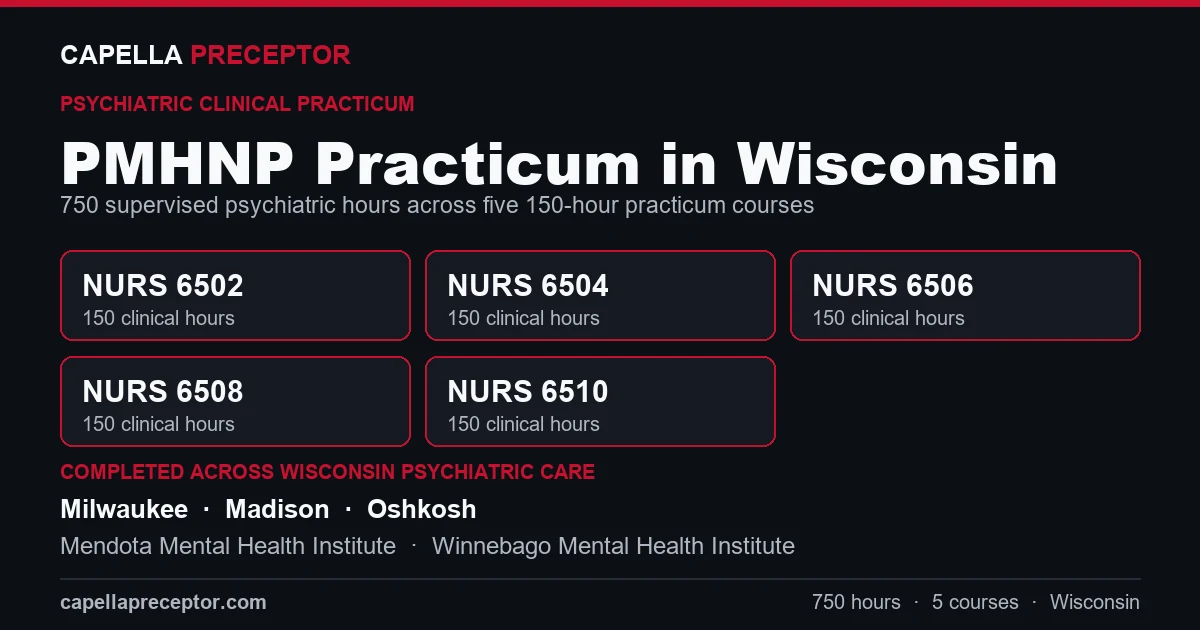
What a Capella PMHNP practicum requires in Wisconsin
The Capella MSN Psychiatric-Mental Health Nurse Practitioner specialization requires a minimum of 750 practicum hours, completed as 150 clinical hours in each of five practicum courses (NURS6502 Practicum I, NURS6504 Practicum II, NURS6506 Practicum III, NURS6508 Practicum IV, and NURS6510 Practicum V), all in psychiatric and behavioral-health settings under a qualified on-site preceptor (Capella, MSN-PMHNP courses). The coursework is online; the psychiatric practicum is completed in person, in your own community. For the full course-by-course breakdown and population focus, see our Capella PMHNP preceptor and hours page.
Wisconsin does not change that hour count, and it is worth saying plainly that this is a psychiatric rotation, not the primary-care path. If you are on the family nurse practitioner track, the requirements and settings are different, so read our Capella FNP preceptor in Wisconsin page instead. What Wisconsin does change is the regulatory frame your preceptor practices under: the practice-authority level, what controlled psychiatric medications a Wisconsin advanced practice nurse can prescribe, and how telepsychiatry hours fit. Those are the details below.
Does Wisconsin's practice authority affect a psychiatric practicum?
The American Association of Nurse Practitioners classifies Wisconsin as a reduced practice state (AANP, State Practice Environment). In practice that means an advanced practice nurse prescriber must keep a documented collaborative relationship with a physician or dentist rather than practicing entirely independently. That changes on September 1, 2026, when Wisconsin's APRN Modernization Act (2025 Wisconsin Act 17) takes effect and opens an independent practice pathway for qualifying APRNs after an experience threshold (Hall Render, APRN Modernization Act effective September 1).
For a student, the practical takeaway is narrow. You are training, not practicing independently, so the supervised model applies to your rotation regardless of which side of that date your hours fall on. The reason it matters at all is that a Wisconsin psychiatric preceptor who already works inside the state's collaborative framework knows exactly what your evaluations, hour logs, and prescribing observations need to reflect. A board-certified PMHNP or a psychiatrist who supervises in Wisconsin can model the collaborative-prescribing dynamic you will step into after you graduate here.
What psychiatric medications can a Wisconsin preceptor prescribe?
This is the part that genuinely separates a psychiatric rotation from a primary-care one in Wisconsin. Much of PMHNP training is medication management, and Wisconsin's Board of Nursing rule for advanced practice nurse prescribers (admin rule N 8) carries a specific limit on stimulants. The rule prohibits an advanced practice nurse prescriber from prescribing, dispensing, or administering a Schedule II amphetamine or sympathomimetic amine, with listed exceptions, the central one being treatment of hyperkinesis, which the board has clarified includes attention-deficit/hyperactivity disorder (Hall Render, Wisconsin Board of Nursing revises N 8).
For a psychiatric trainee, that exception is not academic. ADHD stimulant management (methylphenidate and amphetamine products) is a routine part of outpatient and child/adolescent psychiatry, and the ADHD carve-out is what makes that prescribing observable in a Wisconsin rotation. Other controlled psychiatric medications have their own rules:
Controlled-substance prescribing in Wisconsin runs through a separate federal DEA registration and the state's Enhanced Prescription Drug Monitoring Program (ePDMP), which prescribers are required to consult for monitored Schedule II to V drugs (Wisconsin Prescription Drug Monitoring Program). A preceptor who manages psychiatric controlled substances day to day will walk you through the ePDMP check and the N 8 stimulant boundary as part of your hours, which is exactly the prescribing judgment your certification exam tests.
Can Wisconsin PMHNP hours be done by telepsychiatry?
Partly, and it matters more here than in most specialties because Wisconsin's psychiatric care is spread thin across a wide rural map. Telehealth is broadly permitted under Wisconsin law as long as the provider is properly credentialed in the state and uses clinical judgment about whether the visit suits the patient; the Department of Safety and Professional Services frames it that way and does not single out psychiatry for a separate restriction (Wisconsin DSPS, Telehealth and Remote Supervision guidance). Capella, in turn, names telepsychiatry directly inside its Practicum III experience, so some of your supervised hours can be earned remotely.
The honest limit: the share of telehealth that counts toward your 750 hours depends on your specific course requirements, your preceptor's own practice, and your program's policy at the time. Confirm the current telepsychiatry allowance for each practicum against your course instructions before assuming the whole rotation can be remote. In a state where a student in the Northwoods or the Driftless region may be hours from the nearest psychiatric clinic, a verified telepsychiatry preceptor is often the difference between staying on schedule and losing a term.
Real psychiatric settings for hours in Wisconsin
PMHNP hours must be earned in behavioral and mental-health practice, not general primary care, supervised by an appropriately credentialed provider (a PMHNP-BC, a psychiatrist, or equivalent). In Wisconsin, the settings that typically qualify fall into a few real categories:
County human-services behavioral-health clinics and community mental-health centers in Milwaukee, Dane, Brown, and Waukesha counties, where outpatient psychiatric care and medication management are the daily work.
Wisconsin's two state hospitals, Mendota Mental Health Institute in Madison and Winnebago Mental Health Institute near Oshkosh, for inpatient psychiatric stabilization and assessment exposure.
Private and health-system psychiatry practices across the Milwaukee, Madison, and Fox Valley corridors, strong for adult assessment and psychopharmacology hours.
Addiction and dual-diagnosis programs and buprenorphine (MOUD) clinics, useful for the substance-use exposure built into the PMHNP sequence.
Pediatric behavioral-health practices, needed for the child/adolescent population in Practicum II, which one adult-only site rarely covers.
Statewide telepsychiatry practices that serve rural counties, where in-person psychiatric sites are scarce and a remote match keeps your calendar intact.
Because the lifespan requirement splits your hours between adult/older-adult and child/adolescent psychiatry, many Wisconsin students need more than one preceptor or site over the five-course sequence. Plan for that early rather than discovering it at Practicum II.
Why a Wisconsin psych preceptor is hard to find
Here is the honest part most students learn late. Capella does not assign you a preceptor or a psychiatric site; the university expects you to secure both, in your own community, and submit them for approval. Psychiatric preceptors are the scarcest kind of all. Wisconsin, like most states, has a documented behavioral-health workforce shortage, with large stretches of the state federally designated as mental-health professional shortage areas. The psychiatric prescribers who do practice are already carrying full panels, and a single PMHNP or psychiatrist can usually take only one student at a time.
That is why cold-calling clinics in Milwaukee or Madison while a 150-hour course clock runs is a slow, demoralizing way to find a qualified, willing psychiatric preceptor, and why a thinly populated county can leave a student with no in-person option at all. We work that shortage directly: we match a verified Wisconsin psychiatric preceptor who meets Capella's published requirements, in person where the density supports it and by telepsychiatry where it does not.
What has to clear before you log a Wisconsin psych hour
Identifying a psychiatric preceptor is only step one. Capella still reviews and approves the site and the preceptor, and there is paperwork to clear before any hour counts. All of it runs through CORE ELMS, Capella's practicum-management system.
- Submit the psychiatric site and preceptor in CORE ELMS for Capella's review and approval.
- Verify the credential. The supervising provider holds an active Wisconsin license and the scope to oversee psychiatric care (a PMHNP-BC, psychiatrist, or equivalent); confirm standing through the Wisconsin DSPS credential lookup.
- Get the affiliation agreement signed between Capella and the Wisconsin psychiatric site before practicum begins.
- Clear compliance (background check and health records through a vendor such as CastleBranch; confirm the current one with your program).
- Log hours in CORE ELMS, where your preceptor approves what you record, until each of the five courses reaches its 150-hour total.
An affiliation agreement can take weeks if a psychiatric clinic has never worked with Capella, so we line up the agreement and the compliance file in parallel rather than waiting for one before starting the other.
Wisconsin PMHNP FAQ
How many psychiatric practicum hours does Capella PMHNP require in Wisconsin?
A minimum of 750 supervised psychiatric clinical hours, completed as 150 hours in each of five practicum courses (NURS6502, NURS6504, NURS6506, NURS6508, NURS6510), under an on-site PMHNP preceptor at an approved Wisconsin site. The location does not change the hour count; what changes is the board rules your Wisconsin preceptor practices under.
Can a Wisconsin PMHNP preceptor prescribe stimulants and buprenorphine?
Under Wisconsin admin rule N 8, an advanced practice nurse prescriber generally may not prescribe a Schedule II amphetamine or sympathomimetic amine, but the rule carves out an exception for treating hyperkinesis, which the Board of Nursing has clarified includes ADHD. Buprenorphine for opioid use disorder is a Schedule III drug, so that Schedule II amphetamine restriction does not apply to it. Controlled-substance prescribing also requires a separate federal DEA registration and use of Wisconsin's ePDMP.
Can Wisconsin PMHNP practicum hours be done by telepsychiatry?
Telehealth is broadly permitted in Wisconsin, and Capella names telepsychiatry within Practicum III, so some hours may be earned remotely. How many telehealth hours count toward your 750 depends on your course requirements, your preceptor's practice, and your program's policy, so confirm the current allowance against your course instructions rather than assuming all hours can be remote.
Does Capella assign a PMHNP preceptor to Wisconsin students?
No. Capella requires you to secure your own psychiatric preceptor and site in your local community and submit them through CORE ELMS for Capella's review and approval. We match a verified Wisconsin PMHNP preceptor who meets Capella's published requirements within 7 days, with no payment until you are matched.
Where in Wisconsin can PMHNP students complete psychiatric hours?
Real psychiatric settings include county and community behavioral-health clinics, outpatient psychiatry and medication-management practices, inpatient units at the state institutes (Mendota in Madison and Winnebago near Oshkosh), substance-use and MOUD programs, and telepsychiatry groups serving rural counties. The site and supervising provider must clear Capella's review before any hour is logged.
Sources
- Capella University, MSN-PMHNP courses and practicum hours
- Hall Render, Wisconsin Board of Nursing revises N 8 (Schedule II amphetamine rule and the hyperkinesis/ADHD exception)
- Wisconsin Enhanced Prescription Drug Monitoring Program (ePDMP)
- Wisconsin DSPS, Telehealth and Remote Supervision guidance
- AANP, State Practice Environment (Wisconsin: reduced practice)
- Hall Render, Wisconsin APRN Modernization Act effective September 1, 2026
How Capella Preceptor helps Wisconsin PMHNP students
You now have the full picture: 750 psychiatric hours across five 150-hour courses, a reduced practice state with an independent APRN pathway arriving September 1, 2026, a Board of Nursing stimulant rule with an ADHD exception, and a real psychiatric preceptor shortage. That last piece is where months disappear. We secure a verified Wisconsin psychiatric preceptor who meets Capella's published requirements, prepare every CORE ELMS form and affiliation agreement for Capella's review, and keep your hours logged and submitted on schedule.
- Verified Wisconsin psychiatric preceptor matched in 7 days, in person or telepsychiatry
- Adult and child/adolescent rotations covered across all five practicum courses
- Every CORE ELMS form and affiliation agreement prepared for Capella's review; no payment until you are matched
Need the program details on their own? See the Capella PMHNP preceptor and hours page, or the broader Capella practicum placement in Wisconsin overview for board rules across every specialty.
Get a Capella PMHNP preceptor in Wisconsin
Free 15-minute consult. No payment until matched. We map your entire psychiatric practicum plan.
Get my free consult →