Home / Virtual Preceptorship for Capella, Is It Allowed?
GuideVirtual Preceptorship for Capella, Is It Allowed?
Partly. Precepted, hands-on telehealth hours count toward your Capella practicum exactly like in-person ones, but NP tracks still require some face-to-face clinical work, so a fully virtual practicum is not allowed.
Last updated: June 20, 2026 · Reviewed by the Capella Preceptor placement team
The short answer: yes, with limits
Telehealth is a recognized way to deliver patient care, and the hours you earn through it count toward your Capella practicum the same as in-person hours, as long as the visit is precepted and you are actually delivering care. The national organization that sets nurse practitioner education standards, NONPF, states it plainly: "As long as telehealth is being used to provide patient care from a clinical site, the hours should be no different than those accrued through an in-person encounter" (NONPF, Telehealth in NP Education).
The limit sits in the same paragraph. NONPF adds that "there must be a mix of in-person and telehealth encounters," and that telehealth visits "must be precepted visits and should allow for participation and delivery of care by the student, rather than observational visits." So for nurse practitioner tracks, a fully virtual practicum is not allowed. You can lean heavily on telehealth in the right specialty, but you cannot replace face-to-face clinical work entirely.
What counts as a virtual practicum hour
"Virtual" in a practicum context means synchronous telehealth: you and the patient interact live by video while your preceptor oversees the encounter. NONPF describes telehealth as care delivered at a distance, including direct patient care, remote monitoring, and education (NONPF, Telehealth in NP Education). For a telehealth encounter to count toward your hours, three things have to be true.
- It is precepted. A qualified preceptor supervises the visit, the same way they would for an in-person patient.
- You deliver care. You take the history, reason through the case, and participate in the plan. Watching someone else work does not count.
- It originates from a clinical site. The hours are tied to real patient care provided through an approved practicum site, not informal calls.
What does not count is just as important. Observation-only telehealth, where you sit in but do not deliver care, is excluded. So is simulation. The 2022 National Task Force standards that NP programs follow are explicit that "simulation is not direct patient care, and these hours may not be included in the 750 direct patient care total" (2022 NTF Standards for NP Education). Practicing on a standardized patient builds skill, but it does not earn practicum hours.
How much of your practicum can be virtual
There is no single national percentage that caps telehealth hours, and the share that is reasonable depends on your specialty and your preceptor's actual patient mix. The fixed rule is the requirement for a mix of both modalities. The practical guide is what kind of care your track involves.
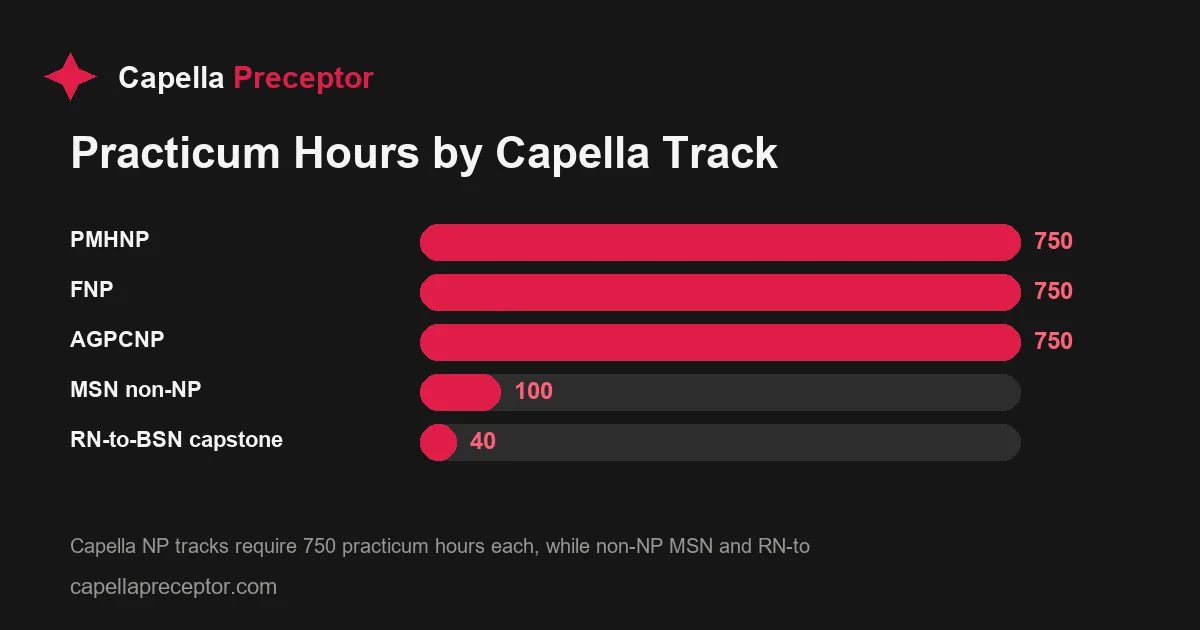
Hour totals are from Capella's official course pages (FNP, PMHNP, RN-to-BSN). The "telehealth fit" column is judgment based on the kind of care each track involves, not a Capella-published quota. Confirm the exact in-person minimum for your course with your program faculty before you build a plan around a high telehealth share.
Why PMHNP is the most telehealth-friendly track
Psychiatric mental health practice leans on history, mental status assessment, medication management, and ongoing follow-up, all of which work well over secure video. That is why telepsychiatry grew faster than most other specialties and why a PMHNP student can often build a large block of practicum hours through telehealth. The PMHNP track at Capella requires a minimum of 750 practicum hours across five practicum courses, with 150 clinical hours in a psychiatric setting per course (Capella, PMHNP courses).
Even here, the mix rule holds. Some patient populations and some clinical situations need an in-person encounter, and your program will still expect face-to-face experience as part of the total. Treat telehealth as the part you can do remotely, not as a way to skip the clinic entirely.
Primary care tracks: telehealth plus hands-on exams
FNP and AGPCNP students see the same pattern with a different balance. Telehealth handles a real slice of primary care: medication refills, chronic disease check-ins, results review, and triage. What it cannot fully replace is the physical exam. Listening to lungs, palpating an abdomen, or doing a well-child or geriatric exam needs you in the room. Capella delivers the MSN-NP program online with practicum completed in the student's local community (Capella, MSN-NP program), which is exactly where your in-person hours come from. Remote monitoring tools, such as connected stethoscopes and otoscopes, extend what telehealth can do, but they supplement in-person exams rather than remove the need for them.
How virtual hours are documented
Telehealth hours are logged exactly like in-person hours. There is no separate virtual log. Capella manages practicum documentation in CORE ELMS, the online system of record where you propose your site and preceptor, submit requirements, and track hours (Capella, CORE ELMS). For each encounter you record the date, the hours, and the patient-care activities, and your preceptor approves the entry. Approved hours roll up into your hours record and appear on your Campus portal.
- Log every telehealth encounter in CORE ELMS with the date, hours, and what you did.
- Note the modality so your in-person and telehealth split is clear if faculty ask.
- Have your preceptor approve entries promptly so the log stays current.
- Complete all practicum paperwork and final approval before you are cleared, since the capstone gate requires it (Capella, RN-to-BSN courses).
What you still need for a virtual preceptorship
A virtual practicum does not remove any of the structure of a regular one. You still need every piece that a fully in-person placement needs, plus a preceptor whose practice actually uses telehealth.
- A qualified preceptor. Capella does not assign preceptors. "Learners are responsible for finding an appropriate preceptor to oversee the practicum experience" (Capella, DNP courses). For telehealth, the preceptor needs a practice that delivers virtual care.
- An approved clinical site. The telehealth encounters must originate from a real practicum site, and a signed affiliation agreement between Capella and that site is part of the clearance workflow.
- A HIPAA-compliant platform. Telehealth visits run on secure, HIPAA-compliant video so patient information stays protected during the encounter.
- Background and compliance clearance. The same background check, immunization, and compliance requirements apply through a third-party vendor before you start.
- A plan for in-person hours. Because the mix is required, line up where your face-to-face hours will come from before you commit to a telehealth-heavy schedule.
Common misconceptions
- "I can do 100% of my NP hours online." Not for NP tracks. The required mix of in-person and telehealth rules this out.
- "Watching telehealth visits counts." No. Observation-only sessions are excluded; you have to deliver care.
- "Simulation fills the gap." No. Simulation is not direct patient care and cannot count toward the direct-hour total.
- "Telehealth hours are worth less." No. When the visit is precepted and hands-on, the hour counts the same as an in-person hour.
FAQ
Can I do my entire Capella practicum virtually?
Not for nurse practitioner tracks. The national NP education standard requires a mix of in-person and telehealth encounters, so a fully virtual NP practicum is not permitted. Telehealth hours count the same as in-person hours when they are precepted and hands-on, but some face-to-face work is still required. The share you can use depends on your specialty, your preceptor's caseload, and your program's policy.
Do telehealth hours count toward my Capella clinical hours?
Yes, when they are precepted, hands-on patient care from a clinical site. NONPF states that as long as telehealth is used to provide patient care from a clinical site, the hours should be no different from an in-person encounter. The visit must be a precepted visit where you participate in and deliver care, not an observation-only session.
Does simulation or shadowing count as virtual practicum hours?
No. Under the 2022 NTF standards, simulation is not direct patient care and may not be counted toward the 750 direct-hour total for NP tracks. Observation-only telehealth visits also do not count; the hours must involve you delivering care under your preceptor.
Which Capella specialties are most telehealth-friendly?
Psychiatric-mental health (PMHNP) work translates to telehealth more readily than most tracks because much psychiatric assessment and follow-up is conversation-based. Primary care tracks such as FNP and AGPCNP also use telehealth, but they involve more physical examination, so they typically require a larger share of in-person hours.
How are virtual practicum hours documented at Capella?
The same way as in-person hours. You log each encounter in CORE ELMS with the date, hours, and patient-care activities, and your preceptor approves the entries. There is no separate telehealth log; the hours go in the same record and appear on your Campus portal.
Sources
- NONPF, Telehealth in Nurse Practitioner Education (Telehealth Resources and 2018 statement)
- Capella University, MSN Nurse Practitioner program
- Capella University, PMHNP courses
- Capella University, FNP courses
- Capella University, RN-to-BSN courses
- Capella University, CORE ELMS practicum management
How Capella Preceptor helps
Knowing the rules is the easy part. The hard part is finding a preceptor whose telehealth practice fits your specialty, getting the site agreement signed, and lining up the in-person hours the mix requires. That is what we handle, a verified Capella-compliant preceptor, the correct CORE ELMS documentation, and your hours logged and submitted properly.
- Verified preceptor matched in 7 days
- Every CORE ELMS form prepared and filed
- Hours logged live and submitted for you
Related guides
Want this handled for you?
Free 15-minute consult. No payment until matched. We map your entire practicum plan.
Get my free consult →