Capella PMHNP Preceptor in North Carolina
A Capella PMHNP practicum in North Carolina requires 750 supervised psychiatric clinical hours across five 150-hour practicum courses, completed under an on-site psychiatric-mental-health preceptor. North Carolina is a restricted-practice state with one of the country's deepest psychiatric workforce shortages, which is exactly why the psychiatric preceptor is the hardest part to secure here. This page explains the PMHNP requirements, the North Carolina psychiatric board rules that shape your clinical setting, and how we find that preceptor for you.
Last updated 2026-06-28 · Reviewed by the Capella Preceptor placement team
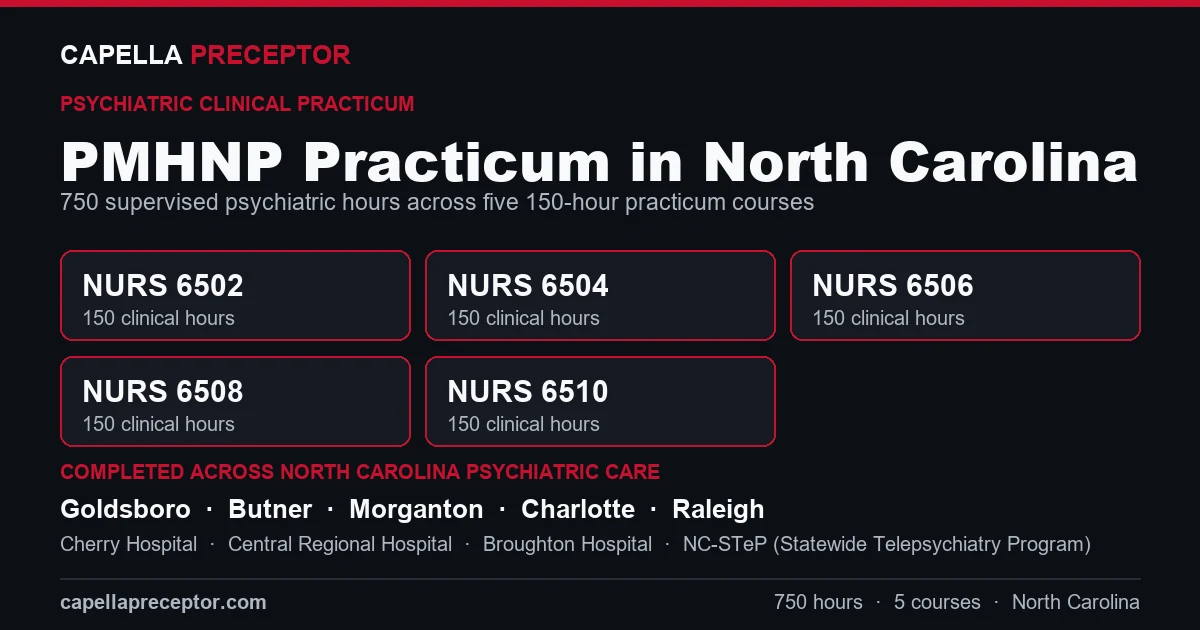
What does a Capella PMHNP practicum require in North Carolina?
The requirement itself is national, not North Carolina specific: the Capella MSN Psychiatric Mental Health Nurse Practitioner specialization needs a minimum of 750 practicum hours, completed as 150 clinical hours in each of five practicum courses, NURS6502, NURS6504, NURS6506, NURS6508, and NURS6510 (Practicum I through V), all in psychiatric and behavioral-health settings under a qualified preceptor (Capella, MSN-PMHNP courses). That five-course, 150-hour structure is specific to PMHNP and differs from the primary-care FNP track, which spreads the same 750 hours differently. For the full course-by-course breakdown, see our Capella PMHNP preceptor and hours page.
What North Carolina changes is the clinical environment those hours sit in. North Carolina is a restricted-practice state, the most regulated tier in the American Association of Nurse Practitioners framework (AANP, State Practice Environment). A practicing North Carolina NP cannot work independently; the psychiatric clinics you rotate through are run by providers who operate under physician collaboration. Your own license is not the gating factor as a student, but your preceptor's practice setting is, and in North Carolina that setting is supervised, team-based psychiatric care. For the general state rules across every specialty, see our North Carolina practicum and preceptors page.
The North Carolina PMHNP equation in one line. 750 psychiatric hours, five 150-hour practicum courses, an on-site PMHNP or psychiatrist preceptor, a restricted-practice state, and 94 of 100 counties short of mental-health providers. The hours are fixed; the preceptor is the bottleneck.
How does North Carolina regulate a psychiatric NP and the preceptor relationship?
Nurse practitioners in North Carolina, including PMHNPs, are regulated jointly by the North Carolina Board of Nursing (NCBON) and the North Carolina Medical Board (NCMB) through a Nurse Practitioner Joint Subcommittee (NCBON, NP scope of practice). A practicing NP must hold an Approval to Practice and maintain a written collaborative practice agreement with a primary supervising physician before performing medical acts or prescribing.
North Carolina also imposes a distinctive quality-assurance cadence that describes the supervised culture your preceptor works inside. State rule requires the NP and the primary supervising physician to hold monthly meetings during the first six months of a collaborative practice agreement, then at least every six months after, to review clinical issues and quality measures, with signed documentation retained for five years (NCMB, 21 NCAC 32M, Approval of Nurse Practitioners). You do not file any of this as a student, but it is why a North Carolina psychiatric preceptor is comfortable with structured oversight and documentation, the same habits Capella's practicum review expects.
License verification is free and public. The NCBON publishes real-time online verification for registered nurses and advanced practice nurses, and it is the primary source for confirming a North Carolina nursing credential (NCBON, Verify a NC License). When we match you, this is one of the checks we run on a preceptor's RN and NP credentials before any CORE ELMS paperwork moves.
What can a North Carolina PMHNP preceptor prescribe, and why does it matter for your hours?
Psychiatric practice is heavily a prescribing specialty, so the controlled-substance rules in North Carolina directly shape what you will see during your 750 hours. A North Carolina NP may prescribe legend drugs and controlled substances in Schedules II through V consistent with their education and certification, but only when those drugs are authorized in the collaborative practice agreement and the NP holds an individual DEA registration (NCBON, NP scope of practice). For Schedules II and III, North Carolina limits a prescription to a 30-day supply with no refills (NCBON, NP FAQ).
For a PMHNP rotation, that framework covers the day-to-day work: Schedule II stimulants for ADHD, Schedule IV benzodiazepines, mood stabilizers, antipsychotics, and antidepressants. Substance-use treatment adds a wrinkle. To treat opioid use disorder with medication, a North Carolina NP generally works under a collaborative practice agreement with a physician who has substance-use-disorder experience (NC Medicaid, CPAs for SUD treatment). If you want medication-assisted treatment hours, we look for a preceptor whose practice actually offers them, because not every psychiatric site does.
Can North Carolina PMHNP hours be done by telepsychiatry?
Some can, and North Carolina is a national leader in psychiatric telehealth. The state runs the North Carolina Statewide Telepsychiatry Program (NC-STeP), based at East Carolina University, which has connected more than 50 hospital emergency departments and health departments and delivered over 60,000 telepsychiatry consults (NC-STeP, ECU; NCDHHS, Statewide Telepsychiatry Program). Capella names telepsychiatry directly within the Practicum III experience, so supervised video-based psychiatric care can count.
What it does not mean is that the whole practicum is remote. How many telehealth hours count toward your 750 depends on your specific course instructions, your preceptor's practice, and the supervision standard for that course. Confirm the current telehealth allowance for each practicum against your course requirements before assuming hours can be earned entirely online. For more on this, our PMHNP page walks through the telehealth detail across all five practicum courses.
Which real psychiatric settings count in North Carolina?
PMHNP hours must be earned in behavioral and mental-health practice, not general primary care, and supervised by an appropriately credentialed provider (a PMHNP-BC, psychiatrist, or equivalent). North Carolina has a real and varied psychiatric landscape, even if access to it is uneven:
Your site and preceptor are proposed and approved before you can log a single hour, so both the setting and the supervising credential have to clear Capella's review first. We confirm the setting matches the course population, especially for the child and adolescent rotation, before we submit anything.
Why is finding a PMHNP preceptor in North Carolina so hard?
This is the honest part, and North Carolina is genuinely one of the harder states for psychiatric placement. The numbers are stark: 94 of North Carolina's 100 counties are designated mental health professional shortage areas, and roughly two in five North Carolinians live in one (NC Institute of Medicine, behavioral health access brief). Twenty-two counties have no practicing psychiatrist at all, and rural counties average roughly 0.58 psychiatrists per 10,000 people against 1.79 in metro areas. For the lifespan side of PMHNP, it is worse: more than 68 counties have no child or adolescent psychiatrist.
Now layer on the practicum reality. Capella leaves the preceptor search entirely to the student. The university expects each learner to secure their own qualified preceptor locally and route that placement through Capella for review; it offers support resources but does not assign the psychiatric site or the supervising provider for any of the 750 hours. Psychiatric preceptors have also pulled back from teaching since the pandemic, citing workload and burnout. So a North Carolina PMHNP student is hunting for a scarce, prescribing psychiatric provider, in a state that is short of them, while also needing a separate child and adolescent option, all on a practicum deadline. That combination is where students lose terms.
Why the child and adolescent hours are the trap. The PMHNP sequence is a lifespan specialty, so you need adult and older-adult hours and a separate child and adolescent rotation. With most North Carolina counties lacking a child and adolescent psychiatrist, one practice rarely covers both ends well. Plan two sources early, not one.
How does practicum clearance work for a North Carolina psychiatric site?
Once you have a psychiatric preceptor and a site, there is a clearance sequence before you can log a single hour. Capella manages practicum applications, site and preceptor approval, hour logging, and evaluations through CORE ELMS, its online practicum-management system (Capella, CORE ELMS).
- Submit the North Carolina psychiatric site and preceptor in CORE ELMS for Capella's review. We confirm the preceptor meets Capella's published requirements before you submit.
- Get the affiliation agreement signed between Capella and your North Carolina psychiatric site before practicum begins.
- Clear the background check through Capella's compliance vendor, CastleBranch, which the PMHNP program requires by the end of your first billing session or quarter.
- Log and submit hours in CORE ELMS for each of the five 150-hour courses, with your preceptor approving what you record.
We prepare these forms, chase the signatures, and keep the timeline moving so a slow affiliation agreement does not push your psychiatric start date into the next quarter. To be clear about what we do and do not promise: we match a preceptor who meets Capella's published requirements and submit the placement for Capella's review. Capella reviews and approves the placement. We never guarantee that a placement will be approved, and no preceptor or site is Capella-endorsed or Capella-affiliated.
In-person or virtual psychiatric practicum across North Carolina
Best near the Charlotte metro, the Research Triangle (Raleigh, Durham, Cary, Chapel Hill), the Triad (Greensboro, Winston-Salem), and Wilmington, where outpatient psychiatry and behavioral-health sites cluster. You train on site with a North Carolina-licensed psychiatric preceptor and build local references for after graduation.
Built for students in rural, eastern, or western North Carolina counties with no local psychiatric provider, the exact counties the shortage data flags. You complete supervised telepsychiatry hours with a verified preceptor, tracked the same way in CORE ELMS.
Either way the preceptor's psychiatric credential is verified and the documentation is identical, so your hours count toward the same Capella PMHNP requirements.
North Carolina PMHNP FAQ
How many psychiatric hours does a Capella PMHNP practicum need in North Carolina?
A minimum of 750 supervised psychiatric clinical hours, completed as 150 clinical hours in each of the five practicum courses (NURS6502, NURS6504, NURS6506, NURS6508, NURS6510 / Practicum I through V), under an on-site psychiatric-mental-health preceptor at an approved North Carolina site. The hours are the same nationwide; North Carolina shapes the settings and supervision you train under, not the hour count.
Can North Carolina PMHNP practicum hours be done by telepsychiatry?
Some can. Psychiatry is one of the more telehealth-friendly specialties, and North Carolina runs a large statewide telepsychiatry program (NC-STeP). Capella names telepsychiatry within Practicum III. How many telehealth hours count toward your 750 depends on your specific course instructions and your preceptor's practice, so confirm the current allowance for each practicum rather than assuming all hours can be remote.
Does North Carolina's restricted practice status affect my Capella psychiatric preceptor?
It shapes the setting. North Carolina is a restricted-practice state, so a practicing NP holds an Approval to Practice issued jointly by the North Carolina Board of Nursing and the North Carolina Medical Board and works under a collaborative practice agreement with a supervising physician. Your psychiatric preceptor is a licensed PMHNP or psychiatrist working in that framework. Your practicum approval runs through Capella in CORE ELMS, not through the state Approval to Practice process, which applies once you are licensed and employed.
Why is it so hard to find a PMHNP preceptor in North Carolina?
North Carolina has an acute psychiatric workforce shortage: 94 of its 100 counties are designated mental health professional shortage areas, 22 counties have no practicing psychiatrist, and more than 68 counties have no child or adolescent psychiatrist. With few prescribing psychiatric providers and many NP students competing for them, the supply of available PMHNP preceptors is thin, especially for the child and adolescent hours the practicum sequence requires.
Do you place PMHNP students in rural North Carolina?
Yes. Where a rural county has no available psychiatric preceptor, our virtual telepsychiatry option keeps you on schedule with hours tracked in CORE ELMS, the same way an in-person placement is documented. We cover the Charlotte metro, the Research Triangle, the Triad, the coast, and the eastern and western counties where local psychiatric preceptors are scarce.
Sources
- Capella University, MSN-PMHNP courses (750 hours across five 150-hour practicum courses)
- North Carolina Board of Nursing, NP scope of practice and prescribing
- North Carolina Board of Nursing, NP FAQ (Schedule II and III 30-day, no-refill limit)
- North Carolina Medical Board, 21 NCAC 32M (Approval of Nurse Practitioners, QA meeting cadence)
- NC Medicaid, collaborative practice agreements for substance-use treatment
- NC Institute of Medicine, behavioral health access brief (94 of 100 counties are shortage areas)
- North Carolina Statewide Telepsychiatry Program (NC-STeP), East Carolina University
- AANP, State Practice Environment (North Carolina, restricted)
How Capella Preceptor helps PMHNP students in North Carolina
You now know the landscape: 750 psychiatric hours across five practicum courses, a restricted-practice state, joint board oversight, controlled-substance rules that shape the work, and a psychiatric provider shortage across nearly the entire state. That shortage is where North Carolina PMHNP students lose the most time. We find a preceptor who meets Capella's published psychiatric requirements, prepare every CORE ELMS form and affiliation agreement, and keep your hours logged and submitted, then your placement goes to Capella for review.
- Verified North Carolina psychiatric preceptor matched in 7 days, in person or by telepsychiatry
- Adult and child/adolescent rotations covered across all five practicums
- No payment until you are matched, with your exact quote at the free consult
On the family nurse practitioner track instead? See Capella FNP preceptor requirements in North Carolina for the primary-care practicum hours and clinical settings, or read the PMHNP hours and courses page and the North Carolina state page.
Get a Capella PMHNP preceptor in North Carolina
Free 15-minute consult. No payment until matched. We map your entire psychiatric practicum plan.
Get my free consult →