Capella PMHNP Preceptor in Oklahoma
A Capella PMHNP practicum in Oklahoma requires 750 supervised psychiatric clinical hours across five 150-hour practicum courses, completed in person under an on-site psychiatric-mental-health preceptor. Oklahoma is a restricted-practice state, and its psychiatric NPs prescribe only Schedule III to V medications, so a few things about lining up a psych site here work differently than in primary care. Here is exactly how the hours, the Oklahoma board rules, controlled-substance limits, and the psych preceptor shortage fit together, and how we secure your placement.
Last updated 2026-06-28 · Reviewed by the Capella Preceptor placement team
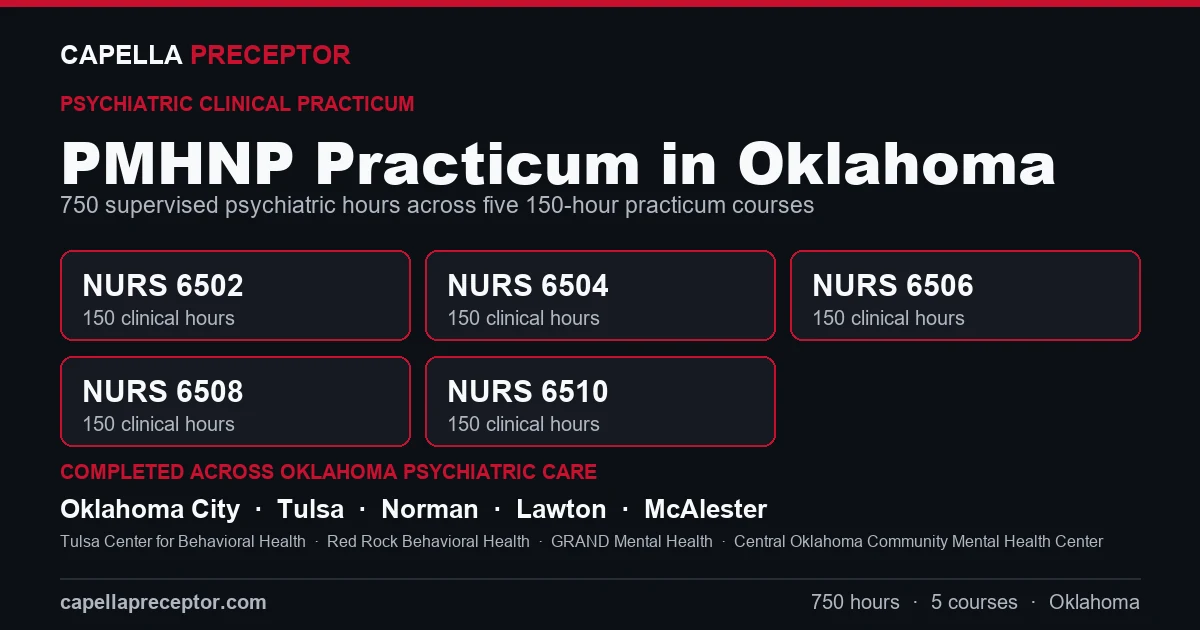
How many psychiatric practicum hours does a Capella PMHNP need in Oklahoma?
The Capella MSN Psychiatric-Mental Health Nurse Practitioner specialization requires a minimum of 750 practicum hours, and that figure is the same whether you train in Oklahoma or anywhere else (Capella, MSN-PMHNP courses). What is specific to Oklahoma is where and under whom those hours are earned. The hours are split into five practicum courses of 150 hours each, completed in person at an Oklahoma psychiatric or behavioral-health site under an on-site preceptor who is a board-certified PMHNP or a psychiatrist. The coursework is online; the supervised psychiatric hours are not.
This is a different requirement than the Capella FNP track that many Oklahoma students compare it to. The FNP totals 750 hours across six courses of 125 hours in primary care; the PMHNP totals 750 across five courses of 150 hours, all in psychiatric settings, and it carries a lifespan requirement that spreads your hours across adult, older-adult, child, and adolescent psychiatry. For the full course-by-course breakdown see our Capella PMHNP practicum and hours page; for the Oklahoma board and placement picture across every program, see our Capella preceptors in Oklahoma page.
Because one Oklahoma practice rarely covers both ends of the lifespan, most students need a child and adolescent option in addition to an adult panel. That is a real planning constraint in a state where psychiatric prescribers are scarce, and it is the first thing we map.
What can an Oklahoma psychiatric preceptor actually prescribe?
This is the question that catches PMHNP students by surprise in Oklahoma, and it matters because so much of psychiatry is medication management. Oklahoma APRNs with prescriptive authority may prescribe only Schedule III to V controlled substances and are prohibited from prescribing Schedule II (ThriveAP, Oklahoma NP scope). Schedule II is where most psychiatric stimulants sit, so an Oklahoma psychiatric NP cannot independently write Adderall, Vyvanse, or methylphenidate for ADHD. Schedule III to V controlled prescriptions are also limited to a 30-day supply without refills, and the NP must hold a federal DEA registration and an Oklahoma Bureau of Narcotics and Dangerous Drugs (OBNDD) registration first (OBNDD, registration).
House Bill 2298, effective November 1, 2025, created a route to independent prescriptive authority, but it explicitly did not expand the formulary: the Oklahoma Board of Nursing confirms approved APRNs still cannot prescribe Schedule II controlled substances (Oklahoma Board of Nursing, HB 2298 FAQ). For your practicum, the practical effect is concrete: a strong Oklahoma psych preceptor manages antidepressants, antipsychotics, mood stabilizers, and Schedule III to V agents directly, while Schedule II ADHD stimulants are typically handled by a collaborating physician at the same site. Knowing that up front means you are not surprised when the prescribing you observe stops at the formulary line.
Why this shapes your site, not just your hours. A buprenorphine or MOUD program is a viable Oklahoma psych site because buprenorphine is Schedule III and within an APRN's formulary. A stimulant-heavy pediatric ADHD clinic, by contrast, leans on Schedule II prescribing the NP cannot do alone. We screen for the prescribing mix that matches the psychiatric experience your practicum courses expect.
How does Oklahoma's restricted practice authority affect a psych placement?
The American Association of Nurse Practitioners places Oklahoma in its restricted category, the most limited of three tiers (AANP, Oklahoma). A psychiatric NP here keeps a written supervising-physician agreement on file with the Oklahoma Board of Nursing for prescriptive authority, unless they have been granted independent prescriptive authority under HB 2298, which requires a minimum of 6,240 supervised clinical practice hours with prescriptive authority first (Oklahoma Board of Nursing, HB 2298 FAQ). Either way, most psych preceptors you will train under in Oklahoma practice in a physician-collaborative model.
For placement this adds a step. In a restricted state, a behavioral-health practice sometimes routes a student request through both the psychiatric NP and the supervising physician before agreeing, and the affiliation agreement may need the medical group's sign-off as well. That is a common reason Oklahoma PMHNP students stall when they cold-call sites on their own. We target practices that already precept and start the paperwork clock early so it does not become your bottleneck.
Where are the real psychiatric clinical settings in Oklahoma?
Oklahoma's public behavioral-health system is unusual and worth knowing as a student, because it concentrates psychiatric prescribers in identifiable places. Oklahoma was the first state to replace all of its community mental health centers with Certified Community Behavioral Health Clinics (CCBHCs), and today 13 CCBHCs serve all 77 counties, the original demonstration sites being NorthCare, GRAND Mental Health, and Red Rock Behavioral Health (Healthy Minds Policy Initiative, CCBHC model in Oklahoma). These clinics, overseen by the Oklahoma Department of Mental Health and Substance Abuse Services (ODMHSAS), are where a large share of the state's outpatient psychiatric care happens, which makes them a logical hunting ground for a PMHNP preceptor.
Inpatient and acute settings exist too. The Tulsa Center for Behavioral Health is a 56-bed acute-care psychiatric hospital operated by ODMHSAS for patients in crisis, and the state runs additional facilities such as the Central Oklahoma Community Mental Health Center in Norman, Carl Albert in McAlester, and the Jim Taliaferro center in Lawton (ODMHSAS, facilities). Add private outpatient psychiatry, telepsychiatry groups, and addiction and medication-assisted-treatment programs, and the menu of approvable PMHNP settings is real, but uneven across the map.
CCBHC outpatient psychiatry, the Central Oklahoma CMHC, and private behavioral-health practices.
Tulsa Center for Behavioral Health, CCBHC clinics, and telepsychiatry groups.
Lawton, McAlester, Woodward, Enid, and the rural CCBHC catchments serving all 77 counties.
Can Oklahoma PMHNP hours be done by telepsychiatry?
Some of them can, and psychiatry is one of the more telehealth-suited specialties because intake interviews, medication management, and psychotherapy are routinely delivered by video. Capella names telepsychiatry directly within its Practicum III experience (Capella, MSN-PMHNP courses). Oklahoma also allows controlled-substance prescribing by telehealth in narrow cases, including Schedule III to V agents approved for medication-assisted treatment such as buprenorphine for opioid use disorder, and federal DEA telemedicine flexibilities for controlled substances have been extended through December 31, 2026 (Telehealth.HHS.gov, prescribing controlled substances via telehealth).
That does not make the whole practicum remote. The amount of telehealth that counts toward your 750 hours depends on your specific course requirements, your preceptor's practice, and the supervised-training rules, so confirm the current allowance for each practicum against your course instructions before assuming hours can be done entirely online. For rural Oklahoma, where a county may have no in-person psychiatric prescriber for an hour's drive, a telepsychiatry-capable preceptor is often the difference between staying on schedule and losing a term.
Best inside the Oklahoma City or Tulsa metros, where CCBHC clinics, state facilities, and private psychiatry sit close together. You build hands-on psychiatric hours with a local preceptor.
Best for the Panhandle, southeastern counties, and rural catchments where a qualified psych site is far away. Telehealth-based hours that still meet Capella site approval and your course's telehealth allowance.
Why is a PMHNP preceptor so hard to find in Oklahoma?
It is honest to say the psychiatric preceptor shortage is acute, and more so than for primary care. The reasons stack: Oklahoma carries a long-standing behavioral-health workforce gap, psychiatric prescribers are concentrated in CCBHCs and a few metros, the restricted-practice model means a yes can depend on a supervising physician as well as the NP, and the lifespan requirement forces you to find both adult and child and adolescent supervision. A single Oklahoma student cold-calling outpatient psychiatry practices can spend a term collecting declines before securing one site, let alone two.
None of that is a reason to panic, but it is a reason to start early and to be deliberate. The students who clear it line up a site well before the practicum quarter opens, confirm a separate option for the child and adolescent rotation, verify the preceptor's psychiatric credential and prescribing scope, and front-load compliance. That sequence is exactly what we run on your behalf.
- Propose your Oklahoma psychiatric site and preceptor in Capella's practicum system, tracked in our workflow as CORE ELMS, for the university's review and approval.
- Execute the affiliation agreement between Capella and the behavioral-health site, which in a restricted state can route through the medical group as well as the NP.
- Clear compliance through a background-check and health-records vendor such as CastleBranch before you are cleared to start.
- Log and submit hours in CORE ELMS, where your Oklahoma psychiatric preceptor approves what you record toward each 150-hour course.
To be clear about what approval means: Capella reviews and approves the site and preceptor you propose. We match a preceptor who meets Capella's published requirements and submit the placement for the university's review. We do not promise placement, and a preceptor or site only carries Capella's clearance once the university has reviewed and approved that specific placement.
How do I verify an Oklahoma psychiatric preceptor's license?
A compliant PMHNP preceptor in Oklahoma holds an active APRN license with the Oklahoma Board of Nursing, prescriptive authority, and, for controlled substances, both a DEA registration and an OBNDD registration. Two of these are publicly checkable. You can verify an Oklahoma APRN or RN license through Nursys, and the board also publishes a written verification request form; OBNDD registrations can be confirmed through the bureau directly (Nursys license verification; Oklahoma Board of Nursing, Forms; OBNDD, verify a registration). We confirm every preceptor's psychiatric credential and prescribing scope before you start.
FAQ
How many practicum hours does a Capella PMHNP need in Oklahoma?
A minimum of 750 supervised psychiatric practicum hours, completed as 150 clinical hours in each of five practicum courses (NURS6502, NURS6504, NURS6506, NURS6508, NURS6510). The hours are earned in person at an Oklahoma psychiatric site under an on-site PMHNP or psychiatrist preceptor; the number does not change because you train in Oklahoma.
Can my Oklahoma psychiatric preceptor prescribe Schedule II stimulants?
Not in Oklahoma. Oklahoma APRNs with prescriptive authority may prescribe only Schedule III to V controlled substances and are prohibited from prescribing Schedule II, which includes stimulants such as Adderall and Vyvanse for ADHD. HB 2298, effective November 1, 2025, did not change this. Plan to see Schedule II ADHD prescribing managed by a physician at the same site.
Is Oklahoma a restricted-practice state for a PMHNP preceptor?
Yes. The AANP classifies Oklahoma as a restricted-practice state. A psychiatric NP keeps a supervising-physician agreement on file with the Oklahoma Board of Nursing unless granted independent prescriptive authority under HB 2298, which requires a minimum of 6,240 supervised clinical practice hours with prescriptive authority.
Can Capella PMHNP hours in Oklahoma be done by telepsychiatry?
Some can. Psychiatric care is among the most telehealth-suited specialties and Capella names telepsychiatry within Practicum III, but the share of telehealth that counts depends on your course requirements and your preceptor's practice. Confirm the current allowance against your course instructions rather than assuming all 750 hours can be remote.
Where in Oklahoma do PMHNP students find psychiatric sites?
Oklahoma replaced its community mental health centers with 13 Certified Community Behavioral Health Clinics serving all 77 counties, alongside state psychiatric hospitals such as the Tulsa Center for Behavioral Health, telepsychiatry groups, and addiction and MOUD programs. We match a verified psychiatric preceptor whose setting fits your practicum population.
Sources
- Capella University, MSN-PMHNP courses (750 hours, five 150-hour practicums)
- Oklahoma Board of Nursing, HB 2298 Independent Prescriptive Authority FAQ (6,240 hours; Schedule II still excluded)
- AANP, Oklahoma state practice environment (restricted)
- ThriveAP, Oklahoma NP scope of practice (Schedule III to V only; 30-day limit)
- Oklahoma Bureau of Narcotics and Dangerous Drugs, registration
- Healthy Minds Policy Initiative, CCBHC model in Oklahoma (13 CCBHCs, 77 counties)
- ODMHSAS, state behavioral-health facilities (incl. Tulsa Center for Behavioral Health)
- Telehealth.HHS.gov, prescribing controlled substances via telehealth
- Nursys, nurse license verification
How Capella Preceptor helps with PMHNP placement in Oklahoma
You now know the terrain: 750 psychiatric hours across five practicums, a restricted-practice state, a Schedule II prescribing limit that shapes which sites fit, real settings concentrated in CCBHCs and a few metros, and a placement Capella leaves to you. We close that gap. We secure a verified Oklahoma psychiatric preceptor who meets Capella's published requirements and whose setting and prescribing scope fit your practicum, prepare every CORE ELMS form and the affiliation agreement, and submit the placement for Capella's review, then keep your hours logged on schedule.
- Verified Oklahoma psychiatric preceptor, in person or telepsychiatry
- Adult and child/adolescent rotations both covered
- Every CORE ELMS form handled, no payment until you are matched
On the family nurse practitioner track instead? See Capella FNP preceptor requirements in Oklahoma for primary-care practicum hours, Oklahoma board rules, and local clinical settings.
Get a Capella PMHNP preceptor in Oklahoma
Free 15-minute consult. No payment until matched. We map your entire Oklahoma psychiatric practicum plan.
Get my free consult →