Home / MSN-PMHNP / PMHNP Preceptor in Pennsylvania
PMHNP · PennsylvaniaCapella PMHNP Preceptor in Pennsylvania
A Capella PMHNP practicum in Pennsylvania requires 750 supervised psychiatric clinical hours across five 150-hour practicum courses, completed under an on-site psychiatric-mental-health preceptor, and you are the one who has to secure that preceptor. Pennsylvania is a reduced practice state where nurse practitioners hold the CRNP title and prescribe psychiatric medications under a collaborative agreement with a physician. This page explains how the psychiatric requirements and the Pennsylvania board rules fit together, then how we close the placement.
Last updated 2026-06-28 · Reviewed by the Capella Preceptor placement team
How many psychiatric practicum hours does a Capella PMHNP need in Pennsylvania?
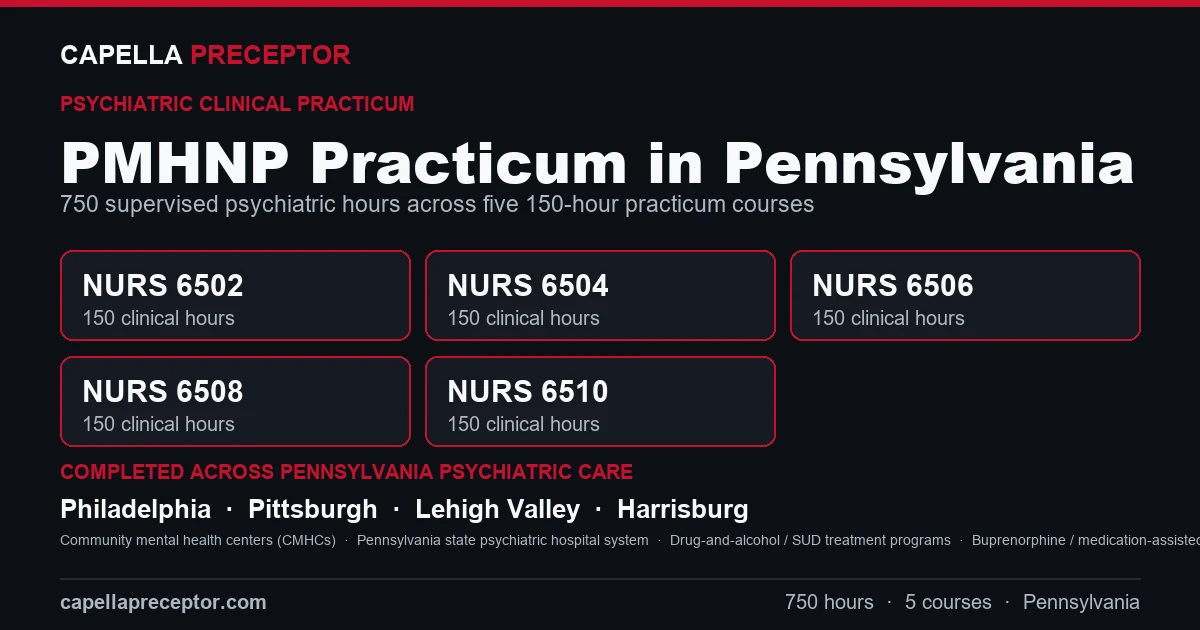
The Capella MSN Psychiatric-Mental Health Nurse Practitioner specialization requires a minimum of 750 practicum hours, completed as 150 clinical hours in each of five practicum courses, NURS6502, NURS6504, NURS6506, NURS6508, and NURS6510, Practicum I through V (Capella, MSN-PMHNP courses). Pennsylvania adds no separate state hour count for students, so the number is the same here as anywhere. What is different in Pennsylvania is where those hours can be earned and who is allowed to supervise them. This is a psychiatric placement, not a primary care one, which is the whole reason it behaves nothing like the FNP preceptor path in Pennsylvania: that track runs six 125-hour courses under a family or primary care preceptor, while yours runs five 150-hour psychiatric rotations under a behavioral-health provider.
Because PMHNP is a lifespan specialty, the sequence deliberately spreads your hours across adult, older-adult, child, and adolescent psychiatry. For the full course-by-course breakdown of the five practicum courses and the population each one targets, see the Capella PMHNP requirements page. Here we focus on the Pennsylvania-specific layer that sits on top of it.
What does Pennsylvania's reduced practice rule mean for a psychiatric preceptor?
The American Association of Nurse Practitioners classifies Pennsylvania as a reduced practice state (AANP, State Practice Environment). A certified registered nurse practitioner, the title Pennsylvania uses, ties diagnosis, treatment, and prescribing to an ongoing collaborative relationship with a physician rather than practicing fully independently. For a psychiatric placement that structure is actually a feature: a PMHNP preceptor in Pennsylvania already works inside a defined collaborative arrangement, so their practice typically has a psychiatrist relationship in place, which is exactly the kind of supervised, physician-connected site Capella site approval looks for.
The collaborative agreement is a requirement on the practicing CRNP, not on you. You will not sign one as a Capella learner. It matters here because it tells you what a compliant Pennsylvania psychiatric site looks like, and because we check it as part of vetting a preceptor.
Who can precept a Capella PMHNP student in Pennsylvania?
Capella requires that PMHNP hours be supervised by a psychiatrically credentialed provider, typically a board-certified PMHNP or a psychiatrist, in behavioral and mental-health practice rather than general primary care. Pennsylvania layers its own verification on top of that. The Pennsylvania State Board of Nursing, within the Department of State, certifies the CRNP credential on top of an active RN license and in a defined specialty, so a psychiatric-mental-health certification is a distinct, checkable thing (Pennsylvania State Board of Nursing).
What we confirm before proposing a Pennsylvania psychiatric preceptor
- Active RN and CRNP records, separately. One active record does not prove the other; we verify both in the Pennsylvania Licensing System (PALS).
- Psychiatric-mental-health scope. The certified specialty has to be behavioral health, so an adult-psychiatry rotation lands with a psychiatric provider, not a family preceptor.
- No open disciplinary action on the record before we put the name forward.
Can a Pennsylvania psychiatric preceptor prescribe controlled medications?
Psychiatry runs on controlled-substance management, stimulants for ADHD, benzodiazepines for acute anxiety, and buprenorphine for opioid use disorder, so the prescribing rules shape what you will actually see in a Pennsylvania rotation. A CRNP with prescriptive authority here may prescribe a Schedule II controlled substance for up to a 30-day supply, and a Schedule III or IV controlled substance for up to a 90-day supply, as identified in a prescriptive authority collaborative agreement with a physician (49 Pa. Code 21.284). Before issuing any controlled-substance prescription the CRNP must also register with the federal Drug Enforcement Administration. Those limits are not a barrier to your training; they describe the real prescribing envelope you will learn to work inside, which is one of the most clinically useful parts of a Pennsylvania psychiatric practicum.
Prescriptive authority itself is granted through that separate collaborative agreement filed with the board (49 Pa. Code 21.285). When we vet a psychiatric preceptor, an established prescriptive-authority arrangement is one of the signals that the site is mature enough to give you meaningful medication-management exposure.
Can PMHNP practicum hours be done by telepsychiatry in Pennsylvania?
Pennsylvania is one of the friendlier states for supervised telepsychiatry, which matters because Capella names telepsychiatry directly within the Practicum III experience. Two recent changes make remote psychiatric sites real here. Act 42 of 2024 expanded telemedicine coverage so that a service covered in person must also be covered when delivered by telemedicine, behavioral health included (Act 42 of 2024). Separately, Pennsylvania permanently allows audio-only delivery of outpatient psychiatric and drug-and-alcohol services in Medical Assistance under Act 98 of 2022, building on the OMHSAS telehealth guidelines (Pennsylvania Department of State, Telemedicine FAQs).
That makes telepsychiatry placements common across the commonwealth, especially valuable in rural counties where in-person psychiatric sites are thin. It does not make the whole practicum remote. How many of your 750 hours can be telehealth depends on your specific course requirements and your preceptor's practice, so confirm the in-person share each practicum demands against your course instructions before assuming hours can be done entirely online.
What psychiatric settings count, and where are they in Pennsylvania?
PMHNP hours must be earned in behavioral and mental-health practice. Pennsylvania has a deep psychiatric infrastructure, but the good teaching sites are concentrated, and they fill fast. Settings that typically qualify, when supervised by a psychiatrically credentialed provider:
County-funded community mental health centers and private outpatient psychiatry across Philadelphia, Pittsburgh, the Lehigh Valley, and the Harrisburg corridor, the backbone of most PMHNP rotations.
Behavioral-health units and Pennsylvania's state psychiatric hospital system, useful for acute and crisis-care exposure in Practicum IV.
Drug-and-alcohol programs and buprenorphine and medication-assisted-treatment clinics, heavily represented in Pennsylvania given the state's opioid burden.
Child-and-adolescent psychiatry practices for the lifespan requirement, plus telepsych groups that cover rural counties between the metros.
Because the lifespan requirement splits between adult and older-adult psychiatry and child and adolescent psychiatry, many students need more than one psychiatric site over the five-course sequence. Plan for that early; one practice rarely covers both ends well.
Why is a PMHNP preceptor so hard to find in Pennsylvania?
Be honest with yourself about this part: psychiatric preceptors are the hardest to secure of any NP specialty, and Pennsylvania is a designated shortage state. As of late 2025 Pennsylvania carried 128 mental health Health Professional Shortage Area designations, meeting only about 32 percent of need, with dozens more psychiatric providers needed just to lift the designations (KFF, Mental Health Care HPSAs). The same psychiatrists and PMHNPs you want as preceptors are already overbooked with patients, and many have pulled back from teaching under workload and burnout pressure. Self-placement in this market routinely stalls for a full term, especially for child and adolescent hours.
Capella does not assign you a psychiatric preceptor or a site. The university expects each learner to secure their own placement in their local community and provides resources but not the match itself. In Pennsylvania's psychiatric-shortage market that search is exactly the gap we close. We hold a vetted psychiatric network across the commonwealth's main regions and use the telepsychiatry route for rural counties where local outpatient sites are limited.
How a Pennsylvania PMHNP placement clears, step by step
The affiliation agreement is the most common delay, and psychiatric and addiction-treatment sites are often the most cautious about signing. We start the agreement the moment a site is identified so it is executed before your course clock starts. None of this means Capella has endorsed a preceptor or site; Capella reviews and approves the placement you propose, and we match preceptors who meet Capella's published requirements and submit them for Capella's review. We never guarantee a placement.
Pennsylvania PMHNP FAQ
Can a Capella PMHNP student do psychiatric practicum hours by telehealth in Pennsylvania?
Pennsylvania is one of the friendlier states for supervised telepsychiatry. Act 42 of 2024 expanded telemedicine coverage for behavioral health, and the commonwealth permanently allows audio-only delivery of outpatient psychiatric and drug-and-alcohol services in Medical Assistance under Act 98 of 2022. That makes telepsychiatry sites real and common here, which matters because Capella names telepsychiatry within Practicum III. How many of your 750 hours can be remote still depends on your specific course requirements and your preceptor's practice, so confirm the in-person share with your course instructions before assuming hours can be done entirely online.
Does my Pennsylvania PMHNP preceptor have to be a psychiatric provider?
Yes. Capella PMHNP hours must be earned in behavioral and mental-health practice under a psychiatrically credentialed supervisor, typically a board-certified PMHNP or a psychiatrist, not a family or primary care provider. In Pennsylvania the CRNP credential is certified in a defined specialty by the State Board of Nursing, so we confirm the preceptor's psychiatric-mental-health certification, not just an active license, before proposing the placement.
Can my Pennsylvania psychiatric preceptor prescribe controlled medications like stimulants or buprenorphine?
A Pennsylvania CRNP with prescriptive authority can prescribe Schedule II controlled substances for up to a 30-day supply and Schedule III or IV substances for up to a 90-day supply, as identified in a prescriptive authority collaborative agreement with a physician and after registering with the federal DEA. That covers the stimulants, benzodiazepines, and buprenorphine that come up constantly in psychiatry, so a compliant psychiatric site gives you real exposure to controlled-substance management within those limits.
Why is a PMHNP preceptor so hard to find in Pennsylvania?
Psychiatric preceptors are scarcer than primary care preceptors everywhere, and Pennsylvania is a designated shortage state. As of late 2025 Pennsylvania carried 128 mental health Health Professional Shortage Area designations meeting only about 32 percent of need, so the same providers students want as preceptors are already overbooked with patients. That is exactly the gap we close with a vetted psychiatric network.
Sources
- Capella University, MSN-PMHNP courses (750 hours, five 150-hour practicum courses)
- AANP, State Practice Environment (Pennsylvania, reduced)
- 49 Pa. Code 21.284, CRNP prescribing and dispensing parameters (Schedule II 30-day, III-IV 90-day)
- 49 Pa. Code 21.285, prescriptive authority collaborative agreements
- Act 42 of 2024, Pennsylvania telemedicine coverage
- Pennsylvania Department of State, Telemedicine FAQs
- KFF, Mental Health Care Health Professional Shortage Areas (Pennsylvania)
- Pennsylvania Licensing System (PALS) license verification
How Capella Preceptor helps with PMHNP in Pennsylvania
You now know the landscape: 750 psychiatric hours across five 150-hour courses, a reduced practice state where CRNPs prescribe controlled psychiatric medications under a collaborative agreement, telepsychiatry that Pennsylvania genuinely supports, and a shortage market that leaves the placement entirely to you. We match a verified, Pennsylvania-licensed psychiatric preceptor who meets Capella's published requirements, submit the placement for Capella's review, prepare every CORE ELMS form, push the affiliation agreement through site legal review, and keep your hours logged and approved on schedule.
- Verified psychiatric preceptor matched, in person or by telepsychiatry
- Psychiatric-mental-health certification confirmed in PALS before we propose a name
- Adult and child/adolescent rotations covered across all five practicums
On the family nurse practitioner track instead? See Capella FNP preceptor requirements in Pennsylvania for primary care practicum hours and local family-medicine settings, or the broader Capella preceptor in Pennsylvania overview.
Get a Capella PMHNP preceptor in Pennsylvania
Free 15-minute consult. No payment until matched. We map your entire psychiatric practicum plan.
Get my free consult →