Home / WGU
SchoolWGU nursing practicum: hours, requirements, and preceptors.
WGU's nurse practitioner tracks require 650 direct patient care hours, and the university tells students plainly that they must find their own preceptor. This page explains the hour totals, the rules per program, and the placement process. Capella Preceptor is our focus, but the practicum wall is identical at WGU, so we place WGU students too.
Last updated: June 21, 2026 · Reviewed by the Capella Preceptor placement team
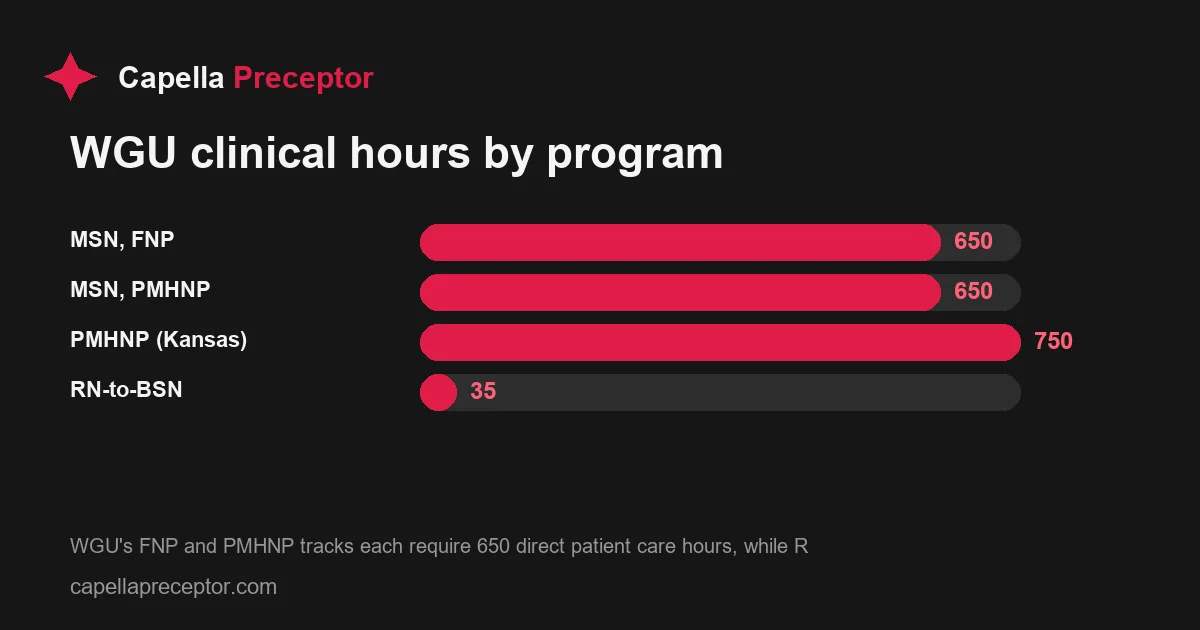
How many clinical hours WGU nursing programs require
WGU is a competency-based university with six-month terms and flat-rate tuition, so you move through coursework as fast as you can prove mastery (WGU, Nursing Tuition and Fees). The clinical hours, though, are fixed by accreditation and cannot be tested out of. They differ sharply by program, so start with the number that applies to you.
The two nurse practitioner tracks, FNP and PMHNP, are the ones where students hit the practicum wall. Both require a minimum of 650 direct patient care clinical hours split across three Clinical Internship courses of 215, 215, and 220 hours (WGU, FNP Clinical Internship Placement; WGU, PMHNP Clinical Internship). The RN-to-BSN program is much lighter: it requires 35 field experience hours completed in community settings the student identifies (WGU, RN to BSN).
Does WGU find your preceptor? No, you do.
This is the single most important fact for any WGU NP student, and the university states it directly. For the FNP and PMHNP programs: "Students must identify their own Preceptor as this is a volunteer (unpaid) position, we do not have a list of Preceptors for students to choose from" (WGU, FNP Clinical Internship Placement). WGU's Clinical Learning and Placement Support (CLPS) team guides you through clearance and paperwork, but securing the preceptor and the site is on you.
The one exception is the prelicensure BSN program. There, WGU arranges clinical rotations through agreements with partner hospitals and clinics, and assigns a clinical coach (WGU, Clinicals and Student Teaching). If you are in an NP track or RN-to-BSN, you do not get that, you build the placement yourself.
Who qualifies as a WGU preceptor
WGU does not let you bring just anyone. A preceptor must hold an active, unencumbered license, hold national certification in the relevant specialty, and have a minimum of two years of current experience in that credential (WGU, PMHNP Clinical Internship). The accepted clinician types differ by track:
- FNP: a board-certified nurse practitioner (family, adult, pediatric, neonatal, women's health, or geriatric), or an MD/DO board-certified in Family Medicine, Internal Medicine, or Pediatrics; certified nurse midwives and PAs with a master's or higher are accepted with additional approval (WGU, FNP).
- PMHNP: a board-certified psychiatrist, a PMHNP, or a DO in psychiatry; licensed counselors and social workers are accepted only for the limited psychotherapy hours (WGU, PMHNP).
- RN-to-BSN: a BSN-prepared RN (preferred) or higher (MSN, NP, DNP) who provides direct patient care in the community setting (WGU, RN to BSN).
The rules that trip students up
Beyond the headline 650 hours, WGU enforces several limits that change how you plan your placement. Reading these before you sign with a preceptor saves rework later.
Sources for these limits: WGU FNP and WGU PMHNP clinical pages.
The WGU placement timeline (start it early)
WGU asks NP students to engage their assigned Placement Coordinator one year before Clinical Internship I begins, and the affiliation agreement between WGU and your clinical site can take up to six months to execute (WGU, PMHNP Clinical Internship). Treat the placement as a parallel project that runs alongside your coursework, not something to start when the internship term arrives.
- ~12 months out: connect with your CLPS Placement Coordinator (FNP: CLPSFNP@wgu.edu; PMHNP: CLPSPMHNP@wgu.edu) and start preceptor outreach.
- Secure a preceptor and site that meet the qualification rules above, and confirm they will commit to the full hour load.
- Submit the site for an affiliation agreement through CLPS, allowing up to six months for it to be signed by both parties.
- Clear compliance: immunizations, background check, and the program-specific requirements handled with the Compliance Coordinator.
- Receive your Clearance Confirmation email from CLPS, then begin logging hours through the Student Facing Field Experience Page in your WGU portal (WGU, Clinicals).
WGU vs Capella: same wall, different labels
If you are choosing between or transferring across the two, the practicum mechanics rhyme. Both are online, competency-based, and self-paced, and both make the student responsible for finding the preceptor. The main differences are the hour totals and the systems each uses to track them.
Capella's NP tracks require a minimum of 750 practicum hours and its RN-to-BSN capstone requires 40 (Capella, MSN FNP Courses; Capella, RN-to-BSN Courses). The takeaway is the same on either side: the school will not place you, and a missed agreement or unqualified preceptor stalls everything.
Common questions
How many clinical hours does the WGU FNP program require?
Does WGU find a preceptor for nurse practitioner students?
Can I do my WGU clinical hours by telehealth?
When should I start looking for a WGU preceptor?
Do you really place WGU students, not just Capella?
Where these facts come from
- WGU, FNP Clinical Internship Placement
- WGU, PMHNP Clinical Internship
- WGU, RN to BSN Nursing
- WGU, Clinicals and Student Teaching
- WGU, Clinicals
- WGU, Nursing Tuition and Fees
- Capella, MSN FNP Courses
- Capella, RN-to-BSN Courses
Figures verified against the cited pages on June 21, 2026; always confirm current requirements with your program.
Available nationwide
Get placed as a WGU student
Free 15-minute consult. No payment until matched. We map your entire practicum plan.
Get my free consult →